
Economics deep-dive
The storage is moving, the engine isn't (yet).
There is a loud version of the off-Splunk story (the open lakehouse is replacing the SIEM analytics engine, the next Splunk is a security data lake on open table formats, and the migration is underway at enterprise scale right now) and a quieter version that holds up better under sourcing: the storage and pipeline layers are moving, fast and measurably, while the analytics engine teams actually run their detections on is mostly staying put. I make the case for the quiet version, because the best-sourced evidence points away from the most exciting claim, and the gap between the two is exactly where a buyer gets oversold.
Reading time: about 17 minutes. Evidence runs from Tier A (Cisco SEC filings and earnings transcripts, regulatory retention mandates) through Tier B (named industry analysts) to Tier C (vendor-reported ARR and pricing, flagged inline), with the unsourced cost multipliers labeled Tier D and left as open questions rather than findings.
The argument
Two stories about leaving Splunk
There is a version of the off-Splunk story that gets told at vendor keynotes, and a quieter version that shows up in pricing books, earnings transcripts, and the architecture diagrams of teams I have actually sat with. The two versions disagree about what is happening and how fast. The loud version says the open lakehouse is replacing the legacy SIEM analytics engine, that the next Splunk is a security data lake on open table formats, and that the migration is underway at enterprise scale right now. The quiet version says something narrower and, I think, truer: the storage layer and the pipeline layer are moving, fast and measurably, while the analytics engine that legacy SIEM customers actually run their detections on is mostly staying put.
I want to make the case for the quiet version, because the evidence supports it and the loud version does not, and because the gap between them is exactly where a buyer gets oversold. My confidence here is moderate, not high. The interesting tension is that the best-sourced evidence points away from the most exciting claim. The structural shifts that are real are also kind of boring. Tiered storage, pipeline-layer cost control, OCSF-normalized lakes feeding analytics you bring yourself. The shift that would be exciting, a regulated enterprise retiring Splunk's analytics engine for an open, engine-agnostic lakehouse with the TCO math published, is the one nobody has publicly attested.
Three layers
What "moving off Splunk" actually means at each layer
The phrase "moving off Splunk" smuggles in an ambiguity that does most of the damage. A SIEM is three things stacked together: a place data lands (storage), the path it takes to get there and what gets dropped along the way (pipeline), and the thing that runs the searches and detections (the analytics engine, which in Splunk's case means the indexer plus SPL plus the correlation and ES content layered on top). When someone says a company "left Splunk," they could mean any one of those three changed, and the three are moving at completely different speeds.
The storage layer is the one in open motion. The pipeline layer is in open motion too, and has been since roughly 2019. The analytics engine is the sticky part, and it is sticky for reasons that have nothing to do with whether ClickHouse or Trino or Spark can run the query faster. Conflating the three is how you end up believing a market is mid-stampede when what you are actually watching is a cold-storage tier getting cheaper and a pipeline vendor getting rich.
The storage signal
The cleanest number is a storage number, and it comes from the incumbent.
Start with the most important instance, because it is the dominant SIEM vendor building the lake pattern into its own product rather than ceding it. Microsoft shipped a Sentinel data lake tier (GA September 30, 2025) that stores security telemetry in open-format Parquet with storage and compute separated, then in April 2026 added read-only federation to query Azure Databricks Unity Catalog, ADLS Gen2, and Microsoft Fabric tables in place. The economics are what make it the cleanest case. Using Microsoft's own analytics-versus-lake meters, the per-GB gap on ingest alone is roughly 80×: analytics-tier pay-as-you-go runs $4.30/GB ingested in East US, against a lake-tier ingest rate near $0.05/GB. That 80× is the headline number, and it is also the misleading one if you stop there. Add the lake's data-processing meter (~$0.10/GB) and the gap narrows to roughly 28× on ingest-plus-processing. Add storage at ~$0.026/GB-month and per-GB query charges and the realized arbitrage depends entirely on how often you scan the data. (Microsoft pricing pages, 2026, Tier C-vendor for the $4.30 anchor; Realm.Security's "Microsoft Sentinel Pricing Explained" breakdown of the lake meters, May 2026, Tier C-independent with pipeline-vendor framing bias.) I would drop the 6:1 stored-byte compression figure that floats around the same writeups; I have not been able to corroborate it, and a bare compression ratio is the kind of number that should be measured, not repeated.
The reason this is a storage signal and not an engine signal is in Microsoft's own design. Federation is one-directional, read-only, and requires the federated source to be delta-parquet. The hot detection path stays in the proprietary KQL analytics tier; the lake is the cold, compliance, and hunting tier. Microsoft built the lake to defend Sentinel's seat, not to vacate it. That is precisely why it is strong evidence that the foundation is moving (open Parquet, decoupled storage and compute, query-in-place across engines) and weak evidence that the engine is being replaced. The control plane stays closed. And the format-war detail my own work tracks gets decided inside the Microsoft stack in Delta's favor, not Iceberg's: Microsoft says Parquet and Delta, never Iceberg, and names no OCSF class or version for the lake schema. If you believe open Iceberg V3 is the inevitable security-lake foundation, the largest incumbent's productized lake is a data point against you, not for you.
One media-cost detail sits a level below this, and it matters when you size the warm tier the lake feeds rather than the cold object floor. The instinct is to spec high-endurance NVMe for the hot path, but for sequential security telemetry that tier is usually over-specified, because the way the drives are rated and the way append-only ingest writes diverge. The JESD219 endurance standard the DWPD ratings come from assumes a random worst-case write pattern, while append-mostly ingest writes with a measured write amplification factor near 1 (Min et al., FAST '12; Cai et al., Proceedings of the IEEE 2018, both Tier A), so the rated endurance and the realized endurance are not the same number for this workload. The field bears that out: roughly 80% of enterprise SSDs run under 1 DWPD (ServeTheHome's 1,347-drive survey and Forward Insights, Tier B/C), and at-scale fleet studies find drives rarely fail by wear-out at all (Google, FAST '16; NetApp, FAST '20, Tier A). The cost-correct default for this profile is read-intensive NVMe over a cold object tier, and the high-endurance premium is hard to justify for append-only ingest. I would still hold reliability-equivalence-at-matched-load as Tier D until I have run it on my own bench; the rating-versus-workload gap is well sourced, but "the cheaper tier is as reliable under your actual load" is the claim I have not yet measured myself.
The pipeline layer
The pipeline revolt is real and priced, and not the same as displacement.
The purest market-priced proxy for SIEM-cost pain is Cribl, and Cribl's numbers are genuinely impressive. The company reports surpassing $300M ARR (announced February 11, 2026), up from $200M a year earlier and $100M in October 2023, with net dollar retention reported above 130% and something close to half the Fortune 100 as customers. Cribl was founded in 2018 by Splunk veterans to attack exactly the pricing pain they watched Splunk customers absorb, and the ARR curve is where that pain shows up as dollars before it shows up in any analyst placement. (All figures Cribl press releases, Tier C, vendor-self-reported and unaudited; Sacra and Contrary restate rather than verify them.)
Here is the discipline the loud narrative skips. Cribl evidences SIEM-cost pain. It does not evidence open-lakehouse adoption, and it does not evidence Splunk displacement. For most of its history the Cribl wedge made Splunk cheaper to keep: insert a vendor-neutral pipeline in front of the indexer, drop the low-value events, route the bulk to cheap object storage, and the bill that might otherwise have forced a migration decision quietly comes down. A company can run Cribl for five years and never leave Splunk. The reported reductions in Splunk ingest volume (Sacra puts the range at 30–90%; SACR cites a German multinational cutting 5–7 TB/day down to 500–600 GB before it hits Splunk) are real cost relief and real evidence of pain, so mechanically Cribl delays leaving rather than causing it. Reading the Cribl ARR curve as a displacement signal is the single most common analytical error in this whole conversation. It is a tolerating-the-incumbent-more-cheaply signal that only started shading toward displacement with the 2024 up-stack into Cribl Lake and Search, which is younger, smaller (roughly 50 Lake deployments by mid-2025), and whose open-table-format substance nobody has confirmed at the resolution that would matter.
I would also note the growth is decelerating in a way that argues against the secular-wave framing. North of 100% early, around 70% at the $200M milestone, north of 40% at $300M, so it looks like a healthy company maturing along an ordinary S-curve rather than a market inflecting.
The engine layer
The engine-replacement claim is where the sourcing collapses.
Now the central negative, stated plainly because it is the spine of the honest read. No named Tier-1 bank or systemically-important entity has publicly attested retiring Splunk's analytics engine for an open, engine-agnostic lakehouse, with quantified TCO, in a venue that is not a vendor stage. The single Tier-1-bank "replacement" claim in the entire corpus is Standard Chartered's "self-managed SIEM" talk (35% cost reduction, 92% faster investigation, 80% faster time-to-detect), and that is a Databricks Data + AI Summit 2025 session, GTM-motivated and vendor-staged. Standard Chartered is also UK-headquartered, so it is not even a US SCI entity for the regulatory argument people try to hang on it. Three of the four named Tier-1 FSI references in Databricks' own roster (HSBC, State Street, Capital One) are augmentation or modernization stories, security-data-lake-alongside-Splunk, not Splunk-out. State Street running 50 PB of security data on a lakehouse is a real and large fact. It is not the same fact as State Street turning off its SIEM engine, and the gap between those two facts is where the loud and quiet versions part ways.
Databricks' Lakewatch, announced March 24, 2026, sharpens this rather than resolving it. It is a first-party "open, agentic SIEM," and it is in private preview with no published GA date. The headline is "up to 80% lower TCO," and the most useful thing about that number is what independent analysts did to it. InfoWorld (March 2026) assembled named skepticism that I think is exactly right. Robert Kramer of Moor Insights & Strategy: "Costs don't disappear; they shift. If usage isn't controlled, compute can add up quickly," and Lakewatch is "more likely to complement existing SIEMs than replace them." Akshat Tyagi of HFS Research framed the savings as concentrated where enterprises "want to retain large amounts of data," which is to say conditional, not universal. Stephanie Walter of HyperFRAME Research pointed out that buyers value domain depth, not just infrastructure scale. (All Tier B, named analysts, named firms.) The pattern worth seeing: the cost claim is a vendor "up to" figure, and the only independent layer touching it is cautionary. That is the inverse of how a well-evidenced trend reads, where the independent sources corroborate and the vendor merely amplifies.
This squares with my own benchmark experience, which I will get to, and which says lakehouse TCO wins are real but concentrated at high-retention cold-tier workloads and conditional on disciplined compute governance. "Up to 80%" is directionally defensible at the workload where retention scale dominates and overstated as a blanket claim. SACR's September 2025 framing puts the structural point cleanly: most security data lakes in 2025 remain coupled to a single analytics engine, not running open Iceberg-on-S3 with the engine swappable underneath. The open, engine-agnostic part, the part that would actually validate the loud narrative, is the part that is least built.
The brakes
The counter-evidence is better-sourced than the move-off case.
When I went looking for the disconfirming cases, the thing that struck me was that the brakes are better-sourced than the accelerant. The move-off case tops out at Tier-C competitor marketing. The friction case reaches a named Gartner analyst, an eleven-year Magic Quadrant record, and concrete cost-meter mechanics. When the counter-case is the higher-tier case, the honest move is to weight it.
Four durable frictions gate the pace, and none of them are fatal to the destination. The first is the data-engineering skills gap. Anton Chuvakin argued in 2018, and revisited in 2022, that most DIY security data lakes "would not succeed," for reasons that have not gone away. Security teams lack scaled data-management skills, the supply of genuine security data scientists is tiny, and the analytics infrastructure is, in his words, hard and costly to operate. By 2022 he softened to "may still fail, but it probably does not have to." The lakehouse SIEM architecture the loud narrative sells is exactly the architecture Chuvakin warned most teams cannot run. That does not disprove the destination. It disconfirms the speed, and it is the strongest brake in the set because it comes from a named analyst rather than a vendor with a product to sell against the problem.
The second friction is that detection content does not port; it gets rebuilt. SPL does not translate mechanically to KQL, ES|QL, or YARA-L. The defensible migration pattern, repeated across CardinalOps, Elastic's own AI-translation tooling, and a stack of integrator checklists, is to seek MITRE technique-coverage equivalency and recreate content from scratch using the old as a guide. Existence of an AI rule-translation product is itself the tell that the manual path is expensive. Add the parallel-run cutover (paying for both SIEMs for a defined 3-to-6-month window) and you get a content-engineering bottleneck and a double-cost period that explains, all by itself, why a flat Splunk revenue line is consistent with slow, sticky migration rather than exodus.
The third friction is that the destination is not automatically cheaper. Patrick Sandu's Falconer Security meter analysis (March 2026) walks the Sentinel data lake's five separate billing meters and lands on the failure modes that erase the per-GB savings: a forgotten Jupyter session that "will beat a month of planned analysis on cost," broad-time-window KQL queries driving full-table-scan charges, and the structural reality that the lake "does not replace the analytics tier," so moving a security-critical log there to save money loses real-time detection on that source. His line is the one I would quote directly: the advertised savings "evaporate the first time a breach goes undetected." The 80% reductions hold only when "suitable" logs move, and that qualifier is doing heavy lifting.
The fourth friction is FSI-specific, and it cuts against the regulatory argument people make in the move-off direction. The intuition is that Reg SCI and 17a-4 retention mandates pull a bank toward a lineage-traceable lakehouse. The counter-reading is at least as strong: the same evidence-integrity mandate makes a regulated entity more reluctant to disturb a working, audited Splunk trail mid-cutover, because a migration that drops or garbles audit records during the cutover window is itself the kind of evidence failure the rule punishes. PCI-DSS Requirement 10, SOX §404, and GLBA Safeguards are Tier-A obligations; the practitioner framing that regulators "won't accept 'we were migrating'" is the blunt version. The forcing function may delay migration as much as it motivates it.
I want to be careful with one number here, because the temptation to invent it is strong. The FSI-specific claim that capital-markets teams over-spend on Splunk by 1.5–3× per TB-year relative to an open cold tier has no named anchor on either side. Every retention-cost data point in the corpus is general-market and vendor-incentive-flagged. I am treating that multiplier as an open question, not a finding. If someone hands you that range as a fact, ask them whose contract it came from.
The Cisco signal
The Cisco signal, and why the obvious reading is a management reading
Cisco's disclosed numbers are the highest-tier evidence in the whole pile, and they are genuinely ambiguous. The Splunk security segment was flat-to-slightly-negative across the first three quarters of FY2026 (down roughly 2% YoY in Q1, around flat near $2.0B in Q3), while Splunk ARR and product RPO grew double digits and the unit added about 500 new logos in H1 FY2026, on pace for 1,000. Those are SEC-filing and earnings-transcript numbers, Tier A, and they do not show an exodus. Double-digit ARR and RPO growth alongside a thousand-logo new-customer pace is not the profile of a platform customers are fleeing.
The reading you will hear from Cisco, and the one repeated everywhere, is that the flat segment line is a deliberate on-prem-to-cloud revenue-recognition transition under ASC 606, not customer flight. CFO Mark Patterson called it a near-term drag from the cloud shift; CEO Chuck Robbins called the mix shift "purely a timing issue." I find that explanation plausible and partially corroborated by the RPO growth, which is what deferred-but-contracted revenue looks like. But it is management self-attribution, and I will flag it as such rather than launder it into settled fact. From public data I cannot cleanly separate "Splunk revenue deferred into later periods" from "Splunk losing some accounts at the margin," because both produce a flat reported line in the near term. The primary numbers do not show flight, and the most-repeated explanation for the flat line is the seller's own. Watch whether the segment inflects positive once the rev-rec transition laps; if it does not, the timing story weakens.
What the Cisco disclosure does show cleanly is a deployment-model move: Cisco is actively winding down the on-prem perpetual indexer footprint and pushing customers into cloud subscription. That validates the broader claim that the legacy on-prem schema-on-read deployment model is in managed decline. It also shows Cisco intends to capture that transition itself, to Splunk Cloud, not to cede it to a third-party lakehouse.
My own evidence
What I've measured myself, and what it does and doesn't prove
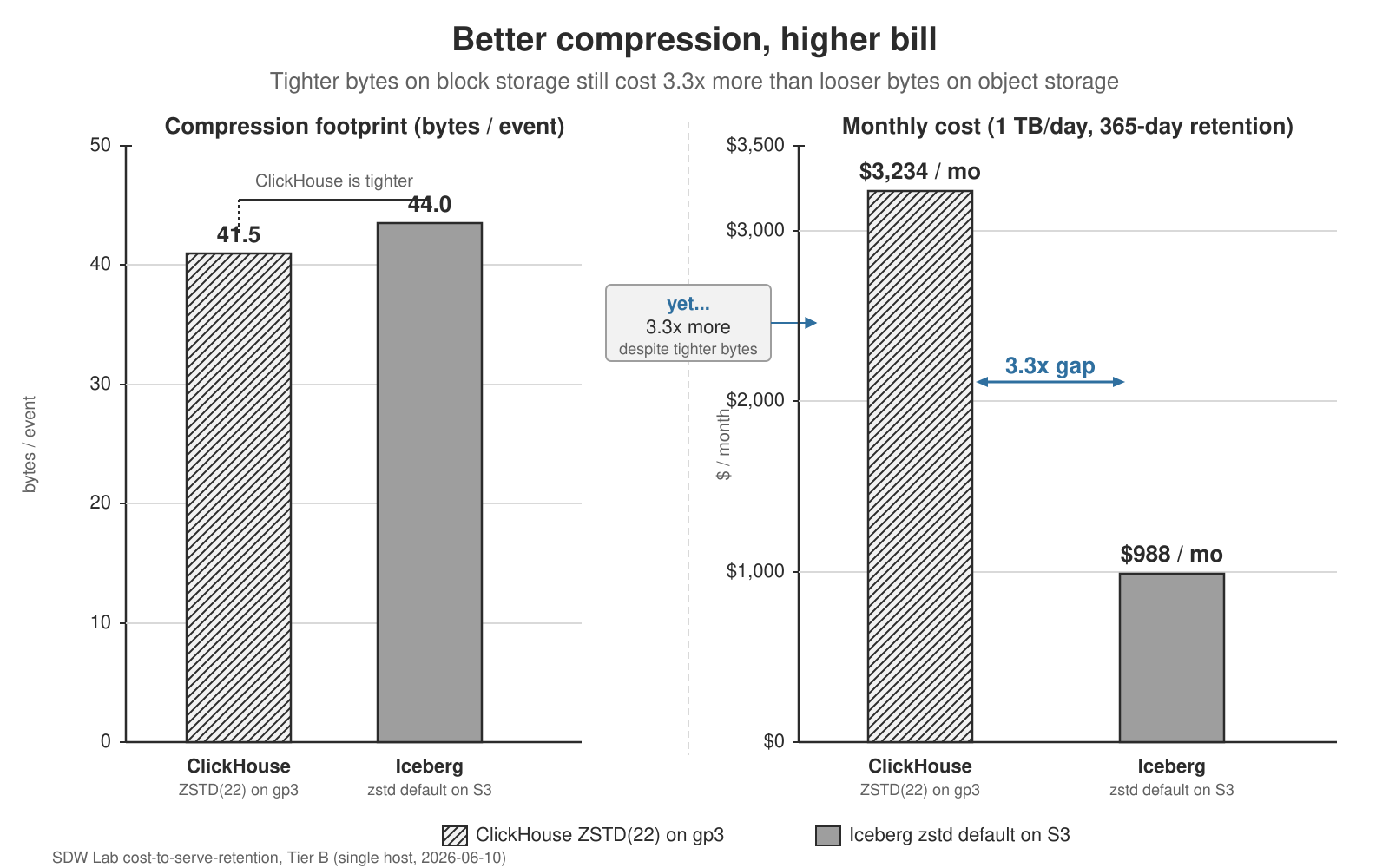
I run an independent lab, and the reason I keep the storage-real, engine-hype distinction so sharp is that my own reproducible results sit on exactly that line. On a 10M-event Zeek workload, ClickHouse runs the hunting-shaped aggregations 5–62× faster than a schema-on-read SIEM (46.8× on the five-query average; the index actually wins the simple lookups), answer-equality verified, single-node Tier B, with 9.0× blanket-ZSTD-22 compression. That is a real engine-and-storage result, and it is mine, reproducible, not vendor data, which is the only reason I will stand behind the number. But I want to say what it proves and what it does not. It proves the storage-and-scan economics of a columnar engine on compressed open formats can dominate a schema-on-read indexer connector by orders of magnitude on the right workload. It does not prove a bank can retire its Splunk ES content, its SOAR integrations, and its analyst muscle memory and run production detection on that engine next quarter. The benchmark is a storage-and-query fact. The migration is an organizational fact. The loud narrative collapses the two; the discipline is in keeping them apart.
I ran a second, deliberately different probe on the MOAR reference stack to see whether the storage side of the thesis holds up against a different schema-on-read engine, and it does. This one is a baseline comparison rather than a winner-take-all benchmark: an open lakehouse (DuckDB reading Parquet) against an OpenSearch schema-on-read SIEM baseline, the same 200,000 OCSF Network Activity events loaded into both, the same three queries run on each. The first thing that matters is that the two sides agreed. A row count, a highly selective needle (dst_port=3389), and a group-by all returned identical answers out of both systems, which is the precondition for any storage-economics comparison to mean anything, since a cheaper store that returns different answers is not cheaper, it is broken. On footprint the lakehouse held the same 200,000 events in 1.6 MB of columnar Parquet while the OpenSearch index occupied 11.5 MB, so the term-indexed SIEM store carried 7.0× the columnar footprint for the identical data and the identical query results. This is a single-host run, and the latency numbers need that caveat carried with them every time: the lakehouse was faster on all three queries, but OpenSearch was answering over HTTP while DuckDB ran in-process, so the SIEM paid a round-trip the lakehouse did not, and a term index's real advantage shows up on highly selective needles at a scale far past 200,000 rows that this run does not isolate. The findings I would actually stand behind because they do not depend on scale are the two structural ones: the answers matched, and the schema-on-read index was 7.0× the size of the columnar store for the same data. That 7.0× is a second first-party data point on the storage side of the thesis, measured against a different engine than the ClickHouse run, and it points the same direction the ClickHouse 46.8× did, which is the whole reason I trust the storage-moves-engine-stays read more than the engine-replacement one.
The same goes for the rest of my evidence base. The OCSF Network Protocol Category work I contributed to is schema normalization, which is what makes a lake feed bring-your-own-analytics in the first place, and it is real and shipping. The federated-query NDR architecture I built (sub-10s cross-site JOINs, roughly 90% WAN reduction) is a query-in-place result that rhymes exactly with what Microsoft just productized as Sentinel federation. Notice what all of this is: storage, schema, query-in-place, the foundation rather than the engine. None of it is the engine-replacement event the loud narrative keeps promising, and I am the person with the strongest commercial incentive to claim otherwise.
Where I land
Where I land, and what would move me
The destination is validated and, more tellingly, incumbent-endorsed. When the two dominant SIEM vendors both ship the lake pattern in-product (Microsoft's Sentinel data lake, Cisco's Splunk-side machine-data-lake-and-federation roadmap), the open-architecture argument has stopped being a challenger's pitch. The storage and pipeline layers are moving, measurably, with hard per-GB numbers and a $300M-ARR pipeline business to price the pain. That much I hold with reasonable confidence.
The speed, at the engine-replacement layer, is slow, selective, and skills-gated, and the evidence for a stampede is the weakest evidence in the file. The best-sourced material in this entire scan is the counter-evidence, and that asymmetry, more than any single number in the file, is what I would take away. A buyer being told the open lakehouse will replace the Splunk engine this fiscal year is being sold the layer with the thinnest proof.
Two things would move my read upward, and I will name them so the claim is falsifiable. A named SCI entity or Tier-1 US bank publicly attesting a Splunk-engine retirement, not augmentation, onto an open catalog with TCO it is willing to print outside a vendor stage. Or Cisco's FY2026 numbers failing to inflect once the rev-rec transition laps, which would weaken the timing story and suggest the flat line was partly flight after all. One thing would move it downward: a documented migration-reversal, a named enterprise that moved off Splunk to a lake and came back. I went looking for that case and did not find it in citable form. Its absence is not evidence the move is permanent; it is a gap, and I would rather name the gap than fill it with a number I cannot source.
