
Practical implementation
The federated rollout playbook.
Most modern data stack pitches assume a single CISO can make the call and a single CFO can write the check. That's accurate for integrated organizations and roughly useless for the conglomerates I tend to work with: eight to fifteen semi-autonomous business units, each with its own P&L, its own CTO, and a standing right to opt out. The technical plan for those environments is the easy part. This essay is about the political plan that decides whether the technical plan ever ships.
Reading time: about 20 minutes. Evidence tier: B overall. Coalition-building research from HBR and McKinsey, federated organizational case studies (J&J, Berkshire Hathaway, pre-2020 United Technologies), compliance separation requirements from SOX, PCI-DSS, HIPAA, and GDPR, plus Team Topologies and the DevOps Handbook on cross-functional embedding. Specific case numbers below come from a composite Fortune 500 financial services engagement and should be treated as illustrative, not benchmarks.
The starting condition
Twelve CEO approvals, not one
The typical pitch deck assumes an integrated organization with one CEO, one CFO, one CIO, and one CISO, so the decision flows top-down: the CISO recommends, the CFO approves, the CIO mandates, and the SOC executes, which means the $5M modern data stack initiative needs one signature.
A federated conglomerate looks nothing like that on the org chart. Holdings Corp sits on top. Corporate functions (finance, IT, legal, security) sit under the parent. The Corporate CISO typically runs an internal MSSP that monitors business unit environments on a chargeback or showback model. Underneath, eight to fifteen business units operate as semi-autonomous entities, each with their own CEO, CFO, CTO, and security team, each with their own P&L, and each with the contractual or political ability to say no to corporate initiatives that affect their budget or operations.
The decision flow inverts, so the Corporate CISO pitches the modern data stack and twelve BU CEOs evaluate it, and each BU decides on its own whether to opt in or out. To make the platform economics work you need something like a two-thirds majority buy-in across the portfolio, which means the $5M stack now requires twelve approvals instead of one, and the twelve approvers don't report to the person doing the pitching.
A few worked examples to anchor the pattern. Johnson & Johnson operates three major business segments and roughly twelve operating companies, each maintaining semi-autonomous operations and security teams under corporate governance. Berkshire Hathaway runs more than eighty subsidiaries with extreme autonomy, so its BU CEOs make independent technology and security decisions and a "corporate mandate" as an approach would fail outright. Pre-2020 United Technologies (now Raytheon Technologies) operated four major business units with separate P&Ls and tech stacks, and even at aerospace-and-defense scale the structural reality held the same way, because corporate IT supports while the BUs decide.
Why the standard pitch fails
Three failure modes I keep seeing.
The corporate mandate
The Corporate CISO sends an email: all BUs will migrate to the modern data stack by Q3. What the BUs hear is corporate forcing expensive change that doesn't benefit their P&L, using their budget and disrupting their operations, and since BUs optimize for their own P&L rather than for corporate efficiency, mandates without per-BU value propositions tend to generate passive resistance: BU CTOs delay ("we'll migrate in 2027 after the ERP upgrade"), negotiate exemptions, or refuse outright. The plan dies in a hundred small accommodations.
The aggregate-savings pitch
"The modern data stack saves $4M annually versus Splunk expansion across all BUs." The BU CFO runs their own math: my BU currently pays $250K per year, which is ten percent of corporate spend. The platform chargeback to my BU is $400K per year. That's a sixty percent cost increase on my P&L. Aggregate corporate savings don't translate to per-BU savings; large BUs subsidize small BUs in any shared platform model with usage-weighted chargeback.
If you can't show every BU a credible per-BU win, several BUs will block the deal, and their math is rational because yours just doesn't apply to them.
Ignoring autonomy
BUs treat their autonomy as an asset they've earned rather than as institutional inefficiency, and "shared services" usually carries scar tissue with it: slow, unresponsive, rarely customized for the BU's needs. Many BU CTOs will pay more to keep their own stack than pay less to rely on a corporate one, so any pitch that ignores this preference shows up as tone-deaf, and tone-deaf reads as untrustworthy, which matters because trust is the resource you're spending across this rollout and budget is downstream of it.
The coalition pitch
Reframe as collective bargaining.
The pitch I've watched survive contact with conglomerate politics doesn't start with "corporate has decided." It starts with "several BUs approached us with the same vendor cost pain, we explored a collective solution, here's what we found, interested BUs can opt in."
That framing positions corporate IT as a supporter rather than a dictator, so the initiative reads as peer-driven instead of corporate-imposed. HBR's "Leading Change Across Silos" work and McKinsey's research on matrix and federated organizations both land on the same finding: peer influence in decentralized enterprises is roughly three to five times more effective than top-down mandates. That number deserves a hedge (the studies measure self-reported adoption intent, not migration completion) but the directional pattern is consistent enough that I treat it as a planning assumption.
Per-BU value, not aggregate value
Every BU gets their own page, and that page lays out their current Splunk licensing cost, their current ingest volume, their current retention gap, and the chargeback they'd pay on the new platform, along with the compliance obligation they're currently missing because seven-year retention is unaffordable on Splunk and the query latency they'd gain. Numbers vary by BU, but the structure of the page is constant.
For one BU in a recent engagement, that page looked roughly like this: $450K per year on Splunk licensing for 1.2 TB per day, no realistic path to seven-year retention, becomes $200K per year on the new platform with retention now affordable and query latency dropping from five-minute timeouts to sub-thirty-second responses. The $250K of annual savings is enough to get a meeting, but what gets the meeting to a yes is closing a compliance gap they were already paying audit findings on.
Anchor BUs, then peer influence
Two anchor BUs do the early work: the BUs with the most pain and the highest peer credibility. They pilot, they get results, and then they present those results to peer BU CISOs at the BU Security Council, and it's the anchor BU CISO who presents rather than the Corporate CISO, saying "we ran this, we saw fifty-five percent cost reduction, we got compliant on retention, our analysts won't go back, BU-D is joining us, who else is in?" That peer credibility has outweighed corporate credibility in every federated environment I've worked in.
Transparent allocation
BU CFOs demand a formula they can audit. The cleanest one I've used is consumption-based: the BU's share of total coalition data volume drives their share of total platform cost, with no fixed tax, no "corporate overhead" line item, and no surprise true-ups. Gartner's IT Symposium research on shared-services funding models suggests transparent allocation formulas improve BU adoption forty to sixty percent versus opaque "corporate tax" approaches. That's another B-tier number I treat as directional rather than precise.
Pair the formula with quarterly invoicing the BU CFO can reconcile against their own usage numbers. The platform becomes a vendor relationship (predictable, accountable, replaceable) rather than a corporate cost center.
Escape clauses
The coalition contract carries annual opt-out windows, query-latency and uptime SLAs, and a ninety-day pilot before any production commitment, so that if the platform misses SLA for two consecutive quarters the BU exits immediately without penalty. This runs counter to intuition but holds consistently, because low commitment risk makes the BU decision easier while the performance accountability forces corporate IT to deliver. I've never seen opt-out clauses get exercised on a healthy platform, but their existence is what gets the coalition signed.
Working across the fence
Security and data engineering, separated by compliance.
Most enterprise data engineering teams spent the last decade learning Iceberg, dbt, Airflow, and the rest of the modern data stack. Most security teams watched from the other side of a compliance wall built out of SOX Section 404 separation-of-duties, PCI-DSS 10.5.3 audit-log access restrictions, HIPAA §164.308(a)(4) audit-control separation, and GDPR Article 32 logging-separation requirements. The wall is legitimate, but it also produced a five-to-seven year tooling gap.
Closing that gap is one of the harder political pieces of a federated rollout, because the compliance teams reviewing your plan correctly read any data sharing between security and data engineering as a violation. The framing that survives compliance review is that security and data engineering teams cannot share data, but they can share architecture patterns, tool evaluations, code reviews, operational playbooks, and training, because the wall has to stand around the data without standing around the knowledge.
Architecture review exchange
Security designs the Iceberg table schema for EDR logs. Data engineering reviews the schema (partition strategy, file-size optimization, schema evolution approach) without touching the data. The deliverable they're reviewing is the DDL and the partitioning design document rather than a sample query result, so there's no compliance violation, and the security team gets the five years of Iceberg operational knowledge the data engineering team has accumulated.
Tool evaluation collaboration
Security attends the data engineering team's internal dbt training. Data engineering shares their dbt project template (project structure, macro library, testing patterns) with no data attached. Security adapts the template for OCSF transformations. The security team gets to proficiency in dbt in two or three weeks instead of three months solo. That ratio is consistent enough that I treat the dbt skills transfer as a near-free win whenever a data engineering team is willing to do it.
The six-month seat swap
The highest-ROI move I've seen is a six-month seat swap. One security engineer joins the data engineering team and learns dbt, Airflow, Iceberg, data quality patterns. One data engineer joins the security team and learns OCSF, threat hunting workflows, the compliance constraints that shape the architecture. Compliance is preserved through temporary access revocation: neither engineer holds simultaneous access to both domains.
In a recent Fortune 500 financial services engagement, the seat swap produced Iceberg adoption in roughly two months versus a six-to-nine month estimate without it, five security engineers with working dbt proficiency where there had been zero, and a roughly 24x improvement in detection-rule testing efficiency once the rules moved from manual review to a dbt-tested pipeline. Cost was one FTE-year. The number to be honest about is that the 24x came from one organization where the prior baseline ("manual review") was unusually inefficient, so your mileage will vary.
The seat swap does cultural work too
The seat swap also does the cultural work that the architecture review and dbt training don't. Security culture defaults to zero trust, controlled change, enterprise-supported tooling, and incidents-prevented as the success metric. Data engineering culture defaults to safe-to-fail iteration, ship-and-rollback change management, open source, and pipeline-uptime as the metric. Both sets of defaults are correct in their own context, and six months embedded teaches each side why the other's defaults exist in a way that two days of training never does.
The twelve-month timeline
Three phases, BU-controlled pacing.
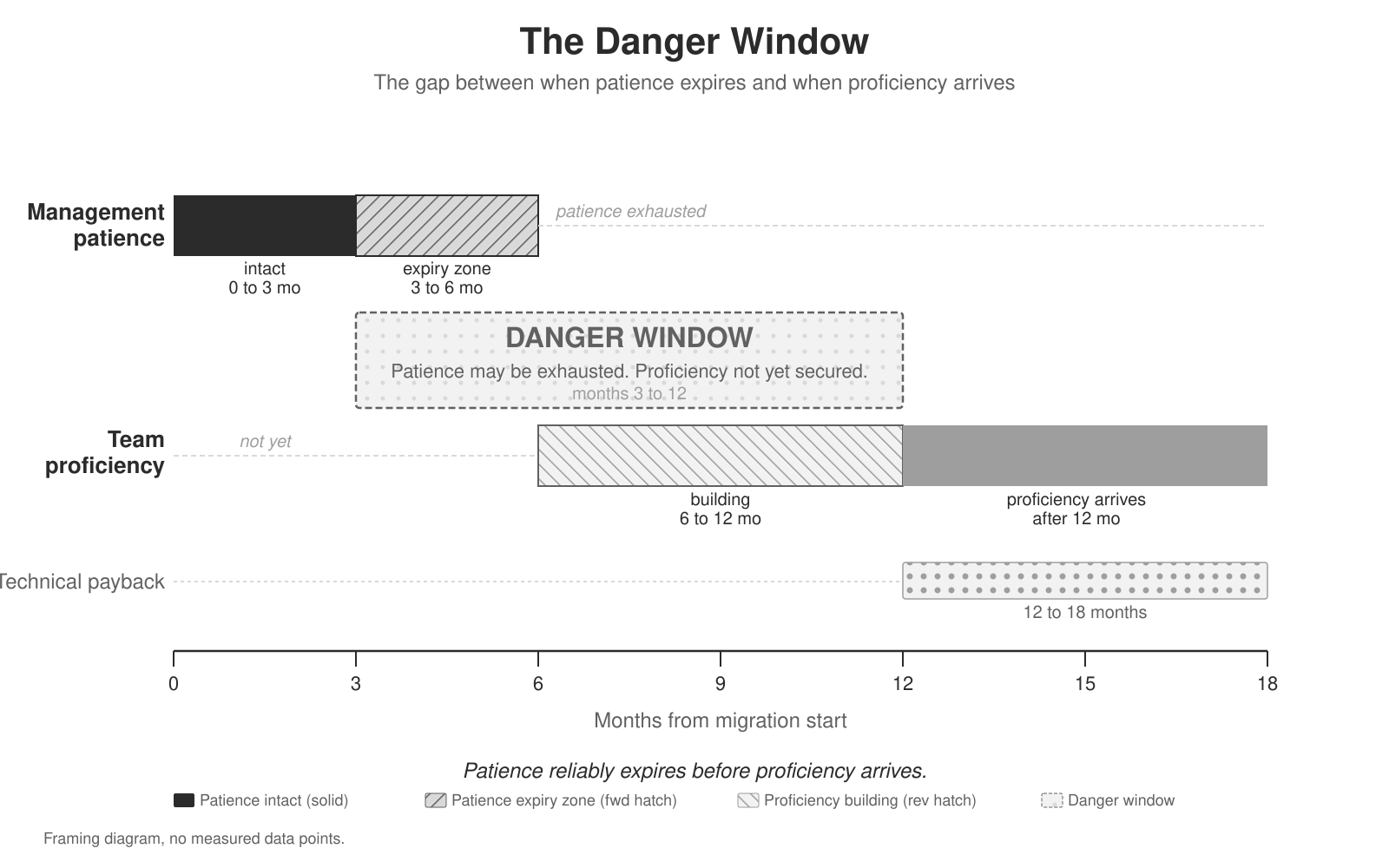
The integrated-organization migration pattern is four to six months. The federated pattern is closer to twelve. The extra time isn't a technical cost, since the platform builds in roughly the same window either way, and it comes instead from coalition pacing and parallel-operation discipline. The schedule below is a planning template, not a promise. BU politics will move milestones by weeks in either direction, and the timeline that ships has to absorb that without losing the coalition.
Phase 1: anchor BU pilot (months 1–3)
Month one is platform build and anchor BU data onboarding, which means per-BU S3 bucket isolation, an Iceberg catalog with per-BU namespaces, and shared compute with RBAC-isolated data access. Two anchor BUs start parallel ingest, so their data flows to both Splunk and the new platform, and nothing cuts over because Splunk continues receiving every event.
Month two is analyst training and parallel queries. Ten early-adopter analysts (five per anchor BU) do two days of hands-on training: SQL basics, OCSF schema, threat-hunting workflow. They run the same hunts on both stacks and compare. The pattern that consistently shows up: detection parity is high, latency is meaningfully lower on the new platform, analysts ask within two weeks whether they can use the new stack for daily hunts. That moment is the pilot inflection point.
Month three is pilot validation and the coalition pitch. The anchor BU CISO, not the Corporate CISO, presents pilot results to peer BU CISOs. In a recent engagement that presentation pulled five additional BUs into the coalition, taking total participation from two to seven of twelve. Seven of twelve is the critical-mass number where chargeback math works for the rest.
Phase 2: coalition onboarding (months 4–9)
Three waves of two BUs each, with each BU controlling its own onboarding timeline, so the fast-moving BUs onboard in five or six weeks while the cautious ones take seven to nine. One BU in a recent engagement insisted on extra validation time, because they were a vaccines manufacturer and their CISO would not move faster than her own confidence, so corporate IT respected the pace, and that respect is what kept the coalition intact.
During this phase every BU pays double. They're running Splunk in parallel with the new platform, typically for two to three months per BU. A BU paying $38K per month on Splunk plus $18K per month on the new stack is consciously absorbing $56K per month to validate a $20K per month perpetual savings. That math has to be set against retention compliance and query latency gains, and the BU CFO has to sign off on the double-pay window explicitly, because surprises here collapse coalitions. The hidden cost of SIEM migration essay covers the parallel-operation math in more detail.
Phase 3: Splunk sunset (months 10–12)
Each BU independently sunsets Splunk when they're confident rather than on a corporate schedule, and that decoupling is what makes the coalition durable. In the engagement I'm composite-quoting from, four BUs sunset in month ten, two more in month eleven, the cautious vaccines BU in month twelve. The total coalition reached roughly $3.2M per year in savings against Splunk renewals, a number I'm comfortable sharing only with the caveat that it's one engagement and the per-BU savings ratios varied from forty to sixty percent depending on ingest volume and retention requirements.
What actually determines success
Five things I'd refuse to ship without.
BU-controlled timelines
Forcing a BU's cutover date to match corporate's schedule is the single fastest way to lose the coalition. The cautious BU's pace is the coalition's pace. Build the financial model assuming a twelve-month sunset rather than a six-month one, and the platform will still ship. Build it assuming six months, and the moment the first BU asks for an extension the model breaks and corporate IT starts pressuring BU CTOs, which is the pressure that kills the coalition.
Zero BU-impacting outages
A 99.9% uptime SLA is the floor rather than the target, because one BU-impacting outage in the first three months tends to come up in nearly every subsequent BU sales meeting. The right pattern is over-engineering the platform reliability during the pilot phase (autoscaler tuning, query timeout management, catalog HA) at the expense of features, then loosening as the coalition matures and trust is established.
Per-BU data isolation, demonstrated
Separate S3 buckets per BU, Iceberg namespace isolation, RBAC enforcement at the catalog layer, and audit logging that the BU compliance officer can query directly, and the demonstration matters as much as the implementation. In one engagement a BU compliance officer asked for proof that a peer BU's analysts couldn't query her data, so we ran the denied query in front of her, showed the audit log entry recording the denial, and that single fifteen-minute meeting unblocked three months of compliance review.
Pipeline portability
Build ingestion in a vendor-neutral way from day one. The coalition will outlast any single ingestion vendor, and the first time a BU is told they can't move off the platform's pipeline layer the autonomy argument collapses. The pipeline lock-in piece covers the specifics: Vector, Cribl, OTel Collector, and where each holds you hostage. The federated version of that argument is sharper, because lock-in at the platform layer is the corporate IT team's risk; lock-in at the pipeline layer is every BU's risk individually, and they will all notice.
Acceptance that some BUs will exit
Not every BU is going to be a fit, and one BU in a recent engagement was eighty percent mainframe, the cloud migration was unapproved at their level, and joining the platform would have meant accelerating a separate strategic decision they weren't ready for, so they exited the coalition amicably while the platform continued with seven BUs and the financials held. Targeting 100% BU participation in a federated environment is the same mistake as targeting a corporate mandate, because it ignores the autonomy that makes federation work, which is why I read roughly 58 to 70 percent BU adoption as success in this model rather than as a failure to reach everyone.
What I'd tell the architect leading this
The job is mostly political.
The architect leading a federated security data migration spends about thirty percent of their time on architecture and seventy percent on coalition maintenance, BU CFO finance conversations, compliance review prep, peer-CISO presentation coaching, and managing the political math around opt-out clauses and parallel-operation costs. That ratio surprises architects coming from integrated organizations, and underestimating it is the most common failure mode I see in this kind of program.
A few hedges worth being explicit about. The savings numbers in this essay come from a single composite engagement and shouldn't be treated as benchmarks for your environment. The peer influence multipliers from HBR and McKinsey are directional rather than precise; the underlying studies measure self-reported adoption intent, not migration completion. The twelve-month timeline assumes a roughly seven-of-twelve BU coalition and a platform team experienced with Iceberg, OCSF, and dbt; an inexperienced team should plan for eighteen months and budget the training accordingly. The compliance citations are accurate to current versions of SOX, PCI-DSS, HIPAA, and GDPR as of mid-2026; re-verify against your auditor's interpretation before relying on them in a board memo.
If you'd like to talk through how this maps to your specific BU portfolio, retention requirements, and current Splunk renewal posture, the migration assessment engagement is the structured way to do that: a four-to-six week scoped review that produces the per-BU value pages, coalition pitch artifacts, and twelve-month timeline tailored to your environment.
