
Where the lock-in moved, part 3
The lock-in moved to the compaction schedule.
Since late 2024 AWS has run Iceberg compaction for S3 Tables customers, with sorting added in 2025, and Google now offers the same kind of automatic optimization in preview, all on the true promise that the files stay open. This essay measures what the arrangement of those files is worth on my own hardware, including a maintenance decision most teams never see being made, and sorts the regime into the parts that leave with the table and the parts that stay with the vendor.
Reading time: about 14 minutes. Evidence tier: B for my lab runs (planning sweep, compaction, layout and pruning, format read-scan), each one host, warm cache, synthetic corpora, June 2026, plus a follow-up manifest arm added on 16 November 2026 after the June results were in; B for vendor documentation of what a feature does; C with the bias flagged for vendor performance claims; D where I say I am inferring.
Writer confound
How the writer's choices decided the speed
When I first measured two open table formats against each other on security telemetry, Iceberg came back about 1.1 to 1.55 times slower than DuckLake across the five-query set at a billion rows, which is the kind of gap that steers a format decision if you stop there. I didn't stop there, because each format was reading Parquet its own writer had produced, with pyiceberg defaulting to ZSTD where the DuckLake path wrote Snappy, so the benchmark was comparing writers while it claimed to compare formats. Once I wrote one canonical set of files and registered the byte-identical bytes into both catalogs, three of the four queries I reran came back at parity (1.00×, 1.01× and 1.01×), and the fourth, a heavy top-N aggregate that still diverged 1.30×, didn't reproduce when I isolated it at 100 million rows (ocsf-read-scan, June 2026, one machine, Tier B). What stayed with me from that run is that the speed had followed the way the bytes were arranged, since the format on the architecture diagram was the one thing I'd held constant by the end and the gap had gone with the writer.
That run is why I read the managed-maintenance announcements the way I do. Over the past two years the large platforms have moved into running Iceberg table maintenance on their customers' behalf, and by 2026 the two services look like this:
- AWS has run compaction automatically on S3 Tables since it launched the service at re:Invent in December 2024, and on 2025-06-24 it added sort and z-order compaction, with sorting applied automatically during compaction when a sort order is defined in the table's metadata.
- Google's Lakehouse prices "automatic table storage optimization, including adaptive file sizing, automatic clustering, garbage collection, and BigQuery metadata (CMETA) generation" from $0.12 per DCU-hour, and its documentation lists automatic table management as an opt-in Preview feature. Separately, on 2026-07-29 Google announced the borderless Lakehouse with catalog federation across AWS Glue, Databricks Unity Catalog and Snowflake Horizon, which was in preview at announcement.
And one move around them points the same way. On 2026-08-26 the DuckDB project announced that DuckLabs, the company behind DuckDB and DuckLake, would join AWS, "expected to be effective in early September", with DuckDB, DuckLake and the extensions staying MIT-licensed under the non-profit DuckDB Foundation, and AWS's own announcement the same day said it expected "the transaction to close shortly, subject to customary closing conditions" (terms undisclosed). Neither page carries a closing notice as of 2026-11-16, though trade coverage since has written about the deal as done (Tier C). The vendor pages above are Tier B for what a feature does, and the sources and read dates are in the table at the end.
Both services come with the same reassurance, that your data stays in open Parquet files under an open metadata specification, that any engine that speaks Iceberg can read it, and that there is nothing to copy or export if you ever leave. I think that's true as far as it goes, and I want to take it at face value and then ask the question it doesn't answer, because the promise is about bytes at rest and says nothing about how those bytes came to be arranged the way they are, and my own benchmark had just shown me that the arrangement is where much of the query performance lives.
This is the third piece in a series about where lock-in went once storage formats opened up. The first, Pipeline lock-in, followed switching costs up into the pipeline layer, and the second, The index in your bucket, looked at the build that sits between index-as-store and open tables. This one goes down a level, into the maintenance jobs that keep an open table fast.
Measurements
What arrangement is worth on my own hardware
I'll give the conditions before the numbers, since the numbers mean little without them. Everything below ran on one host, a Beelink mini-PC under WSL2, with a warm page cache, so cold object-store behavior is unmeasured, and the corpora are synthetic. The three runs used three setups, which matters when you compare them: the planning sweep ran in a container against a Nessie catalog over MinIO object storage, the compaction run used pyiceberg's local SQL catalog on the local filesystem, and the layout run was a single Parquet file with no table format at all. The engine throughout is DuckDB 1.5.3, reading Iceberg through pyiceberg 0.11.1 where there was a table, and none of it is Tier A or a production-scale result. I treat it as Tier B, single-host lab evidence that shows the direction of an effect and its rough size. Clock drift on that host, since fixed, may make the June 2026 milliseconds read about 4% short without affecting the ratios, and the manifest arm from 2026-11-16 described below was added after the June results were in.
The first measurement is query planning, the step where the engine reads the table's manifests to work out which files to open before it touches any data. I wrote the same 700,000 rows as 10, 100, 1,000 and 3,000 appends, each count into its own table, so the files at the high end hold a few hundred rows each, and measured planning latency as the median of five trials at each point (bench-d-tiered-realization, 2026-06-16). Planning took 43.6 ms at 10 files, 480.9 ms at 100, 4,083 ms at 1,000 and 12,769 ms at 3,000, which is roughly linear and crosses a 200 ms interactive service level somewhere around 40 files. An independent first pass on the same rig agreed within run-to-run variance at 47.5, 541.2 and 4,090.3 ms. The 10-file median comes with a blown coefficient of variation (94%, one slow outlier trial), so I'd read that point loosely, but the 1,000- and 3,000-file points are tight at 3.6% and 0.4%. I also tried 10,000 files, and building that many sequential commits exhausted the container before it finished, which I take as its own small datapoint about how untenable a never-maintained table becomes. After compaction to a single file, planning sat between 9.7 and 13.0 ms at every size I tested.
Planning latency · fragmented vs compacted
There's a second effect inside that curve, because pyiceberg's default append writes one manifest per commit, so the 1,000-file table also carried 1,000 manifests and plan_files() opened every one of them. A follow-up arm that an agent ran on 2026-11-16 split the two effects, on pyiceberg's local catalog this time, so its conditions compare with each other and its milliseconds don't compare with June's. At 1,000 appends, rewriting the manifests alone, with all 1,000 data files still in place, took planning from 1,227 ms to 66 ms, which is about 95% of what compaction removed, and compaction then took it the rest of the way to 1.7 ms, so the data-file count still mattered by a further factor of about 40 at the small end. A table written with Iceberg Java's defaults merges manifests once 100 have accumulated, and in the same arm that kept planning at 72 ms at 1,000 files, so a reader whose tables come from Spark or Flink with default properties wouldn't see my linear curve. I'd take that as the first piece of evidence for the argument, because most of the planning cliff came from a manifest-merge setting the writer chose for me and I never looked at, which is exactly the kind of maintenance decision this essay is about. Planning here is pyiceberg's plan_files(), and Trino or Spark will plan faster in absolute terms, so what transfers is the split between manifests and data files and the flat line after maintenance, while the specific milliseconds don't.
Planning · manifests vs data files
Scan latency moves too, though less steeply, and how much depends on the query. In a separate run I wrote a 10-million-row Zeek conn corpus as 500 small appends, rewrote it into 4 files, and ran a four-query battery with seven trials per query (iceberg-compaction, 2026-06-14). The two hunting-shaped scans, a full aggregation and a selective filter, recovered 5.3× and 3.2×, while a group-by sum recovered 2.2× and a metadata-bound count(*) recovered 24×, with answers identical before and after on all four. That table also carried one manifest per append, and the follow-up arm reran it with the manifests rewritten and no data touched, which recovered 5.1× on count(*), 3.0× on the full aggregation, 2.15× on the selective filter and 1.4× on the group-by sum, while full compaction in the same rerun recovered 21.6×, 6.5×, 3.5× and 2.3×, close to June's figures. So in ratio terms somewhere between 40% and 60% of each recovery came from the manifests and the rest from having fewer, larger data files, and I credit the June numbers to compaction of a fast-append table, which is what they measured. A third run added the arm that a sorted rewrite would give, on a shuffled copy of the corpus and a selective 5% time-window scan, and there compaction alone recovered 6.0× while compaction sorted on the timestamp recovered 10.1×, so the sort added about 1.7× on top of what compaction alone gave, though on a full-scan hunt it added nothing, as you'd expect when there is nothing to prune (iceberg-compaction/results/sorted.json). I've written up the mechanics of those operations in Iceberg table maintenance at scale, so I won't re-teach them here.
Scan recovery · manifests vs data files
Rewriting manifests alone recovered 1.4× to 5.1×; full compaction 2.3× to 21.6×
Put together, the maintenance layer is expensive to skip and worth getting right, and that is the strongest case for letting someone else run it, which I think is a good case for many teams.
Layout
Why the policy doesn't travel with the files
The trouble starts with what "getting it right" means, because the answer changes with the query.
I wrote a 2,000,000-row OCSF Network Activity corpus three ways, unordered, sorted on source address, and z-ordered across source address, destination port and a one-hour time bucket, so the data and the answers were identical and only the row order differed (ocsf-zorder-pruning, DuckDB 1.5.3, pyarrow 23.0.1, 50,000-row row groups, 40 per file). Then I ran four queries with different predicate shapes and counted how many row groups each layout let the reader skip on footer statistics. Sorting on source address pruned 95.0% and 97.5% of row groups on the two queries whose predicates include source address, and pruned none at all on the other two, a destination-block-and-port lookup and a pure time-window filter. Z-ordering pruned 15.0% and 65.0% on exactly those two queries, where both other layouts pruned nothing, and gave ground on the first two, falling to 72.5% and 65.0%. On latency the simple sort beat z-order on the queries it serves (3.7 ms against 4.8 ms, and 2.7 ms against 5.8 ms), and z-order beat the sort on the pure time-window query the sort can't see (5.9 ms against 10.2 ms); on the destination lookup z-order's pruning gain is real but its latency edge sits inside the noise of that query's unordered baseline (CV 30.8%), so I'd only claim the pruning there. Z-order also took 5.6 times as long to write as the single sort and 4.4 times as long as leaving the rows unordered, in my Python implementation, so I'd take the direction from that and leave the multiple. At DuckDB's default 122,880-row groups the z-order advantage on the abandoned queries shrinks to 11.8% and 47.1% but survives (RESULTS-rowgroup-sensitivity-2026-06-15.md). This is one unpartitioned Parquet file with no table format around it, and the pruning counts are replayed from footer statistics, so a table partitioned by day would prune the time-window query whatever the sort order, and the part of the result I'd carry over is the split between the source-address queries and the destination lookup, which partitioning by time does nothing for.
Pruning · layout against query shape
Each layout prunes the queries it was built for
So I didn't find a layout that wins across the board, only a layout that matches the queries a team actually runs, and security workloads have shapes a general-purpose optimizer has no particular reason to anticipate. A hunt filters on a source address inside a narrow time window, an investigation pivots on one entity across six months of retention, and a detection scans one event class continuously and touches nothing else, so those three want different sort orders, and tuning for their average probably serves none of them well (that last step is my inference from the four-query run, Tier D until someone measures it on a real workload). A managed optimizer watching the table sees file sizes, write rates and query statistics, which is useful signal, but it doesn't know that the source-address filter is the hunt path and the destination-port filter is a monthly report nobody reads, which the team knows and the optimizer would have to infer from statistics that look much the same for both.
The writer-confound run from the opening is the same lesson seen from the other side. In both catalogs the bytes were open and readable, and what decided the speed was a set of choices a writer had made about codec and encoding before any query arrived, which nobody on the architecture diagram had chosen on purpose.
The handover
What travels and what doesn't
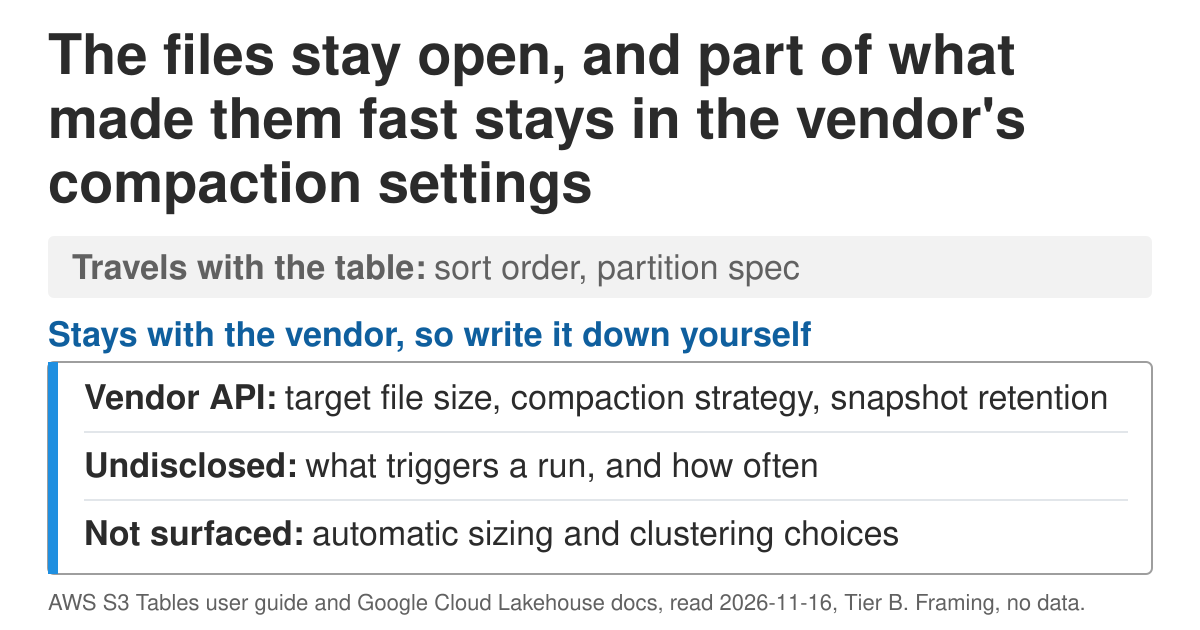
Compaction cadence, target file size, sort columns, clustering strategy, manifest layout and snapshot retention together form an operating regime, and on my rig the part I had never looked at was worth the most, since at a thousand appends merging the manifests alone cut planning by about 19 times, compaction took the total to several hundred times, and on the 500-append Zeek table the data-reading scans recovered roughly two to six and a half times after compaction, about half of it from the manifests. The useful question for a managed service is which parts of that regime leave with the table and which stay behind, and on the two services read for this piece the answer splits four ways (AWS S3 user guide, "Maintenance for tables", read 2026-11-16, Tier B for what the feature does):
- The sort order and the partition spec travel, because they are fields in the Iceberg table metadata, and on S3 Tables the team has to define a sort order there before the service will sort at all, since the default
autostrategy applies sort compaction only "for tables with a defined sort order in their metadata" and falls back to binpack otherwise. - The target file size, the compaction strategy and the snapshot retention are readable but live in the vendor's maintenance API, set with
PutTableMaintenanceConfigurationand read back withGetTableMaintenanceConfiguration, and on S3 Tables a retention set as an Iceberg table property is not honored at all, because settinghistory.expire.max-snapshot-age-msmakes snapshot management "fail for the entire table", so a copy of the table's metadata doesn't carry them. - The trigger and the cadence are undisclosed, since the documentation says compaction is on by default with a 512 MB target and that it "occurs on an automated schedule", and nothing about what starts a run or how often one runs.
- The choices an automatic mode makes on the team's behalf, such as Google's "adaptive file sizing" and "automatic clustering" or an S3 table left on
autowith no sort order, are recorded nowhere the team would look, and Google's pages don't say which columns get clustered or why.
The default retention is worth a sentence of its own for a security reader, because S3 Tables keeps a minimum of one snapshot and expires the rest after 120 hours unless someone changes it, which is five days of time travel on a table whose owner may never have chosen a number. When part of the regime sits in a vendor's maintenance settings and the rest in a schedule the vendor doesn't publish, there's a decent chance nobody on the team ever writes the whole of it down in one place, and there's no file in the repository that says the table sorts on source address because the hunt path filters on it and accepts that destination-port queries scan everything.
One detail from my own planning run makes this concrete. The run was meant to expire snapshots after each compaction, and every expiry call failed with "Nessie Catalog does not allow external snapshot management" (bench_d_integrating_sweep.json, expire_ok field), and Iceberg's own Nessie page warns that table maintenance "is complicated when using nessie" and points to Nessie's management services, which I read as a design reason, since a catalog with branches and tags has to know what else still references a snapshot before anything expires it. That had no effect on the planning numbers, but it is a working example of a catalog having a say in who runs a maintenance job, and snapshot retention is one of the regime decisions that also bounds your erasure window, which I covered in Deletion vectors and GDPR.
So the migration story changes, because the files are still yours and still readable, exactly as promised, but leaving stops being a data migration and becomes re-deriving an operating regime that may never have been written down, on a platform whose defaults differ, for a workload whose shape the team may never have characterized because it never had to. The "no copy" promise stays true while the inference people tend to draw from it, that there is therefore no lock-in, stops being true, and I haven't seen an announcement that says so.
Prior art
Who has already said part of this
Alex Merced wrote the conceptual version of this argument on 2026-07-06, catalog first but with optimization inside it, and he wrote it well: "openness at the table layer can be weakened if the catalog, access control, optimization, or query path is tightly bound to one platform," and "a table can be open while the operating model remains closed" (iceberglakehouse.com, read 2026-11-16, Tier B/C). He also tells readers to "ask whether table optimization policies are visible and adjustable," which is the third habit below, and what I'm adding is a measurement of what those policies are worth. He works at Dremio, which has been part of SAP since an acquisition that closed the day that post went up, and that is worth knowing when you read him, though the post says its views are his own and I don't think the affiliation changes the analysis. Much of the 2026 discussion of lakehouse lock-in lands on the catalog, and I think it lands there correctly.
The compaction and layout half I haven't found worked out anywhere with numbers attached. It appears in fragments, often as an aside inside a catalog piece, and I couldn't confirm that the practitioners I'd expect to have written it have done so, which may just mean I haven't found it. The vendor material that does address maintenance in depth is mostly written by the vendors who sell it (Onehouse's table-performance guide and its unbenchmarked "10x" figure, LakeOps's six-layer framing, RisingWave's case for Rust compaction; all Tier C with the seller's bias flagged), and it tends to frame maintenance as a capability to acquire, and I think that leaves out the question of who holds the policy once the capability is bought. The newest example points the same way: Lakekeeper, an open-source Iceberg catalog, shipped compaction that runs in Rust inside the catalog with its 0.15 release (2026-11-06), but only in the commercial Lakekeeper Plus tier, which the open-source release notes don't mention and which I take from a post by Viktor Kessler of Lakekeeper (Tier C), so the maintenance policy moved into the catalog and behind a license in the same step.
What I'd do
What I'd do about it
I'm not arguing against managed optimization. Many teams run Iceberg maintenance badly or not at all, and for them a vendor doing it automatically is a straightforward improvement, and the numbers above are the strongest argument I have for the service. What I'd argue for is keeping the policy on your side of the line while the vendor executes it, and four habits make that handover reversible:
- Measure your own planning curve before enabling anything, meaning planning latency against data-file count and manifest count on your data and your engine, and check whether your writer merges manifests, because that curve is what the maintenance layer is buying you, and in my run most of it turned out to be a writer setting that left the data files untouched.
- Write down the regime you want, in your repository and in plain language, covering whether manifests get merged, target file size, each sort column and the specific query that justifies it, the compaction trigger, and snapshot retention with its reason, since that document is the artifact that survives a change of vendor.
- Ask the service what policy it applies, and treat a refusal as information, because managed optimization that publishes its heuristics and managed optimization that reports only outcomes carry different exit costs even when both are worth buying; on S3 Tables the answer is one
GetTableMaintenanceConfigurationcall, and what it leaves out is the schedule. - Re-derive the layout question yourself at least once by running your top five queries against two layouts and comparing the pruning, which in my four-query run showed quickly that the right answer differs per query and that the tradeoff is yours to make.
All four habits sit comfortably alongside the managed service, and what they buy is a written record of what the service is doing, so that "we could leave" stays something you've checked.
Bottom line: the files and the sort order stay portable under the managed services read here, and the rest of the regime that makes them fast, the settings, the schedule and the automatic choices, is the part you have to write down yourself if you want it to travel.
Open questions
What would change my mind
If a managed optimizer, given a real security workload at production scale, converges on a layout close to what a practitioner would choose deliberately, the portability concern shrinks to a documentation problem, and that is a testable claim I haven't tested, since it needs a multi-host rig and a real corpus. The other thing that would change my mind is a vendor publishing the trigger, the cadence and the choices its automatic modes make in enough detail to reimplement them, since AWS already exposes the settings, because a regime I can read is one I can rebuild somewhere else, and I'd be glad to be wrong that way.
Sources
Sources and tiers
| Claim | Source | Tier |
|---|---|---|
| Iceberg 1.1-1.55× slower at default config; parity on byte-identical files (3 of 4); top-N not reproduced at 100M | ocsf-read-scan LARGE-SCAN, SAME-FILES, TOPN-ISOLATION (2026-06-05/06) | B |
| Planning on fast-append tables 43.6 / 480.9 / 4,083 / 12,769 ms; compacted 9.7-13.0 ms; Nessie expiry refusal | bench-d-tiered-realization (2026-06-16) | B |
| Manifests vs data files: manifest rewrite alone 1,227 → 66 ms at 1,000 appends, merge-on 72 ms; Zeek scans 5.1 / 3.0 / 2.15 / 1.4× vs compaction 21.6 / 6.5 / 3.5 / 2.3× | iceberg-compaction RESULTS-MANIFEST-ARM-2026-11-16 (follow-up arm, local catalog) | B |
| Scan recovery after compaction 2.2× to 24× (fast-append table); sorted arm 6.0× vs 10.1× | iceberg-compaction (2026-06-14) | B |
| Pruning by layout; write cost; row-group sensitivity | ocsf-zorder-pruning (2026-06-08, sensitivity 2026-06-15) | B |
| S3 Tables managed, sort and z-order compaction (2025-06-24) | AWS What's New and S3 Tables page, read 2026-11-16 | B (what the feature does) |
| Google automatic storage optimization; opt-in Preview | Google Cloud Lakehouse product page and docs, read 2026-11-16 | B (what the feature does) |
| S3 Tables sort order from table metadata; target size, strategy and retention in the maintenance API; retention table properties not honored; "automated schedule"; 120-hour default | AWS S3 user guide, Maintenance for tables and Considerations, read 2026-11-16 | B (what the feature does) |
| pyiceberg fast-append default (merge off); Iceberg Java default merge on at 100 manifests | pyiceberg 0.11.1 TableProperties; Iceberg configuration page, read 2026-11-16 | A/B |
| Nessie maintenance warning | Iceberg docs, Nessie page, read 2026-11-16 | B |
| Borderless Lakehouse federation in preview (2026-07-29) | Google Cloud blog, 2026-07-29 | C (vendor), status checkable |
| DuckLabs to join AWS; MIT under the DuckDB Foundation; close expected "shortly" | duckdb.org and aboutamazon.com, both 2026-08-26, read 2026-11-16 | B |
| Merced quotes | iceberglakehouse.com, 2026-07-06, read 2026-11-16 | B/C |
| Onehouse "10x", LakeOps six layers, RisingWave Rust compaction | Vendor material | C (seller's bias) |
| Security query shapes want different sort orders | My inference from the four-query run | D |
