Architecture / Handbook Chapter 2
MOAR, explained.
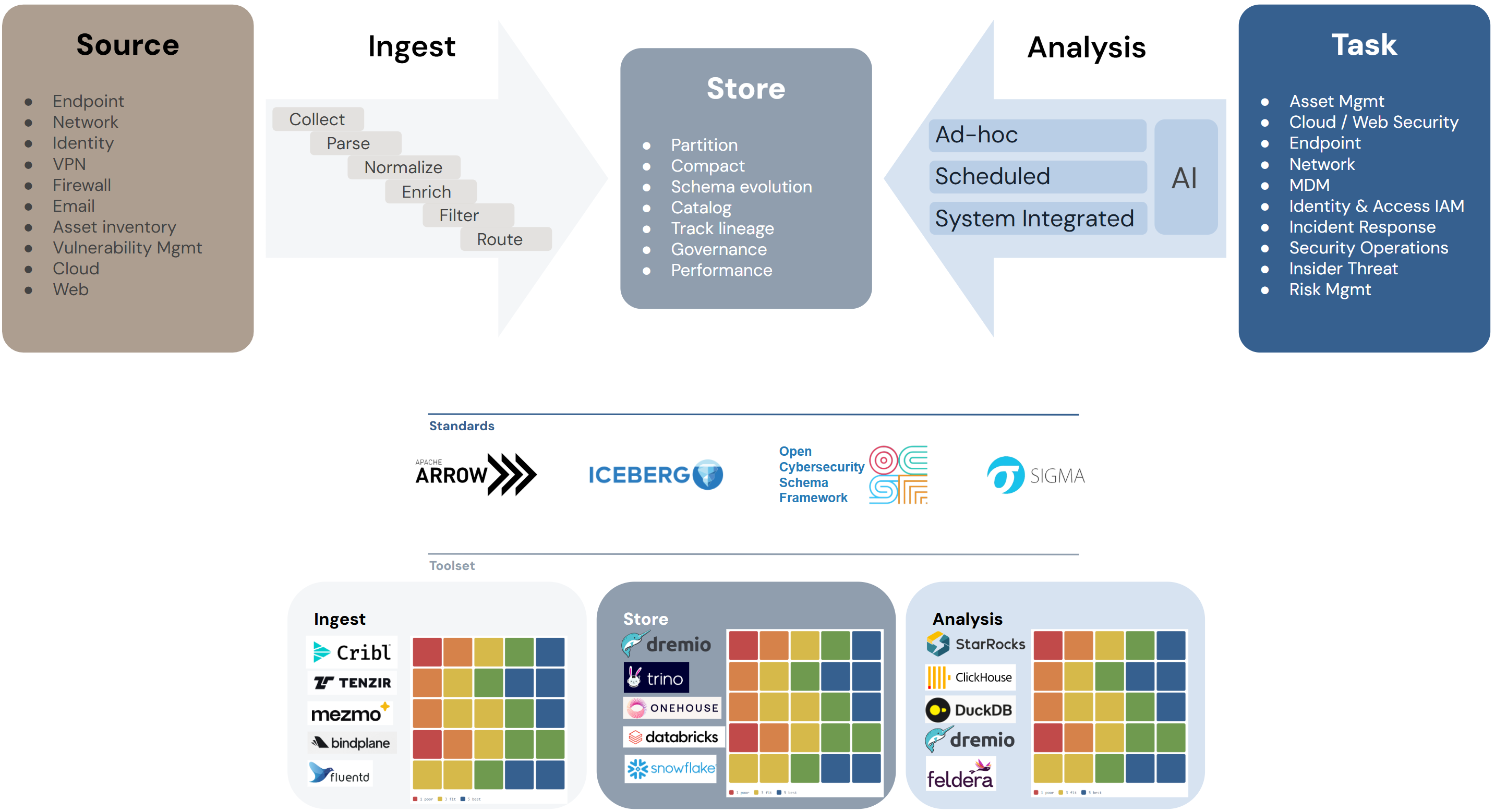
Modular Open Architecture is the assembled set of open, swappable pieces that replaces and upgrades the ELK stack for security: Iceberg for the table, Arrow for the wire, D3FEND for the ontology, OCSF for the schema, Sigma for the detections, and a query engine you can change your mind about. The argument of this essay is that being able to swap any one piece without rebuilding the rest is what makes the architecture safe to adopt, not just attractive on a slide.
Reading time: 16 minutes. Evidence tier: B (practitioner experience, conference field validation, and the original MOAR Stack reference architecture) with the cost and volume figures flagged as author estimates, not measured numbers.
Story time
Where this came from.
The realization hit me at a dbt-sponsored book signing in Atlanta in 2023, the moment Joe Reis asked the room, "Who here uses the modern data stack?" Every hand went up but mine. I was the only person there from security, and the only one who didn't know what he was talking about. Joe moved on without defining it (no explanation, which is unusual for him) because everyone else already knew. I sat there with a different question: what is a modern data stack, and is security so far behind that we don't even know what we're missing?
The rest of the talk only sharpened it. Joe described how miserable the old way was: the cost pressure, the scaling walls, the vendor lock-in, the struggle to run analytics across diverse sources, and he was describing my Tuesday. It was security operations line for line, except this room had stopped treating any of it as hard. Separation of storage and compute, open table formats, object storage, query engines that had gotten genuinely fast: settled furniture for them, exotic or unheard-of for us. The data engineering community had worked these problems out years earlier, in the open, and cybersecurity had simply never walked into the room.
That day sent me deep into data engineering, and the more I pieced together what a security stack would actually look like, what would replace and upgrade the ELK stack so many of us were running, the more I realized I wasn't designing something new. A modular, open architecture was already taking shape on the data-engineering side, and it was organizing itself around Apache Iceberg as the table format. The pieces to handle security data differently already existed; nobody had assembled them for us, and most of us didn't know they were there.
That assembled set of open, swappable pieces is what I mean by Modular Open Architecture. MOAR is a way of composing the matured open standards (Iceberg for the table, Arrow for the wire, D3FEND for the ontology, OCSF for the schema, Sigma for the detections, and a query engine you can change your mind about) rather than a single platform you buy from one vendor, so that no one part owns the whole and any part can be replaced without rebuilding the rest. The rest of this essay is what that stack looks like for security, component by component, and why being able to swap any piece is what makes it safe to adopt rather than just attractive on a slide.
The bridge
What the modern data stack actually is.
For a security reader who has spent a career inside a single search cluster, the modern data stack can sound like marketing, so it helps to name the four moves underneath it, because each one is a thing the ELK era did the hard way and the data-engineering world stopped doing the hard way.
The first move is separating storage from compute. In an Elasticsearch cluster the nodes that hold your data are the same nodes that answer your queries, so retention and query capacity scale together whether you want them to or not, and growing one means paying for the other. The modern stack puts the data in object storage (S3, ADLS, GCS) at roughly $0.023/GB/month, and spins compute up against it on demand, so you can hold a year of logs cheaply and only pay for the engine while a query runs. You can turn off every engine and the data is still there, readable by a different tool tomorrow.
The second move is the open table format. Object storage on its own is just a pile of files, and what makes that pile behave like a table (atomic commits, schema evolution, time travel, hidden partitioning) is a metadata layer written in the open and readable by any engine that implements the spec. That layer is Apache Iceberg, and it is the reason the pile of Parquet files in your bucket can be queried as one consistent table by Spark, Trino, ClickHouse, DuckDB, or StarRocks without each of them needing its own copy.
The third move is cheap, durable object storage as the foundation everything sits on, which is what lets the first two moves pay off, because storage that costs almost nothing per gigabyte is what makes long-retention security telemetry affordable to keep queryable instead of shipped to cold archive you can never search again.
The fourth move is query engines that got genuinely fast. Columnar engines like ClickHouse and StarRocks and embeddable ones like DuckDB closed the gap with proprietary indexed stores, so reading open Parquet off object storage is no longer the slow path it was a decade ago. Put those four together and you get the shape of the thing: open data the engines share, compute you scale on its own, and no single vendor holding the format your data lives in. The MOAR Stack is what you get when you take that shape and build it for security telemetry instead of for analytics dashboards.
At a glance
The components, and what each one replaces.
The map before the walk-through. Every row is expanded in the prose below, with what it upgrades from the ELK-era stack and why open plus modular matters at that layer.
| Component | Role | What it replaces / upgrades |
|---|---|---|
| Iceberg | The table: open table format, the organizing center of the stack. | The proprietary search index (tsidx, Lucene segments) that tied your data to one engine. Now the table is open and many engines read it. |
| Arrow | The wire: in-memory columnar interchange between tools. | The serialize-deserialize tax every time data crossed a tool boundary. Now tools hand columnar memory across without re-encoding. |
| D3FEND | The ontology: defensive-technique and artifact grounding that ties observations to meaning. | Tribal knowledge and per-analyst mental models of what a log line means defensively. Now the meaning is a published graph. |
| OCSF | The schema: event normalization across sources. | Per-vendor field soup and the index-time parsing you maintained per source. Now sources normalize to one shared event model. |
| Sigma | The detections: portable detection-as-code. | Detection logic locked in one vendor's query language (SPL, EQL, KQL). Now a rule is written once and compiled to many backends. |
| Query engine | The compute: workload-matched engines you can swap. | The single search cluster that had to be real-time alerting, ad-hoc hunting, and reporting all at once. Now you match the engine to the workload. |
The table
Iceberg: the organizing center.
Iceberg comes first because it is what the rest of the architecture organizes around, and it is the piece that the data-engineering world had already converged on by the time I went looking. In the ELK-era stack the equivalent layer was the search index itself, Elasticsearch's Lucene segments or Splunk's tsidx, and the problem with an index as your storage layer is that the index belongs to the engine, so your data and your query tool are the same decision, and changing one means re-ingesting everything into the other. Iceberg breaks that pairing by sitting as an open metadata layer between the query engine and object storage, so the table is described once, in the open, and any engine that implements the Iceberg spec can read it.
What that buys a security team is concrete. Schema evolution means that when OCSF adds a field or a cloud provider changes a CloudTrail structure, you update metadata rather than rewriting millions of Parquet files, so onboarding a new log source or absorbing a vendor format change stops being a downtime event. Time travel means a breach investigation can query the table as it existed at a past timestamp, which is how you reconstruct an attack timeline without restoring an archive. ACID transactions mean a query never reads a half-written file, so concurrent ingestion from many pipelines doesn't corrupt the count a compliance report depends on. Hidden partitioning means an analyst writes WHERE event_time > now() - interval '24 hours' and Iceberg applies the partition filter underneath, so the analyst doesn't need to know the physical layout to write an efficient query.
This is the layer your data physically lives in, which is exactly why an open, plural standard matters most here. Iceberg has first-class support across more than twenty query engines (Spark, Trino, Dremio, Flink, ClickHouse, DuckDB, StarRocks, Athena, Snowflake, BigQuery, and others), and the governance is plural: it's an Apache Software Foundation project with contributors across Netflix, Apple, AWS, and others, so no single vendor steers it. That convergence is recent and real, because Databricks acquired Tabular (the company founded by Iceberg's creators) in 2024, and Snowflake open-sourced the Polaris catalog to the ASF, which are the two clearest signals that the table format question has largely settled on Iceberg.
A fair caveat keeps this honest: Iceberg does not fit every workload. It's an analytic table format, not a real-time streaming sink and not a transactional database, and for a workload that only ever touches the last 24 to 48 hours the lakehouse benefits are thin. The detection tier that needs seconds-to-sub-second latency runs on streaming infrastructure (Kafka plus a stream processor) that feeds Iceberg rather than living inside it. Iceberg earns its place as the historical and investigative foundation, the layer that holds the long retention everything else reads from, and the architecture labels which workload each layer serves rather than pretending one layer serves all of them.
The wire
Arrow: the interchange between tools
Arrow is the quietest component in the stack and the one a security reader is least likely to have heard of, because it lives below the surface where data moves between tools rather than at the surface where you write queries. Apache Arrow is a columnar in-memory format, a shared way of laying out a table in RAM, and its job is to be the common representation that different tools can hand to each other without re-encoding. In the older world, every time data crossed a boundary, from the pipeline to the store, from the store to the engine, from the engine to a Python notebook, it got serialized into one tool's format and deserialized into the next, and that translation is pure overhead that buys nothing.
What fixes that is Arrow being the same in-memory shape on both sides, so a tool can pass columnar memory to the next tool and it just reads it, no parse step in between. For security telemetry, which moves through a lot of boundaries (router to lakehouse, lakehouse to engine, engine to the analyst's notebook or dashboard) the cost of all that re-encoding adds up, and Arrow is what makes the modular stack not pay a tax for being modular. It's also the reason the engines can be fast at all, because columnar memory is what the vectorized query engines are built to operate on directly.
The open-and-modular case lands more subtly at this layer, because Arrow's job is removing the re-encoding tax a modular architecture would otherwise pay every boundary a tool crossed, working as the lingua franca that lets the stack stay modular without a performance penalty. If every tool spoke its own in-memory format, swapping one tool for another would mean writing a new translation layer each time, and the modularity would carry a real cost. Because the tools share Arrow, the boundaries between them are close to free, which is part of why an assembled-from-parts stack can compete with a monolith on speed rather than only on price and openness. Arrow is infrastructure you mostly don't think about, and that's the sign it's doing its job.
The ontology
D3FEND: tying observations to meaning.
The first three components move and store bytes; D3FEND is the first one that's about what the bytes mean. MITRE D3FEND is a knowledge graph of defensive techniques and the digital artifacts they operate on, and its role in MOAR is to be the grounding layer, the published model that connects an observation in your data to a defensive technique and the artifact it concerns. The ELK-era equivalent was tribal knowledge: a senior analyst knew that a particular log line mattered because it touched a credential, or a process, or a network connection, and that knowledge lived in heads and runbooks rather than in a graph a machine could traverse.
What D3FEND changes is that the meaning becomes explicit and queryable rather than living in someone's head. When you can say that a given artifact in your telemetry maps to a digital artifact in D3FEND, and that artifact is operated on by a set of defensive techniques, you have a path from a raw observation to a defensive posture that doesn't depend on which analyst is on shift. That's the part of the stack that lets you ask structural questions: which techniques can I even detect given the artifacts I'm collecting, and where are the gaps where I'm collecting nothing that any defense reads. A mapping between an observation and a defensive technique is a claim about meaning, though, and claims about meaning carry a confidence that the architecture should show rather than hide. The discipline is to treat each cross-graph link as carrying its own support, so a multi-hop inference is only as trustworthy as its weakest edge, and an intent-blind inference is labeled as a lead rather than asserted as a fact.
The tribal-knowledge problem is exactly what a public, community-maintained ontology solves at this layer, because when the grounding is a published standard rather than a vendor's internal content library, the meaning your detections rest on isn't something you lose when you change platforms. D3FEND is the layer most foreign to a security architect coming from the SIEM world, since the old stack didn't really have an explicit ontology at all, it had product features and a content marketplace. The shift to a published graph of techniques and artifacts is one of the genuine upgrades MOAR carries over the architecture it replaces.
The schema
OCSF: one event model across sources
OCSF is where the meaning from D3FEND meets the bytes from Iceberg, because the Open Cybersecurity Schema Framework is the normalized event model that gets every source speaking the same field names. In the ELK era the work this replaces was index-time parsing maintained per source: every vendor emitted its own field layout. You wrote and maintained the parsers and field extractions that turned each one into something your detections could read, which is the per-vendor field soup that consumed a large share of a detection engineer's time. OCSF moves that normalization to a shared schema, so an authentication event from Okta and an authentication event from Active Directory both land as the OCSF Authentication class with the same fields, and a detection written against those fields works regardless of which source produced the event.
What OCSF changes is that detection logic stops being source-specific. When your rules query OCSF fields rather than vendor-specific fields, adding a new log source is a mapping exercise rather than a rewrite of every rule that touches that data, and your detections become portable across the sources that share the schema. That portability is also what makes the Sigma layer below it work, because a detection language needs a stable field vocabulary to compile against, and OCSF is that vocabulary. The mapping work is real, though: normalizing a source to OCSF is non-trivial, the schema is large, and a hyperscale deployment can take an engineer-year of effort to map hundreds of sources even with tooling help, so OCSF trades recurring per-source parser maintenance for upfront mapping work rather than making the work vanish.
The schema is the contract that lets the rest of the stack be swappable, and that contract only holds if it stays open rather than owned by one vendor. OCSF has commercial backing across AWS, Splunk, IBM, CrowdStrike, and others, and AWS Security Lake produces OCSF-normalized output directly, so it's a shared schema with broad backing and not one vendor's. The architecture works with or without OCSF, though, because raw logs and vendor schemas are also supported, and OCSF is the recommended normalization layer rather than a hard prerequisite. You can land data first and normalize later, which matters for a phased migration where ripping out parsing on day one isn't realistic.
The detections
Sigma: detection-as-code that travels.
Sigma is the detection layer, and it's the component that most directly attacks the lock-in a security team feels every day. In the ELK-era stack your detection logic was written in one vendor's query language, SPL for Splunk, EQL or KQL elsewhere. That meant your accumulated detection content, the rules you'd tuned over years, was the thing most tightly bound to the platform, so changing platforms meant rewriting your detections rather than carrying them. That binding is a large part of why the four real barriers to leaving a SIEM (risk aversion, the skills gap, the migration gap, and status-quo bias) feel as heavy as they do: the rules are the institutional memory, and they don't move.
What Sigma adds is a vendor-neutral, YAML-based way of expressing a detection that compiles to many backends. You write the rule once against a stable field model, and a converter targets the query language of whichever engine or SIEM you're running, so the detection is portable in the way the data is portable. Sigma plus OCSF is the combination that does the real work: OCSF gives the rule a consistent field vocabulary to reference, and Sigma gives that rule a form that isn't married to one engine, so a detection can outlive a platform decision the same way the data does.
This is where reversibility either holds or collapses for the people who actually run the SOC, which is why an open, portable detection format matters more here than almost anywhere else in the stack. If you can leave a vendor but your detections can't come with you, the openness of the data layer is cold comfort, so a portable detection format is what makes the whole reversibility argument credible to a detection engineer rather than only to an architect. Sigma's coverage and the fidelity of its conversion to a given backend vary by backend and by rule complexity, and a portable rule still has to be validated on the engine it lands on rather than assumed to behave identically everywhere, so portable is not the same as free.
The compute
The query engine you can change your mind about.
The last component is deliberately not named after a single product, because the point of this layer is that it's the one you should expect to change your mind about. In the ELK-era stack the engine and the store were the same cluster, and that one cluster had to be everything at once: the real-time alerting path, the ad-hoc threat-hunting path, and the scheduled reporting path, which is a set of workloads no single engine is actually optimal for. MOAR separates the engine from the store (that's what Iceberg makes possible) and then matches the engine to the workload: a columnar engine like ClickHouse or StarRocks for fast aggregations and dashboards, an MPP engine like Trino or Dremio for ad-hoc hunting across many tables, an embeddable engine like DuckDB at the edge or on a single host, Spark for batch maintenance and transformation.
Two changes follow from separating the engine from the store this way, so a team gets to use the right tool for each workload instead of forcing one tool to do all of them badly, and because all of these engines read the same Iceberg tables, swapping one for another requires no data migration. If a managed engine's pricing escalates, or a faster one appears, you point the new engine at the same tables and your data doesn't move, which is the exit strategy that the data layer's openness was for in the first place. This is also the layer where the architecture's central promise is most testable, because "any engine, no migration" is exactly the kind of claim that sounds good and is rarely shown.
The freedom to change your mind is most visible at this layer, and it's here that open and modular pay off most directly, because the cost of having chosen wrong is smallest under MOAR and largest under a monolith. Under a monolith, the engine choice and the storage choice and the detection-language choice were one decision, so getting any of them wrong meant getting all of them wrong. Separating them is what turns a wrong engine choice from a re-platforming project into an afternoon of pointing a new engine at the same tables.
The through-line
Why swappable is what makes it safe.
Lay the six components next to each other and the same property runs through all of them: each one is a maintained open standard that composes with the others over open formats, and each one can be replaced without rebuilding the rest. The table can change underneath the engine, the engine can change above the table, the schema can absorb a new source without touching the detections, and the detections can move to a new backend without moving the data. That is the whole reversibility argument, and it's a sentence a monolith vendor cannot say: if a layer choice turns out wrong, you swap the part and the data stays.
That reversibility is exactly what makes adoption safe and incremental rather than a bet-the-SOC migration, because the four real barriers to leaving a SIEM all soften when the move can be partial and reversible. You don't rip out the existing platform on day one; you stand up the lakehouse alongside it, land a couple of high-volume sources, query them from a familiar interface during the transition, and expand as the team's confidence and skills grow. Each step is reversible, so the migration risk is low at every phase, and the architecture is built to let an analyst keep working in the console they already know while the data foundation changes underneath.
One distinction is worth holding onto, because it's easy to confuse the durable idea with one instantiation of it. MOAR is the durable concept: maintained open-standard parts composing over open formats, any part swappable. A specific named stack (a particular store, catalog, engine, and router wired together at a stated scale) is one example of MOAR, the composition I happen to defend on a given host, and it is falsifiable on its own without putting the concept at risk. When you read a later chapter that names exact components, read it as one defensible instance rather than as the definition, because the architecture's value is in the composition pattern, not in any single parts list.
This chapter is the orientation, the map before the deeper walks. Each pillar here gets a chapter of its own that goes past the introduction: the table format choice and what changed with the latest Iceberg spec, the schema and the real cost of normalization, the detection layer and how far portability actually carries, the engines and the measured differences between them, and the migration path that ties it together into a sequence a team can actually run. The components are the vocabulary; the chapters that follow are where each one gets tested rather than introduced.
