
Framework data
ATLAS moves fast and deprecates nothing
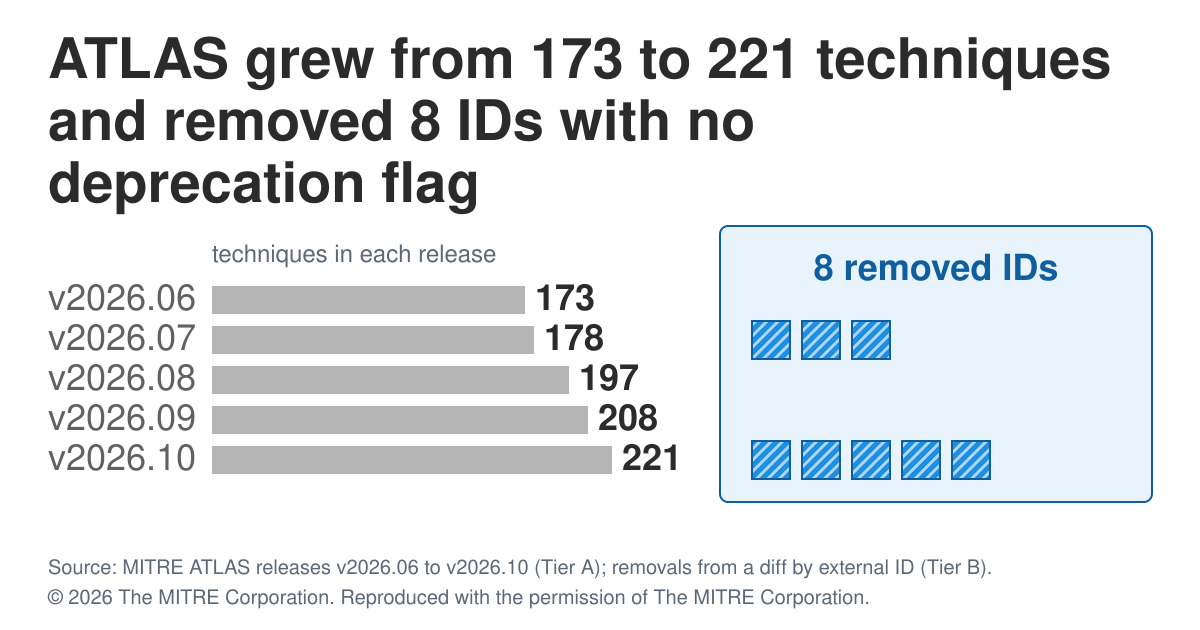
Between June and October 2026, MITRE ATLAS removed eight technique IDs with no revoked flag, no deprecation flag and no pointer to where their content went. This essay measures the drift across four releases, works through what it does to anyone who keys detections, controls or mappings to ATLAS IDs, and sets out what I would do about it today.
Reading time: about 12 minutes. Evidence tier: A for the MITRE ATLAS and ATT&CK release data and the D3FEND source, each re-read 2026-11-16 against ATLAS v2026.10, the latest release on that date; B for the crosswalk's diffs, counts and rebaseline and the readings of the release data built on them, with sources and dates in the table at the end.
The short version
Eight IDs with no counterpart in October
MITRE ATLAS had moved each of the eight technique IDs it removed between the June and October 2026 releases, but it marked none of them revoked or deprecated and nothing in the STIX bundle points from an old ID to wherever its content went, so they show up only as disappearances when each release is diffed against the one before it by external ID, which is how they surfaced when my ATLAS-to-D3FEND crosswalk was rebaselined against the October release on November 2, with seven of the eight sitting under rows in its queue. A consumer that works the way D3FEND's importer does, adding each release to an existing graph and retiring a class only when a flag says so, would carry eight live-looking techniques with stale definitions into its next build and never know. ATLAS has been shipping roughly monthly, which is good for a framework trying to keep up with agentic attacks, but a framework that moves this fast without a deprecation signal turns into a data-quality problem for everyone who keys detections, controls or mappings to its IDs, and the release table below measures how much moved in four releases.
Four releases
What moved
The counts below come from the stix-atlas.json release assets for each version, keyed by mitre-atlas external ID, which is the same file D3FEND's importer ingests. An agent session in my lab re-derived them from freshly downloaded release files on 2026-11-16, when v2026.10 was still the latest release.
| Step | Techniques after | Added | Removed | Renamed | Definition text changed |
|---|---|---|---|---|---|
| v2026.06 (baseline) | 173 | ||||
| v2026.06 → v2026.07 | 178 | 8 | 3 | 1 | 41 |
| v2026.07 → v2026.08 | 197 | 19 | 0 | 3 | 5 |
| v2026.08 → v2026.09 | 208 | 11 | 0 | 0 | 9 |
| v2026.09 → v2026.10 | 221 | 18 | 5 | 8 | 43 |
Net over the four steps that is 56 added, 8 removed and 12 renamed, and 68 of the 165 v2026.06 IDs that survive had their definition text changed. v2026.10 shipped on 2026-10-28 with data format v6.1.0. Much of the growth is the agentic material, the autonomous reconnaissance, attack-path adaptation, agent communication and attack orchestration techniques (AML.T0116, AML.T0117, AML.T0118 and AML.T0124) that arrived in v2026.08 alongside six techniques that carry ATT&CK technique names, and the discovery and agent-runtime techniques in v2026.09, and I think that growth is the right call for a framework whose job is to describe what attackers are doing to AI systems this year, so the trouble I want to look at sits in the two smaller columns, the removals and the renames.
No forwarding address
Where the eight IDs went
These are the eight removals and where their content went. Successors come from the release notes, checked against the YAML, because the STIX bundle itself carries no successor information at all.
| Removed | v2026.06 name | Successor | Basis |
|---|---|---|---|
AML.T0019 | Publish Poisoned Datasets | AML.T0115.000 Datasets | release notes v2026.07 |
AML.T0058 | Publish Poisoned Models | AML.T0115.001 Models | notes print .000; sub-ID from YAML |
AML.T0104 | Publish Poisoned AI Agent Tool | AML.T0115.002 AI Agent Tools | notes print .000; sub-ID from YAML |
AML.T0024.000 | Infer Training Data Membership | AML.T0137.000 Infer Membership | release notes v2026.10 |
AML.T0024.001 | Invert AI Model | AML.T0137.002 Invert AI Model | release notes v2026.10 |
AML.T0024.002 | Extract AI Model | AML.T0005.001 Replicate Behavior from Model Outputs | not in the notes; AML.CS0056's step was re-homed to T0024, T0135 and T0005.001 in the v2026.10 YAML (my reading) |
AML.T0056 | Extract LLM System Prompt | AML.T0085.003 System Instructions | release notes v2026.10 |
AML.T0057 | LLM Data Leakage | AML.T0085.002 Conversation Context and Memory | release notes v2026.10; the old definition also covered what is now T0085.000 and T0137.003, and ATLAS's one case-study use went to T0085.000 |
The consolidations themselves look sensible to me. Folding three "publish poisoned" techniques into one AML.T0115 parent with dataset, model and agent-tool children is a cleaner shape, and moving system-prompt extraction under AML.T0085 puts it next to the other things an attacker pulls out of a model's context. My complaint is with how the move was published. ATLAS removes a moved technique from the STIX bundle outright, with no revoked: true, no x_mitre_deprecated: true and no revoked-by relationship; none of the five bundles from v2026.06 to v2026.10 flags a single attack-pattern as revoked or deprecated, and the v2026.10 bundle's relationship types are only uses, mitigates, subtechnique-of and attributed-to. So a consumer that diffs by ID sees eight disappearances, a consumer that merges each release into what it already holds and trusts the flags sees nothing, a consumer that rebuilds from the latest bundle sees its old tags stop joining, and none of them is told the successor by the data.
ATT&CK, the framework ATLAS is modeled on, handles the same situation differently, and the contrast is the clearest way I know to show what is missing. When ATT&CK retired T1656 in v19, whose bundle records the revocation on 2026-04-14, the object stayed in the bundle marked revoked with a revoked-by relationship pointing to T1684.001, so anyone holding a T1656 reference could resolve it from the data. ATLAS's own AML.T0073 kept pointing at T1656 through v2026.09 and was repointed in v2026.10, after a third party raised it as atlas-data#32, which tells me a tombstone doesn't make a consumer migrate, though it does mean the answer was sitting in the bundle when someone went looking. The v20.0 Enterprise bundle that D3FEND develop now ingests carries 149 revoked and 12 deprecated attack-patterns, as does the v20.1 bundle of 2026-11-05, and those tombstones are how a consumer resolves a retired ATT&CK ID without reading anyone's prose. ATLAS has the same STIX vocabulary available and is not using it for moves.
No forwarding address · tombstone versus removal
Who breaks
Who breaks, and how quietly
The obvious casualty is anyone with a detection rule, a SOAR playbook or a coverage dashboard tagged AML.T0056, because that tag now points at nothing in the current release and nothing tells the tagging system to re-home it. I'd expect that population to be small today, since ATLAS-tagged detection content is still rare in the environments I've seen, but it is the population the framework is trying to grow, and the failure is the kind that never throws an error, because a coverage count built from rule tags goes on counting a rule tagged AML.T0056 long after the ID left the framework unless something checks the tag against the current release, which is the weakness of counted coverage I wrote about in Measuring the detection coverage you actually have.
The less obvious casualties are the other frameworks that ingest ATLAS. D3FEND's importer, src/util/update_atlas.py on develop, merges each release into the existing ontology and deprecates a technique only when the STIX object carries revoked or x_mitre_deprecated. D3FEND develop is still on ATLAS_VERSION := 2026.06, four releases behind, and on my reading of the code, when someone runs the next bump the importer would leave all eight removed IDs as live classes with their June definitions and no pointer to a successor, unless whoever reviews the generated diff notices that eight classes didn't change. Nobody at D3FEND did anything wrong here; the importer is reasonable for ATT&CK-shaped data, and ATLAS data looks ATT&CK-shaped until a technique moves.
Who breaks · three consumers
048c693 (Tier A for the code, B for what the next bump would do).Then there is ATLAS's own internal graph, which I think is the part many teams would not think to check. A count of references to the eight removed IDs in the two YAML releases shows the spread. In v2026.06, nine case-study procedure steps across nine case studies, and 20 mitigation-to-technique edges spread over seven of the eight IDs, pointed at them. In v2026.10 the eight IDs appear nowhere in the file, whether as a technique, a case-study step, a mitigation target or a mention inside a description. MITRE re-homed those references internally, which is correct, though not always to the successor its notes name, but a team that pulled the June case studies into an incident-weighted coverage model, which is what this site's control burn-down does with ATLAS's 27 incident case studies, has no way to reconcile its stored copy with the October one except by diffing the two files themselves.
Renames and definition changes are a slower version of the same problem. Twelve techniques were renamed over the four releases, some cosmetically (AML.T0020 Poison Training Data became Training Data Poisoning) and some in ways that change what a mapper would reach for (AML.T0072 Reverse Shell became Cyber Communication Channel, AML.T0010 AI Supply Chain Compromise became Supply Chain Compromise). The tactic AML.TA0001 went from "AI Attack Staging" to "AI Attack Adaptation" in v2026.08, which, on my reading of the importer, will probably add a new :ATLASAIAttackAdaptationTechnique class at the next ingest and keep the old :ATLASAIAttackStagingTechnique class beside it, with the existing techniques still filed under the old one, rather than rename it. Of the 68 definition changes, 19 are near-identical (a hyphen, a plural, a dropped article) and 40 are substantial rewrites, by a simple text-similarity measure, and because the crosswalk cites a verbatim quote from each technique's definition as evidence for every mapping, the definition changes have a cost I can count: 34 of my 242 queued rows quote text that is no longer a verbatim substring of the v2026.10 definition, and another 7 sit on the removed IDs, so 41 rows need re-quoting when D3FEND bumps. Some of those changes are a letter and a hyphen ("make a request to an adversary controlled server" became "makes a request to an adversary-controlled server" in the text behind PR #619), which is harmless to a human reader and fatal to a substring check, so a pipeline that verifies its quotes has to re-check every one of them on each bump where an editor would have let the hyphen pass.
Definition drift · what it costs the crosswalk
Release notes
The release notes are not a substitute for the data
The natural objection is that MITRE documents the moves in the GitHub release notes, so a careful consumer can read them. The notes do carry the moves, but checked against the data they also carry four errors:
- The v2026.07 notes list
AML.T0115.000as the successor for all three consolidated techniques, where the data uses.000,.001and.002. - The v2026.07 notes link
AML.AML.T0010.005, with the prefix doubled. - The v2026.08 notes describe Autonomous Exploit Development as
AML.T0016.001under Develop Capabilities, where the data has it asAML.T0017.001, andAML.T0016.003Exploits goes unlisted. - The v2026.10 notes omit the removal of
AML.T0024.002Extract AI Model altogether, which is why its successor in the table above comes from my reading of the case-study data and not from the notes.
None of these is a big deal on its own, and I'd make the same kind of slip writing notes for a monthly release. But prose release notes are the only place the successor is declared, so every error in them becomes an error in any consumer that automates from them, and a framework that wants to be machine-consumed probably needs the machine-readable form to carry the migration.
ATT&CK v20
Two frameworks with the same attack and no join key
There is one more kind of drift worth naming because it is new this quarter. ATT&CK v20, published 2026-10-13, added five AI items of its own: T1698 Indirect Prompt Injection, T1699 Direct Prompt Injection, T1700 AI-Enabled Exfiltration, T1608.007 AI Result Poisoning and T1685.007 Impair Autonomous Defenses. In ATLAS v2026.10, 48 of the 221 techniques carry an attack-reference to ATT&CK, and none of those references, nor any other in the file, points at those five, even though the same release notes say ATLAS moved its pinned ATT&CK dataset from v19.2 to v20.0, the release that contains them. The ATT&CK v20.1 Enterprise bundle, for its part, does not mention ATLAS at all, so AML.T0051 LLM Prompt Injection and its direct and indirect children now have conceptual twins in ATT&CK that neither framework acknowledges. A SOC that maps prompt-injection detections to both frameworks will double-count or split its coverage depending on which ID the analyst happened to pick, and I don't think either outcome is visible on a heat map. I'd expect the cross-references to arrive in a later release, and the fix on the ATLAS side is small, but until then the two frameworks are describing the same attack under two IDs with no join key.
ATT&CK v20 · the missing join key
What I'd do
Keying detections to ATLAS today
None of this argues against using ATLAS. It is the most complete public catalogue of attacks on AI systems I know of, and the monthly cadence is a feature for a field moving this fast. It does argue for treating ATLAS the way a data engineer treats any upstream schema that changes without a contract, which in practice comes down to a few habits:
- Pin the ATLAS version on every mapping row, rule tag and coverage record, so "T0056" is always "T0056 as of v2026.06" and a later reader can tell a stale reference from a current one.
- Diff each release's STIX bundle by external ID against the last one you ingested, and treat a disappearance as a signal in its own right, since the flags will not fire for a move.
- Keep a local successor table (the eight rows above are a starting point) and treat each row as a candidate set to review, since two of the eight were splits where the right successor depends on what the rule was detecting.
- Store the definition text, or a hash of it, alongside any mapping whose justification depends on the wording, so a definition change shows up as a diff you can review instead of a silently invalidated argument.
- Check both directions of the ATT&CK link on every release, because the ATT&CK side now has AI techniques that ATLAS does not reference.
The crosswalk pipeline does most of that now, and I'd rather the framework carried the migration in its data than every consumer rebuilding the same diff.
I raised the root cause upstream as mitre-atlas/atlas-data#33 on 2026-11-02, asking for moved techniques to stay in the STIX bundle marked revoked with a revoked-by relationship to the successor, the way ATT&CK does it, with the release-note errata folded in; as of 2026-11-16 it is open with no replies. That fix would help every STIX consumer at once, D3FEND included, since D3FEND's importer already turns revoked-by into a deprecation with a pointer to the successor and would need no change, and it does not depend on anyone's review bandwidth on the D3FEND side. The rows, quotes and drift flags behind this piece are public in the crosswalk repository, and the Blind Quadrant essay carries what the drift did to the D3FEND coverage numbers, including the seven techniques I am holding back until the next ATLAS bump so nothing gets mapped onto an IRI that is about to change.
Bottom line: ATLAS is the right framework to build AI detection coverage against, and its IDs are not yet stable enough to build on without a version column and a diff. Whether that changes will show in the next bundle before it shows on the issue, and I'll update this piece when the next ATLAS release ships, either with a note that moved techniques now carry tombstones or with that release's diff showing how many more IDs left without one.
Sources
Where each claim comes from
| Claim | Source | Tier |
|---|---|---|
| Release table, flags, relationship types, removed IDs, renames, the four release-note errata and the v19.2-to-v20.0 pin | MITRE ATLAS releases v2026.06 to v2026.10 (stix-atlas.json, ATLAS YAML and release notes, re-read 2026-11-16; v2026.10 published 2026-10-28) | A |
| Release table derivation and the full diff, including the removed-ID successors | Diff, 2026-11-02, re-run 2026-11-16: VERSION-DIFF-2026-11.md and scripts/01_diff_atlas_releases.py | B |
| Splits: Extract AI Model and LLM Data Leakage re-homed in the case studies | A reading of AML.CS0056 and AML.CS0024 in ATLAS-2026.06.yaml against ATLAS-2026.10.yaml, 2026-11-16 | B |
| Case-study and mitigation references to the eight removed IDs | Count over ATLAS-2026.06.yaml and ATLAS-2026.10.yaml, 2026-11-09, re-run 2026-11-16: scripts/08_removed_id_refs.py | B |
| T1656 revoked by T1684.001 in v19; 149 revoked and 12 deprecated attack-patterns; the five v20 AI techniques; no ATLAS reference in ATT&CK | ATT&CK STIX data, Enterprise v18.1, v19.0 and v20.1 bundles, and the ATT&CK versions page (read 2026-11-16) | A |
| AML.T0073 kept T1656 through v2026.09 and was repointed after a third-party report | ATLAS STIX v2026.06 to v2026.10; mitre-atlas/atlas-data#32 (opened 2026-10-15) | A |
| D3FEND importer behaviour and ATLAS pin | d3fend-ontology develop @ 048c693, Makefile, src/util/update_atlas.sh and src/util/update_atlas.py (read 2026-11-16) | A (code); B (what the next bump would do) |
| 34 + 7 = 41 of 242 queued rows need re-quoting; seven held techniques | Crosswalk rebaseline, 2026-11-02: crosswalk-rebaseline-2026-11.csv, columns quote_survives_latest and removed_in_latest | B |
| 19 near-identical and 40 substantial definition changes | Text-similarity count over the 68 changed definitions, 2026-11-16 | B |
| 27 incident case studies in the control burn-down | This site's control burn-down over ATLAS v2026.10, 2026-11-09, independently re-implemented: ATLAS mitigations | B |
| 48 ATLAS techniques with an ATT&CK reference, none to the five v20 AI techniques | Count over ATLAS-2026.10.yaml against ATT&CK v20.1, 2026-11-09, re-checked 2026-11-16 | B |
| Upstream request | mitre-atlas/atlas-data#33 (opened 2026-11-02; open with no replies on 2026-11-16) | The issue itself |
