
ATLAS and OCSF
ATLAS has no detection layer. Here is the column it is missing.
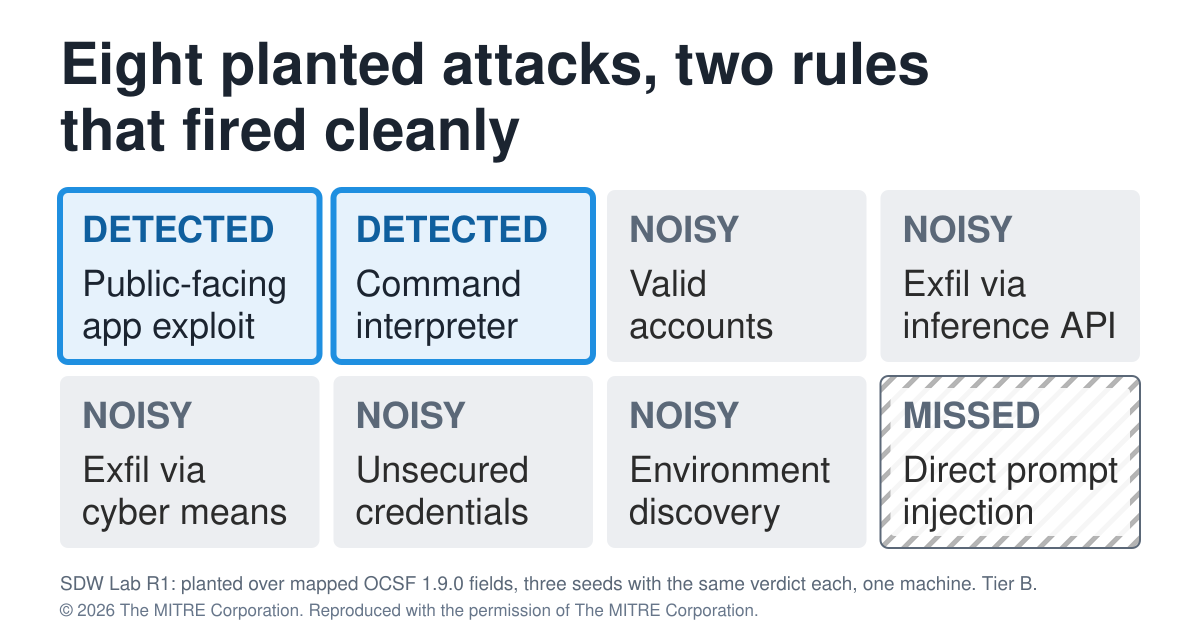
MITRE ATLAS maps attacks on AI systems to mitigations, but nothing in its data says which telemetry a given technique would show up in, so this essay builds that column for the 27 ATLAS incidents, from technique to D3FEND artifact to OCSF 1.9.0 field to a Sigma rule. About 56% of incident steps reach a specific field, the AI-native steps mostly don't, and when eight attacks were planted over the mapped fields, two rules fired cleanly.
Reading time: about 20 minutes. Evidence tier: A for the MITRE ATLAS and ATT&CK bundles and the OCSF 1.9.0 schema; B for my lab runs (R1 and its 2026-11-16 supplement, M1 blind re-grade, the mixed-case check, R8), each on one machine, agent-run against pre-registrations I have not reviewed myself, with the 2026-11-16 additions post-hoc; D for every artifact-to-field grade, the vocabulary grades in R8 and my reading of the CSA techniques, flagged in line. Sources are listed at the foot.
A SOC I worked with had roughly five hundred detection rules, and when I asked where the holes were, the honest answer was that nobody knew, because coverage there meant a number that went up, rules written and ATT&CK techniques tagged and a heat map that got greener every quarter, and none of that measured whether a rule would fire on the behavior it was tagged with. I told that story on the D3FEND Wall page, and I've been carrying a version of it into AI security ever since, because the AI frameworks have the same shape of gap and, in one respect, a worse one.
The ATLAS Wall on this site asks readers to "read a filled cell as 'mapped to a real, recent technique' and never as 'this would have worked'," and the one dated test of the stronger reading, on ATLAS v2026.06, found that none of 17 mitigation-and-case pairs that looked like they might interdict a step survived an adversarial refuter, on a map half the size it is now (247 mitigation edges then, 494 now, and not re-run since). That caveat is about whether a control would stop an attack, and this essay takes the question one step earlier, the one a SOC usually has to answer first: if the technique happened in my environment, is there a field in my telemetry where it would show up, and would a rule over that field fire?
The gap
The question ATLAS can't answer
ATLAS can't answer that question from its data, and I mean that literally rather than as a criticism of its authors. The v2026.10 STIX bundle carries 221 attack-pattern objects, 44 course-of-action objects, 77 campaigns, 31 tools, 6 malware entries, 5 intrusion sets and 1,429 relationships, and it carries no object of type x-mitre-data-source, x-mitre-data-component, x-mitre-detection-strategy or x-mitre-analytic (Tier A). The YAML distribution has the same shape, so the detection guidance ATLAS does carry sits in mitigation prose. Four of the 44 mitigations are about detection or monitoring by name, AI Telemetry Logging and Monitoring (AML.M0024), AI Agent Scope Drift Detection (AML.M0038), Predictive AI Adversarial Input Detection (AML.M0015) and Deepfake Detection (AML.M0034), and M0024 in particular says what kind of thing to log, down to distinguishing an agent's requested actions from the ones it actually executed, but it attaches no data source, field or analytic to any technique (Tier A).
ATT&CK, which ATLAS is modelled on, has been through two generations of exactly this layer. Version 9 listed data sources only as strings on techniques, 472 of them carrying the field, and version 10, published 2021-10-21, introduced 38 x-mitre-data-source and 109 x-mitre-data-component objects. Detection strategies arrived in v18, released 2025-10-28 with 691 of them and 1,739 analytics where v17.1 had none, and the current v20.1 bundle carries 706 live detection strategies (708 objects, two deprecated) and 1,773 analytics (Tier A for every count). ATT&CK v20, published 2026-10-13, carried that layer into AI territory, with detection strategies for Direct Prompt Injection (T1699), Indirect Prompt Injection (T1698) and AI-Enabled Exfiltration (T1700) whose analytics name vendor log channels, the Microsoft 365 Copilot interaction record for the first and Amazon Bedrock agent traces for the other two, and ATLAS v2026.10 links to none of them. So a team that works from ATT&CK has had a structured answer to "where would I see this" for five years, and now has one for a few AI techniques, while a team working from ATLAS has a mitigation map and no structured answer to which telemetry a given technique would show up in. That matters more each release, because ATLAS links roughly two thirds of its catalogue, 150 of 221 techniques, to no ATT&CK entry, and a little under three fifths of the techniques seen in incidents, 67 of 116 when sub-techniques are credited to their parents (Tier A for the counts, and an upper bound, since a few of those now have an ATT&CK home ATLAS hasn't linked).
The gap · five years of detection objects
Method
Building the column
The column runs technique to D3FEND artifact to OCSF field to rule, and it reuses two things that already existed. The first is the ATLAS-to-D3FEND crosswalk, which assigns each ATLAS technique the digital artifact it acts on. The second is OCSF 1.9.0, where each D3FEND artifact either has an object or field that records it or doesn't. The D3FEND artifact and the OCSF object are supposed to be the same noun seen from two sides, a modelling side and a logging side, so the join should be mechanical, and where it isn't, the gap is itself a finding (more on that below).
It is scoped to what actually happened and leaves the rest of the framework out. The 27 ATLAS case studies typed Incident contain 290 steps using 107 distinct techniques, 182 of those steps fall on what I'd call defender ground (outside Reconnaissance, Resource Development and AI Attack Adaptation, where the defender has no telemetry to speak of), and 92 of the 107 techniques have at least one crosswalk row. Each of the 79 artifact-to-field links got a grade: direct or event when OCSF has a field that records the specific thing, generic or proxy when the best available field is a broader carrier, and none when nothing fits. Then, for eight techniques picked before the run, a synthetic OCSF background got one planted attack per technique and one Sigma rule per technique, each scored DETECTED, NOISY or MISSED across three seeds. A Claude Opus 5.5 session ran it in my lab against a pre-registration frozen before the join ran, and a second agent re-ran the whole pipeline to byte-identical outputs; the run records seven deviations from the pre-registration, and the one I'd flag is a map row (d3f:ConfigurationFile, graded generic) added after the freeze, with the original map not kept. The join and the planted runs are Tier B, and the grades are Tier D, because a grade is a judgement about what a field means and the first set was one pass by the agent that ran the bench.
Method · the column
Results
What the column says
In the core arm (native class fields, no profiles), 235 of the 290 incident steps have some OCSF field, 81.0%, and 161 have a specific one, 55.5%. On defender ground the shares are higher, 155 of 182 (85.2%) with some field and 112 (61.5%) with a specific field. Applying the ai_operation profile barely moves anything: one technique, Prompt Infiltration via Public-Facing Application (AML.T0093), gains a generic field through message_context.prompt_text, and specific steps go from 161 to 163 only because Acquire Infrastructure (AML.T0008, two steps, neither on defender ground) improves from generic to direct.
Because those percentages rest on judgement, a second grader re-did every row blind, with the same five-grade rubric, a one-sentence-per-object excerpt of the OCSF 1.9.0 schema the first grader had read in full, and no sight of the first grades. The first grades came from Claude Opus 5.5 and the second from a model from a different provider, Gemini 3.8 Flash, run three times, though only the grading call crosses providers, since Claude agents built the prompts and scripts around it. The second grader moves the specific-field headline from 161 of 290 to 168 (57.9%), with the three passes spanning 167 to 173 (57.6% to 59.7%), which is a net figure: 9 techniques moved up to a specific grade and 6 moved down, so 31 of the 290 steps changed status underneath the +2.4 points, and on defender ground the share moved the other way, from 112 to 109. Agreement across the five grades on the 79 artifact rows is 62.0%, Cohen's kappa 0.452 against a pre-set bar of 0.40, and it clears that bar on the point estimate only, since a bootstrap over the 79 rows puts the 95% interval at roughly 0.31 to 0.59, with about a quarter of resamples under 0.40. On the cut the headline actually uses, specific or not, agreement is 83.5% with kappa 0.67, and even where the graders agreed on a grade, only 58.2% of rows named the same OCSF object or class. The second grader was very stable against itself, with 9 of its 282 row-grades differing from its own modal grade, and it named no OCSF object, class or attribute that doesn't exist. So the specific-field share lands within two and a half points of the first reading under a blind second grader, unadjudicated, and I still treat it as Tier D.
The any-field share does not reproduce as well. The second grader put 13 artifact rows at none against the first grader's single one, mostly rows the first grader called proxy or generic, and that takes any-field from 235 of 290 (81.0%) to 204 (70.3%), identical in all three passes, and on defender ground from 155 of 182 (85.2%) to 136 (74.7%); on that cut the kappa is 0.12, which is low partly because the first grader called 78 of 79 rows observable, so nearly all the raw agreement is what chance would give. I don't know which reading is closer, because no adjudication pass has run yet, so there is no consensus grade set, and agreement between two graders says nothing about whether either is right. So I quote the any-field share as two readings, 81% under the first grader and 70% under the second, and I can't yet say whether the gap is a real difference over what counts as a carrier, an artefact of the shortened schema excerpt the second grader worked from, or both.
Results · two graders, four readings
Whether more than half the steps reach a specific field depends heavily on two broad artifacts, d3f:File and d3f:UserAccount, which the crosswalk often lists beside a narrower artifact and which a "best grade wins" rule lets carry the technique; without them the specific share falls to 123 of 290 (42.4%) under the first grades and 130 (44.8%) under the second. That sensitivity was not pre-registered, so I'm reporting it as a reading rather than a result, but I think it is the more honest number for the AI part of the attack, because OCSF records a file or a user account nearly everywhere and neither says much about what the model or agent did.
The split that explains most of this was not pre-registered either, though it falls straight out of the data, and it is the finding I'd put the most weight on because it survives the second grader almost untouched. Steps using techniques that carry an ATT&CK reference have a specific field 85.2% of the time under the first grades and 91.8% under the second, across 122 steps and 36 techniques, while steps using ATLAS-native techniques have a specific field 33.9% and 33.3% of the time, across 168 steps and 71 techniques (a post-hoc recomputation that a second agent reproduced). So the ordinary tradecraft inside an AI incident, the valid accounts and exploited public-facing apps and shell commands, lands on OCSF fields that have existed for years, while the AI-native steps mostly land on generic carriers: an API call with no model or tool semantics, an email object standing in for a prompt, an application object standing in for an adversary's tool. Where the graders part is how many native steps land on nothing at all, 52 of 168 (31.0%) under the first grades and 82 (48.8%) under the second.
Results · the split
The dark list
Under the first grades, 16 techniques covering 55 steps have no field via the crosswalk route, and 54 of those 55 steps come from the 15 techniques that have no crosswalk row at all, so that part is structural rather than a matter of grading; only one step comes from a mapped artifact OCSF lacks a core field for (AML.T0093, whose artifact d3f:DigitalText has none). The second grader's extra none grades lengthen the list to 31 techniques and 86 steps. Reading the 16 directly against OCSF 1.9.0, bypassing D3FEND, gives a mixed picture:
| ATLAS technique | Incident steps | Why the crosswalk has no field | OCSF 1.9.0 read directly (first grader) |
|---|---|---|---|
| T0116 Autonomous Reconnaissance | 9 | honest no-fit (agent planning loop) | ai_agent identity only, profile |
| T0025 Exfiltration via Cyber Means | 8 | no row (a pointer to ATT&CK Exfiltration) | network_traffic.bytes_out, core |
| T0117 Autonomous Attack-Path Adaptation | 8 | honest no-fit (control loop) | ai_agent identity only, profile |
| T0017.001 Autonomous Exploit Development | 6 | pending, no row emitted | none |
| T0048.000 Financial Harm | 6 | no row (an outcome) | none |
| T0054 LLM Jailbreak | 3 | no LLM class in D3FEND | message_context.prompt_text, profile |
| T0031 Erode AI Model Integrity | 2 | proposed model artifact | ai_model identity only, profile |
| T0011.001 Malicious Package | 1 | row killed as over-generic | package.purl, core |
| T0011.002 Poisoned AI Agent Tool | 1 | class gap | none (no tool object in 1.9.0) |
| T0093 Prompt Infiltration via Public-Facing Application | 1 | mapped artifact d3f:DigitalText has no core field | message_context.prompt_text, profile |
| six others, 10 steps between them | 10 | outcomes, roles, honest no-fits | none |
Source: R1 results, table "Realized techniques with no observable", with the full per-row data in technique_artifact_ocsf.csv (194 rows). Of the 10 steps in the last row, five are the remaining External Harms outcomes (Societal Harm 2, User Harm 2, External Harms 1).
Of the 15 no-row techniques, the first grader found two observable in core OCSF (T0025 and T0011.001), and the ai_operation profile adds four more, but three of those four only identify which agent or model was involved, so counting fields that record the act itself rather than the actor gives three: the outbound byte count, the package URL and the jailbreak prompt. The second grader graded all 15 none in every pass, arguing in most of its rationales that the act happens on adversary infrastructure or outside the system boundary, which reads to me as a disagreement about framing (does a field that could record the act count, when the act mostly happens elsewhere?) rather than about what the schema holds, and with no adjudication I'd treat that last column as one grader's reading. The autonomous-agent techniques are the ones I'd watch either way, because they account for 23 incident steps between T0116, T0117 and T0017.001, and the best OCSF home any of them has is a name tag on the agent; none of those 23 steps falls on defender ground today, since the incidents file them under Reconnaissance, Resource Development or AI Attack Adaptation, before the defender has telemetry, and that is the condition I'd expect to change first once attackers run agents inside the networks they've breached (Tier D, my speculation).
Planted attacks
What happened when the attacks were planted
The planted bench is the part of the column I'd keep if I could keep only one, because a mapping table would have scored seven of the eight techniques as covered, and the eighth, T0025, has a field the crosswalk never reaches.
| ATLAS technique | Artifact (grade) | Core arm, DuckDB 1.5.3 | Precision min / median / max |
|---|---|---|---|
| T0049 Exploit Public-Facing Application | DatabaseQuery (direct) | DETECTED ×3 | 1.0 / 1.0 / 1.0 |
| T0050 Command and Scripting Interpreter | ShellCommand (direct) | DETECTED ×3 | 1.0 / 1.0 / 1.0 |
| T0012 Valid Accounts | DefaultUserAccount (generic) | NOISY ×3 | 0.14 / 0.25 / 0.33 |
| T0024 Exfiltration via AI Inference API | WebAPIResource (generic) | NOISY ×3 | 0.23 / 0.23 / 0.23 |
| T0025 Exfiltration via Cyber Means | none via crosswalk; network_traffic | NOISY ×3 | 0.024 / 0.029 / 0.036 |
| T0055 Unsecured Credentials | CloudInstanceMetadata (proxy) | NOISY ×3 | 0.056 / 0.083 / 0.083 |
| T0089 Enterprise Environment Discovery | CreateProcess (event) | NOISY ×3 | 0.011 / 0.011 / 0.012 |
| T0051.000 Direct prompt injection | DigitalMessage (generic in core via email; prompt field profile only) | MISSED ×3 | 0 |
Source: R1 results; coverage.json identical across three full runs. pySigma 2.0.3, pySigma-backend-sqlite 2.1.1, DuckDB 1.5.3 as the pre-registered engine. The grades are the first grader's; the second grader graded CloudInstanceMetadata and DigitalMessage as none and agreed on the rest. The planted states don't depend on either grader.
Two of eight detected, five noisy and one missed, and every state held on all three seeds. The pattern I take from it is that the two rules which fired cleanly match on the attack's own content, the injected UNION SELECT in the query and the inline decode-and-exec call in the command line, while every rule that matches on the kind of artifact gets lost in the lookalikes the ordinary background produces: a built-in account name, an inference call, a large outbound transfer, a request to the cloud metadata service, a tasklist. The rules were written under a constraint set before writing them, that each could express the artifact signal plus at most one filter named in the technique's own definition, with no allowlist tuned to the background, and under that constraint T0055 and T0089 stay noisy even though a parent-process allowlist would make both clean; that allowlist is the real-world fix, and it is also tuning to a corpus the bench wrote. The precision figures show the mechanism and are not field false-positive rates, since the same run wrote the rules, the background and the one needle per technique (T0024's needle was a 600-call burst, which is why its single-event precision sits at 0.23).
One supplementary rule is worth mentioning because it suggests what the AI-native rows need. A pySigma event_count correlation for T0024, 300 or more inference calls from one source in an hour, went DETECTED on all three seeds, 600 of 600 burst events and zero false positives, which says the inference-API exfiltration is visible as a rate even though no single call looks wrong. It ran only on SQLite because the backend emits SQLite-specific SQL, and it produced 301 alert rows for one burst, so it needs deduplication downstream.
The same rule matches differently on SQLite and DuckDB
The prompt-injection rule shows the engine problem most plainly. With the ai_operation profile, the prompt lands in message_context.prompt_text and the rule has something to match, and on SQLite it fires, noisily, at precision 0.048 with 20 false positives per seed. On DuckDB, the engine the run committed to, it was MISSED on every seed, so the profile does not rescue it on that pipeline. The cause is that the pySigma SQLite backend compiles Sigma's contains to LIKE '%…%', SQLite evaluates that case-insensitively for ASCII, as Sigma's semantics require, and DuckDB evaluates it case-sensitively, so the planted "Ignore previous instructions…" never matched while 20 lower-case benign quotes did, an operator difference confirmed directly in both engines.
It reaches back into this run too, because the SQL-injection rule that scored DETECTED matches UNION and SELECT through the same compiled LIKE, and a later probe confirms that on DuckDB a lower-case or mixed-case union select is not matched while SQLite catches both, which matters because SQL keywords are case-insensitive and lower case is an ordinary attacker choice (post-hoc, Tier B). So one of the two clean detections is clean only for the case the bench planted. It also reaches past this run, because the site's earlier ocsf-attack-coverage bench compiles with the same backend and executes in DuckDB, so its four rules were also compiled the way that bench's runner does, on the versions R1 pinned (that bench leaves pySigma unpinned and its June backend build isn't recorded), and run on SQLite and DuckDB over each matching value in original, lower, upper and mixed case (post-hoc, Tier B). The one rule that uses contains, encoded PowerShell on a named host, matched every case variant on SQLite and only the original on DuckDB, so a lower-case or mixed-case -encodedcommand would be missed in that pipeline on the current backend. The two string-equality rules turned out to be case-sensitive on both engines, because the backend emits a plain = where Sigma's default matching is case-insensitive, which is the less comfortable result, since the engines agree with each other and a cross-engine comparison would not surface it. The committed results of that bench stand for the values it plants, which match its rules' case, but the contains rule would not survive an attacker who varies case, the equality rules depend on every source logging the value in exactly one case, and Same detection, different answer has the pre-cutover check I'd run for this.
Robustness check
Adding the 21 researched incidents
The Wall's prioritisation runs over 48 incidents, the 27 ATLAS ones plus 21 researched separately from public reporting, so the column was re-weighted over all 48 as a post-hoc check, which a second agent reproduced. The 21 add 130 technique uses, filtered the same way the control-ranking analysis filters them, and the unit is different, since these are technique uses mapped at high or medium confidence from that reporting, about six per incident, while ATLAS's are published procedure steps, about eleven per incident. They also add 13 techniques and three cells neither grader had graded (two D3FEND artifacts missing from the map and AI Agent Tool Poisoning, AML.T0110, which has no crosswalk row), which were graded by analogy to existing rows and then bounded by setting all three to none and to direct. Across all 48 incidents and 420 steps, the specific-field share is 235 (56.0%) under the first grades and 234 (55.7%) under the second, and between 55.7% and 56.9% under either grader whatever those three cells are, which is closer than it deserves to look, because on the 21 alone the graders sit at 56.9% and 50.8%, the opposite order from the 27, and the two gaps cancel. The ATT&CK-referenced steps reach a specific field 89.0% and 90.7% of the time against 33.1% and 31.5% for ATLAS-native steps, and any-field again depends on the grader, 332 (79.0%) against 288 (68.6%). So the 21 leave the split where the 27 left it, and they don't settle the grader question, which is why I'd still quote the 27 as the primary figures, since the verification and the second grader both cover them.
Vocabularies
The two vocabularies don't share nouns yet
The join from D3FEND artifact to OCSF object only works where the two vocabularies name the same thing, and a companion lab analysis on 2026-11-09, graded by an agent, suggests that for AI they mostly don't. Across 25 rows comparing D3FEND's AI artifact nouns with OCSF's ai_* objects in both directions, zero reach an exact match: D3FEND to OCSF grades 0 exact, 9 partial, 2 wrong-kind and 3 none, and OCSF to D3FEND 0, 4, 3 and 4 (Tier D, judgement against definitions with no inter-rater check). The sharpest mismatch is the model itself. OCSF ai_model in 1.9.0 is an identity descriptor with five attributes, four of its own (ai_provider, name, version, uid) and uid_numeric inherited from the base entity, while D3FEND's proposed model classes denote the learned parameters, so a swapped model reusing a name looks identical in telemetry, which is why Erode AI Model Integrity appears in the table above with an identity field and nothing that records the act. Agent memory has no OCSF home at all, and the tool-definition counterpart, ai_capability, exists only on OCSF main (1.10.0-dev) and not in 1.9.0, which is also why AI Agent Tool Poisoning has no tool object to land on.
I read that as two communities that built their AI vocabularies a few months apart, apparently without much cross-reference, and the partials are mostly granularity or version gaps rather than disagreements about what a thing is, which seems fixable.
Mitigation gap
How this sits next to the control burn-down
The same 27 incidents went through a different question on 2026-11-09, which mitigations in ATLAS v2026.10 and ATT&CK Enterprise v20.1 reach each step, and 31 of the 290 steps are reached by no catalogue, 30 of them ATLAS-native (counted there with sub-techniques of ATT&CK-referenced parents set apart, a slightly narrower "native" than the split above uses; Tier B). That is a mitigation gap, and the dark list above is an observability gap, and I haven't joined them step by step, so I won't quote an overlap figure. Reading the two technique lists side by side, the External Harms outcomes (Financial, Societal and User Harm and their parent) sit on both, which I'd expect, since an outcome is neither something you log nor something a technical control prevents. Enterprise Environment Discovery (AML.T0089) is the more instructive case, unmitigated in both catalogues and observable in OCSF through process creation, yet noisy in the bench at a median precision of 0.011, so it is a step you can see, can't block, and will drown in tasklist noise unless you accept an environment-specific allowlist.
Control planes
The six control-plane techniques CSA proposed
A Cloud Security Alliance research note from March 2026, still marked draft, proposed six techniques it argued were unique to autonomous agent control planes and suggested ATLAS IDs AML.T0090 to T0095 for them, IDs that ATLAS had already assigned five months earlier, to techniques such as OS Credential Dumping at T0090 (ATLAS's own created dates run from 2025-10-27 to 2025-11-05). The note was written against an older ATLAS release, and it says ATLAS excludes lateral movement and command and control as tactics when ATLAS's own records date both tactics before the note, so I take it as Tier B for what it proposes and closer to Tier C for what it says ATLAS contains. Each of the six was read against the definitions in ATLAS v2026.10 in one agent pass with no second reader, and that placement, a judgement against definitions and so Tier D, is that two have close homes, one is substantially covered, two are partly covered and one has none:
- Memory persistence across sessions matches Memory (AML.T0080.000), which describes injecting instructions into an LLM's cross-session memory, and the note itself names it as the nearest technique.
- Tool-chain poisoning, which the note describes as redirecting tool invocations by modifying registry entries, sits inside AI Agent Tool Poisoning (AML.T0110), whose definition covers a tool's model-visible definition, implementation and runtime responses, though registry redirection is an implementation route it doesn't name.
- MCP server compromise is substantially covered, since T0110 lists MCP servers among the tools it covers and the supply-chain sub-technique AI Agent Tool (AML.T0010.005) cites a poisoned MCP server in its own text, though the note's emphasis, a compromised server intercepting every agent's calls, is a position ATLAS describes only through those two.
- Agent-to-agent lateral movement is partly covered by LLM Prompt Propagation (AML.T0143), which includes direct agent-to-agent communication as a propagation route but describes instructions moving onward rather than an adversary using one agent's trust relationships to command another.
- Credential relay through delegation chains is partly covered by Use Alternate Authentication Material (AML.T0091), which covers moving laterally with tokens but says nothing about scope failing to narrow at each delegation hop, which is the note's actual point.
- Orchestrator hijacking has no home I can find. Autonomous Attack Orchestration (AML.T0124) and Autonomous AI Agent Communication (AML.T0118) describe the adversary's own orchestration and agents, which is the opposite side of the same machinery.
Read through those homes, three of the six already touch the incident record, since Memory, AI Agent Tool and the Implementation sub-technique of tool poisoning (AML.T0110.001) each appear as a step in the 27, and the first grader has them at direct, direct and generic, while a fourth, credential relay, reaches it only through Application Access Token (AML.T0091.000, two steps, graded direct), a sub-technique of a home I called partial. LLM Prompt Propagation, which ATLAS added on 2026-10-28, and orchestrator hijacking have no step yet, so the part of the control-plane threat model still ahead of the incident record is the multi-agent part.
My view
What I think ATLAS should carry
My view, offered as a practitioner's opinion rather than a proposal anyone has accepted, is that ATLAS would benefit from an observable layer of its own, alongside the monitoring guidance M0024 already gives, and the D3FEND artifact is the natural key for it, since ATLAS techniques already reach D3FEND through the crosswalk and D3FEND already points at OCSF through seeAlso links in places (d3f:Agent to OCSF actor, for one). A per-technique list of the artifacts it touches, each with the OCSF object that records it and a grade, is roughly what ATT&CK's v10 data components were, and the result above suggests the grade is the part that matters, because "has a field" and "a rule over the field fires" came apart on five of the seven planted techniques the crosswalk maps, and because two graders working from the same rubric disagreed on 12 of 79 rows about whether a broad carrier counts as a field at all. Until something like that exists upstream, I'd treat this column as the thing to build locally, starting from the per-row table in the R1 results, and I'd re-grade every row against the sources your own products actually emit, since a field the schema can hold is not a field your EDR populates.
Bottom line: across the 27 ATLAS incidents, the familiar part of an AI attack lands on OCSF fields that already exist and the AI-native part mostly lands on generic carriers or on nothing, a split that held under a blind second grader and across the 21 researched incidents, and even where a field exists, two of eight planted rules fired cleanly, both matching on the attack's content, and one of those two only for the case the bench planted. The specific-field share, about 56% of incident steps, landed within two and a half points under that second grader; the any-field share did not, at 81% under one grader and 70% under the other, and the adjudication that would settle it is the next run I'd want, along with a third grader from a third provider.
Sources
Sources and method
| Claim | Source | Tier |
|---|---|---|
| ATLAS v2026.10 object counts, mitigations, technique dates | MITRE ATLAS data, v2026.10, counted 2026-11-16 | A |
| ATT&CK data sources and detection strategies, v9 to v20.1 | mitre-attack/attack-stix-data Enterprise bundles 9.0, 10.0, 17.1, 18.0, 19.0, 20.1, counted 2026-11-09 and 2026-11-16 | A |
| Technique to artifact | atlas-d3fend-crosswalk at commit 66b7726 | B |
| Column, planted bench, 2026-11-16 supplement and case probe | atlas-ocsf-observables (R1, pre-registration sha256 0e93ad54…5283, agent-frozen 2026-11-09T23:06:16Z, seven deviations, independently re-run) | B; grades D |
| Blind second grader | m1-r1-blind-regrade (Gemini 3.8 Flash, three passes, verified, not adjudicated) | B; grades D |
| Mixed-case check of the earlier bench | ocsf-attack-coverage (2026-11-16 check) | B |
| D3FEND and OCSF AI vocabularies | d3fend-ocsf-ai-alignment (R8) | D |
| OCSF 1.9.0 | schema.ocsf.io, API fetched 2026-11-09 | A |
| Control burn-down and ATT&CK overlap | my ATLAS Wall analysis, 2026-11-09, behind the ATLAS Wall | B |
| Six control-plane techniques | CSA research note, draft, 2026-03-27, read 2026-11-16 | B for the proposal, C for its account of ATLAS |
