
AI attack surface · Part 12
A fine-tuned model is a data store that can be weaker on safety
A team that fine-tunes a model on its own tickets and contracts usually wants to know three things: what it just created, who can get the data back out, and what it has to keep to answer a regulator. My answer, at the evidence levels marked below, is that it probably created something that can hold parts of that data in a form most data controls cannot read, certainly created a new model whose safety behaviour has to be measured again, and opened a lineage question that the documentation for the three managed platforms checked here (Bedrock, Azure and Vertex AI) doesn't answer, so until a test on that model says otherwise I'd classify it with its training data.
The previous piece dealt with the weights an organization holds as an unnamed file, and this one takes the models it fine-tunes on its own data, where the one first-party measurement I can offer is small and partial. In a run that an agent session carried out in my lab on 10 November, a 135-million-parameter SmolLM2 model was fine-tuned with LoRA for three epochs on about 59,000 tokens of synthetic shift-handover notes, into which a sentence giving a four-digit alarm-panel code for a fictional facility had been planted between zero and fifty times per code, and then every checkpoint was asked for those codes, once greedily and 150 times across three sampling settings per code, plus 200 blind samples. None came back, 0 of 1,510 attempts on each checkpoint, even though the model plainly learned the notes (held-out perplexity fell from 43.9 to 2.5) and the strongest fifty-copy code moved from rank 3,011 to rank 337 out of the 10,000 possible codes, while the other fifty-copy code ended slightly lower than it started on the base model, at rank 1,251 against 1,181. That is one training seed of a light, CPU-budget run, so it bounds very little, but it is a case where the test came back empty and I still can't say the model is safe, which is the position anyone who fine-tunes is in until they have tested the model they built at the budget they actually trained it.
Reading time: about 15 minutes. Evidence tier: A for the peer-reviewed results, each with its venue confirmed at the primary, and for ATLAS, CoSAI and OCSF definitions read from pinned releases, CoSAI's being working-group content at a pinned commit rather than a ratified standard; B for preprints, for a vendor's first-party incident post and for platform documentation of what a feature does; D for the judgement cells in the two tables and for the inferences marked as mine; first-party lab measurement for the one partial run in the opening.
What the model keeps
What the published record says a fine-tune keeps
The extraction record starts with models trained on public web text, which is worth saying plainly before borrowing it for fine-tunes. Carlini and colleagues recovered hundreds of verbatim training sequences from GPT-2 with query access alone, including names, phone numbers and email addresses, some of which appeared in just one training document (USENIX Security 2021; Tier A). A follow-up found that memorization grows log-linearly with model size, with how many times an example is duplicated and with how much context the prompt supplies (ICLR 2023; Tier A), and Nasr and colleagues then showed that alignment does not remove it, since a divergence attack made the aligned ChatGPT emit training data at 150 times its normal rate in the arXiv version of their paper, published at ICLR 2025 under a revised title (Tier A). All three are about pre-training data, so they establish that language models keep text and give it back under the right prompt, and they say less about the much smaller, more repetitive and more sensitive sets an organization fine-tunes on.
The fine-tuning record is younger and less uniform. Mireshghallah and colleagues compared ways of fine-tuning a language model and found that tuning only the model's head was the most exposed to membership and extraction attacks, while small adapters looked less vulnerable to the extraction attacks they knew of (EMNLP 2022; Tier A). Zeng and colleagues found a strong disparity in memorization across fine-tuning tasks (ACL 2024; Tier A), so what the model is trained to do changes how much of its data it keeps, and Szep and colleagues found that personal data appearing only in a fine-tune's inputs, never in the answers it was trained to give, was still memorized and could be extracted, while how often a piece of personal data repeated explained less than a quarter of the variance in whether it came back out, in the one model, dataset and seed where they plotted it (EACL 2026; Tier A). A 2025 preprint goes further for LoRA specifically, reporting that model scale and duplication, which drive memorization in pre-training and full fine-tuning, don't follow the same trend under LoRA, which it found leaked significantly less than full fine-tuning on a similarity-based measure (Wang and Li, arXiv 2506.20856; Tier B). And the only study cited here that fine-tunes on security-team data, 96 LoRA adapters on one- to three-billion-parameter models trained over CSIRT vulnerability-scan records with 20 planted canaries, found that cutting the number of optimizer updates alone reproduced the drop in memorization it measured across training regimes, and that DP-SGD gave a formal guarantee without any further measurable reduction, though none of its 96 adapters reached a useful score on the task (F1 of 0.19 to 0.28 with four-shot prompting), so it shows that training less leaks less and leaves open whether a fine-tune trained long enough to be worth deploying does (Kapelinski and Kreutz, BRACIS 2026, published in Springer's LNCS series; Tier A).
So the conditions often assumed for a typical enterprise fine-tune, a small set, many near-duplicates (templated tickets, repeated signatures, boilerplate clauses) and several epochs, have a mixed record behind them. Duplication is a strong driver when whole models are trained, since a sequence present ten times in the training data was regenerated about a thousand times more often than one present once (Kandpal, Wallace and Raffel, ICML 2022; Tier A), but the evidence for adapter fine-tunes points the other way as often as not, and the premise about what enterprise sets look like is an assumption nobody has measured, so Tier D. Membership inference, asking whether a given record was in the training set, follows the same split. It barely beat random guessing in most of the settings tried on the pre-training data of models up to 12 billion parameters (Duan and colleagues, COLM 2024; Tier A), and a strong attack scaled to one-billion-parameter models could succeed but stayed under an AUC of 0.7 in practical settings, with many per-record verdicts that flipped with training randomness (Hayes and colleagues, NeurIPS 2025; Tier A), while against fine-tuned models a calibrated attack raised the AUC from about 0.7 to about 0.9 (Fu and colleagues, NeurIPS 2024; Tier A), and asking whether any of one user's data was in a fine-tune worked, at times near-perfectly, from black-box access and a few of that user's samples (Kandpal and colleagues, EMNLP 2024; Tier A), so the question "was this customer's data used" is more answerable for a fine-tune than for a base model.
What the model keeps · membership inference
The lab run in the opening sits inside that uncertainty rather than resolving it. Planted codes were scored at five insertion counts with the base model as a control, and a light LoRA run on a tiny model came to emit four-digit codes where the template calls for one (182 of 200 blind samples after the third epoch, against 57 on the base model) without returning any of the planted ones. The run had no full fine-tune arm, so it can't say whether that null comes from the adapter, from the 87 training steps or from the 135-million-parameter model, and I don't read it as evidence for the adapter results above. The test that would answer the enterprise question is a small enterprise-shaped fine-tune with planted canaries and templated near-duplicates, run across several seeds and scored on canary recovery and membership AUC against a one-epoch deduplicated control, and because that run hasn't been done, the argument here rests on the published record and on the planning rule that follows from it.
Lab run · a planted code, before and after fine-tuning
That rule is that a fine-tuned model inherits the classification of its most sensitive training record until a test on that model says otherwise, because the leaking cases are well documented and the safe cases depend on method and budget choices a security team often doesn't make. The test costs several training runs, since it needs more than one seed, and what I'd want before lifting the label is a canary rank no better than the never-planted controls across those seeds, scored on near matches as well as exact ones, at the training budget the model actually ships with, with anything short of that treated as not yet tested.
The flow
Where the data goes, and what follows it
The table below follows one training set from the systems it came from to the endpoint that answers questions about it, using the component names from CoSAI's risk map, and marks the three places where a control decides whether the model is treated as the data it came from. The third column is a judgement of how a typical programme behaves, so read it as Tier D.
| Stage (CoSAI component) | What sits there | Does the data's classification follow it in a typical programme? | Control point | Record that usually exists |
|---|---|---|---|---|
| Data Sources; Data Filtering and Processing | Tickets, contracts, mail, exports from the warehouse | Yes, where the data platform's labels and access rules apply | Provenance (1): record the exact dataset version, deduplicate, strip identifiers the task doesn't need | Warehouse and bucket access logs |
| Training Data | The frozen training set in a bucket | Usually, since it is still a dataset | Provenance (1), continued | Object-store data-access logs, where enabled |
| Training and Tuning | The job, the base model, adapters, training libraries, credentials | Rarely, since the job is treated as a compute workload | Pin base-model and adapter digests; credentials scoped to one dataset | Platform job records (control plane), orchestrator logs |
| The Model | Weights or an adapter file | Rarely | Extraction and membership test (2); safety evaluation of the derivative (3) | None by default; a test report only if someone keeps one |
| Model Storage; Model Registry and Marketplace | Checkpoints, adapter files, registered versions | Rarely | Storage access policy matched to the dataset's class | Registry promotion events, storage access logs |
| Model Serving Infrastructure & Policy Enforcement Point | The endpoint that answers queries | No | Inference logging; an alert on high volumes of near-identical prompts is a weak extraction signal (Tier D) | Inference logs, which don't name the training set |
Read down the third column: the classification travels with the data until the training job and stops there, and every row below that may hold parts of the data, which is the argument for giving the model, its checkpoints and its adapter files the dataset's label and access policy rather than the compute team's. The weak extraction signal in the last row is an untested idea, and no study cited here measures what extraction traffic looks like in serving logs.
The flow · where the classification stops
The record column is where an investigation gets stuck. In the documentation for three managed platforms, read in November (Bedrock customization jobs, Azure fine-tuning and Vertex AI), the training job and the resulting model show up as control-plane events and the training bucket's access log shows reads, but none of the documentation linked a trained model back to the specific rows that went into it, and the schema side has the same gap. OCSF 1.9.0 has no event class for a training or fine-tuning job, and its ai_model object carries five attributes (ai_provider, name, uid and version of its own, plus uid_numeric inherited from the base entity) and no digest of the weights or link to a base model, so even a team that maps its AI telemetry to OCSF can record a model's name and version but cannot tie that name to specific weights, let alone to the data they learned from. So the join from "this answer" to "this training set" is a lineage record the organization keeps itself, keyed on the weights digest and the dataset version, and a team that already tracks row lineage in its lakehouse has most of the pattern. Without it, a data-poisoning investigation (ATLAS AML.T0020 Training Data Poisoning) starts by rebuilding lineage from bucket logs by hand.
The pipeline in the middle of that table is also a target in its own right, separate from the model it produces. In July 2026 Hugging Face disclosed that an intrusion into part of its production infrastructure started in its dataset-processing pipeline, where a malicious dataset abused two code-execution paths, and that the attacker reached a limited set of internal datasets and several service credentials, with no evidence of tampering with public models, datasets or Spaces (Hugging Face incident post, 16 July 2026; Tier B, first-party). That is a platform's pipeline rather than an enterprise fine-tune, but the shape carries over, because a fine-tuning job runs with read access to the organization's most sensitive training set and usually pulls a base model, datasets, libraries and sometimes adapters from outside.
Adapters are the newer carrier in that supply chain, and CoSAI's risk map names trojaned LoRA and other parameter-efficient adapters merged at load time as riskAdapterPEFTInjection, gives it no ATLAS mapping, and points it at four controls covering access, integrity, execution integrity and secure-by-default tooling. The research it rests on is LoRATK, which shows a backdoor LoRA trained once can be merged into other task adapters without retraining (Findings of EMNLP 2025; Tier A), and PETA, presented at a non-archival ICLR 2024 workshop (Tier B), and the closest ATLAS v2026.10 technique, on a one-pass reading (Tier D), is AML.T0018.000 Poison AI Model. One more inference I'd keep labelled is that a small fine-tuning set probably needs fewer poisoned records to shift a model than a pre-training corpus does, which follows from the general poisoning results but hasn't been measured on an enterprise fine-tune that I know of, so it stays Tier D.
Deletion
What a deletion request reaches
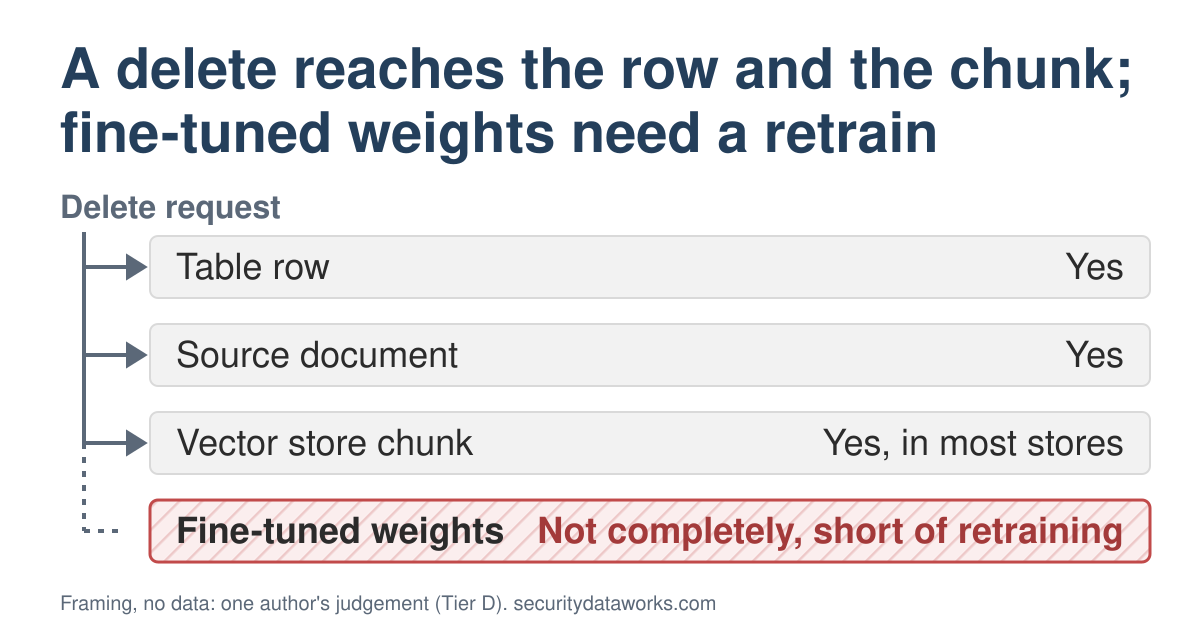
The regulator part of the opening question usually arrives as a deletion request, and the panel below is one way to show what changes when the record has been through a fine-tune. The cells are a judgement (Tier D), and the warehouse row is less simple than "yes" suggests, as the deletion-vectors piece works through for Iceberg.
| Where the person's record lives | Does deletion reach it? | What it takes |
|---|---|---|
| A warehouse or lakehouse table row | Yes | The delete, then compaction and snapshot expiry before the bytes are gone |
| A source document | Yes | Deleting the document and the copies made from it |
| A chunk in a vector store | Yes, in most stores | Deleting the chunk and its embedding, and reindexing where the store requires it |
| Fine-tuned weights that memorized it | Not completely, short of retraining | Retraining without the record; no study cited here measures removing one named record from a fine-tune, and the nearest benchmark, of methods that reduce personal-data leakage overall, topped out around 40 percent |
The last row has the nearest thing to a measured number behind it, though it measures something adjacent. Szep and colleagues benchmarked four privacy methods on fine-tunes (differential privacy, machine unlearning, regularization and preference alignment), and even the most effective, differential privacy, which is applied during training and not after a request, reached only around a 40 percent reduction in direct memorization of personal data in their multi-seed evaluation on Llama 3.2 1B (EACL 2026; Tier A). That is leakage reduced across a whole fine-tune and says nothing directly about removing one named person's record, so retraining without the record is the only complete remedy in the work cited here. A deletion process that names the tables and documents holding a person's data should therefore also name the models trained on them, even where the only remedy is retraining on a schedule, and that list is only possible if the lineage record from the previous section exists.
Safety
The derivative is a new model
The second change a fine-tune makes is to safety behaviour, and the evidence here is narrower than the memorization record but harder to ignore. Qi and colleagues showed that fine-tuning GPT-3.5 Turbo on ten adversarially designed examples, for under $0.20 through OpenAI's fine-tuning API, made it responsive to nearly any harmful instruction, and, closer to most enterprises, that fine-tuning on benign and commonly used datasets also degraded safety alignment, though to a lesser extent, with GPT-3.5 Turbo's harmfulness rate rising from 5.5 to 31.8 percent after one epoch on the Alpaca instruction set in the arXiv version's table (ICLR 2024; Tier A). Betley and colleagues fine-tuned GPT-4o to write insecure code without saying so and found the result gave misaligned answers to unrelated questions 20 percent of the time on their selected evaluation questions and 6 percent on the questions they pre-registered, against 0 and 0.1 percent on the same two question sets for the control fine-tunes on secure code and on the same insecure code requested for a security class, so in their experiment the shift tracked what the training data taught, with inconsistent behaviour across samples and a variant where the misalignment appeared only when a trigger was present (ICML 2025; Tier A). Neither study used enterprise data, and the benign-data effect in Qi's work is smaller than the adversarial one, so read together they say that a fine-tune can lose some of the base model's safety behaviour without anyone intending it, and the size of the loss for a given fine-tune is something only its own evaluation can say.
Safety · what a fine-tune did to two base models
The practical consequence is about how a fine-tuned model gets accepted, because a base model's safety evaluation, which is often what a model card or a vendor offers, says little about the derivative, so the fine-tuned model needs its own evaluation before it is registered, and where the same weights are served in two places the result can differ, since a managed platform may put its own filters in front of a hosted fine-tune while a self-hosted copy of those weights may have nothing in front of it, which is an inference from how the two deployments differ rather than something the studies above tested. On Azure, for one, the fine-tuning service documents a preview step that evaluates the trained model for harmful output before it can be deployed (Tier B for what the feature does), which covers part of this on that platform, though it keeps only a deployable-or-not result, tests harm categories at thresholds the customer can't change and says nothing about memorization, so it doesn't replace an evaluation the team can read and keep, and a copy of the weights served anywhere else gets none of it. Bedrock, Vertex AI and OpenAI's own fine-tuning service weren't checked for an equivalent.
Controls
Classify, test, log
None of what follows is exotic, and most of it is existing data-governance practice pointed at a new kind of asset, which is why I think it's achievable for a team that already runs a data platform. ATLAS v2026.10 gives the privacy side its own technique, AML.T0137 Training Data Information from AI Models, with Infer Membership (.000, rated Feasible) and Extract Memorized Data (.003, rated Demonstrated) beneath it, and the controls map onto its mitigations and CoSAI's.
- Classify the model as its data. Give each fine-tuned model, its checkpoints, its adapter files and its training logs the classification of its training set, and store them where that class of data is allowed to live (ATLAS AML.M0005 and AML.M0019; CoSAI Model and Data Access Controls, Model and Data Inventory Management).
- Record provenance and shrink the set. Record which dataset version went into each run, deduplicate before training, and strip or pseudonymize identifiers the task doesn't need (AML.M0025, AML.M0007; CoSAI Training Data Management, Training Data Sanitization). Deduplicating pre-training data cut memorized output tenfold in Lee and colleagues (ACL 2022; Tier A), and keyed pseudonymization cut the exposure of the original identifiers by 40 to 61 percent in the CSIRT study above (Tier A), though Szep's result on input-only personal data means deduplication reduces exposure without removing it.
- Use privacy-preserving training where the data warrants it, with eyes open. Differential-privacy fine-tuning gives a formal bound for the unit it protects (AML.M0041; CoSAI Privacy Enhancing Technologies for Model Training), but the CSIRT study saw no measurable reduction beyond what fewer optimizer updates already gave, and Szep found it can make training unstable, so I'd treat it as one control among these and not as the whole answer. M0041 is also among the 18 of ATLAS's 44 mitigations that have no edge to CSF 2.0 in a parse of NIST's IR 8596 draft bridge file (Tier B), so a programme driven from CSF will not be prompted for it.
- Test for extraction and membership before release. Plant canaries in the training set and try to recover them from the trained model, which is the method the Secret Sharer paper proposed as a practical first line of defence (Carlini and colleagues, USENIX Security 2019; Tier A), score the result as a rank over all possible secrets and on near matches as well as exact hits, since a filter that blocks verbatim regurgitation still leaked training data through minimally modified prompts (Ippolito and colleagues, INLG 2023; Tier A), and run more than one training seed, since per-record membership verdicts can flip with training randomness (Hayes and colleagues; Tier A). The mappings here are AML.M0035 and CoSAI Adversarial Training and Testing.
- Evaluate the derivative's safety. Run a safety evaluation on the fine-tuned model itself and keep the result with the model in the registry (AML.M0008).
- Pin the pipeline. Pin base-model and adapter digests, load adapters only in safetensors format, pin training libraries, and run the job with credentials scoped to its one dataset (CoSAI Secure-by-Default ML Tooling, Model and Data Integrity Management).
The detections that follow are ordinary ones aimed at a new asset: a checkpoint or adapter read by a principal that is neither the training identity nor the serving identity, a model artifact copied out of its storage location, a registry promotion with no safety-evaluation record attached, and, as a weak and untested signal, a burst of near-identical prompts against a fine-tuned endpoint. Each of those needs object-level access logging on the dataset and checkpoint buckets, and on AWS, for one, CloudTrail's documentation says trails do not log data events such as S3 object reads by default and that additional charges apply when they do (Tier B), so the first piece of work is often confirming that the logs exist at all.
Limits
Limits of this argument
Falsifiers
What would change my mind
- An enterprise-shaped fine-tune, with templated near-duplicates, planted canaries and a membership probe across several seeds, that shows no recoverable canaries and membership AUC near chance against a deduplicated control would move the planning rule from "treat it as the data until tested" toward "test a sample of fine-tunes", and a run that shows recovery would make the test a release gate without exception.
- Managed fine-tuning platforms recording the dataset version and a weights digest on the job and on the registered model, and OCSF adding a training-job class or a weights digest on
ai_model, would close most of the lineage gap without the organization building its own record. - An unlearning method that reliably removes a named record from a fine-tuned model at a measured rate close to retraining would change the deletion panel's last row.
Bottom line: a model fine-tuned on an organization's own records may hold those records in a form the data controls can't read and may have lost some of its base model's safety behaviour, and because neither is knowable without testing that model, I'd classify it with its training data, keep the lineage from weights digest to dataset version myself, and make an extraction test and a safety evaluation part of registering it. The next piece turns from the models an organization holds to the logging and controls it already licenses and hasn't switched on.
Sources
| # | Source | What it supports | Tier |
|---|---|---|---|
| 1 | Lab run T6, "Fine-tune memorization of planted canaries", 2026-11-10, sdw-lab-benchmarks/t6-finetune-memorization | 0 of 1,510 extraction attempts per checkpoint, against a pre-registered prediction of extraction at fifty copies; rank 3,011 to 337; perplexity 43.9 to 2.5; what the run did not measure | First-party measurement, partial (one seed of three), independently re-run in part |
| 2 | Carlini et al., "Extracting Training Data from Large Language Models", USENIX Security 2021 | Hundreds of verbatim sequences from GPT-2, some from a single document | A |
| 3 | Carlini et al., "Quantifying Memorization Across Neural Language Models", ICLR 2023 | Memorization grows log-linearly with model size, duplication and context | A |
| 4 | Nasr et al., "Scalable Extraction of Training Data from Aligned, Production Language Models", ICLR 2025; arXiv 2311.17035 for the 150x figure | Alignment does not remove memorization | A |
| 5 | Mireshghallah et al., "An Empirical Analysis of Memorization in Fine-tuned Autoregressive Language Models", EMNLP 2022 | Head-only fine-tuning most exposed; small adapters less so | A |
| 6 | Zeng et al., "Exploring Memorization in Fine-tuned Language Models", ACL 2024 | Memorization differs strongly across fine-tuning tasks | A |
| 7 | Szep et al., "Unintended Memorization of Sensitive Information in Fine-Tuned Language Models", EACL 2026 | Input-only personal data memorized; repetition explains under 24% of variance (one model, dataset and seed); best of four methods, differential privacy, about 40% reduction in aggregate leakage on Llama 3.2 1B; DP instability | A |
| 8 | Wang and Li, "Leaner Training, Lower Leakage: Revisiting Memorization in LLM Fine-Tuning with LoRA", arXiv 2506.20856 | Duplication and scale trends differ under LoRA | B (preprint) |
| 9 | Kapelinski and Kreutz, "Decomposing Memorization Reduction in Privacy-Preserving Fine-Tuning of SLMs for CSIRTs", BRACIS 2026 (LNCS), arXiv 2606.28479 | Fewer optimizer updates account for the measured reduction; DP no further measurable reduction; pseudonymization 40 to 61%; F1 0.19 to 0.28, not operationally useful at the tested budget | A |
| 10 | Kandpal, Wallace and Raffel, "Deduplicating Training Data Mitigates Privacy Risks in Language Models", ICML 2022 | Ten copies regenerated about 1,000 times more often than one | A |
| 11 | Lee et al., "Deduplicating Training Data Makes Language Models Better", ACL 2022 | Deduplicated models emit memorized text ten times less often | A |
| 12 | Duan et al., "Do Membership Inference Attacks Work on Large Language Models?", COLM 2024 | Membership inference near random on pre-training data | A |
| 13 | Hayes et al., "Exploring the limits of strong membership inference attacks on large language models", NeurIPS 2025 | AUC under 0.7 on pre-trained models; per-record verdicts unstable across training runs | A |
| 14 | Fu et al., "Practical Membership Inference Attacks against Fine-tuned Large Language Models via Self-prompt Calibration", NeurIPS 2024 | Membership AUC on fine-tuned models from about 0.7 to about 0.9 | A |
| 15 | Carlini et al., "The Secret Sharer", USENIX Security 2019 | Canary testing as a practical first line of defence | A |
| 16 | Qi et al., "Fine-tuning Aligned Language Models Compromises Safety, Even When Users Do Not Intend To!", ICLR 2024 | Ten examples under $0.20 remove safety; benign data degrades it less (GPT-3.5 Turbo 5.5% to 31.8% harmfulness rate on Alpaca, arXiv Table 3) | A |
| 17 | Betley et al., "Emergent Misalignment: Narrow finetuning can produce broadly misaligned LLMs", ICML 2025 | 20% (selected) and 6% (pre-registered) misaligned answers against 0% and 0.1% for control fine-tunes; trigger-conditioned variant | A |
| 18 | Liu et al., "LoRATK: LoRA Once, Backdoor Everywhere in the Share-and-Play Ecosystem", Findings of EMNLP 2025 | A backdoor LoRA merged into task adapters without retraining | A |
| 19 | CoSAI risk map, secure-ai-tooling at 622605a1 | Component names; riskAdapterPEFTInjection with no ATLAS mapping; control names | A in the sense of primary files read at a pinned commit; working-group content, not a ratified standard |
| 20 | MITRE ATLAS v2026.10 | AML.T0137 and children, AML.T0020, AML.T0018.000, mitigation IDs | A |
| 21 | OCSF schema v1.9.0 | ai_model attributes; no training-job class | A |
| 22 | Hugging Face, security incident post, 2026-07-16 | Intrusion entered through the dataset-processing pipeline | B (first-party) |
| 23 | Bedrock, Azure and Vertex AI fine-tuning documentation, read 2026-11-09 | Training jobs recorded as control-plane events; no model-to-row lineage found | B |
| 24 | AWS CloudTrail User Guide, "Logging data events", read 2026-11-16 | Data events not logged by default; additional charges | B |
| 25 | NIST IR 8596 initial public draft, ATLAS-to-CSF 2.0 bridge file, parsed by Security Data Works | M0041 among 18 mitigations with no CSF edge | B |
| 26 | PETA: Parameter-Efficient Trojan Attacks, arXiv 2310.00648; ICLR 2024 workshop (Secure and Trustworthy LLMs) | Trojans that persist through parameter-efficient fine-tuning | B (non-archival workshop) |
| 27 | Kandpal et al., "User Inference Attacks on Large Language Models", EMNLP 2024 | Inferring whether any of a user's data was in a fine-tune, at times near-perfectly | A |
| 28 | Ippolito et al., "Preventing Generation of Verbatim Memorization in Language Models Gives a False Sense of Privacy", INLG 2023 | Verbatim filters miss leakage through minimally modified prompts | A |
| 29 | Microsoft Learn, "Safety evaluation for fine-tuning (preview)", ms.date 2026-07-31, read 2026-11-16 | Pre-deployment harm evaluation of fine-tuned models; only deployable-or-not persisted; fixed thresholds | B (what the feature does) |
