
AI attack surface · Part 13
Turn on before you buy
Amazon's documentation for Bedrock says in so many words that "Model invocation logging is disabled by default", Google's says the Data Access audit logs on its agent platform "are disabled by default and aren't written unless explicitly enabled", and Gemini Enterprise replaces prompt and response text with <elided> until an administrator turns a setting on. None of that is hidden, since each vendor documents the switch plainly, but read together the pages describe the state many AI features arrive in, where the feature exists, the licence may already cover it, and the record that would give a defender the evidence is switched off, scoped to a subset or kept in the vendor's window until someone decides otherwise.
Before deciding what AI-security product to buy, it is worth asking what not to buy yet. What each AI surface emits today graded each deployment surface twice, on the best per-interaction record a defender can get and on the one it ships with, and What the tools you already own can see graded fourteen categories of incumbent tooling against the 42 components in CoSAI's risk map. This piece takes the feature view underneath both: the specific switches in incumbent platforms that close the distance between a surface's default grade and its best one, what each switch produces, where its licence line sits and whether it is still in preview, all read at the vendor's own documentation on 16 November 2026. My working view is that much of what a team needs for AI governance may already be licensed but switched off or half-configured, which is a hypothesis rather than a measurement (Tier D), and on this series' own grades the documented switches would lift 18 of the 42 components from their default record to their best one, so the rest of this article tries to say how far the public documentation supports that view and where it stops.
Reading time: about 20 minutes. Evidence tier: B for what each feature does, its default, its status label and its licence line, from the vendor's own pages read on 2026-11-16, apart from a few table cells marked as carried from an earlier read on 9 November; C for anything about how well a feature works; D for the turn on, evaluate and wait bands and for the component count, which research agents drafted from a fixed rule and from the series' own grades, without a second reader.
The count
How much of the map a switch reaches
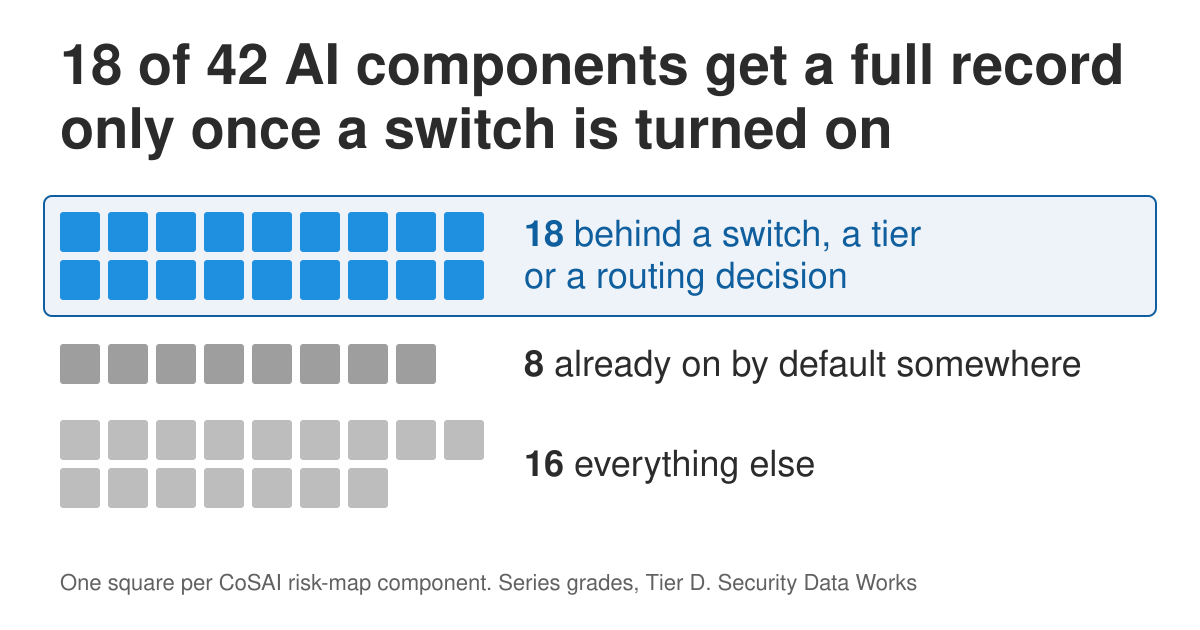
The number that sizes the opportunity is how many of CoSAI's 42 components reach a full-grade record only through a source whose default is worse than its best, and on the series' current grades the answer is 18, with 3 more that depend on a platform's RAG record.
| What the telemetry grades say about a component | Components | Examples |
|---|---|---|
| A full-grade record that is already on by default somewhere | 8 | the agent user query, the identity provider, the application, the audit record store (mostly through the enterprise assistants' audit logs and Security Copilot's) |
| A full-grade record only behind a switch, a tier or a routing decision | 18 | model serving, model registry, memory, runtime and tool hosting (managed platforms); the isolation runtime and agent consent surface (coding agents); the tool registry, tool server and tool transport (MCP); the two network enforcement points (gateways); the application consent surface (a vendor's agent browser) |
| A full-grade record only through a platform's RAG audit record, which is on by default on some platforms and needs enabling on others | 3 | data sources, data storage, agent input handling |
| Partial records only, at any setting | 8 | training data, the model itself, model storage, application input and output handling, the orchestration output stage |
| A lab measurement only | 1 | the authorization decision point |
| No telemetry row at all | 4 | model evaluation, model frameworks and code, agent output handling, the tool network enforcement point |
Counts from a script over the series' coverage data at Part 4's current grades, run 2026-11-16; the 18 and 3 together are the 21 components that The SAIF coverage map shows getting a full-grade record only once something is turned on. Grades and counts are Tier D.
So configured, the switches the series already documented would move the default grade to the best grade on 18 of the 42 components, a little under half the map, and on 21 counting the three that ride on a RAG platform's record. I'd read that number with three qualifications attached, because each one changes what it means:
- "Switch" is generous for some of the 18, since the two network enforcement points reach a full-grade record only when traffic is routed through a gateway, which is an architecture decision, and several coding-agent components reach their best grade only on an Enterprise tier for some products, which is a purchase.
- Moving a default grade to a best grade means the record exists and lands somewhere a defender can read it, and says nothing about whether a detection would fire on it; nothing in this article moves a cell to verified, because only a lab run does that.
- This is a count of components on a map, so it is a different kind of number from my sense of how much of what a team needs is already there, and I wouldn't set the two side by side as if one confirmed the other.
The switches
What is already there, by what it produces
The table below lists the switches I'd look at first, grouped by what each one produces rather than by vendor, because the useful question for a security team is which record it is missing. The examples lean on Microsoft, Google and AWS because their documentation is the most complete public record of these features, which says something about the documentation and ranks nobody, and nothing here says how well any feature works or assumes a given organization runs any of these products. Whether a feature sits inside a tier you already hold is a check against your own contracts.
| Switch | What it produces | Default, read 2026-11-16 | Licence line | Band |
|---|---|---|---|---|
| Content and interaction records | ||||
| Amazon Bedrock model invocation logging | Request and response bodies, model id and caller principal for runtime calls, to S3 or CloudWatch | "disabled by default"; calls through bedrock-mantle not captured | S3 or CloudWatch charges inside the account | Turn on |
| Bedrock data events in CloudTrail | Knowledge-base Retrieve and RetrieveAndGenerate, and ApplyGuardrail evaluations, as CloudTrail data events | Runtime calls are management events, logged by default without content; data events need advanced event selectors | CloudTrail data-event charges | Turn on |
| Data Access audit logs on Google's agent platform (formerly Vertex AI) | An audit record for generateContent, predict and rawPredict calls | "disabled by default" until explicitly enabled | Cloud Logging charges | Turn on |
| Gemini Enterprise usage audit logs | Per-interaction log entries, with prompt and response text | Text values replaced with <elided> until the prompt-and-response setting is on; logs land in the _Default bucket | Gemini Enterprise licence (carried from the 2026-11-09 read), Cloud Logging charges | Turn on, where Gemini Enterprise is held |
Microsoft Purview Audit, CopilotInteraction | Interaction records for Microsoft's Copilots and for agents built in Copilot Studio and Foundry, with no prompt text in the record | Logged as part of Audit (Standard), retained 180 days | Audit (Standard); longer retention through Audit (Premium) or a retention policy | Turn on (confirm it, and export before day 180) |
| Claude Code telemetry | OpenTelemetry metrics and events from the coding agent, with prompt content as a separate opt-in | Off until CLAUDE_CODE_ENABLE_TELEMETRY=1; prompt content "Redacted by default" until OTEL_LOG_USER_PROMPTS=1 | Configuration and a collector you run | Turn on |
| Cloudflare AI Gateway logging | Per-request logs for traffic routed through the gateway, bodies included unless a header drops them | "Logs are enabled by default for each gateway" | AI Gateway "Available on all plans" | Turn on, for traffic already routed |
| Databricks inference tables | Request and response payloads with the requesting user or service principal, in Unity Catalog tables | Configured by hand per model service; rows can take up to an hour to appear | "a billed Unity Gateway feature" | Turn on, where model serving is in use |
| Inventory | ||||
| Defender for Endpoint local AI agent discovery | An inventory of local agents with their configured MCP servers, the start command of each local server and an auto-approve flag, in the AgentsInfo table | "agent discovery begins automatically" once prerequisites are met | Defender for Endpoint Plan 2; the risk view needs Microsoft 365 E7, or Agent 365 with Plan 2 | Turn on (inventory); evaluate (risk view) |
| Entra Agent ID | An identity type for agents, with their authentication "logged in Microsoft Entra ID" | "available for all Microsoft Entra customers" | Extending Entra's security features to agents "requires Microsoft Agent 365" | Turn on (inventory); evaluate (controls) |
| Okta AI agent discovery | Discovered agents with their "ownership and permissions" and the resources they can affect | Not stated on the page | Included with either Identity Security Posture Management or Okta for AI Agents | Turn on, where either is held |
| Purview audit for non-Microsoft AI apps | AIAppInteraction records for third-party AI apps, retained 180 days | Off until pay-as-you-go features are enabled | Pay-as-you-go billing | Evaluate |
| Policy and scope | ||||
| Copilot Studio governance | Data policies on agent features, a tenant switch to stop publishing generative AI agents, maker audit logs in Purview | Data policies apply once an admin creates them | Power Platform admin center; Entra network controls for agents need Agent 365 | Turn on; evaluate (network controls) |
GitHub Copilot MCP allowlist in managed-settings.json | An enterprise-enforced list of the MCP servers developers may use | Off until set | Copilot Business or Enterprise (carried, not re-read) | Turn on |
| Gemini app in Google Workspace | Per-group availability of the assistant | On by default for licensed users over 18 | "a license that provides access under your Google Workspace agreement" | Turn on (review the scope) |
| GitLab Duo | Per-instance, group and project control over AI features | "on by default"; Duo Core is on automatically for new customers on 18.0 or later and must be turned on by customers from 17.11 or earlier | Premium and Ultimate, with add-ons | Turn on (review the scope and lock it) |
| Logged classifier decisions and findings | ||||
| Amazon GuardDuty AI Protection | Three finding types for anomalous model invocation, token-volume cost harvesting and direct prompt injection | A separate protection plan you must enable; an organization's delegated administrator can auto-enable it for new accounts | Billed on the CloudTrail data analysed | Turn on, where GuardDuty is held (the injection finding depends on Guardrails) |
| Bedrock Guardrails enforcement across an account or organization | A guardrail applied to every model invocation in scope, with its evaluations as CloudTrail data events | No guardrail applies until one is attached per request or enforced (carried) | Metered per use (rate not re-read) | Evaluate (classifier) |
| Model Armor | Prompt and response screening, with the decision in Cloud Logging SanitizeOperationLogEntry records | CSAM detection on by default in floor settings; content not stored unless platform logging is configured | Standalone, or as part of Security Command Center | Evaluate (classifier) |
| Defender for Cloud AI threat protection | Runtime alerts on Azure OpenAI and Azure AI Model Inference traffic; connected AWS accounts not covered | The plan has to be enabled (carried from the 2026-11-09 read) | Defender for AI Services plan, with a 30-day trial capped at 75 billion tokens | Evaluate (classifier) |
| Cloudflare AI Security for Apps | Detection fields for prompt injection, PII and unsafe topics on endpoints you serve | Endpoint discovery on every plan; detection off until enabled | Detection fields and Log Mode are an Enterprise paid add-on | Evaluate |
| Posture | ||||
| AWS Security Hub CSPM "AI Security Best Practices" v1.0.0 | 31 configuration checks across Bedrock, AgentCore and SageMaker | Not among the standards Security Hub enables by default | Security Hub CSPM | Turn on, where Security Hub is held |
| Defender CSPM AI security posture | Discovery and posture recommendations for AI resources | The plan has to be enabled (carried); AI agents are labelled Preview | Defender CSPM; since 1 July 2026, agent discovery and posture require Agent 365 | Evaluate; wait (agents) |
| Security Command Center AI Protection | AI asset discovery and findings in Google Cloud | Some detectors on automatically, others configured by hand | AI Discovery is documented for Premium; the page's note on Standard implies a reduced form there | Evaluate |
Defaults, status labels and licence lines from each vendor's own documentation, read 2026-11-16 (Tier B for what the feature does), except the cells marked carried, which rest on an earlier read of 9 November. Bands are Tier D, a judgement against a fixed rule, and nothing in the table says how well a feature works.
Three things stand out to me in that table:
- On the platforms that host or broker the model, the content record is usually the one that's off. Bedrock, Google's agent platform, Gemini Enterprise and Claude Code all ship the record that holds what was asked and answered disabled, redacted or elided, while the audit trail of settings, seats and management calls tends to be on, which matches what Part 4 found surface by surface; Cloudflare's gateway is the exception that logs bodies unless told not to, and only for traffic routed through it.
- The cheapest rows to act on are not all "turn it on", since several are already on by default, Purview's Copilot audit and Cloudflare's gateway logs among the records, and the Workspace Gemini app, GitLab Duo and Defender for Endpoint's discovery among the features, and the work on those is to read the scope that someone else chose, decide whether it is the one you want, and get the record out of the vendor's window.
- The incumbents now ship three of the five things What the new AI vendors deliver counts as the deliverable core of the newer market, an inventory of AI apps and agents within the sources the platform can reach, an identity type for agents and a classifier in front of the model that logs its decision, and they add an audit record for agent actions in the platform's own vocabulary; I didn't find change detection on tool manifests or model-file scanning in the incumbent pages read for this article.
None of these rows documents native OCSF output on the pages read, and the one that speaks OpenTelemetry, Claude Code, exports its own claude_code.* event and metric names alongside some gen_ai.* attributes from conventions the OpenTelemetry project still lists as in development, so the work of normalizing them into typed identity, model and tool-name columns is the same whether the feature came with a platform you already run or with a product you buy next quarter, and Who bought whom and Part 15 take up the buying side of that comparison.
Keeping what these switches produce can cost less in object storage than the SIEM bill suggests. What to keep when the agent did it priced a year of full prompt text for 1,000 coding-agent users at about $20 to $79 a month on S3 Standard at average volume on its pre-registered grid, with the caveat that the same content sent to a SIEM at ingest pricing is a different and much larger bill, so the plan that piece argues for is landing the content in a store you own and sending the SIEM a projection.
The licence line
Where the switch is a purchase
The licence line decides the band more often than the feature does, and the pattern across the families read for this article is consistent enough to plan around. Microsoft has put agent-level posture, risk and controls behind Agent 365, which its own overview describes as "generally available for the Commercial segment on a per user basis", so Entra Agent ID, Defender for Endpoint's agent inventory and Copilot Studio's data policies come with licences an organization may already hold while the risk scoring, the network controls and Defender CSPM's agent discovery since 1 July 2026 need the new licence. Google puts AI Discovery in Security Command Center Premium and sells Model Armor standalone or as part of it, and the Enterprise tier some organizations bought is documented to shut down on 21 May 2027 with an automatic move to Premium, which is a re-decision date in its own right. AWS keeps invocation logging, data events, guardrails and GuardDuty's AI Protection usage-metered inside the account, so the licence question there is mostly whether the bill is acceptable, and Cloudflare puts the gateway on every plan and the detection fields behind an Enterprise add-on.
Licence lines · four vendor families
Where each vendor family draws the licence line for its AI-security features
| Vendor family | No new licence needed | Behind a new licence, tier or add-on |
|---|---|---|
| Microsoft | Entra Agent ID, Defender for Endpoint's agent inventory and Copilot Studio's data policies, with licences an organization may already hold | Agent 365: risk scoring, network controls, and Defender CSPM's agent discovery since 1 July 2026 |
| Security Command Center Standard: the page's note implies a reduced form of AI Discovery there | AI Discovery in Security Command Center Premium; Model Armor, standalone or as part of it; the Enterprise tier shuts down on 21 May 2027 with an automatic move to Premium | |
| AWS | No licence line: invocation logging, data events, guardrails and GuardDuty's AI Protection are usage-metered inside the account, so the question is whether the bill is acceptable | |
| Cloudflare | AI Gateway on every plan | Detection fields: an Enterprise add-on |
For the rows that need a purchase, I'd run the evaluation the same way whether the feature belongs to an incumbent or to a new vendor, with the four questions Part 15 of this series asks of the new market: which sensor, on which surfaces, in what export schema, and evaluated against which adaptive attack set. The classifiers in the table, Bedrock Guardrails, Model Armor, Defender for Cloud's AI threat protection and Cloudflare's detection fields, are where that last question matters most, because a classifier's value rests on how well it holds up against an attacker who moves second, and a vendor's own page can't settle that, which is why every efficacy statement about them stays at Tier C here. The part of a classifier I'd value without an efficacy number is the logged decision, and AWS's GuardDuty page states the design point I'd copy on any platform, which is to "enforce it broadly instead of relying on individual applications to attach it to each request", since a guardrail attached call by call produces no evidence for the calls that skipped it. Bedrock's organization-level enforcement has a qualifier worth reading before relying on it, though, because the page says the effective policy for an account is "not a union of every attachment in the tree", so a guardrail attached higher in the organization is not automatically enforced alongside one attached closer to the account.
The order I'd work in is turn on, then evaluate, then buy, then build, and the reason for it is that each step is cheaper, quicker to reverse and asks less of the organization than the next, so a gap moves to the next step only once the current one has been shown not to reach it. A toggle costs administrator time and reverses with another toggle; an evaluation is a time-boxed test in your own tenant; a purchase adds a contract and a renewal; and a build adds a system that someone has to own for as long as it runs, which Every custom tool gets a high priest takes up. The inventory that feeds the first step needs three columns kept apart, because they fail separately: what the organization is entitled to, with the renewal date; what that tier makes available, GA or preview, as of a date; and what is actually enabled in the tenant, read from the admin console on a date. The table above is mostly about the gap between the second column and the third, and it is also why "we have the Copilot logs" needs the follow-up question of which record, the audit trail or the content.
The order · cheapest and most reversible first
Turn on, then evaluate, then buy, then build
A practitioner ordering for closing an AI-security gap.
| Step | What it takes |
|---|---|
| 1. Turn on | administrator time; reverses with another toggle |
| 2. Evaluate | a time-boxed test in your own tenant |
| 3. Buy | a contract and a renewal |
| 4. Build | a system someone owns for as long as it runs |
A gap moves to the next step only once the current one has been shown not to reach it.
The calendar
What to wait for
The preview layer is best read as a calendar of re-decision dates rather than a shopping list, since a preview with no GA date is a vendor's promise and nothing in a plan should depend on one. On the pages read on 16 November, the features still labelled preview or pre-GA were Google's request-response logging on its agent platform, which an earlier read on 9 November found is the only documented path on that platform to prompt and response content and which an organization can still switch on today if it accepts Pre-GA terms; Security Command Center's Agent Platform Threat Detection, Agent Platform Vulnerability Assessment and Notebook Security Scanner; Defender CSPM's AI agent coverage; GitHub's registry-based MCP allowlist, which GitHub's own page calls "not the recommended method"; and the macOS entries for VS Code extensions in Defender for Endpoint's agent inventory.
The calendar moves in both directions, which is the reason to keep the read date beside every row. Between reads on 9 and 16 November, Model Armor's image screening lost the Preview label it carried, so it leaves this list, and CrowdStrike's AI Detection and Response, which CrowdStrike's March announcement described as pre-beta for desktop AI applications, now has documentation saying it "reaches end of support on November 30, 2026" with its capabilities continuing in Falcon Guardian, which CrowdStrike's 3 November release describes as generally available since September 2026, with the network inspection part GA on Windows and in early access on macOS. Microsoft Sentinel's connector reference now lists a Microsoft Copilot logs connector and an Agent 365 connector, with no preview or GA label beside either, so I'd treat their status as unstated until a page says otherwise.
What to wait for · dated re-decisions
Four dated changes, and previews with no date to plan on
Still labelled preview on 16 November, with no GA date
- Google's request-response logging on its agent platform
- Security Command Center's Agent Platform Threat Detection
- Security Command Center's Agent Platform Vulnerability Assessment
- Security Command Center's Notebook Security Scanner
- Defender CSPM's AI agent coverage
- GitHub's registry-based MCP allowlist
- The macOS entries for VS Code extensions in Defender for Endpoint's agent inventory
Between the 9 and 16 November reads, Model Armor's image screening lost its Preview label, so it left this list.
On is five things
What turned on has to mean
A feature that's enabled is not yet a control, and the reason the method in this series checks five things is that each of them is a place where the record can stop before it reaches a defender. I'd audit each feature as a pipeline, scoring it at the highest state at which every earlier state is a yes:
- Enabled: the toggle, policy or diagnostic setting is on, confirmed on a date.
- Scoped: it covers the users, devices, accounts and regions that matter, which for Bedrock means knowing that calls through
bedrock-mantlefall outside invocation logging whatever the toggle says. - Exported: the record leaves the vendor's window and lands in a store you own with a retention you chose, before 180 days in Purview Standard or 30 days in Cloud Logging's default bucket.
- Alerted: a rule consumes the record and has fired at least once on a planted event, ideally with a variant, since a single planted event shows that a rule can fire rather than that it holds.
- Owned: a named role owns the configuration and the response, written down somewhere a successor will find it.
So a feature that is exported but not scoped scores at enabled, which looks harsh, but the series keeps finding records that exist for some users on some endpoints and sit in a vendor's 30-day window, and a coverage view that calls that "logged" is describing what the vendor's page offers and not what the team can query. For AI surfaces there is one more check I'd fold into scoped, which is whether the record carries identity, model, tool name and content in typed fields, because a content table with no caller-identity column, as Google's request-response logging documents, is enabled and exported and still needs a join before anyone can hunt on it.
On is five things · scoring a feature
The public record doesn't measure how often owned controls sit unconfigured, but several sources point the same way, each measuring something different. The NSA and CISA joint advisory AA23-278A, drawn from red and blue team assessments and incident response work, puts "default configurations of software and applications" first among the ten most common misconfigurations it found, and its third item, insufficient internal network monitoring, opens on host and network sensors that aren't optimally configured for traffic collection and end-host logging, with the caveat that many of the assessed networks were Windows and Active Directory environments (Tier B). Datadog's 2025 cloud data found only 49 percent of EC2 instances enforcing IMDSv2 while 82 percent had used only IMDSv2 for the prior two weeks, a free control that was safe to enforce on most of the fleet and sat off on half of it, and Orca's 2026 report found 80 percent of the SageMaker organizations it sees running with all default settings and 57.1 percent of Bedrock organizations with no guardrails configured; both describe the customer base of a vendor that sells the fix, which is already a population that bought a posture tool (Tier C, bias flagged). And the Center for Internet Security's Community Defense Model v2.0 estimates that its first implementation group of safeguards, the basic ones, defends against 77 percent of the ATT&CK techniques used in the five most common attack types, which is a model over technique mappings that counts no incidents, from a non-profit that also sells membership tooling for assessing configuration against its own benchmarks, which is a different interest from a posture vendor's but still an interest (Tier B). None of those is a measure of how much of an organization's AI-security need its owned tools could meet, and I wouldn't let any of them stand in for one, but nothing in the public record read for this series contradicts the view that owned controls often sit unconfigured.
The residue
What no switch reaches
Configuration moves defaults, and there are parts of the map it doesn't move at any setting. Four components have no telemetry row in the series at all, and there are features that would give three of them a partial record, Bedrock Guardrails' output-side assessments and Model Armor's response screening for agent output handling, Entra's network controls for Copilot Studio agents and API gateway logging for the tool network enforcement point, and Defender's AI security posture scanning for model frameworks and code, most of them in the evaluate band. Model evaluation has nothing, since the one feature found touching it, Security Command Center's Agent Platform Vulnerability Assessment, is still in preview, so model evaluation is blind to every incumbent category and to every telemetry source in the series, and an evaluation harness the team runs itself is the only answer I can see today.
The other residue is positional, which What the tools you already own can see lists in full. The agent-to-tool hop inside a managed platform shows up only as far as the platform exports it, AI inside sanctioned SaaS shares a domain and an identity with the ordinary app, and network-side tools are blind by construction to stdio MCP traffic and to local models with no egress. The endpoint picture is moving faster than that list suggests, though, since Defender for Endpoint now documents an inventory of local agents with the MCP servers configured for them and the command that starts each local one, and the page is candid that "Discovery doesn't prove active use or successful access to an AI service", so a team that already holds Plan 2 may be able to inventory a stdio MCP server it would otherwise not know about, without seeing what the client and server say to each other. For the residue that no switch reaches and no product reaches by position, the series' answer is the join, meaning the work of putting the partial views from the SSE, the endpoint, the identity provider and the code platform into one store on shared keys, which is a data-engineering job on telemetry the team already collects and the one build I'd defend before most purchases.
Limits
Limits of this reading
- The bands are a judgement. The turn on, evaluate and wait classes apply a fixed rule to the 16 November reads, so argue with any row where your contracts or your tenant differ (Tier D).
- The count rests on the series' grades. The 18 and 21 come from a script over grades that nobody has second-read, and they move whenever Part 4's ladder moves. Part 4 now grades the managed platforms' default as C+ on Bedrock, because CloudTrail logs each runtime call with its caller and model by default, and if a later pass lifted that default to B, six managed-platform components would count as already on and the 18 would fall to 12. One open question, whether Copilot Studio's audit record reaches the orchestration output stage, would move that component into the already-on row without changing the 18.
- Documentation describes what a feature does. Every row says what a vendor's page says on one date, which is silent on how the feature behaves in a tenant, and none of it has run in a lab tenant for this article.
- The feature list is partial. This article leaves out rows whose pages weren't re-read on 16 November, among them Defender for Cloud Apps' generative AI catalogue, Zscaler's AI category rule, CrowdStrike's AI Discovery, Cursor's telemetry, LiteLLM's logging and Foundry's diagnostic settings, so a feature missing from the table may simply be one that wasn't re-read.
- Licence lines and labels move. Agent 365's GA date, which the 9 November read carried, is no longer on Microsoft's overview page, and Model Armor's image screening changed status inside a week, so every row is dated and should be re-read before it is acted on.
Falsifiers
What would change my mind
The measurement that would replace my working view with a number is a pre-registered pass over a reference tenant, inventorying the AI-relevant features a held licence entitles, auditing each through the five states and grading the components before and after configuration with no purchase, and that pass hasn't been run yet. If that pass found that configuration moved few components past documented in a real tenant, because the scoping and export states fail far more often than the documentation suggests, I'd argue for buying sooner than this article does. And if the next quarter's reads showed the content records moving behind new licence lines rather than staying inside the platforms' base tiers, the turn-on band would shrink and the evaluate band would grow, which is a reason to repeat the reads on a schedule, since this table describes one week in November.
Bottom line: the platforms an organization may already pay for have shipped audit records, agent inventories and logged classifier decisions across much of the AI surface, and on the series' own grades, configuring the switches documented so far would move the default grade to the best one on 18 of CoSAI's 42 components, with the content record as the switch that is usually off. So before a purchase order goes out, I'd read the scope of what is already on, turn on and export what sits inside a held tier, evaluate the add-ons and classifiers with the same questions I'd ask a new vendor, and keep the preview list as a dated calendar. The next part of the series, Who bought whom, and which sensor they bought, looks at the other side of that decision.
Sources
Sources
| # | Source | What it supports | Tier |
|---|---|---|---|
| 1 | Microsoft Learn: Purview "Audit logs for Copilot and AI applications" and "Auditing solutions"; Defender for Endpoint "Discover local AI agents"; "Microsoft Agent 365 overview"; Entra "What are agent identities?"; Copilot Studio "Security and governance"; Defender for Cloud "AI security posture management" and "AI threat protection"; Sentinel data connectors reference; read 2026-11-16 (cells marked carried in the table rest on the 2026-11-09 read) | Microsoft rows, Agent 365 licence line, Sentinel connector listing | B |
| 2 | Google Cloud: Security Command Center "AI Protection overview"; "Model Armor overview" and "Screen images"; agent platform "Audit logging" and "Request-response logging"; Gemini Enterprise "Set up usage audit logs"; Google Workspace Admin "Turn the Gemini app on or off"; all read 2026-11-16 | Google rows, SCC tier and shutdown date, preview labels | B |
| 3 | AWS: Bedrock "Monitor model invocation using CloudWatch Logs and Amazon S3", "Log Amazon Bedrock API calls using AWS CloudTrail", "Guardrails enforcements"; GuardDuty "AI Protection finding types" and enable pages; Security Hub "AI Security Best Practices standard" and auto-enabled standards; all read 2026-11-16 | AWS rows, enforcement caveat, "enforce it broadly" | B |
| 4 | Cloudflare AI Gateway landing and "Logging"; "AI Security for Apps"; GitHub "Configure MCP server access"; GitLab "Turn GitLab Duo on or off"; Databricks "Inference tables"; Anthropic "Claude Code monitoring"; Okta "AI agent discovery"; all read 2026-11-16 | Gateway, developer-platform, data-platform and identity rows | B |
| 5 | CrowdStrike blog 2026-03-23, press release 2026-11-03 and AIDR documentation, read 2026-11-16 | AIDR pre-beta in March; AIDR end of support and Falcon Guardian GA status | B for status, C for anything else |
| 6 | Security Data Works research on incumbent AI-governance features and on quantifying what you hold (2026-11-09) | Classification rule, feature set, the five-state audit | D (bands and method) |
| 7 | Coverage recount over the series' SAIF/CoSAI coverage data, with Part 4's ladder applied, run 2026-11-16 | 18 components (21 with three RAG-dependent ones), 8 already on, 8 partial, 1 lab measurement only, 4 with no row | D |
| 8 | What each AI surface emits today | Best and default grades per surface; retention windows | D for grades, B for facts |
| 9 | What the tools you already own can see | Category grades; misses by position | D |
| 10 | What to keep when the agent did it | About $20 to $79 a month to keep a year of full prompt text for 1,000 coding-agent users in object storage | First-party measurement, as carried there |
| 11 | NSA and CISA, "NSA and CISA Red and Blue Teams Share Top Ten Cybersecurity Misconfigurations", AA23-278A, 2023-10-05 | Default configurations first of ten; sensor configuration third | B |
| 12 | Datadog, State of Cloud Security 2025 | IMDSv2 enforced on 49 percent of instances, 82 percent IMDSv2-only | C (vendor telemetry) |
| 13 | Orca Security, 2026 State of AI Security report | 80 percent of SageMaker organizations on all default settings; 57.1 percent of Bedrock organizations without guardrails | C (vendor telemetry, sells the fix) |
| 14 | Center for Internet Security, Community Defense Model v2.0 (2021) | Implementation Group 1 against 77 percent of techniques in the top five attack types | B |
