
Agent telemetry
OCSF already has the AI-agent objects. Where your agent's tool call lands decides whether you can query it.
If a team decided tomorrow to log what its AI agents do, the first practical question is what one agent's tool call looks like as a stored record. A lab run walked one real MCP tool call through OCSF, OpenTelemetry and OWASP's Agent Observability Standard, counted what each shape kept typed, and timed five hunts over a million synthetic calls in each layout, which put a price on the difference and showed where it comes from.
Reading time: about 15 minutes. Evidence tier: A for OCSF releases and merged pull requests (read 2026-11-16); B for my lab runs (R1, R2, R5, R8 and T8a), each run by an agent session on one machine from a pre-registration it froze and I have not yet reviewed, plus one post-hoc R2 layout, and for the pinned OpenTelemetry, AOS and ACS documents, the CoSAI addendum and vendor documentation on what a feature does; D for the adoption impression and single-author grades, labelled where they appear.
The short version
Three schemas, three shapes for one tool call
Three schemas have each answered what one agent's tool call looks like as a stored record, and their shapes do not agree with each other. A lab run scored five mappings across them: OCSF's main branch, the OCSF #1754 draft class, OpenTelemetry, and the two examples OWASP's Agent Observability Standard (AOS) publishes for OCSF. OCSF has shipped identity and delegation objects in a release, and the tool-call object, which was only on its main branch when the run was made, shipped in 1.10.0 on 2026-11-20. OpenTelemetry has the richest span model, and every GenAI and MCP attribute the mapping used is marked Development. AOS reuses an existing OCSF class and puts most of the agent-specific facts into unmapped, which is the context-collapse failure this site has already measured for ordinary sources in the flattening essay, and the AOS records, which pass the released OCSF validator with zero errors, are also the ones that leave most of the facts the run counted inside a JSON document a query engine has to parse.
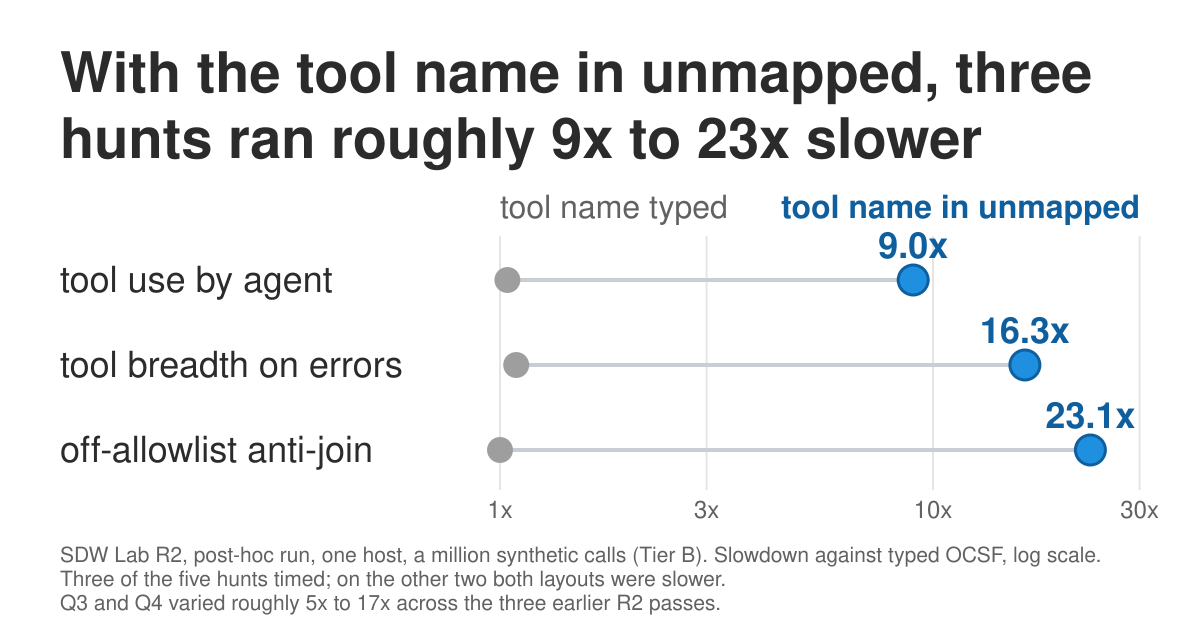
Whether that costs anything at query time depends on which of AOS's two examples a producer follows, because the price lands on the hunts only when the tool name and session go into unmapped with everything else. Over a million synthetic calls, the example that does that ran roughly 8x to 23x slower than the example that types them on three of the five hunts timed (tool use by agent, tool breadth on errors and an off-allowlist anti-join), and the typed example ran level with typed OCSF on those three (a post-hoc timing, described below), so I think the shape a record lands in does decide whether anyone can query it later, and the cost comes from one specific part of the shape. The control this feeds, AI Telemetry Logging and Monitoring (AML.M0024), is the one row on the ATLAS mitigations page whose efficacy column reads "Detection supported, conditionally", and it is the ATLAS control that is squarely a data problem, reaching 21 of the 290 steps in the 27 incident case studies of ATLAS v2026.10 in my own unpublished step-level burn-down (Tier B). The rest of this piece walks one real MCP tools/call through each mapping, counts what survives, and prices the difference.
Versions
What OCSF actually has today
It is worth being exact about versions here, because the OCSF AI work has moved in three steps since March and a fair amount of what I read about it is one step behind. The ai_operation profile and the ai_model object first shipped in the 1.8.0 release of 2026-03-18 (#1488, merged in December 2025), where the profile was attached to API Activity, Datastore Activity and Process Activity. The 1.9.0 release of 2026-08-03 added the ai_agent object (#1641), the IAM delegation object (#1665), and prompt_text and response_text on message_context (#1674), and it moved ai_operation up to the system, network, application and IAM category base classes (OCSF releases, merged PRs and the class files at both tags, read 2026-11-16, Tier A as the standards body's own record). Since then main, versioned 1.10.0-dev, has merged ai_capability (#1729, 2026-10-07), which carries MCP primitive metadata, and ai_status (#1704, 2026-10-13), which carries stop reasons and permission results, and it kept moving after the lab run pinned it, with a uuid on ai_agent (#1810) and AI-agent-only evidence artifacts (#1796) both merged in the week of 2026-11-10. On the main branch pinned for the lab run (d1cbd61, 2026-11-09), the ai_operation profile lists six attributes: ai_agent, ai_capability, ai_model, ai_status, delegation and message_context. So "OCSF already has the AI-agent objects" is true in a released schema for who the agent is and whose authority it carries, and, since the 1.10.0 release of 2026-11-20, true in a release for what tool it called as well, and the delegation object is the one I would read first if agents act on a person's behalf, which the delegation piece takes further.
What OCSF does not have is an AI event class. There is no ai category on main, and the place that argument is happening is draft PR #1754, an AI Agent Activity class opened on 2026-09-08 with Tool Use and Stop information objects, seven of whose nine info objects were still empty stubs at the head pinned for the run, 08d6f53, which is still its head as of 2026-11-16 (R8 RESULTS.md and VERIFICATION.md, Tier B). So today an agent's tool call has to ride on an existing class with the profile attached, and API Activity (6003) is the obvious carrier, which is what the AOS page chose.
Dated note, 23 November 2026: OCSF released 1.10.0 on 20 November 2026, and it carries ai_capability (#1729), ai_status (#1704), the uuid on ai_agent (#1810), the AI-agent-only evidence change (#1796) and the per-node delegation scopes (#1705), so the objects this piece describes as main-only are now in a release, while the AI event class is still draft PR #1754 (OCSF 1.10.0 release notes on GitHub and schema.ocsf.io 1.10.0, read 2026-11-23, Tier A). The lab runs below were made against main before that release.
Versions · OCSF's AI objects, March to November 2026
ai_capability) reached a release only with 1.10.0 on 2026-11-20, and the AI event class is a draft, which is why a tool call today rides on API Activity (6003) with the profile attached. Dates from OCSF releases and merged pull requests, read 2026-11-16, with the 1.10.0 release read 2026-11-23 (Tier A).The closest prior work to this essay is a coalition document. CoSAI's Telemetry Cross-Mapping Addendum (Working Draft v0.6, last changed 2026-11-09) maps one field set onto OCSF 1.9.0, OpenTelemetry, CoSAI's own AI Telemetry Framework (AITF) and OWASP AOS, rates OCSF 1.9.0 "partial" for tool-call input and output because it has "no tool object", and notes, as I do below, that coverage "says the publication can carry the field at the pin, not that any producer emits it" (Tier B as a working draft from a standards coalition).
The OTel side is the GenAI and MCP semantic conventions, pinned for the run at commit e6658f1 of the gen-ai registry alongside semconv v1.45.0. Every GenAI, MCP and JSON-RPC attribute the mapping used is marked stability: development, and the only stable ones in the mapping were generic core attributes, network.transport, error.type and the resource's service.name and service.version (R2 ref/, Tier B for what the spec says). AOS publishes its OCSF mapping at aos.owasp.org under "Trace with OCSF", pinned at 9a9bc37 for the run and unchanged in substance when I re-read it on 2026-11-16: it extends API Activity 6003, sets actor.user to a type of "AI Agent" (type_id 99), and places the agent and tool data under unmapped.aos (Tier B). AOS has since been rebranded as the OWASP Agent Control Standard (ACS), whose 0.1.4 release of 2026-10-16 pins OCSF 1.9.0 and moves tool calls to Process Activity (1007) with the tool detail under unmapped.acs and no ai_operation profile, though aos.owasp.org still serves the mapping the run scored with no notice, so what the run measured is the shape a team following the published AOS page would write today, and the run did not score an ACS column (Tier B for what the ACS documents say).
Lab run R2
One tool call, walked through five mappings
The lab run (R2, 2026-11-09) is small on purpose. It sent ten tools/call requests from the MCP Python SDK 2.3.0 client through a stdio tee to an SDK server backed by DuckDB, and captured the 25 wire messages that resulted: the initialize exchange, tools/list, and ten request and response pairs, six of which succeeded and four of which came back with isError: true (a SQL syntax error, a rejected DROP, a missing table and an unknown tool). From those the run built an inventory of 33 facts per call covering protocol, tool, payload, outcome, server, client, the tool's advertisement, timing, and six agent-context facts that the harness supplied because no agent runtime was in the loop. Each mapping was declared in a script that wrote every fact into a record, read it back, and checked every OCSF path against the pinned object definitions and every OTel key against the pinned registries, with zero path failures. An agent session ran it from a pre-registration it froze before any capture, which I have not yet reviewed, and a second agent re-ran every number below on the same host (R2 VERIFICATION.md; Tier B for method, with the few placements that are judgment calls flagged as such in the mapping script).
Two things showed up on the wire before any schema was involved, and both matter for anyone planning collection. The SDK client advertises LATEST_PROTOCOL_VERSION = 2026-07-28 but offered, and the server accepted, 2025-11-25, so the low-level ClientSession.initialize() handshake that this run used does not speak the revision that changed MCP's logging story, though a later lab run (T8a, 2026-11-10 UTC) found that the SDK's high-level Client probes server/discover by default and does adopt 2026-07-28 when the server answers (the MCP piece covers that revision). And the SDK server masks tool exceptions, so the syntax error, the rejected DROP and the missing table all reached the wire as the same string, Error executing tool <name>. The cause never leaves the server process, which means no client-side record in any schema can carry it, and the server's own stderr becomes the only place the real reason lives, which T8a later confirmed for SDK 2.3.0 by finding the raising tool's traceback there.
Here is how the 33 facts landed (R2 results/loss_table.md). The script wrote every fact somewhere, so where a schema's examples have no slot the script parked the fact in unmapped or a custom attribute, which means the Dropped row is zero by construction and the Unmapped row mixes what a spec places there with what it is silent on; for AOS example 2 that is six facts the page puts under unmapped.aos and sixteen it never mentions.
| class | OCSF main (6003 + ai_operation) | OCSF #1754 draft | OTel GenAI + MCP | AOS on OCSF (example 2) | AOS example 1 |
|---|---|---|---|---|---|
| Typed | 24 | 22 | 19 | 11 | 8 |
| Hashed (fingerprint only) | 3 | 3 | 0 | 0 | 0 |
Blob (json_t / any) | 3 | 3 | 3 | 0 | 0 |
| Unmapped / custom | 3 | 5 | 11 | 22 | 25 |
| Dropped | 0 | 0 | 0 | 0 | 0 |
OCSF main types the most because ai_capability has typed slots for the server identity, the transport (transport_id 1 for stdio), the primitive kind, the request id as transaction_uid, and all four MCP tool annotations (is_readonly, is_destructive, is_idempotent, is_open_world). It keeps the tool description and the input and output schemas only as fingerprints, so the text is gone but a change to it is detectable, and its unmapped residue is small: the JSON-RPC version, the server's instructions and its capabilities. That column leans on main, though, since ten of its 24 typed facts and all three hashed ones are ai_capability paths, and on the released 1.9.0 schema the same call would lose those slots, so the annotations, transport, primitive kind and fingerprints would fall to unmapped; I have not scored a 1.9.0-as-released column. The #1754 draft matches main except that it has no api object, so the MCP method and protocol version fall to unmapped. OTel is the only one of the five with a typed JSON-RPC version and it types the protocol layer most completely, but it has no attribute for the MCP server's name or version on a tool span, none for the annotations, none for the schemas on an execute_tool span and none for an agent instance id, so those eleven facts went to custom sdw.* attributes.
Lab run R2 · where 33 facts landed
OCSF main types more of the tool call's 33 facts than any other mapping, but ten typed and three hashed ones sit on ai_capability, which the 1.9.0 release lacks
The two examples on the same AOS page disagree with each other. Example 2 puts the tool name in api.operation and the session in actor.session.uid; example 1 puts the literal tools/call in api.operation and moves the tool name and session into unmapped, and both still read that way on the live page on 2026-11-16. AOS's own SIEM query examples then filter on unmapped.asop.*, spelled "asop" rather than "aos" (16 occurrences in the implementation-examples page, unchanged on the project's current branch since June 2025 and carried over into ACS), so a consumer has to know which spelling a given producer used before a hunt returns anything. Of the twelve agent- and tool-specific facts the run scored (tool name, the four annotations, model name, model provider, session, arguments, result content, structured content and the error flag), nine land in unmapped under example 2 and eleven under example 1, though five of example 2's nine are facts the page is silent on (the four annotations and structured content).
The validator result is a version effect, and it is worth reading that way. Against the released OCSF 1.9.0 schema, all ten AOS records validate with zero errors and two kinds of warning, while all ten OCSF-main records fail, because ai_capability is not in 1.9.0 and the version string reads 1.10.0-dev (R2 results/ocsf_validator_1.9.0.json). The same public validator also serves the 1.10.0-dev schema, where the ten OCSF-main records were re-sent on 2026-11-16 and every one passed with no errors and no warnings, and the AOS records pass on 1.9.0 because the validator does not look inside unmapped, which is a free-form object. So schema-valid and queryable are separate properties, and passing the released validator says nothing about whether the facts a hunt needs are typed.
None of the five mappings types individual argument values. OCSF carries arguments and results as json_t, OTel as an opt-in any, and AOS in unmapped, so a hunt for a particular SQL string inside a tool argument is a JSON parse in every schema, which turned out to matter less than I expected for a reason I will get to.
Query time
What the unmapped shape costs
Counting fields is a proxy, so the second half of the run priced it. It generated one million synthetic calls (and a 100,000-call sweep point) from one seeded generator and wrote them three ways with DuckDB 1.5.3 over Parquet, zstd and 122,880-row groups: L1 as typed OCSF columns, L2 as OTel attributes in a single MAP(VARCHAR, VARCHAR) column, which R2 modelled on the OpenTelemetry ClickHouse exporter's attributes map though the run timed it only in DuckDB, and L3 as the shape of AOS's first example, with the tool name, the session and the agent context in an unmapped JSON document. Example 1 is the worse of the two AOS examples for a query engine, and it was the L3 layout the run was designed around while the counts above lead with example 2, so a later post-hoc run timed example 2 as well (below). Five pre-registered hunts ran 21 times per cell across three processes with rotated layout order, and every layout returned identical answers on every query in every pass.
Pooled medians at one million calls, with L1 as the baseline (R2 RESULTS.md, formal run):
| hunt | L3 AOS example 1 / L1 | L2 OTel map / L1 |
|---|---|---|
| Q1 tool use by agent | 8.4x | 32.3x |
| Q2 argument hunt (designed as the null control) | 5.3x | 7.4x |
| Q3 tool breadth on errors | 5.4x | 10.6x |
| Q4 failure bursts | 4.7x | 10.7x |
| Q5 off-allowlist anti-join | 22.5x | 32.4x |
The host was shared with other benchmark jobs during the formal run, with a one-minute load average of 25 at one check, so the absolute milliseconds are inflated and noisy and I would not quote them, which leaves the within-pass ratios as what I am claiming. A rerun under lower (though still shared) load reproduced the direction on every query, and Q1 and Q5 barely moved (8.5x and 21.6x), while Q3 and Q4 swung to 14.7x and 16.1x because L1 finishes those in single-digit milliseconds where any scheduler stall is a large fraction of the run, and the verifier's own third pass landed at 10.1x and 17.5x. So for Q3 and Q4 the fair statement is "roughly 5x to 17x across three passes" rather than a point estimate, and the OTel-map column swings the same way, from about 11x in the formal run to between 18x and 36x in the other two passes. The most conservative reading, the fastest L3 trial against the slowest L1 trial, still has L3 slower on every one of the four test queries in every pass, with the lowest floors across the three passes at 1.72x, 1.19x, 1.37x and 4.82x for Q1, Q3, Q4 and Q5, and the 100,000-call point gave the same direction.
The example-2 run is post-hoc, so I hold it to a lower standard than the pre-registered one, but it changes what the table means. On 2026-11-16 it regenerated the same corpus (identical file sizes, identical answers on all five hunts) with the same DuckDB 1.5.3, added an example-2 layout that types the tool name, session, agent and server the way the page does, and timed all four layouts in four rotated passes under a load average that rose from 3 to 8 (R2 RESULTS-EX2-POSTHOC-2026-11-16.md, a single-agent run with no second-agent re-run yet; Tier B for method, labelled post-hoc).
| hunt | AOS example 1 / L1 | AOS example 2 / L1 |
|---|---|---|
| Q1 tool use by agent | 9.0x | 1.04x |
| Q2 argument hunt | 5.4x | 3.0x |
| Q3 tool breadth on errors | 16.3x | 1.09x |
| Q4 failure bursts | 18.6x | 3.8x |
| Q5 off-allowlist anti-join | 23.1x | 1.00x |
Example 2 types every column that Q1, Q3, Q4 and Q5 filter or group on, and on three of them it ran level with typed OCSF, while the argument hunt still paid 3.0x because the arguments sit in unmapped in every AOS shape. Q4 was 3.8x slower in all four passes for a reason I have not found, since both layouts group a typed session column, and its fastest example-2 trial did not separate from L1's slowest, so I would not lean on that row. So the price in the first table belongs to example 1, the record that keeps the tool name and session in unmapped, and AOS's own two examples differ by roughly 8x to 23x on the same three hunts, which says more about where a record lands than any comparison across schemas does.
Two results show where the cost sits, and the first is the argument hunt, which was designed as the null control because arguments are JSON in every layout, yet L3 was 5.3x and L2 7.4x slower. The reason is that L1 filters on a typed tool name first and only parses the small arguments string for the roughly 28% of calls that are run_query, while L3 has to parse the whole unmapped document on every row just to find out which tool was called before it ever reaches the arguments, which is also why example 2, with its typed tool name, cut that cost by close to half. So the cost of unmapped shows up even in a query whose target is untyped in every schema. The OTel map, which I expected to sit between typed and unmapped, was the slowest layout on every query. My best explanation, which this run did not test, is that a lookup on a Parquet map has to read the map's whole value column, which in L2 includes the opt-in argument and result payloads (23.9 MB of the 58.2 MB file), payloads the MCP SDK's own spans did not set in T8a; an exploratory rewrite without the payloads ran while the host was badly overloaded and I do not draw a conclusion from it. I would expect a column-per-attribute OTel landing to behave much more like L1, though I did not test one, and I have not measured ClickHouse's own Map storage, so this result is about one landing choice in one engine and says little about OTel's model as such.
Query time · where the unmapped cost comes from
Storage barely moved, since at one million calls L1 was 27.4 MB and L3 30.9 MB, a ratio of 1.13x, because zstd absorbs most of the repeated JSON keys. So the cost of the unmapped shape is paid at query time, every time a hunt runs, and not on the storage bill, which is a cost I have rarely seen itemized in a procurement comparison. A lakehouse VARIANT column, which shreds semi-structured data into typed sub-columns on write, might close much of the example-1 gap, and I have not tested one.
Coverage
Where the schema runs out
The field count and the query cost answer "which shape", but there is a second question underneath, which is whether any of these shapes carries what a detection would need for the attacks ATLAS records. Three other runs from the same day speak to that, and they say the AI objects help less than their names suggest.
The first (R1) joined the 290 steps of the 27 ATLAS v2026.10 incident case studies to the D3FEND crosswalk and then to OCSF 1.9.0 fields. Steps whose technique carries an ATT&CK reference land on a specific OCSF field 85.2% of the time and on some field 97.5% of the time, while the 168 steps on ATLAS-native techniques land on a specific field only about a third of the time (33.9%, or 33.3% under a second grader) and on nothing at all for between a third and a half of them, depending on which of two graders you take (R1 RESULTS.md and its post-hoc, unverified 2026-11-16 supplement; Tier B for the mechanical join, Tier D for the artifact-to-field grades, which are single-author grades from each grader). Through the crosswalk route, applying the ai_operation profile moved the observable total from 235 to 236 of 290 steps, with T0093 Prompt Infiltration the only technique gaining a field where it previously had none, through message_context.prompt_text (the specific-field count also moved from 161 to 163, but that came from T0008 Acquire Infrastructure being regraded, not from the profile reaching a new technique). Read directly against OCSF instead of through D3FEND, the profile does a little more, giving LLM Jailbreak (T0054) the same prompt_text field and three more techniques only the agent's or model's identity. The profile gives you a place to put agent context, but it does not by itself give most AI-native techniques a field that records the act.
The second (R5) tested whether ai_capability can carry tool-poisoning detection, and found that because it holds the description and schemas as fingerprints, a hidden instruction and a typo fix produce the identical OCSF signal. The one rule written purely on OCSF-native fields fired on all nine poisoned mutations and on 12 of 15 benign ones, and a second rule that compares those fingerprints against previous values did little better, firing on all nine and on 9 of 15 benign (R5 RESULTS.md, Tier B, with the circularity that one author wrote both the poisonings and the rules, and with the caveat that none of the mutations touched the annotations or the tool type, so the non-separation is partly a property of the mutations chosen). The rule carried those previous values in unmapped, although main's baseline_fingerprint now gives a single approved-contract fingerprint a native home, which R5 did not populate and which would not change the result, since a fingerprint is still a fingerprint. That is a change inventory, which is useful for a review queue, but a poisoning detection needs the text, and the text has to sit in unmapped. The tool-poisoning piece carries that result in full.
There is also a gap the schema leaves for every vocabulary at once. When R8 lined up the D3FEND AI artifact nouns against the OCSF ai_* objects, 25 rows produced zero exact matches in either direction, and agent memory, which ATLAS attacks as AML.T0080.000, has no AI-specific home in OCSF, since memory_activity is operating-system process memory and the generic carrier is Datastore Activity, which is where ACS maps its memory-store steps (R8 RESULTS.md, Tier B for the reading of pinned definitions and Tier D for the 25 grades, which are single-author).
Bottom line
Which shape I would store today
I would store OCSF with the ai_operation profile on API Activity 6003, populated from ai_capability, which I took from main before 1.10.0 carried it, and I would keep the raw MCP message alongside it for the facts the profile fingerprints, and the retention piece takes up how long to keep it. My reasoning is partly the query numbers, but mostly something the numbers do not show, which is that a typed OCSF record lands in the same table, and joins on the same actor and endpoint columns, as the rest of the SOC's data, so "which agent touched the host that just alerted" becomes a join instead of a JSON extraction across two stores. OTel is the better wire format for traces and I would not argue anyone out of emitting it, since its protocol-layer typing is the most complete of the five, but in DuckDB over a Parquet attributes map, with payloads in the map, the three passes ran 6x to 36x slower than typed columns, and since I have not measured ClickHouse's own Map storage I would treat that as a reason to test your landing and not as a number to plan with, and the Development stability of its GenAI and MCP attributes means the names may move under a stored corpus. I would not adopt the AOS or ACS OCSF bindings as published as a storage contract, at least until they settle, because AOS's two examples on one page price so differently that the choice between them decides whether a hunt runs level with typed columns or up to twenty-odd times slower, and ACS has since moved the tool call to a different class without the profile, and in both the agent context in unmapped is the context collapse the flattening essay measured for ordinary telemetry, and the unmapped tail the six-schemas comparison found when mapping ordinary sources into OCSF.
The main-branch choice is a trade-off, because writing ai_capability today means writing records the released 1.9.0 validator rejects, and if #1754 merges in a different shape the mapping will need revisiting. I think that is still the better bet, because the alternative is landing the agent context in unmapped now (nine of the twelve agent- and tool-specific facts under AOS's example 2, eleven under example 1) and promising to parse it out later, and the example-1 timings above are what "later" costs once the tool name and session have gone in there too, paid on every hunt until someone does the promotion. I have watched the ordinary-telemetry version of this turn a single authentication-failure panel into a five-figure monthly line item at a Tier-1 financial-services SOC, where Splunk re-ran the field extraction on every search and the team that owned the panel could not see the cost because it was buried in aggregate license spend. Agent telemetry is young enough that a team choosing its record shape now can still avoid building the same tax in, which is the main reason I would accept a record the released validator rejects today over an unmapped document I would be parsing for years.
Limits
What is still open
My impression is that very little is being logged into these objects yet, but that is an observation and not a measurement (Tier D). Schema vocabulary is not evidence that any producer emits it, and the three things I checked point the same way without settling it. CoSAI's addendum says its AITF SDKs already emit OCSF events with the ai_operation profile and the ai_agent and delegation objects, which is capability shipped in an SDK rather than evidence of deployment (Tier B for what the document says). ACS, the renamed AOS, pinned itself to OCSF 1.9.0 in October and still does not use the profile. And LangSmith's audit logs are returned as OCSF API Activity (6003), but on OCSF v1.7.0, which predates the profile, and they are an admin audit product, so the documentation describes a record of administrative and configuration actions, with agents audited as things that get created, updated and deleted, an mcp_proxy operation listed without saying what that record holds, and the raw LangSmith record carried in unmapped.original_audit_log, which is this essay's pattern again (LangSmith audit-log documentation, read 2026-11-16, Tier B for what the feature does). Where real emission seems to be heading is the trace, since in T8a the MCP SDK 2.3.0 emitted mcp.* and gen_ai.* spans of its own once an operator configured a provider. What I can say from the lab is narrower: the MCP SDK's low-level handshake path negotiates the pre-revision protocol, the default SDK server keeps the cause of a tool failure off the wire, and the published AOS mapping puts most agent facts in unmapped, and a producer survey, which I have not run, is what would turn the impression into a number.
The run itself has limits I would want fixed before anyone leans on it hard. It covered stdio only, so the Streamable-HTTP transport facts (HTTP status, endpoint and, under the older revision, Mcp-Session-Id) were never exercised and the 33-fact inventory undercounts transport. Agent and model identity were supplied by the harness and not emitted by a runtime. AOS was scored on its published examples, and a producer could type more than they show, and ACS was not scored at all. The timing ran on one engine, warm cache, on a contended host, over a synthetic corpus, and the example-2 column is post-hoc and single-agent. The next run I would do is the HTTP leg against a real agent runtime, with a 1.9.0-as-released column and an ACS column beside the others, which would also tell me whether mcp.session.id and the new Mcp-Method and Mcp-Name request headers end up anywhere a SOC can see them.
Sources
Sources and tiers
| Claim | Source | Tier |
|---|---|---|
OCSF release dates and ai_* object history; ai_operation on the system, network, application and IAM base classes from 1.9.0 | OCSF releases and pull requests #1488, #1641, #1665, #1674, #1729 and #1704, with the base-class files at v1.8.0 and v1.9.0 (read 2026-11-16) | A |
ai_operation attribute list on main | OCSF main profiles/ai_operation.json at d1cbd61, pinned in R2 | A/B |
| #1754 draft state | ocsf/ocsf-schema PR #1754 at 08d6f53 (still the head on 2026-11-16); lab R8 | B |
| OpenTelemetry attribute stability | OTel gen-ai registry at e6658f1 and semconv v1.45.0, pinned in R2 | B |
| AOS mapping, the two examples and the "asop" spelling | AOS, Trace with OCSF, pinned at 9a9bc37 and re-read 2026-11-16; the AOS implementation-examples page | B |
| Loss table, wire observations, query ratios | Lab R2, 2026-11-09, agent-toolcall-schemas, independently verified with fixes | B |
| SDK 2.3.0 server writes the tool failure cause to stderr; high-level client adopts 2026-07-28 | Lab T8a, 2026-11-10 UTC, t8a-mcp-before-after | B |
| ATLAS steps to OCSF fields | Lab R1, atlas-ocsf-observables | B (join), D (grades) |
ai_capability cannot separate poisoned from benign | Lab R5, mcp-manifest-drift | B |
| D3FEND against OCSF vocabulary | Lab R8, d3fend-ocsf-ai-alignment | B (definitions), D (grades) |
| AML.M0024 reach (21 of 290 steps, ninth or tenth on a tie) and efficacy label | My step-level burn-down over ATLAS v2026.10, built 2026-11-09 (unpublished), which puts the control ninth or tenth on a tie; the ATLAS mitigations coverage table ranks it eighth by counting incident-technique pairs across a wider 48-incident corpus | B |
| AOS example 2 timed beside example 1, OCSF and the OTel map | Lab R2 post-hoc layout, 2026-11-16, RESULTS-EX2-POSTHOC, single agent, not yet re-run by a second | B (post-hoc) |
| Main-branch records pass the 1.10.0-dev validator | schema.ocsf.io validate endpoint for 1.10.0-dev, ten records, 2026-11-16 | B |
| AOS renamed to the OWASP Agent Control Standard; 0.1.4 pins OCSF 1.9.0 and maps tool calls to 1007 | agent-control-standard changelog, FAQ and OCSF mapping, read 2026-11-16 | B |
Cross-mapping prior art; AITF emits OCSF with the ai_operation profile | CoSAI Telemetry Cross-Mapping Addendum, Working Draft v0.6, read 2026-11-16 | B |
| ATLAS-native steps with no field under a second grader | Lab R1 post-hoc supplement, 2026-11-16, atlas-ocsf-observables, not independently verified | B (join), D (grades) |
| LangSmith audit logs as OCSF 6003 on v1.7.0, administrative actions | LangSmith audit-log documentation, read 2026-11-16 | B (what the feature does) |
| Re-parsing cost at a Tier-1 financial-services SOC | Schema-on-read vs schema-on-write, first-person, pre-August 2026 | B |
| "Very little logged yet" | My observation; no producer survey | D |
