
Agent identity
Delegation is the new logon event.
When an agent acts for a user through two or three other agents, the authority that reaches the data has passed through several hands, and the record a SIEM sees at the end often names one of them. OCSF 1.9.0 added a delegation object in August 2026 and the 1.10.0 release of 20 November 2026 added the scopes that make it useful, so this essay works out what the 4624 equivalent for agents should hold, measures the escalation check over ten million synthetic hops, and runs a real identity provider through a three-hop token exchange to see how much of the chain it actually writes down.
Reading time: about 18 minutes. Evidence tier: A for the OCSF schema files (1.9.0 and main, re-read 2026-11-16); A/B for draft-ietf-wimse-aims-01, an Internet-Draft, and for NIST's proposed agent identity tenets, a staff blog proposal; B for the CoSAI whitepaper, the CSA research note and my lab runs (R7, T7 and R8), each run by an agent session on one machine from a pre-registration it froze and I have not yet reviewed; B for Microsoft documentation on what a field does.
The short version
Three hops through an identity provider
When a user's token passes through a three-hop agent chain, the one thing a SOC needs from the identity provider's event log is a pointer from each hop back to the token it came from. A lab run on 2026-11-10 tested Keycloak 26.8.1's standard OAuth token exchange for that pointer, with the user logging in to a front-end application, agent-a exchanging that token for one addressed to agent-b, and agent-b exchanging its token for one addressed to a tool API. Keycloak got about halfway there, because every successful TOKEN_EXCHANGE event, 72 of 72, named the client the presented token had been issued to and the id of the token it issued, but none of them named the presented token's own id, so the chain was explicit at the level of which client handed authority to which, and only implicit, through a shared session id and time order, at the level of which token produced which. That gap matters as soon as agents behave like agents, because when three agent-a instances exchanged the same user token in one session, the events said "agent-b exchanged a token from agent-a" three times with no identifier linking any second hop to its first. A nearest-earlier attribution rule got 5 of the 15 second hops right, a figure the run order fixed in advance, while matching on scope would have got all 15 only because the fixture gave each chain a different scope set, so neither figure is an accuracy rate, and what the events lack is an id.
T7 · the missing token pointer
Three second hops, three possible parents, no id to choose
The comparison in the title is to the Windows 4624 event, the successful logon. It is the record the operating system writes at the moment authority is granted, naming the account that authenticated, how, from where, and under which Logon ID, a value Microsoft's documentation says "can help you correlate this event with recent events that might contain the same Logon ID" (Microsoft Learn, event 4624, read 2026-11-16; Tier B for what the field does). That join key is what lets an investigator tie later process, file and network activity back to the session that produced it, and a lot of Windows lateral-movement work rests on it. 4624 carries only a weak parent pointer, though. Its Subject block names the account and session that "reported information about successful logon or invokes it", with a Logon ID of its own, and Microsoft notes that the block can hold a null SID and nothing else, while its Linked Logon ID is "a hexadecimal value of the paired logon session", which pairs two sessions of one logon, so neither field reliably chains one logon to the next the way parent_uid is meant to chain one grant to the next.
Agents need it because they break the single-hop model in a specific way. When a user asks a triage agent to investigate an alert, and the triage agent asks an enrichment agent to query the lake, which in turn calls a tool that reads a table, the authority that reaches the table has passed through three hands, and the record a SIEM often sees at the end names one of them. In the NANDA essay I argued that identity and trust are the binding constraint on the agentic SOC, because agents will come from different vendors with different ideas of what "authenticated" means, and that was an architectural claim, but what changed in 2026 is that the standards bodies turned it into a logging problem. So I think the useful question now is what the 4624 equivalent is for "agent A acted as user U through tool T under scope S", which query over that record catches an agent widening its authority without anyone having granted it, and who in the chain is in a position to write the record at all.
The standards
What arrived in 2026
OCSF 1.9.0, released 2026-08-03, added an IAM delegation object (#1665), which the schema describes as "a durable authorization context that a principal issues to a delegate", and which reaches an event through the ai_operation profile alongside the ai_agent object (OCSF 1.9.0 objects/delegation.json and profiles/ai_operation.json, Tier A). The principal and the delegate are not inside the object, since the description places them elsewhere on the event, as actor.user or actor.iam_role for the principal and the profile's ai_agent for an AI delegate. In 1.9.0 the object has four attributes, uid (required), parent_uid, issuer_uid and created_time, all strings except the timestamp, and parent_uid is what makes it a chain, since a re-delegation points at the delegation it came from, and the description says these links form a directed acyclic graph that "supports lineage queries across the chain of authority."
What 1.9.0 does not have is any statement of what was delegated. That arrived on main after the release, through per-node authority fields (#1705, merged 2026-10-21), which add scopes, audience and expiration_time, and the scopes description is the most useful sentence in the object for a detection engineer: "Comparing a delegation's scopes with its parent's scopes reveals scope attenuation across the chain" (OCSF main, 1.10.0-dev, re-read at bc2c87c2 on 2026-11-16, Tier A for what the schema says). Two proposals were still open when checked on 2026-11-16, #1739 on making delegation lineage reconstructable from records and #1756 for a constraint object, and #1739 matters to everything below, because it argues that an optional parent_uid lets one producer silently break a chain and proposes a root_uid that "makes subtree membership a single-field equality join instead of a recursive walk" (OCSF issue #1739, one contributor's open proposal with no maintainer reply yet, Tier C/B), so the shape is still moving.
Dated note, 23 November 2026: OCSF released 1.10.0 on 20 November 2026 with #1705's scopes, audience and expiration_time on delegation and with ai_capability, all optional, so the rows the table below now marks 1.10.0, which were main-only when this piece was written, are in a release, while #1739 and #1756 are still open issues (OCSF 1.10.0 release notes, schema.ocsf.io 1.10.0 and the two issues on GitHub, read 2026-11-23, Tier A). The lab runs in this piece predate the release.
The identity side moved in the same direction. The IETF WIMSE working group lists draft-ietf-wimse-aims, "AI Identity Management System", as a working-group document, with -01 dated 2026-11-02 and still the latest revision when re-read on 2026-11-16, and authors from Defakto Security, AWS, Zscaler, Ping Identity, OpenAI and Okta (IETF datatracker; Tier A/B as an Internet-Draft, a work in progress). It reuses WIMSE and OAuth instead of inventing protocols, uses SPIFFE credential formats (X.509-SVID, a WIT-SVID profile and JWT-SVID) for agent identity, and puts the delegated user or system in the sub claim of access tokens (Section 10.3). Its Section 10.6 on Transaction Tokens says the scope conveyed by each token in a sequence of exchanges "can never exceed that of the token presented to obtain it", and its Section 11 says observability "is therefore a security control", with a minimum audit record of the authenticated agent identifier, the delegated subject when present, the resource or tool, the requested action and decision, a timestamp and correlation identifier, the posture or risk state, and any remediation or revocation events with their cause, all in tamper-evident records. Teleport's Agentic Identity Framework, announced on 2026-01-27, had already made the SPIFFE argument from the vendor side (Teleport's announcement, Tier B for what it does, with the vendor's interest noted).
CoSAI got to the logging question in March. Its "Agentic Identity and Access Management" whitepaper, approved by the coalition's Technical Steering Committee on 2026-03-20 and published in the workstream 4 repository, says delegation chains "MUST remain visible in credentials and logs", that in multi-hop delegation scope "SHOULD narrow at each hop and MUST NOT expand beyond the delegating principal's effective permissions", and in its logging appendix it lists the fields each agent action should carry, tells implementers to map these events to OCSF or CEF, and says agent-specific fields such as delegation_path "SHOULD be placed in extension fields until formal support is adopted" (CoSAI WS4, read 2026-11-16, Tier B as coalition guidance). Its example for rebuilding a chain is to retrieve the events that share a correlation id, ordered by delegation depth, which is a grouping and a sort with no recursion in it.
NIST's Cybersecurity Insights blog added a set of principles on 2026-10-27, ten proposed design tenets for agent identity management systems from authors at NIST and MITRE, which the post offers as an initial set and a starting point, so I'd read it as a staff proposal (NIST blog, re-read 2026-11-16, Tier A/B, NIST's own page but a blog proposal). Two of the tenets bear directly on the missing record. Tenet 2, "Agent Linking, Delegation & Attenuation", says that as authority is delegated down, "scopes attenuate so that downstream entities can never claim more authority than the parent", which is the property the escalation check below tests, and tenet 10, "Immutable Evidence", asks for a "tamper-evident chain of custody and append-only body of evidence detailing the agent's identity, the delegated intent, and the resulting actions", kept on logging infrastructure independent of the agent. Neither tenet names fields, though, so the proposal says what the record has to prove without saying what it contains.
So by November there is a schema object for the grant, an Informational Internet-Draft on the credential with an audit field list, a coalition paper approved in March that carries its own field list, and a proposed set of principles. The only example event a search of the OCSF threads turned up is the two-event stub in #1739, which shows the delegation object and nothing around it, so as far as I can tell nobody has yet written down the whole OCSF row, with the principal, the agent, the tool and the scopes in place.
The row
The record I would want
Here is my attempt, mapping the sentence "agent A acted as user U through tool T under scope S" onto OCSF paths, with the release each path exists in and the AIMS Section 11 field it satisfies (OCSF schema files at 1.9.0 and main, with the release column updated for 1.10.0 on 2026-11-23, Tier A; the mapping is a single-pass judgement with no second reader, Tier D).
| fact | OCSF path | release | AIMS §11 field |
|---|---|---|---|
| user U, the principal | actor.user | 1.9.0 | delegated subject |
| agent A, the delegate | ai_agent.uid, ai_agent.instance_uid | 1.9.0 | authenticated agent identifier |
| tool T | ai_capability | 1.10.0 | resource or tool |
| this grant | delegation.uid | 1.9.0 | (none; AIMS's correlation identifier is per request) |
| the grant it came from | delegation.parent_uid | 1.9.0, optional | (not listed) |
| who issued it | delegation.issuer_uid | 1.9.0 | (implied by authentication) |
| scope S | delegation.scopes | 1.10.0 | requested action and decision, partly |
| where it may be used | delegation.audience | 1.10.0 | resource or tool, partly |
| when it ends | delegation.expiration_time | 1.10.0 | (not listed) |
The 4624 comparison holds for three of those rows and no further, since delegation.uid plays the Logon ID's part as the key every later event shares, actor.user is the account the authority belongs to, and parent_uid is the pointer 4624 carries only weakly. Two other things stand out to me from building the table. The first is that the chain itself, parent_uid, is not in the AIMS minimum field list, although Section 11 does say operators should be able to reconstruct "a complete execution chain of an agent task, including delegated authority", so a deployment could satisfy the letter of the audit list and still lose the lineage. The second is that the scope, audience and tool rows exist only from OCSF 1.10.0 on, so anyone logging to 1.9.0 can record that a delegation happened and where it came from, but not what it allowed, and without that no query can tell an attenuating chain from an escalating one. Lined up against D3FEND's artifact vocabulary in a lab run (R8, 2026-11-09), OCSF's delegation had no counterpart of the same kind on the D3FEND side, since d3f:AccessToken is the carrier and d3f:PermissionGrantingEvent is the act, so scope attenuation across agent hops has no defensive-ontology artifact to attach to either (R8 RESULTS.md and vocabulary-table.md row O7, Tier B for the pinned definitions, while the grade is an agent's judgement against those definitions).
My own call on the scope rows is that I would carry them now, ahead of a move to 1.10.0, which is close to the advice CoSAI gives for delegation_path, because a chain logged without scopes cannot be checked for escalation later and the scopes cannot be recovered from the record after the fact. The cost is real, though, because a record that uses main-branch attributes can fail the public 1.9.0 validator, as the lab's ten main-shaped records in R2 did on a different main-only attribute (ai_capability) and on the version string, so the cautious version of this advice is to keep the release-shaped record valid and put the scopes, audience and expiry in unmapped under their main-branch names until the pipeline moves to 1.10.0 (released 20 November 2026), which keeps the data and loses only the type checking. That is an opinion, and a team that validates on ingest may weigh it differently.
Lab run R7
The detection, and the shortcut that misses it
The detection the table makes possible is scope escalation, a hop that grants authority its delegator did not hold, and the obvious way to write it is to compare each hop against the human root's authority. That shortcut is cheap and, as the R7 bench showed, blind to one whole class of escalation. If agent A drops a permission the user held and agent B later re-grants it, B's grant still sits inside the user's authority, so a root-only check passes it, even though B was handed something its own delegator no longer had. The CSA's agentic gap analysis covers this case under credential relay through agent delegation chains, where it recommends "token inspection at each agent boundary" for detection and says every delegation step "must enforce explicit scope reduction through token claims" (CSA research note, "MITRE ATT&CK and ATLAS Agentic Gap Analysis", status draft, 2026-03-27, re-read 2026-11-16, Tier B), and CoSAI's "delegating principal's effective permissions" points at the same per-hop comparison.
Lab run R7 · the shortcut that misses
scopes plus parent_uid provide; the reacquire case is drawn with the scope names the T7 fixture used. R7 (synthetic, single host) and T7 (Keycloak 26.8.1 in dev mode), Tier B.To see what catching it costs, a lab bench (R7, 2026-11-09) ran on synthetic delegation-shaped records, one row per hop with a 16-bit scope mask, at 100,000, one million and ten million rows and chain depths from 2 to 12, in DuckDB 1.5.3 and chDB 4.4.0 (ClickHouse 26.9.2.1). One percent of chains carried exactly one escalation, split between a new class that grants a bit no root holds and a reacquire class that re-grants a bit an earlier hop dropped. Four ways of finding them ran against the same data: a recursive walk from each root carrying effective authority down the chain (A), a single child-to-parent self-join comparing each hop with its parent's grant (B), a filter on a column holding the delegator's effective authority materialized at write time (C), and the root-only filter (D). An agent session ran the bench from a pre-registration it froze before the run, which I have not yet reviewed, and an independent verifier re-derived every number from the raw records and re-ran the key cells (R7 VERIFICATION.md; Tier B for method, synthetic and single-host).
The correctness result is the one I would put first. The walk, the self-join and the materialized filter returned exactly the planted escalation set in all 18 cells, in both engines and both runs, with recall 1.000 and no false positives. The root-only filter missed every reacquire plant and nothing else, 31,758 planted chains per run across the grid, which in the one- and ten-million-row cells at depth 4 or more meant a recall of 0.55 to 0.67 (R7 RESULTS.md). That recall level comes from the generator, which makes about half of the eligible plants reacquire, so it shows the blind spot exists and says nothing about how common re-grant escalation is in real agent traffic.
The cost result is what changed my view of where the check belongs. At ten million rows and depth 12, which is 833,333 chains, the recursive walk took a median of 1.56 to 1.70 s in DuckDB and 0.87 to 0.99 s in chDB across the two runs. The one-join check in the same cell took 0.28 to 0.41 s, and the materialized filter 20 to 27 ms, which is 34 to 80 times faster than the walk. At ten million rows the walk-to-join ratio, taken inside each cell, rose from depth 2 to depth 12 in both runs, from 2.21 and 1.97 to 5.13 and 5.55 in DuckDB, and from 1.37 and 1.30 to 2.45 and 2.86 in chDB (a comparison across cells, observed after the run), and chDB ran the walk 1.3 to 1.8 times faster than DuckDB at every depth at ten million rows. The host was shared with other jobs throughout, with one-minute load averages between 7.5 and 26, so the absolute milliseconds are not quiet-host numbers and I would lean on the within-cell ratios, which at ten million rows and depth 12 kept the walk above three times the join in DuckDB and at 2.45 to 2.99 times it in chDB across five measurements. How the walk's own cost grows with depth is less settled, since the ratio of its depth-12 cost to its depth-2 cost was 1.95 for DuckDB at one million rows in the main run and moved between runs for chDB, while a lower-load re-run at ten million rows gave 2.57 for DuckDB and 2.39 for chDB, which suggests that ratio tracks host load more than depth, and the self-join was not flat across depth either, though load drift between cells confounds that comparison too.
Lab run R7 · what the check costs
The part that matters for design is that the self-join is not an approximation for deciding which chains escalated. Because every hop before the first escalation is a subset of its parent, comparing a hop with its parent's grant flags the same chains the full walk does, and the bench confirmed it cell for cell, though the join names only the hop where the escalation happened, and finding the later hops that carried the extra authority still takes the walk or the stamped column. So the recursive walk that the phrase "lineage query" invites turned out to be unnecessary for this detection, provided each hop's row carries its own scopes and its parent's row is in reach, which is exactly what OCSF 1.10.0's per-node scopes plus parent_uid give you, over a table with one row per grant. That is the shape of an identity provider's issuance events, and it is one deduplication away from the shape of activity events, which repeat delegation.uid on every event run under a grant. #1739 puts the counter-argument in its own heading, "Lineage is a walk, not a join", because each event carries one edge, and resolving the chain "presumes the issuer published those delegation records and retained them for as long as the events", which it says a consumer holding only the event stream, such as a SIEM, generally cannot assume. That is about subtree membership, a different query from the hop check, but it hits the "in reach" proviso directly, so the join is enough only where the store holds a row for every grant in the chain. And if the ingest path can stamp each hop with its delegator's effective authority, the check becomes a filter that runs in tens of milliseconds at ten million rows. The bench did not measure that write-time cost, which is one lookup per hop against recent chain state, and it is the next thing I would want to know.
The bench's columns were modelled on the 1.9.0 object, and when they are checked against the schema files the names line up but the grain does not. The bench's event_uid and parent_uid correspond to delegation.uid and delegation.parent_uid, with the same meaning, but the bench has one row per grant with a unique event_uid, while OCSF repeats delegation.uid on every event executed under the grant, so over activity events a real check first reduces the stream to one row per delegation.uid, or keeps a small table of grants at ingest, and that step is unmeasured. agent_uid is ai_agent.uid and time is delegation.created_time, both present in 1.9.0. The bench's actor_uid maps to actor.user only at the root hop, because at later hops the delegator is the previous agent, which OCSF reaches through the parent delegation and does not name on the row. The scope column is the other real difference, because the bench's scope_mask is a 16-bit integer compared with a bitwise OR, while delegation.scopes exists only from 1.10.0 on and is an array of strings such as OAuth scope labels, so in a real record the subset test becomes an array-containment test (list_has_all in DuckDB, hasAll in ClickHouse) over string scopes, joined on string uids, and the bench did not measure what that does to the join or the walk. The remaining four columns have no OCSF home at all. parent_eff_scope stands in for an ingest-time enrichment and would live in unmapped or an extension, root_scope and hop are bench conveniences, and chain_uid is the root identifier that #1739 proposes as root_uid, which the self-join and the filters only use to report which chain fired, so they work without it. What every exact arm does depend on is a parent_uid on every hop, the walk and the join directly, since a hop without one looks like a root to the walk and drops out of the join, and the materialized filter through whatever stamped it at ingest, which is the first point #1739 makes about the optional field.
Lab run T7
What an identity provider writes down
R7 assumed the records exist, and the T7 run in the opening tests whether a real identity provider produces them, which makes it the evidence I would point anyone at before designing a delegation pipeline (T7, Keycloak 26.8.1 in dev mode on one host, 2026-11-10 UTC; run by an agent session from a pre-registration it froze before the run, which I have not yet reviewed, with an independent agent's full re-run reproducing every scored value; Tier B). It found four things that bear on the record above.
- In this run the parent pointer could only come from the agent. Mapping Keycloak's events to OCSF 1.9.0, and taking each issued token's id as the delegation id, which is a mapping choice the schema does not make for me since it describes a grant that outlives any one token, an events-only producer filled
delegation.uid,issuer_uidandcreated_timeon every exchange andparent_uidon none, 0 of 81, because Keycloak 26.8.1 validates the presented token and does not log its id, while a producer holding the token it presented, which in practice is the agent's own runtime, could fill it on every hop (T7 fill table). That is an uncomfortable place for it, since OCSF asks that delegation ids come from a trusted issuer because a delegate could otherwise assert its own, and an agent that is escalating is the one writer with a reason to omit or misstate its parent, so I would treat an agent-emittedparent_uidas a lead to corroborate against the issuer's events. - R7's blind spot shows up on real fields. In single-chain runs, with hops grouped by session id in standard exchange and by user, client and time under the delegation preview, the per-hop check caught the
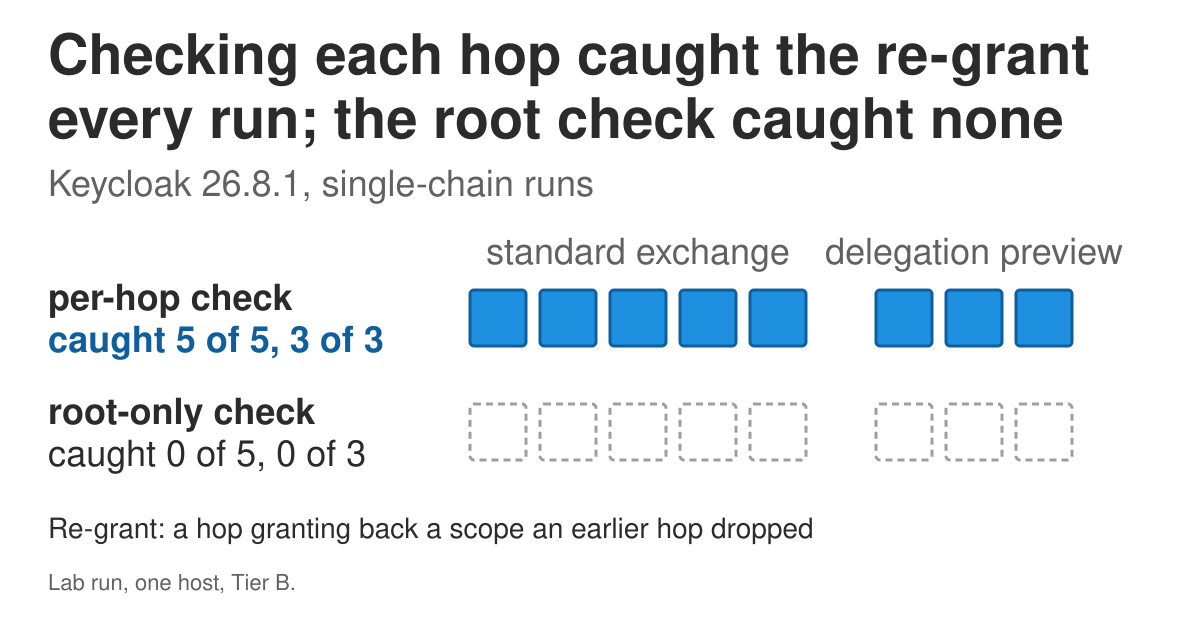
reacquireplant 5 of 5 times in standard exchange and 3 of 3 under Keycloak's RFC 8693 delegation preview, while the root-only check caught it 0 times in either, because Keycloak logs the effectivescopeof each token it issues (T7). When several chains share one session the check inherits the attribution problem from the opening, and that case was not scored. Keycloak's token-exchange guide documents that by default an exchange "can be used to request extra scopes and audiences that are not present in the initial subject_token", which it calls upscoping, so in a default realm the per-hop check flags exchanges the server considers legitimate, and the first thing such an alert tells you is that the deployment does not attenuate, with whether an agent misbehaved as the second question (Keycloak documentation, read 2026-11-16, the current page, which is not pinned to 26.8.1; Tier B for what the feature does). - An escalation the identity provider refuses to grant can leave no trace. The
newplant asked for a scope the user had no role for, and Keycloak issued the token without it, in 5 of 5 standard and 3 of 3 delegated runs, and no event field recorded what had been asked for in any of the 8 reduced hops, so a detection built on these events sees a cleandata:readtoken and nothing else (T7). With Keycloak's downscope enforcer policy switched on the request is refused and the attempted scope does appear, inside an error-detail string on an event that carries no user, session or chain field, and switching the policy on and off, a security-control change, produced no admin event on the surfaces checked (T7 admin-event inventory). - Attenuation is not what the server enforced by default, which is the upscoping default the guide documents. In both modes Keycloak issued the
reacquirehop its re-granted scope, including under the delegation preview, where the delegated token came back withdata:write data:readalthough the token presented held onlydata:read, so the property that AIMS states for its token sequences, and that CoSAI and NIST tenet 2 state in general, held in standard exchange only once the enforcer policy was on, and the delegation preview was not run with that policy (T7 detectability table). The delegation preview also stops at one actor hop, and its delegated token carries no session id, which removes the field the standard-exchange chains were grouped by.
T7 · reduced and refused escalations
What Keycloak's events show when a hop asks for a scope the user has no role for
| Case | What Keycloak did | What the event log shows |
|---|---|---|
| Enforcer off (standard exchange and delegation preview) | Issued the token without the scope, in 5 of 5 standard and 3 of 3 delegated runs | A clean data:read token; no field recorded the requested scope in any of the 8 reduced hops |
| Downscope enforcer on | Refused the request | The attempted scope, inside an error-detail string on an event with no user, session or chain field |
| Switching the enforcer on or off | Changed a security control | No admin event on the surfaces checked |
That is one identity provider at one version in dev mode, and another product's exchange event may well carry the presented token's id, so I would not generalize the gaps to identity providers as a class. What it does show is that, in this product, the chain an agent pipeline needs is split across two writers, with the identity provider holding the scopes it actually issued and the agent holding the pointer back, which is a reason to want both writers emitting delegation, with the issuer's record as the one to trust when they disagree.
Lab run T7 · two writers
parent_uid on 0 of 81 mapped exchanges, and the pointer back has to come from the agent, best treated as a lead to corroborate against the issuer's events. Lab run T7, Keycloak 26.8.1 in dev mode on one host, Tier B.The catalog
Where enforcement actually happens
Logging the chain tells you what happened after the fact, which leaves the question of where an agent's access to security data is enforced today, and as far as I can tell the answer is still mostly the query engine. Iceberg PR #13879 added row filters and column masks to the REST catalog spec, merged 2026-09-03 and shipped in Iceberg 1.12.0, and a check this month found no engine that enforces them yet, so for now I read it as a spec ahead of its implementations (Tier A for the merge). The lab's ocsf-rls-overhead bench measured engine-side row-level security in DuckDB as a lower bound, and its own caveat is that catalog-layer enforcement would add token validation and policy round trips it did not measure (Tier B).
The audit side of the catalog has a gap that maps directly onto the delegation table. With Apache Polaris 1.5.0's event listener turned on in a June lab run, which is off by default and needs a config selector and a JDBC backend, it wrote durable, queryable catalog events with a principal_name, an event type, a resource, a timestamp and a request_id (polaris-catalog-dryrun/RESULTS-auditevents-2026-06-16.md, Tier B, dev-grade, single host). That is a good audit record, and it has one principal column. I have not run the delegated case, but with one principal column, if an agent presents a token whose sub is the user, as AIMS describes, the catalog row would name the user and the agent would disappear, and if the agent uses its own credential the user would disappear, and in neither case would the row carry a delegation id that lets a SOC join it back to the chain. The authorization-chain pattern discussed on the Apache Polaris dev list in November 2025, layered authorizers each with its own audit trail, would give each layer a place to record its decision, but as far as I know none of the layers yet records whose authority it was acting on (Polaris dev list, my reading at the time, Tier B).
Limits
What would change my mind
I would revise the "self-join is enough" conclusion if real delegation turns out to be trees with fan-out and the occasional cycle, where the bench generated linear chains, because a recursive walk over a graph with cycles needs guards the bench did not test, and string uids instead of the bench's integer keys would raise the cost of both the walk and the join. Fan-out also opens a case the per-hop check cannot see by construction, which #1739 states plainly, that several delegates each properly attenuated can together exceed what their parent could do, so a control that has to budget across a subtree needs a root identifier and an aggregate, and a hop-to-parent comparison will pass every edge. The subset test also assumes the hops share one scope vocabulary, as the bench's bitmask and the lab's Keycloak realm did, and where the audience changes at each hop and the scope names change with it, the comparison needs a mapping between vocabularies that neither run had (my argument, Tier D). I would revise the logging recommendation if #1705's per-node scopes do not make it into 1.10.0 (they did, in the release of 20 November 2026), or if #1739 and #1756 change the object enough that a scope comparison has to look somewhere other than the parent row. And the array-containment version of the check, over string scopes on an event table that first has to be reduced to one row per grant, is unmeasured, so the R7 timings are a floor for the shape I am recommending.
Bottom line: the 4624 equivalent for agents now has a home in OCSF, but the scope field that makes it useful arrived only with 1.10.0, released 20 November 2026, and with that field in each hop's row the escalation check is one join over a table with one row per grant, or a filter if you pay at ingest, without the recursive walk the word "lineage" suggests. The open questions I would most like answered are what that write-time stamp costs on a real ingest path, whether the event stream a SOC actually keeps holds a row for every intermediate grant, whether any agent runtime emits delegation with a filled parent_uid yet, given that in the T7 run the identity provider could not, and whether a second identity provider logs the presented token's id where Keycloak 26.8.1 did not.
Sources
Sources and tiers
| claim | source | tier |
|---|---|---|
delegation attributes in 1.9.0 and on main; scope-attenuation text; ai_operation profile contents | OCSF objects/delegation.json and profiles/ai_operation.json, 1.9.0 and main (R8 sources/; main re-read at bc2c87c2, 2026-11-16) | A |
#1665, #1705 merged; #1739, #1756 open; #1739 root_uid proposal, worked example and "walk, not a join" | OCSF CHANGELOG.md and GitHub issues, read 2026-11-16 | A (status) / C/B (one contributor's proposal) |
| 4624 Subject block, Logon ID and Linked Logon ID | Microsoft Learn, event 4624, read 2026-11-16 | B (vendor, what the field does) |
| Keycloak upscoping default and downscope enforcer | Keycloak token-exchange guide, keycloak.org, read 2026-11-16 (current page) | B (vendor, what the feature does) |
| AIMS adoption, authors, §7, §10.3, §10.6, §11 | IETF datatracker; draft-ietf-wimse-aims-01, re-read 2026-11-16 | A/B (Internet-Draft) |
| CoSAI delegation visibility, per-hop scope, OCSF extension-field advice, correlation-id chain query | CoSAI WS4 "Agentic Identity and Access Management", approved 2026-03-20, read 2026-11-16 | B (coalition guidance) |
| Ten proposed agent identity tenets; tenet 2 attenuation, tenet 10 tamper-evident evidence | NIST Cybersecurity Insights blog, 2026-10-27, re-read 2026-11-16 | A/B (staff proposal, not a standard) |
| Teleport framework | Teleport announcement, 2026-01-27 | B (vendor, for what it does) |
| Per-boundary scope inspection | CSA research note, draft 2026-03-27, re-read 2026-11-16 | B |
| Escalation correctness and cost | Lab R7, 2026-11-09, delegation-chain-query/RESULTS.md, VERIFICATION.md | B |
| R7 columns against OCSF 1.9.0 and main | R7 gen.py against R8 sources/ schema files, 2026-11-16 | A (schema) / D (my mapping) |
| Keycloak exchange events, parent pointer, scope drops, enforcer, delegation preview, OCSF fill | Lab T7, 2026-11-10 UTC, t7-idp-delegation-logging/RESULTS.md, VERIFICATION.md | B |
delegation has no D3FEND counterpart | Lab R8, d3fend-ocsf-ai-alignment/RESULTS.md, row O7 | B (pinned definitions) / judgment for the grade |
| Iceberg #13879 merged and in 1.12.0; no enforcing engine found | apache/iceberg PR #13879; a lab check, November 2026 | A (merge) / D (no engine found) |
| Polaris audit event shape; authorization-chain pattern | polaris-catalog-dryrun/RESULTS-auditevents-2026-06-16.md; Apache Polaris dev list, November 2025 | B |
| Identity as the binding constraint | /writing/ai/nanda-automation | author's prior essay |
Related
- Delegation across the AI surface. →
- OCSF already has the AI-agent objects. Where your agent's tool call lands decides whether you can query it. →
- MCP just told you where its logs went. →
- What's real vs marketed in the agentic SOC. →
- The catalog became the control plane. For security, who enforces is still an open question. →
