
AI attack surface · Part 7
Delegation across the AI surface: where agent credentials sit and who logs the hand-off
On 2026-11-10 an agent-driven bench in my lab ran a scripted Claude Code session, version 2.1.321 signed in through OAuth on a subscription account, through an OpenTelemetry collector to see what an agent's own telemetry says about who did what, and on identity the answer was the account. Every record carried the account email, the account and organization ids and a user id, and the export had no client address, so the join key it offers a SIEM is the person's email, which is accurate in a literal sense, because the agent had no credential of its own and was running on that person's. It had inherited more than the login, too, since the session that was meant to be a bare three-step task arrived with the account's own configuration loaded, 10 plugin-load, 8 hook-registration and 11 MCP-connection events' worth of it, and seven of the captured environment dumps held a live token belonging to the session that launched the bench, picked up from the shell the way an agent picks up everything else in it, and that token was redacted before the files went public. The local Ollama server in the same run logged 127.0.0.1 on every line, for the bench's requests and for other clients on the host alike, so on that surface there was no principal to record at all.
This is the seventh part of a series on the AI attack surface. Part 1 set out thirteen ways AI gets deployed and found that on seven of them a security team holds at most the identity provider, an enforcement point and the vendor's exported log, Part 3 found that the incident evidence for CoSAI's agent-identity risks is 29 steps of ordinary credential tradecraft, most of them in incidents where the AI belonged to the attacker, and Part 6 asked what the tools a team already owns can see. This part takes the identity half of that collection plan and asks where an agent's authority actually comes from on each surface, where the credential behind it sits, what the identity plane writes down when one principal hands authority to another, and what the 2026 habit of gathering agent secrets into one broker does to the target. The measurement detail on delegation records, the two lab runs that test the escalation check and a real identity provider, and the OCSF field mapping all live in Delegation is the new logon event, and I link to it at each point instead of repeating it.
Reading time: about 16 minutes. Evidence tier: A for the CISA KEV catalog and NVD records and the MCP authorization specification; A/B for the two IETF Internet-Drafts, which are working documents and not standards, all read 2026-11-16; B for each vendor identity feature, re-read at the vendor's own page on 2026-11-16, for LiteLLM's own incident write-up, and for the lab runs, each pre-registered and run by an agent session on one host; D for every cell in the credential-location grid, which is an agent's single draft, and for my own reasoning where it is labelled.
The vocabulary
Four kinds of non-human principal
Across the thirteen surfaces the authority an agent acts with comes from one of four places, and it helps to keep them apart, because each fails in its own way and each is logged by a different system in a different vocabulary.
- An agent identity is a directory object made for an agent, such as a Microsoft Entra Agent ID agent identity, an Amazon Bedrock AgentCore workload identity or a Google Cloud Agent Identity principal.
- A borrowed workload identity is the older thing an agent often runs as instead, an Entra service principal, an IAM role, a GCP service account, or on a laptop the developer's own cloud CLI login.
- A static secret is an API key, a personal access token or a client secret sitting in an environment variable, a config file, a gateway database or a vault.
- A delegated grant is authority a person, or another agent, hands to the agent for a task: an OAuth token issued on a user's behalf, a token-exchange result, or an identity assertion of the kind the IETF OAuth working group's ID-JAG draft defines.
The vocabulary splits along vendor lines as soon as you look at a log. Entra marks an agent with an agentType value and a blueprintId on the audit event, AWS names it with a workload-identity ARN of the form arn:aws:bedrock-agentcore:region:account:workload-identity/directory/default/workload-identity/agent-name, and Google gives it a SPIFFE ID and a matching principal:// identifier, so "which agent, acting for whom" is a mapping job before it is a query, and the one cross-vendor target I know of that has a place for the grant as well as the agent is OCSF's ai_agent object with the delegation object beside it (Tier D that nobody has published that mapping; the search covered only the sources listed here).
The grid
Where the credentials sit, surface by surface
The grid below takes those four kinds across the thirteen surfaces and says, for each, where the credential behind that kind of principal usually sits. It is built from the series' per-surface identity research and checked against the vendor pages cited below, and it uses the surface scoping from Part 1, so S5 means MCP servers the organization runs itself and S6 means self-hosted builders, with Copilot Studio counted under S2. The codes are:
- T, a short-lived token an identity provider or platform mints at the moment of use;
- B, a broker or store the organization configures, such as a token vault, an auth manager, a gateway's key store or a builder's credential store;
- F, a static secret in a file, an environment variable or a config value;
- U, the user's own session or credential set, which the agent borrows;
- V, held by the vendor, outside the organization's view.
| Surface | Agent identity | Borrowed workload identity | Static secret | Delegated grant |
|---|---|---|---|---|
| S1 AI features in SaaS apps | · | V | · | V |
| S2 Enterprise assistants | T | V | · | V |
| S3 Browser AI | · | · | · | U |
| S4 IDE and coding agents | · | U | F | U |
| S5 MCP servers you run | · | F | F | T |
| S6 Self-hosted low-code builders | · | B | B | B |
| S7 Managed AI build platforms | T | T | B | B |
| S8 Direct model API and gateways | · | T | F/B | · |
| S9 Self-hosted model serving | · | · | F | · |
| S10 Local open-weight models | · | · | · | · |
| S11 Fine-tuning pipelines | · | T | F | · |
| S12 RAG pipelines and vector stores | · | T | F | F |
| S13 AI inside security tools | T/V | V | V | V |
A dot means that kind of principal is not typical on the surface. S2's agent identity is the Entra identity Copilot Studio gives each agent it creates. S5's delegated grant is the audience-bound OAuth token a client gets for a remote server; a stdio server reads its credentials from the environment. S13's agent identity is T where the product's agent carries an Entra agent identity in your tenant and V where the vendor holds the credential. S9's static secret is the bearer token where one is set, and several serving stacks ship with none. S12's delegated grant is the connector's stored OAuth grant to the source repositories, which sits closer to B where the connector keeps it in a managed store. S8's static secret is F for provider keys in an application's config and B for a gateway's virtual and master keys. A given organization's S4 or S7 may look different.
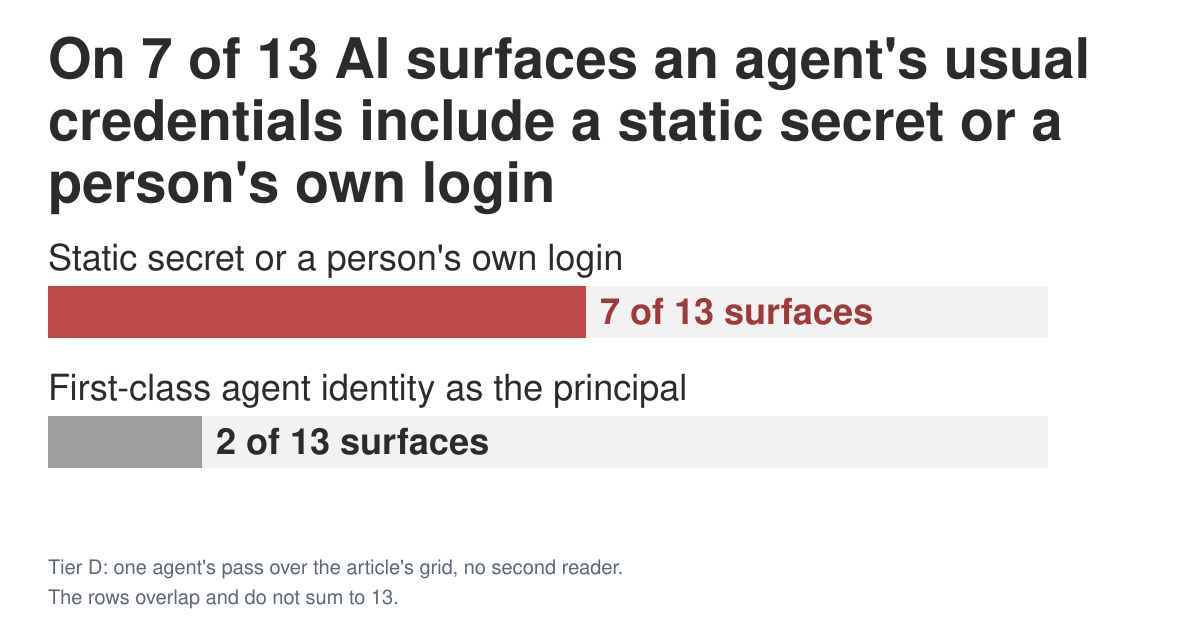
Read down the first column and, in this grid, a first-class agent identity is the typical principal on only two surfaces, the managed build platforms (S7) and the agents an enterprise assistant's builder creates (S2), with a third, AI inside security tools (S13), where some products give their agent an Entra agent identity in your tenant, as Microsoft's own conditional access optimization agent does, and others keep the credential on the vendor's side. That describes how these surfaces are usually deployed today and says less about where the products can reach, since AWS says AgentCore Identity serves agents running on its runtime, "self-hosted environments, or hybrid deployments", so an agent on several of the other rows could carry one if someone set it up. Elsewhere the agent usually runs as something older. On six surfaces a static secret in a file or an environment variable is among the working credentials, coding agents (S4), MCP servers the organization runs (S5), direct API use (S8), self-hosted serving (S9), fine-tuning pipelines (S11) and RAG stores (S12), and on two the agent simply is the user, browser AI (S3), which rides the user's live session, and coding agents (S4), which inherit the developer's whole credential set the way the session in my opening inherited a token from its shell. Local models (S10) carry no credential at all, which is also why Part 1 found no identity row for them.
The other two codes say where a security team can act. The brokers (B) cluster on three surfaces, the builder's credential store on S6, the token vault or auth manager on S7 and the gateway on S8, which are the three places on the grid where an organization has gathered several principals' secrets into one system it configures, and that concentration is the subject of the section after next. The vendor-held cells (V) on S1, S2 and S13 are grants the organization issued once, usually through a consent screen, and then stopped seeing, so on those surfaces the identity work is mostly the consent and grant records in the organization's own identity provider, which I come back to below.
The products
What the 2026 identity products ship
Each of these is Tier B for what the feature does, from the vendor's own page as read on 2026-11-16, and none of it says how well any of them works.
| Product | Principal model | Where credentials live | What the identity plane logs | Status |
|---|---|---|---|---|
| Microsoft Entra Agent ID | Agent identity blueprint (analogous to an app registration), agent identity (analogous to a service principal), optional agent's user account paired one to one | Tokens from Entra; agents act "autonomously" with rights on the agent identity or with "delegated access" on a user's behalf | Audit events carry agentType and blueprintId; an agentSignIn event type, with sign-ins that "might appear across each of the four sign-in log types"; Graph access on /beta | "Agent ID is available for all Microsoft Entra customers"; "Extending Microsoft Entra security features to agents requires Microsoft Agent 365" |
| Amazon Bedrock AgentCore Identity | Workload identity per agent in a directory, with its own ARN | A token vault for "OAuth 2.0 tokens, OAuth client credentials, and API keys", encrypted with KMS and released "only when they present verifiable proof of workload identity"; OAuth client credentials and authorization code flows | The features page says "All operations are logged"; CloudTrail lists WorkloadIdentity, WorkloadIdentityDirectory, TokenVault, APIKeyCredentialProvider and OAuth2CredentialProvider as AgentCore data-event resource types, and data events "are not logged by default" and carry "additional charges" | Product documentation; which individual operations fall under each data-event type was not checked |
| Google Cloud Agent Identity | SPIFFE ID and principal:// identifier; an X.509 certificate "valid for 24 hours" | Auth manager, "a centralized credentials vault and authentication broker", holding API keys, OAuth client secrets and user tokens for 3-legged OAuth | "When an agent acts on a user's behalf, logs show both the agent's and user's identities", with no field names on the page | The overview page states no launch stage; Google's 2026-05-06 IAM post says Agent Identity for Agent Runtime "is now generally available" and the auth manager "is in preview", status as of that post |
| ID-JAG (IETF draft) | The enterprise identity provider's user plus the requesting app | The identity provider issues an assertion that the resource's own authorization server exchanges for a token | A protocol, so no log of its own | draft-ietf-oauth-identity-assertion-authz-grant-06, 2026-10-31, an OAuth working-group document with authors from Okta, Ping Identity and one independent |
Two things stand out to me in that table. The first is that two of the three cloud products ship a credential broker as part of the identity product, AgentCore's token vault and Google's auth manager, and gateways play the same role on S8 (Azure API Management's credential manager configures OAuth for "AI apps and agents", and LiteLLM's master key sits over the upstream provider keys), so the design pattern for agent secrets this year is to gather them in one place. I think that is the right call for sprawl, since the alternative is the static-secret column above, and it also changes what has to be protected. The second is that the identity plane's records describe the hand-off unevenly, with Entra's logs page documenting the agent fields in detail and saying nothing about the grant lineage, Google saying both identities appear without naming the fields, and AWS putting the vault and workload-identity activity in a data-event category that costs extra and is off until someone turns it on.
The broker
What the exploited-vulnerability record says about brokers
The case that a broker is a target rests, so far, on gateways and builders, and I'd rather state exactly what the record shows than lean on the general shape. The CISA Known Exploited Vulnerabilities catalog (version 2026.11.13, read 2026-11-16) carries three LiteLLM entries added in 2026, and reading each NVD record for whether the flaw sits in the credential path gives this:
- CVE-2026-42208, added 2026-05-08, is SQL injection in the database query LiteLLM runs during proxy API key checks, reachable without authentication through a crafted
Authorizationheader, which NVD says could lead to "unauthorised access to the proxy and the credentials it manages". - CVE-2026-42271, added 2026-06-08, is command injection through two MCP-server preview endpoints that "were gated only by a valid proxy API key, with no role check", so a holder of a low-privilege internal-user key could run commands on the proxy host.
- CVE-2026-59822, added 2026-09-02, is an authentication bypass on the MCP Streamable HTTP endpoint, where a fabricated
Authorizationheader triggered an OAuth2 passthrough fallback that let requests "reach MCP tooling without a valid LiteLLM key".
So two of the three are in the gateway's own authentication of callers, and the third turns any valid key, however junior, into the proxy's host, which is where the master key and the upstream provider keys live, and LiteLLM's own cleanup list for its compromised release names the provider keys in the proxy database, the master key and the virtual keys among what to rotate on such a host (the step from host access to the keys is my inference, Tier D). That mostly supports the broker argument, because none of the three is an instance someone forgot to put behind authentication: two are flaws in how the gateway authenticates a caller and the third is a missing role check behind a valid key. Only the first record names the stored credentials as what is exposed, the second reaches them by my inference above, and the third reaches the MCP tools, and neither KEV nor NVD says what the exploitation was after. The same catalog carries five Langflow entries and one n8n entry added in 2026, and both are builders that hold their users' connection credentials, though those six have not been read against the credential path the way LiteLLM's three were, while it names no entry for the hyperscalers' token vaults or agent identity services, an absence that says little on its own, because a flaw in a managed cloud service is fixed on the provider's side and often never gets a CVE the catalog could list (my reading, Tier D). So the evidence for "brokers are where attackers go" is about one gateway read closely and two builders on the strength of the catalog alone, and I would not stretch it to AgentCore's vault or Google's auth manager without a case.
The broker · KEV entries as of 13 November
The incident that shows what a credential sitting in an agent system is worth comes from LiteLLM itself, in the canonical write-up of its compromised 1.107.0 release, posted on 2026-10-23 to replace a first post's theory that GitHub CLI tokens had been taken from the logs of an internal deployment. An administrative key to an internal "LiteLLM Agent Platform", "an experimental project for self-hosted cloud agents to file PRs to GitHub repositories", had been committed to a public repository on 2026-05-27, deleted from the tree about three hours later and never revoked, "because of human error", and on 2026-10-10 the attacker used it to call the platform's API, where a request listing the managed agents returned their configuration, including the GitHub CLI OAuth token the platform had been configured with. That token was "not a Personal Access Token scoped to the appropriate repositories and capabilities, but was the GitHub CLI OAuth token associated with our GitHub organization owner", and from there the attacker exfiltrated two more maintainers' tokens from CI secrets and published the malicious release (LiteLLM's own post-mortem, Tier B, the vendor's own account).
The broker · one incident, three codes
Read against the grid, that incident touches three of its codes in one chain, F for the committed key, U for the owner's own CLI token and B for the platform that held it. It starts with a static secret in a file that outlived its revocation note, which on my mapping covers two entries in OWASP's Non-Human Identities Top 10, secret leakage (NHI2) and improper offboarding (NHI1), in one event, moves through an agent platform that held a human's broad, unscoped credential so its agents could act, which is the borrowed-credential pattern of the S4 row running on a server, and turns on the platform's own API handing that credential to anyone holding the admin key. On the other internal systems the attacker reached, LiteLLM reports attempts to find and exfiltrate more keys "with a primary focus on upstream inference API tokens", and the only provider keys it says were taken are minimally funded ones from CI testing, so what the write-up shows is what the attacker went looking for, which is the kind of key a gateway holds, and it does not show a gateway's key store being emptied. LiteLLM's first post, in a section it has since flagged as partly inaccurate without saying which parts, also reports having observed situations where Claude Code embeds a user's GitHub CLI token in a response body, so a gateway that logs response bodies may store it. The canonical write-up neither repeats nor withdraws that observation, I have not reproduced it, and none of the three tokens in this incident came from a log, so I'd keep response-body logging on the list of things to scrub as a reported possibility.
The chain
What each record carries about a hand-off
The detection most teams want from agent identity is scope escalation along a chain, a hop that hands an agent authority its delegator did not hold, and Delegation is the new logon event owns the measurement. In short, a single child-to-parent join was exact in the lab when each hop's row carried its own scopes and its parent's row was in reach, over a table with one row per grant, while checking each hop only against the human at the root missed every planted case where an intermediate agent dropped a permission and a later one re-granted it. A run of Keycloak 26.8.1's token exchange then showed one identity provider logging the scope of every token it issued and the client the presented token came from, but not the presented token's own id, so the pointer back had to come from the agent's own record. That essay also carries the caveats that bound those findings, which I'd rather link than paraphrase: one product at one version, a default that grants extra scopes on exchange so the per-hop check flags exchanges the server considers legitimate, and a join that needs every grant in reach.
What this article adds is the cross-surface view of which record carries which half. Taking the sentence "agent A acted for user U, under grant G, which came from grant P, with scopes S" and asking each source for its parts gives the table below, where a dash means the source as read does not carry the part.
| Part of the hand-off | OCSF 1.9.0 | OCSF 1.10.0 (main when read) | IETF AIMS -01 §11 | Entra Agent ID logs | Google Agent Identity | Keycloak 26.8.1 exchange events |
|---|---|---|---|---|---|---|
| The agent | ai_agent | ai_agent | authenticated agent identifier | agentType, blueprintId | present, fields not named | the requesting client |
| The user it acts for | actor.user | actor.user | delegated subject | not stated on the logs page | present, fields not named | the user |
| This grant's id | delegation.uid | delegation.uid | none (its correlation id is per request) | not stated | not stated | the issued token's id, if you map it as the grant id |
| The grant it came from | delegation.parent_uid, optional | delegation.parent_uid, optional | not in the list | not stated | not stated | the client only |
| What was delegated | not in the object | delegation.scopes | the requested action and decision, partly | not stated | not stated | the issued token's scope |
The pattern I take from it is that the two halves the escalation check needs, a pointer to the parent grant and the scopes on each hop, are each carried somewhere and are not both carried on one record by any production source read for this piece. OCSF 1.9.0 has the pointer and no scopes, OCSF 1.10.0, released 20 November 2026, defines both on one object though no production source read for this piece emits it, the AIMS audit list has the subject and leaves out the parent, the cloud agent-log pages read for it document the agent and say nothing about lineage, and the one identity provider the lab ran logged scopes per hop and the parent only at the level of which client handed authority to which. The CoSAI risk map names this case riskAgentDelegationChainOpacity, where chains "become opaque when intermediate agents do not emit structured delegation events, making it impossible to determine which human, agent, or system authorized or performed an action", which is a fair description of what the table shows on the clouds as well.
Grants and keys
Consent grants and gateway keys
Two quieter places hold delegated authority on the rented surfaces, and both sit in systems the organization already runs. The first is the OAuth consent grant, the standing permission an identity provider records when a user or admin consents to an AI app, an assistant connector or a security product's integration, which is how most of the V cells in the grid came to exist. In Entra the trail is the Core Directory audit log, where "Consent to application" and "Add delegated permission grant" are listed application-management activities (Microsoft's audit activity reference), and the useful query lists grants to AI apps by scope and by last use, which is the offboarding question asked of grants instead of identities. What that log cannot tell you is what the app later did with the grant, because those reads land in each resource's own audit log under the app's identity, so the join from a consent in March to a mailbox read in October runs on app id and time, because the grant has an id in the directory (Graph's oAuth2PermissionGrant, which also carries the client, the user and the scopes) that, as far as I can tell, the resource logs do not carry (my reasoning, Tier D).
Grants and keys · the consent join
Microsoft's write-up of Storm-0940 (2026-10-21) shows a standing app grant used as the way in. The group took control of the identities of several ConnectWise cloud applications and used ARTEX, an open-source multi-agent penetration-testing framework, to attempt sign-ins to more than 2,250 tenants through them, "effectively taking advantage of the already established trust by these apps within a tenant." Most of that targeting failed, but Microsoft reports several cases where initial targeting reached privileged access in under three hours, and some where the agents added application credentials for persistence. Its hunting advice is the consent-grant query above plus service principal sign-ins, searched "by application ID rather than display name," with a warning not to delete enterprise applications as the first response (Microsoft Security blog, Tier B).
The second is the gateway key on S8, where the caller is a key and the person behind it is optional. LiteLLM's documentation says that because the key-generation endpoint stamps the caller's user_id only for non-admin callers, "an admin-created key with no user_id has no owner and inherits nothing from the admin", and Azure API Management's own example of per-user token metrics takes the user id from an x-user-id request header, which is something the caller asserts about itself (vendor documentation). So a gateway gives you spend per key by default and spend per person only when someone binds the key to an owner, and how that turns into a cost signal for stolen keys is where Part 8 picks up.
What I'd do
Where I would start
Pulling the grid, the products and the incident together, these are the moves I'd make first, roughly in this order (my recommendations, built on the Tier B facts above):
- Treat every credential broker as a system on the level of a domain controller. That covers token vaults, auth managers, gateway master keys, builder credential stores and any agent platform holding a person's token, including their admin APIs, their own authentication and anything they log.
- Turn on the identity plane's records where they are off. On AWS that means adding the AgentCore workload-identity, token-vault and credential-provider data events to a trail deliberately, since they are neither logged by default nor free, and checking first which operations each type covers, which I have not.
- Give agents their own identity where the platform offers one, and stop issuing them a person's credential. The LiteLLM chain turned on a platform configured with an organization owner's unscoped CLI token, and the coding-agent row of the grid is the same pattern on a laptop.
- Bind every gateway key to an owner, and don't trust identity headers the caller sets.
- Log scopes on every hop if you log delegation at all, and keep the parent pointer, because the escalation check needs both and no single source above carries both.
- Run offboarding queries for agents and their grants. That means Google's inactive IAM bindings, which the overview page says remain "as inactive grants" after an agent is deleted, agent identities whose sponsor has left, consent grants to AI apps nobody uses, and gateway keys for retired deployments.
- Scrub response bodies from gateway logs or keep them out, given LiteLLM's report, unreproduced, of a CLI token embedded in one.
The secret-scanning and short-lived-credential work for developer machines, where coding agents and local MCP servers read their keys from the environment and EDR is often the only telemetry, belongs with the static-secret column, and I'd run it inside the non-human identity program a team already has, which is where Part 3 suggested the AI service identities belong.
Limits
What would change my mind
Bottom line: in this grid (Tier D), a static secret or a person's own session or login is among an agent's usual working credentials on seven of the thirteen surfaces and a first-class agent identity is the typical principal on two, and the systems that gather agent secrets into one place, gateways and self-hosted builders so far, picked up nine CISA known-exploited entries between them in 2026, of which three were read against the credential path and one has a record that names the stored credentials, so I'd put the brokers and the grants under the same scrutiny as a domain controller now and log the scope and the parent of every delegated hop before the record format settles, starting with whichever of the two halves your identity provider already writes down.
Sources
| # | Source | What it supports | Tier |
|---|---|---|---|
| 1 | Lab run T2, platform telemetry, 2026-11-10 UTC, sdw-lab-benchmarks/t2-platform-telemetry RESULTS.md and VERIFICATION.md | Opening: account identity in the agent's telemetry, inherited configuration, the redacted session token, Ollama's loopback address | B (one host, one account, pre-registered) |
| 2 | Delegation is the new logon event, with lab runs R7 and T7 | The escalation check, the root-only blind spot, Keycloak's exchange events, the OCSF and AIMS columns | B (lab) / A (schema) |
| 3 | Microsoft Learn, "What are agent identities?" (updated 2026-06-15) and "Microsoft Entra Agent ID logs" (updated 2026-06-17), read 2026-11-16 | Entra object model, delegated access, availability and licensing, agentType, blueprintId, agentSignIn | B |
| 4 | Microsoft Learn, audit log activity reference (updated 2026-06-15), read 2026-11-16 | "Consent to application", "Add delegated permission grant" | B |
| 5 | AWS, AgentCore Identity features page and CloudTrail concepts page, read 2026-11-16 | Workload identity ARN, token vault, data-event resource types, off by default and billed | B |
| 6 | Google Cloud, Agent Identity overview (last updated 2026-11-13) and IAM blog post of 2026-05-06, read 2026-11-16 | SPIFFE and principal formats, 24-hour certificates, auth manager, logs show both identities, inactive bindings, launch status | B |
| 7 | IETF, draft-ietf-oauth-identity-assertion-authz-grant-06 (2026-10-31), datatracker read 2026-11-16 | ID-JAG status and authors | A/B (Internet-Draft) |
| 8 | MCP specification 2026-07-28, Authorization, read 2026-11-16 | Stdio credentials from the environment; audience-bound tokens | A (the project's own specification) |
| 9 | CISA KEV catalog 2026.11.13 and NVD records for CVE-2026-42208, CVE-2026-42271, CVE-2026-59822, read 2026-11-16 | LiteLLM, Langflow and n8n entries and what each LiteLLM flaw is | A |
| 10 | LiteLLM, incident posts of 2026-10-21 and 2026-10-23 (the latter canonical), read 2026-11-16 | The Agent Platform key, the organization owner's token, the withdrawn log theory, the reported response-body observation, the cleanup list | B (vendor's account of its own incident) |
| 11 | LiteLLM virtual keys documentation and Azure API Management AI gateway documentation (ms.date 2026-05-29), read 2026-11-16 | Ownerless admin keys, master key, x-user-id header example, credential manager | B |
| 12 | OWASP Non-Human Identities Top 10, 2025, read 2026-11-16 | NHI1 and NHI2 titles | B (community project) |
| 13 | Security Data Works background research on non-human identity and the API view (2026-11-09), spot-checked by a second agent session the same day | Per-surface principal and credential table behind the grid; consent-grant reasoning | B for vendor facts, D for the grid cells |
| 14 | Part 3 | 29 incident steps of credential tradecraft behind CoSAI's agent-identity risks | A/B (as cited there) |
| 15 | Microsoft Graph v1.0, oAuth2PermissionGrant resource type, read 2026-11-16 | The consent grant's own id, client, user and scopes | B |
| 16 | CoSAI secure-ai-tooling, risk-map/yaml/risks.yaml at 622605a13fafaa2784acbdbe3f8d23ee22da4be7, read 2026-11-16 | riskAgentDelegationChainOpacity description | A in the sense of primary files read at a pinned commit; working-group content, not a ratified standard |
| 17 | Microsoft Security blog on Storm-0940, ARTEX and the ConnectWise supply-chain compromise (2026-10-21), read 2026-11-17 | 2,250 tenants targeted through ConnectWise app identities; under three hours to privileged access in several cases; consent-grant and service principal hunting | B |
