
Agent telemetry
MCP just told you where its logs went.
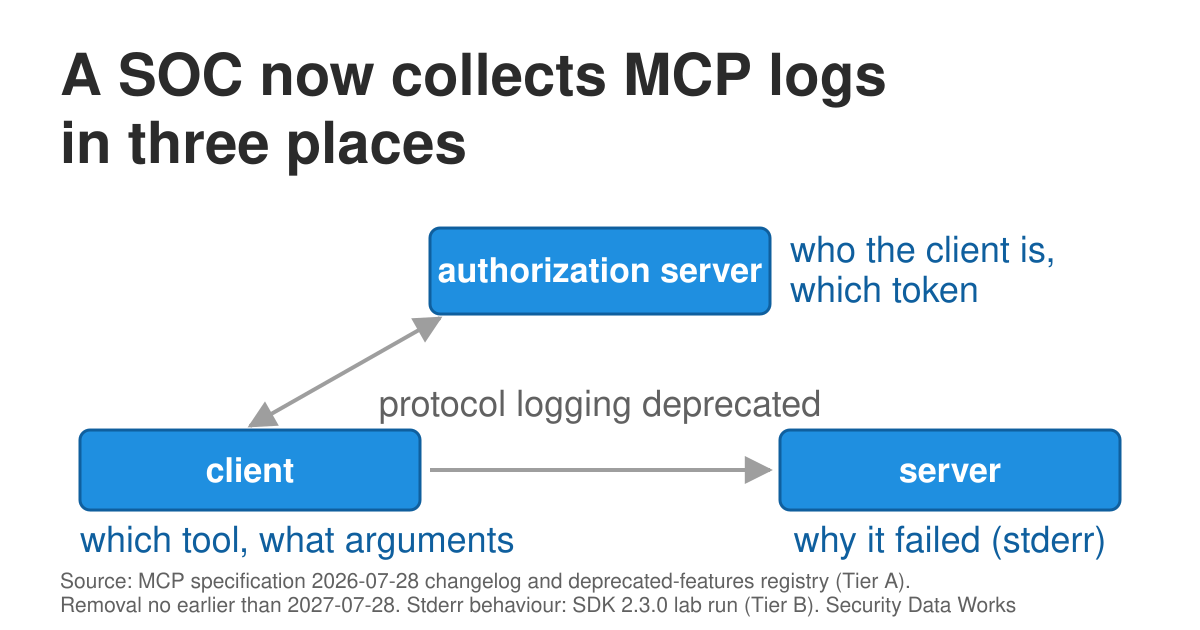
The 2026-07-28 MCP revision deprecated in-protocol logging and removed sessions, so a SOC now collects three logs (client, server and authorization server), and a lab capture of both revisions shows what reaches each one, with three smaller runs around it.
Reading time: about 15 minutes. Evidence tier: A for the MCP specification (2026-07-28 changelog and deprecated-features registry, re-read 2026-11-16); A/B for draft-ietf-wimse-aims-01, an Internet-Draft; B for my lab runs (R2, R5, T8a and T2), each run by an agent session on one machine from a pre-registration it froze and I have not yet reviewed; B for vendor documentation on what a feature does.
The short version
The protocol handed its logs to the stack around it
The line in the 2026-07-28 MCP changelog that I would put in front of a detection engineer is easy to miss, because it sits under the Deprecated heading most people skim. SEP-2577 deprecates the Roots, Sampling and Logging features, and the suggested migration for Logging reads, in full, "log to stderr (stdio) or use OpenTelemetry instead of Logging" (MCP specification changelog, 2026-07-28, re-read 2026-11-16, Tier A as the project's own record). The SEP's own motivation is one line, that Logging "overlaps with stderr and OpenTelemetry", and the feature stays functional through a deprecation window the same revision sets at a minimum of twelve months under its new lifecycle policy (SEP-2596). The deprecated-features registry puts Logging's earliest removal at the first revision released on or after 2027-07-28, and new implementations are told not to adopt it in the meantime. Put next to the other changes in the revision, which removed protocol sessions and the initialize handshake and tightened the OAuth rules that bind a client to its authorization server, I read it as the protocol deciding that observability, and the parts of identity that can actually be checked, are the surrounding stack's job. That works in your favor if you run that stack yourself, and it leaves a gap if a vendor runs it for you.
The changelog · Logging's deprecation window
Which revision a connection actually speaks turned out, in lab captures, to be the client library's choice. The MCP Python SDK 2.3.0 advertises LATEST_PROTOCOL_VERSION = 2026-07-28, but its low-level ClientSession.initialize() offers only the handshake-era revision by design, so the R2 connection negotiated 2025-11-25 (R2, 2026-11-09), while the same SDK's high-level Client, left at its default mode="auto", probes server/discover and adopted 2026-07-28 on every run against a 2.3.0 server, and fell back to 2025-11-25 against a 1.30.0 server that couldn't answer the probe (T8a, 2026-11-10 UTC; R2 and T8a RESULTS.md, each independently re-run in VERIFICATION.md; Tier B for the measured runs and for what the cited SDK source lines do). So which SDK release a developer was on, and which call in it they reached for, chose the protocol version, and the protocol version decides a lot of what reaches a log. Under 2026-07-28 all 11 requests in T8a carried their protocol version and client identity in _meta, and over HTTP every POST carried Mcp-Method, with Mcp-Name on every tool call, while the same SDK speaking 2025-11-25 sent none of those and tied the run together with the Mcp-Session-Id header instead.
Negotiation · who chose the revision
server/discover, decided the revision, and the revision decided whether the routing headers and per-request identity reached a log. SDW Lab R2 and T8a (Tier B).Some of what changed came with the SDK release whatever revision the connection spoke, since 2.3.0 emits OpenTelemetry spans when the operator configures a provider and moves a failing tool's cause out of the client's error text and onto the server's stderr. The server still caps the choice, as the 1.30.0 fallback shows, so a collection plan has to cover both the old shape and the new one for as long as older servers are deployed. I would not generalize this sample to the ecosystem, since it is one Python SDK on two releases and one fixture server.
The changelog
What the revision moved out of the protocol
Everything below is from the changelog itself (Tier A, re-read 2026-11-16); the security reading of each item is mine.
- Sessions. The revision removes protocol-level sessions and the
Mcp-Session-Idheader from Streamable HTTP, and list endpoints no longer vary per connection; servers that need cross-call state mint their own handles and pass them as tool arguments (SEP-2567). For a SOC that means the one transport-level identifier that tied a run of calls together is gone, and whatever replaces it lives in tool arguments, which every schema the R2 run tested carries as an untyped blob (R2 loss table). - The handshake.
initializeandnotifications/initializedare removed, and every request carries its protocol version and client capabilities in_meta; clients SHOULD sendclientInfoper request and servers SHOULD returnserverInfoin each result (SEP-2575). That is better for logging than it sounds, because every request becomes self-describing, but those are SHOULDs, so a record cannot assume they are present. - Logging. Besides the SEP-2577 deprecation,
logging/setLevelis removed and the log level is set per request throughio.modelcontextprotocol/logLevelin_meta, and servers MUST NOT emitnotifications/messagefor requests that did not include it (SEP-2575). So in-protocol log messages now flow only when the client asks for them on that request. - Trace context. The revision documents OpenTelemetry trace-context propagation in
_metathroughtraceparent,tracestateandbaggage(SEP-414), which is the hook that makes "use OpenTelemetry" workable across a client, a server and whatever the server calls next. - Errors. Resource-not-found moves from
-32002to-32602, and the server-error range is partitioned, with-32020to-32099reserved for the spec. Any detection that keys on MCP error codes needs to know which revision produced them, and in T8a it also needed the SDK release, because the 1.30.0 server returned code0for a missing resource where the older spec defined-32002, while over HTTP that error's status went from 200 to 400 on the new revision, which comes from the 2.3.0 SDK's own table giving any-32602sent as plain JSON a 400, since the revision itself requires a 400 only for a handful of named errors such as a request missing its required metadata (SDK source, Tier B for what the code does). - Authorization. Clients MUST validate a present
issagainst the recorded issuer before redeeming an authorization code (SEP-2468, per RFC 9207); clients MUST key persisted credentials by issuer, MUST NOT reuse them with a different authorization server, and MUST re-register when it changes (SEP-2352); and Dynamic Client Registration is deprecated in favor of Client ID Metadata Documents (PR #2858). These close a mix-up class of attack, and they also mean the authorization server's logs are where client identity now gets established and checked, while theclientInfoeach request now carries is, as I read the spec, the client's own unauthenticated statement.
Three logs
The collection plan
The way I would frame the plan is three logs, at the client, the server and the authorization server, with a gateway in front of the server as the one place that sees the wire view of the first two. The T8a capture covered the client, the server and the wire, and not the authorization server.
The client is where the agent's intent is, meaning which tool it chose, with what arguments, under which delegated authority, and what it did with the result, and it sees whether a tool call failed but, on the 2.3.0 SDK, no longer why, since the server masks the cause behind the string Error executing tool <name> and writes the traceback to its own stderr, where 1.30.0 put the cause in the client's error text and wrote nothing on the server (R2; T8a). The server is where the cause of a failure lives, on stderr if the operator ships it, while the span the 2.3.0 server emits records only that the call failed (error.type=tool_error) and not the reason. The authorization server is where client registration, issuer validation and token issuance are recorded, and after SEP-2352 and the CIMD change I would expect it to be the most reliable place to establish which client was which.
| Where it lands | SDK 1.30.0 | SDK 2.3.0 |
|---|---|---|
| Client error text | Error executing tool <name>: then the exception text, which carries the cause | Error executing tool <name> and no cause |
| Server stderr | per-request INFO lines and nothing for the tool that raised, so no cause | a 37-line traceback ending in the tool’s own exception: the cause |
| OpenTelemetry span | no spans from this release, so no cause | error.type=tool_error, only with a provider configured, and no cause |
Keeping the error means collecting the server’s stderr, since on 2.3.0 the wire doesn’t carry it. SDW Lab T8a (2026-11-10 UTC), one fixture server on two releases of the MCP Python SDK, an independent agent's re-run reproducing every presence fact; Tier B. The SDK release makes this choice and the protocol revision does not, so it shows up whichever revision the connection speaks.
The revision also requires standard Mcp-Method and Mcp-Name headers on Streamable HTTP POST requests (SEP-2243), which looks like a routing detail and turns out to matter for logging, because it means an HTTP proxy or AI gateway can record the MCP method and the tool name without parsing the JSON-RPC body. The headers are the client's own claim, and the spec covers that by requiring any server that reads the body to reject a mismatch with a 400 and -32020, which T8a did not test. Capturing the name is the cheap part, and what R2 measured is the cost of not giving it a column of its own once it lands, because in that query run the layout that held the tool name as a typed column was the fastest on every hunt, and the two that held it inside an attributes map or an unmapped document ran roughly 5x to 36x slower across three timing passes, none of them on an idle host and with the map layout's share of that cost not yet explained, so I'd quote the range and not a point ratio (R2 RESULTS.md and VERIFICATION.md, Tier B). The documentation for two gateways that already handle MCP, Tyk's MCP gateway and Azure API Management, read on 2026-11-16, lists the MCP method and the tool name as fields of their MCP logs. Tyk's documentation says it reads the JSON-RPC body and checks the new headers against it, so there the headers act as a consistency check on the body, and Azure's table reference doesn't say where its fields come from (vendor documentation, Tier B for what the feature does), so I haven't yet seen a gateway that relies on the headers alone.
The table below is where each fact about a tools/call exchange landed in T8a when the same SDK release (2.3.0) spoke each revision, so the difference between the two columns is the revision and nothing else (the T8a section below has the run). "Wire" means the JSON-RPC traffic as a proxy in front of the server sees it, which for stdio means a tee on the pipe; the header rows exist only over Streamable HTTP, and every other row reads the same on both transports. The OCSF column is the target in OCSF main (1.10.0-dev when R2 and T8a ran, released as 1.10.0 on 2026-11-20, and ai_capability is not in 1.9.0) with the ai_operation profile, taken from the R2 mapping where R2 had the fact and marked as a T8a judgment call where it didn't (T8a RESULTS.md, "Where each fact is reachable"; Tier B).
| Fact | 2025-11-25 (SDK 2.3.0) | 2026-07-28 (SDK 2.3.0) | OCSF main target |
|---|---|---|---|
| Tool name | wire, client, OTel span (gen_ai.tool.name) | the same, plus the Mcp-Name header over HTTP | ai_capability.name, typed (R2) |
| MCP method | wire, client, OTel span (mcp.method.name) | the same, plus the Mcp-Method header over HTTP | api.operation, typed (R2) |
| Protocol version | the initialize request, the MCP-Protocol-Version header over HTTP, OTel | every request's _meta, the header, OTel | api.version, typed (R2, judgment) |
| Client name and version | the initialize request only | every request's _meta.clientInfo | message_context.application.name / .version, typed (R2) |
| Server name and version | the initialize result only | every result's _meta.serverInfo, and server/discover | ai_capability.service.name / .version, typed (R2) |
| Session id (HTTP) | Mcp-Session-Id header, server stderr lifecycle lines, client | none | session.uid, typed (T8a judgment); nothing to map under 2026-07-28 |
| Tool arguments | wire, client; never on a span | the same | api.request.data, blob (R2) |
| Cause of a raising tool's failure | server stderr only (a traceback) | the same | outside any record unless stderr is shipped |
Server log lines (ctx.info) | wire and client, without asking | none unless the request sets logLevel in _meta | unmapped, since API Activity has no home for a server log line (T8a judgment) |
| Trace context | _meta.traceparent and parented spans, only if the operator configures OTel | the same | metadata.correlation_uid (T8a judgment) |
Cache hints and server/discover | none | wire, client | unmapped (T8a judgment) |
| HTTP status of a JSON-RPC error | always 200 | 400 for -32602, from the SDK's status table | http_response.code (T8a judgment) |
Three gaps are the same under both revisions:
- No typed field holds an individual argument value, so the URL or path a tool was given stays inside a blob in every schema, which is the R2 result again, though SEP-2243 also lets a server annotate a parameter with
x-mcp-headerso its value reaches the proxy as a header of its own, which T8a did not exercise. - No span carries the arguments or the result, because the OpenTelemetry GenAI conventions make those opt-in and the SDK doesn't set them.
- API Activity has nowhere to put a server log line.
The authorization-server log the plan calls for is not in the table, because T8a ran without OAuth, so what that log holds under the new revision is still unmeasured and the AIMS list below is the checklist I'd hold it to.
The IETF draft that the WIMSE working group adopted for AI agents gives a useful checklist for the authorization side. Section 11 of draft-ietf-wimse-aims-01 (dated 2026-11-02, still the latest revision when re-read on 2026-11-16) says audit records of authorization decisions MUST be tamper-evident and retained according to the deployment's security policy, and it lists a minimum set of fields: the authenticated agent identifier, the delegated subject when present, the resource or tool, the requested action and decision, a timestamp and correlation identifier, the posture or risk state, and any remediation or revocation events with their cause (Tier A/B as an Internet-Draft with intended status Informational, which is a work in progress and not a standard). I would use that list as the acceptance test for the authorization-server log, and the delegation piece carries the identity side further.
Hosted servers
What you can reach when the server is someone else's
All of this assumes you can get at the server's stderr and spans, which depends on who runs the server. A June inventory of 31 security MCP servers split on that axis: of 25 self-hostable security MCP servers, 22 were inspection-legible and 18 air-gappable (one of the 18 by inference from the vendor's deployment model), while of 6 cloud-hosted managed servers, none was inspection-legible and none air-gappable (research notes, 2026-06-06; Tier B, with the legibility scoring partly my own judgment and the inventory a June snapshot). The revision makes that split matter more for logging than it did for legibility. With a self-hosted server, "log to stderr or use OpenTelemetry" is an instruction you can follow, but with a hosted vendor server the server-side half of the plan is whatever the vendor chooses to export, and the client log plus the gateway headers are all you hold yourself.
Hosted servers · what you can reach
I haven't measured a hosted MCP server's export, and the nearest evidence I have sits one layer over, at the AI platforms themselves: in T2 (2026-11-10 UTC) a lab pass scored the vendor documentation for six logging surfaces on hosted AI platforms (two for Vertex AI, plus AWS Bedrock, Azure OpenAI in Foundry, GitHub Copilot and ChatGPT Enterprise), and none of them documented all twelve of the fields the pass looked for at its default, while the closest, Bedrock's invocation logging, gets near them only once someone switches it on (T2 RESULTS.md, Tier B for what the vendors document).
There is also a third case the two tiers miss, which a Datadog engineer described at [un]prompted in March 2026 while presenting the company's threat-hunting copilot, where the deck credits Datadog's own MCP server with 17 points of query syntax accuracy (the talk is Tier B as practitioner evidence, and the figure is Tier C, a vendor's number for its own product, with the model and agent design also changing between the two versions). That is a vendor's own product consuming its own managed MCP server, where as I read it the server was legible because its author was also its consumer, and where neither end of the call is yours to log.
Manifests
A free integrity baseline
The revision also handed defenders something without labelling it as security. Servers SHOULD return tools/list in a deterministic order (a minor change the changelog lists without a SEP), the list results now carry required ttlMs and cacheScope fields (SEP-2549), and servers MUST implement server/discover to advertise versions, capabilities and identity (SEP-2575). A deterministic manifest is a document you can snapshot and diff (the SDK's default ttlMs was 0 in T8a, so the cache hint itself did nothing there), and R5 showed the diff is quiet on a server that isn't changing: across 51 consecutive snapshot pairs on three servers in one session, including restarts, the canonicalized manifests produced zero drift events, though the arm that would have diffed real published releases did not run (R5 RESULTS.md, Tier B). The same run is also the caution, because OCSF's ai_capability holds descriptions as fingerprints, so a drift alert tells you something changed without telling you whether the change was a typo fix or a hidden instruction. The tool-poisoning piece goes into that.
Lab run T8a
Before and after, measured
The capture ran one fixture server, written on each SDK's high-level API, over stdio and over Streamable HTTP, and drove it through the same request script in five arms (eleven requests on the wire, twelve in the arm whose client had to probe and fall back): the 1.30.0 SDK at both ends (2025-11-25), the 2.3.0 SDK at both ends held to 2025-11-25 with mode="legacy", the 2.3.0 SDK at both ends left at its default and so speaking 2026-07-28, that same arm with in-protocol logging switched on, and a 2.3.0 client against a 1.30.0 server. Each exchange was captured on the wire through a proxy tee, in the client process, on the server's stderr and in an OpenTelemetry exporter the operator configured, three repeats per cell, and the presence record came out identical across repeats in all ten of those cells (T8a results/stability.md; an agent session ran it from a pre-registration it froze before the run, which I have not yet reviewed, and an independent agent's full re-run reproduced every presence fact; Tier B, one machine). Holding the SDK at 2.3.0 and changing only the revision separates what the protocol moved from what the new SDK release moved, and that split turned out to carry more of the change than the protocol alone.
The SDK's high-level client uses the new revision by default, as the opening describes, so the more interesting result is what happens when it probes a server that can't answer. Over stdio the 1.30.0 server replied to server/discover with -32602 and wrote about 90 lines of pydantic validation errors to its stderr, 105 lines in that cell against 11 in the all-1.30.0 one, and over HTTP it answered 400 with "Bad Request: Missing session ID"; in both transports the client then fell back to initialize and finished on 2025-11-25 (T8a RESULTS.md, Tier B). So over stdio a burst of validation noise on an older server's stderr at connection time, and over HTTP a 400 for a missing session id, may be the first sign in a log that a newer client has arrived, which I'd note for whoever writes the parsing rules, though one fixture server is a thin base for calling it a pattern.
Under 2025-11-25 the HTTP session id was everywhere a collector could want it, on 11 of the 12 POSTs (every one after initialize) and on all 14 HTTP responses, and in OCSF main it maps cleanly to session.uid, which is a judgment call T8a made because R2 never saw the header. Under 2026-07-28 it is gone from every request and response, there is no standalone GET stream and no DELETE at the end, and the whole run used one TCP connection where the older revision used 14 (T8a RESULTS.md). What replaces it is self-description per message, with protocol version and client identity on all 11 requests and server identity on all 10 results, but the protocol itself no longer names the run as a whole (a server that needs cross-call state mints its own handle and passes it in tool arguments), so the nearest thing to a session key is the OpenTelemetry trace id, and that exists only where the operator has configured a provider.
The routing headers reached the proxy as the spec describes for header-safe names. Under 2026-07-28 all 11 POSTs carried Mcp-Method equal to the method in the body, all 6 tools/call POSTs carried Mcp-Name equal to the tool name, including scan.v2-beta verbatim, and both resources/read POSTs carried the resource URI in Mcp-Name, while the same 2.3.0 SDK speaking 2025-11-25 sent neither header, so in this SDK the gateway's cheap view of the tool name is a revision fact (T8a results/matrix.md, HTTP rows). The tool-name rule is a SHOULD in the 2025-11-25 spec (SEP-986: 1 to 128 ASCII letters, digits, underscores, hyphens and dots), and both SDK releases only log a warning and register a name that breaks it, so a tool name with a space or a non-ASCII character can reach Mcp-Name as readily as a resource URI can, and the SDK's base64 wrapping for those cases exists in code and was never triggered. The proxy was also the lab's own TCP tee, so whether a commercial AI gateway takes these values from the headers is the open check from the collection-plan section.
The stderr and OpenTelemetry results are where the SDK release, and not the revision, did most of the moving. The 1.30.0 server wrote one INFO line per request (10 of them) and nothing at all for the tool that raised, so its stderr had neither the tool name nor the cause, while 2.3.0 under either revision writes no per-request line and logs only when something goes wrong (T8a RESULTS.md):
- a 37-line traceback for the tool that raised, ending in the tool's own exception;
- one line each for the unknown tool, the rejected arguments and the missing resource;
- four
MCPDeprecationWarninglines for the twoctx.info()calls the fixture made.
Nothing reaches an exporter by default, because with the OpenTelemetry API importable and no TracerProvider configured both 2.3.0 arms put no traceparent on the wire and exported nothing. With a provider configured, the 2026-07-28 arm emitted 11 client spans and 11 server spans, each server span a child of a client span, with mcp.method.name, mcp.protocol.version, gen_ai.tool.name and on failures error.type as attributes and no arguments or results anywhere, and the 2025-11-25 arm emitted the same plus a twelfth, unparented server span for notifications/initialized, which only the handshake era sends. Trace context did not survive the hop from the server to a backend it called until the server's HTTP client was instrumented as well, at which point the backend received a traceparent whose trace id matched the server's tools/call span, so the MCP SDK's own instrumentation stops at the MCP boundary (a single-run cell, with the httpx instrumentation package installed after the formal runs).
In-protocol logging behaved the way the deprecation says it should. The two ctx.info() calls reached the client as two notifications/message under 2025-11-25 on both SDK releases, with no logging/setLevel sent, and reached it zero times under 2026-07-28 until the client was built with log_level="info", which stamped logLevel into _meta on all 10 requests after the probe and brought the two messages back. Read together, the two comparisons split the facts into two lists (T8a RESULTS.md, Headline):
- The revision moved the session id, the handshake, the per-request self-description, the routing headers, the cache hints and the default silence of in-protocol logs.
- The SDK release moved the spans, the trace context, the failure cause, the per-request stderr line and the missing-resource error code.
So a team that upgrades the SDK but pins the old revision gets the second list without the first. I wouldn't stretch any of this past one Python fixture server per release with defaults untouched, since a low-level server, or one written against the TypeScript or Go SDK, may log differently.
Bottom line
What I would ask of an agent deployment first
Bottom line: the 2026-07-28 revision deprecated MCP's own logging and removed the session that tied a run together, and the identity it adds per request is, as I read it, the client's own claim, so the evidence I'd want sits in the stack around the protocol. I think that is the right design, and it leaves the SOC collecting at the client, the server and the authorization server, with the gateway as the one place that sees the wire, where under the old revision the server's log lines arrived at the client without anyone asking. In my lab the revision a connection actually spoke was chosen by the client library, through which API the developer called and whether the server could answer server/discover, which is a decision nobody on the security side made, so the first collection question I'd ask of an agent deployment is which MCP SDK release and which client entry point it runs. I'd still plan to collect both shapes for a while, since any server still on an older SDK release pulls a new client back to the handshake-era shape, as the 2.3.0 client against the 1.30.0 server showed, and whether any of this is an improvement in practice depends on whether you can reach the server side.
Sources
Sources and evidence tiers
| Claim | Source | Tier |
|---|---|---|
| Every spec change and SEP number | MCP 2026-07-28 changelog (read 2026-11-09, re-read 2026-11-16) | A |
| Logging earliest removal on or after 2027-07-28 | Deprecated-features registry (read 2026-11-16) | A |
| SEP-2577 motivation for deprecating Logging | SEP-2577 (merged 2026-05-15) | A |
Header-body mismatch rejection; x-mcp-header | MCP 2026-07-28, Streamable HTTP (read 2026-11-16) | A |
| Tool-name rule (SEP-986) | MCP 2025-11-25, Tools | A |
Low-level ClientSession.initialize() negotiated 2025-11-25; error masking; typed-versus-map timing range | Lab R2, 2026-11-09, agent-toolcall-schemas | B |
Default Client adopts 2026-07-28 and falls back against a 1.30.0 server (the server cap); per-revision presence of _meta, headers and session id; SDK-release facts | Lab T8a, 2026-11-10 UTC, t8a-mcp-before-after, independently verified with fixes | B |
| Zero drift across 51 snapshot pairs on three servers | Lab R5, 2026-11-09, mcp-manifest-drift | B |
| Self-hosted versus hosted split; vendor consuming its own server | 31-server MCP inventory, research notes (June 2026); Datadog at [un]prompted, March 2026 | B (talk); C for the vendor's accuracy figure |
| No hosted AI platform all-present at its default | Lab T2, 2026-11-10 UTC, t2-platform-telemetry (documented columns) | B |
| Two gateways list method and tool-name fields in their MCP logs; one reads the body and checks the headers against it | Tyk MCP access logs and protocol versions; Azure API Management MCP log table; read 2026-11-16 | B (what the feature does) |
| AIMS minimum audit fields | draft-ietf-wimse-aims-01, Section 11 | A/B (Internet-Draft) |
