
Agent detection
Tool poisoning shows up as a diff.
When an MCP server changes what one of its tools says it does, the change is visible in the tool list, and taking that list costs a few milliseconds per server, so a snapshot-and-diff detector with Sigma rules over OCSF events is cheap to run, and what matters is what it can and can’t tell apart. The short version is that it sees every change, the OCSF-native fields can’t tell a poisoned description from a typo fix, and the rules that can were tested on changes written in my lab plus eleven real release-to-release transitions, on one of which they fired.
Reading time: about 18 minutes. Evidence tier: A for ATLAS v2026.10, the MCP 2026-07-28 changelog and the OCSF schema text; B for my lab run (R5, 2026-11-09, and its real-release arm, 2026-11-16), one machine, agent-run under a pre-registration I have not yet reviewed, and for the CSA draft research note; D for my reading of signing versus diffing.
The gap
A quiet result has to mean something.
I've told the story of a rule that passed review, deployed clean and then matched nothing for months at more length in The ground you're already standing on, and the short version is that the field it keyed on had been mapped somewhere upstream to a path that didn't exist in the data it actually ran against, so zero results looked exactly like a quiet network. I keep coming back to it when people describe MCP allowlists, because an allowlist keyed on a server's name decides which server runs and tells you nothing when the tool behind that name changes what it says it does. The obvious detector for that gap is to snapshot each server's tool list and diff it, and the question I wanted answered before recommending one is the same one that rule should have raised: when the review queue is quiet, does that mean nothing changed, and when it isn't, can the detector tell an attack from a maintainer fixing a typo? The lab run behind this essay produced its own small version of that silent rule, a widening check that said nothing while nine real tool schemas opened up, which I come to in the real-release section.
The answers below come from a lab run, R5 on 2026-11-09 plus a real-release arm on 2026-11-16, and they have a hard edge, because the one tool-poisoning case ATLAS records as a real incident sits outside what any manifest diff can see.
The edge
The incident a manifest diff would have missed
The one tool-poisoning case ATLAS records as an incident, as distinct from its exercises, is a rug pull, and it marks the edge of everything that follows. Someone registered postmark-mcp on npm, impersonating the email company Postmark, published legitimate versions until the package reached over 1,000 downloads a week, and then shipped a version that added the attacker's address to the BCC line of every email the tool sent (ATLAS v2026.10, AML.CS0053, an Incident starting 2025-09-17, Tier A for the case record). Among the nine techniques ATLAS maps it to are AI Supply Chain Rug Pull (AML.T0109), Publish Poisoned AI Artifacts: AI Agent Tools (AML.T0115.002), Poisoned AI Agent Tool (AML.T0011.002) and AI Agent Tool Poisoning: Implementation (AML.T0110.001), and the last two of those have no mitigation mapped to them directly (the parent User Execution technique, AML.T0011, has four).
What the attacker changed was code, and the tool's name, description and input schema had no reason to move, so the document an MCP client fetches to learn what the tool does would have looked the same before and after the BCC line appeared. The Implementation sub-technique describes exactly that, and its one step in this incident is one of the 31 incident steps that neither the ATLAS nor the ATT&CK mitigation catalogue reaches in the 2026-11-09 control burn-down (the ATLAS Wall burn-down's residual list, Tier B) . So the detection this essay measures would not have caught the headline real-world case, and the case for building it rests on the poisoning variants that live in the tool's description and schema.
The attack
The attack that lives in the document
Those variants are well described, and the core one, AI Agent Tool Poisoning: Definition and Instructions (AML.T0110.000, maturity Demonstrated), covers poisoned "tool descriptions, docstrings, parameter names, help text, input or output schemas, annotations, examples, manifests, skill instruction files", which direct the agent to collect extra data, fill hidden parameters, hide actions from the user or call other tools (ATLAS v2026.10, Tier A). Its only mapped mitigation is Generative AI Guardrails (AML.M0020), and the ATLAS mitigations page on this site already explains why a guardrail without a named sub-type is a weak thing to lean on. The two ATLAS case studies that use it are Exercises, AML.CS0049 (a poisoned ClawdBot skill) and AML.CS0054 (exfiltration through a remote poisoned MCP tool). A Cloud Security Alliance draft note from March 2026, written against ATLAS v5.x before ATLAS added the T0110 sub-techniques, describes a neighbouring attack it calls tool-chain poisoning, where an adversary modifies the agent's own tool registry "to redirect tool invocations to attacker-controlled endpoints", and its detection advice is the same move one layer over, "integrity monitoring on tool registry configuration files, with hash verification on each agent startup" (CSA research note, 2026-03-27, status draft, re-read 2026-11-16, Tier B).
The protocol moved in a direction that helps. The MCP 2026-07-28 revision says servers "SHOULD return tools from tools/list in a deterministic order to enable client-side caching", requires ttlMs and cacheScope on tools/list and the other list and read results as a freshness hint through a new CacheableResult interface (SEP-2549), and moves change notifications such as toolsListChanged onto a single opt-in subscriptions/listen stream (SEP-2575) (MCP changelog, re-read 2026-11-16, Tier A). Taken together, the tool list is now a document the spec expects clients to cache and re-fetch on a schedule, which gets a client most of the way to a snapshot-and-diff detector already. The same revision also loosened inputSchema and outputSchema to allow any JSON Schema 2020-12 keyword (SEP-2106), which makes judging whether a schema change widened what a tool accepts harder than it was, a point I'll come back to. I covered what else that revision moved, including the removal of the initialize handshake, in MCP just told you where its logs went.
Whether cryptographic tool validation, meaning signed manifests and scoped tokens, can mitigate rug pulls and tool poisoning is still an open question in my literature review, graded Tier D because the attack class is real and the mitigation is still emerging (LITERATURE-HYPOTHESIS-GAP-ANALYSIS.md, RQ17). I think signing and diffing answer different questions. A signature tells you who published a manifest, and the Postmark attacker was the publisher, so a signed malicious update would verify cleanly, while a diff tells you that something changed and what, regardless of who signed it. That is my reading and not a measured result (Tier D), and I'd want both, but the diff is the one you can run this afternoon against servers you already have. The signing side has a published proposal, ETDI (Bhatt, Narajala and Habler, arXiv 2506.01333, June 2025), which adds cryptographic identity verification and "immutable versioned tool definitions" to MCP (read 2026-11-16, Tier B as a preprint).
Lab run R5
What the run did
The run snapshotted tools/list from three MCP servers 18 times each across three fresh processes: the lab's own security-context-graph server (7 tools, mcp 1.30.0), the reference server-everything at npm version 2026.8.31 (13 tools) and the reference server-filesystem at 2026.8.31 (14 tools). The snapshotter offered protocol version 2025-06-18 and all three servers accepted it, so this run did not test the 2026-07-28 determinism SHOULD. The two reference packages have since moved on: 2026.8.31 was their last date-versioned release, both resumed semantic versioning at 1.0.0 on 2026-10-11 and were at 2.3.0 on 2026-11-16, and none of those versions was replayed. The run then applied eight kinds of change to one tool per server, picked by a rule fixed in advance: three poisoned (P1 a rug-pull rewrite of the description, P2 a hidden instruction appended to it, P3 a widened input schema) and five benign (B1 a wording fix, B2 a clarifying sentence, B3 a new tool, B4 a narrowed schema, B5 a pure key reorder). A detector diffed each snapshot pair and emitted OCSF Application Lifecycle (6002) Update events carrying ai_capability under the ai_operation profile from OCSF main, which was 1.10.0-dev and not yet in a release when the run was made (1.9.0 was the latest, read 2026-11-16, and ai_capability shipped in 1.10.0 on 2026-11-20), and five pre-registered Sigma rules ran over those events. Agents ran it in my lab against pre-registration and rule files frozen before the first server contact, and a second agent re-ran the analysis and an independent live snapshot session to identical counts and byte-identical manifests (Tier B, single host).
Two results came before any rule ran. Static servers produced no drift noise at all: 51 consecutive snapshot pairs, 17 per server including two across process restarts, emitted zero events, and the second agent's session later the same evening returned byte-identical tool lists, so on this sample a server that isn't changing doesn't look like it is. The second is that canonical hashing matters more than I'd have guessed, because with naive json.dumps hashing the key reorder B5 alone produced 34 Update events, one for every tool on every server (7, 13 and 14), and with canonical hashing (sorted keys, compact separators) it produced none. The OCSF attribute text already points at serialization_id: JCS, and this is a concrete reason to follow it.
R5 · canonical hashing
A key reorder is 34 changes or none, depending on the hash
Taking the snapshot costs little once a connection is open, since the tools/list round trip had a median of a few milliseconds per server, 2.04, 3.44 and 7.65 ms in the original run and 2.26, 5.36 and 9.52 ms in the re-run, with single snapshots spiking to around 20 to 37 ms; the medians reproduce to "a few milliseconds" and not to the second digit, which is what coefficients of variation between 61% and 140% predict. Starting a fresh process and getting through the initialize handshake is the slower part, between about half a second and nine seconds per process in the original run with the slow end including the npx package fetch (the cached re-run was under 3.5 seconds), so on the handshake-era protocol a snapshotter that holds a connection open is the cheap version. At any interval a SOC would plausibly choose, neither cost is the constraint.
Authored changes
What the rules could and couldn't tell apart
| Rule | What it reads | Poisoned detected (of 9) | Benign fired (of 15) |
|---|---|---|---|
| S1 any drift | OCSF-native ai_capability fingerprints | 9 | 12 |
| S2 contract drift | native fingerprints vs previous values carried in unmapped | 9 | 9 |
| S3 hidden-instruction markers | description delta in unmapped | 3 | 0 |
| S4 description similarity below 0.5 | similarity score in unmapped | 4 | 0 |
| S5 schema widened | producer-computed boolean | 3 | 0 |
| S3 or S4 or S5 | the three above | 9 | 0 |
Each count is servers times mutations where any event matched, under canonical hashing, identical on both working backend paths. Source: results/scores.json.
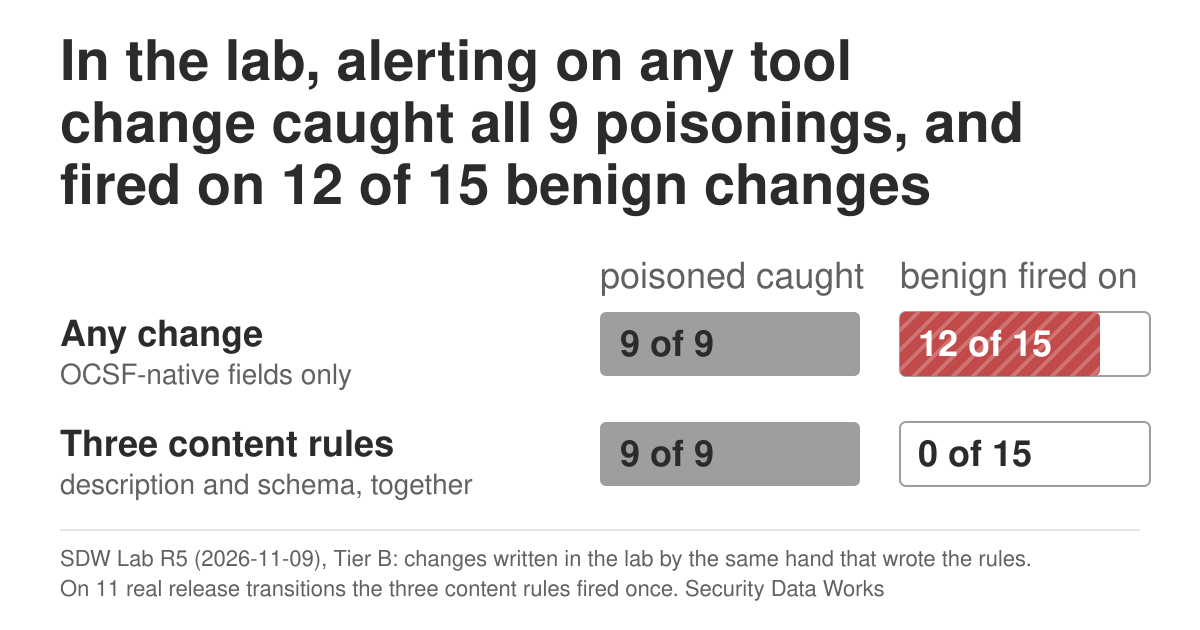
In this corpus the two change rules catch every poisoning because they catch every change, and the reason is structural. OCSF's ai_capability object carries fingerprints of a tool's description and schema, plus annotation booleans, cache, transport and identity fields, and it deliberately carries no description text; the object definition says it "carries no desc attribute" and that "consumers diff, the object does not assess" (OCSF objects/ai_capability.json at commit 6461440, re-confirmed on main 2026-11-16, Tier A). So the hidden instruction P2, the wording fix B1 and the clarifying sentence B2 all produce the same native signature, activity_id 8 with desc_fingerprint changed, on all three servers, and the schema widening P3 looks the same natively as its mirror, the narrowing B4. A rule built only on native fields is a change-inventory alert. I think that is useful as a review queue, especially because a static server produced no noise, but it is a different thing from a poisoning detection, and anyone writing it as one will page the on-call engineer for typo fixes.
R5 · native signatures
Five changes, two native signatures
Part of that is a property of the mutations the run used. None of them touched annotations, and a rug pull that also flipped readOnlyHint or destructiveHint would show up natively in is_readonly or is_destructive, which the real-release arm below gives a small example of. The body-aware rules also only see updates to a tool the differ already knew by name, because the detector fills its analysis fields only when there is a previous version, so a new tool, a renamed tool and a tool poisoned the first time it is listed all reach the queue with S1 alone; the B3 row's zero is true by construction, and in the real releases 22 of the 65 events were of that kind.
The body-aware rules separated the two sets completely, nine of nine poisonings and zero of fifteen benign changes, and I want to be careful with that number because the poisonings and the rules were written by the same hand. It is an upper bound on how good the rules look. Two details in the scores suggest the real margin is thinner. S4's similarity depends on description length: on everything/echo, whose description is the short "Echoes back the input string", the benign clarifying sentence scored 0.571 against a 0.5 threshold, while the hidden instruction appended to the two longer descriptions scored 0.681 and 0.744 and passed S4 untouched, leaving S3's keyword markers to catch it. So a slightly higher threshold, or a benign rewrite of a short description, turns S4 into a false-positive source, and a rug pull written as a small edit to a long description slips under it. And the rug-pull rewrite P1, which carried no keyword markers, was caught only by S4, so the rug-pull detection rests on that one length-sensitive heuristic; the two description rules together caught six of the nine poisonings, and S5 caught the other three. The widening check was only partly exercised too, because none of the three target tools carried enum, pattern, maxLength or format, so three of its branches never ran, and SEP-2106's opening of the schema to every 2020-12 keyword makes that branch list longer.
Real releases
What eleven real release transitions did to the rules
The authored corpus can't show how the rules behave on drift nobody wrote to test them, so a real-release arm took tools/list from consecutive published versions of the two reference servers, treated every release as benign, and counted how often the composite fires. An agent ran it on 2026-11-16, a week after the authored results were known, calling the 2026-11-09 detector and the frozen rule files unchanged through the DuckDB Sigma backend, so read it as post-hoc and not yet independently re-run (Tier B). All 13 planned versions started, seven of server-filesystem and six of server-everything, which gives 11 release-to-release transitions, and every version accepted the 2025-06-18 the snapshotter offered. Each version was installed by npx on 2026-11-16, which resolves transitive dependencies to today's versions, so every replayed version ran on MCP TypeScript SDK 1.32.2, and every server-filesystem version ran on zod 4.6.7 with zod-to-json-schema 3.25.2; the parts of a manifest that a dependency generates reflect today's libraries and not necessarily what each release advertised when it shipped.
Five of the 11 transitions changed nothing in the tool list at all, down to the full canonical JSON of every tool, and the other six produced 65 events between them (all counts below are as replayed), 12 tools added, 10 removed and 43 updated, with S1 firing on every one of them. Most of that drift is housekeeping: one server-everything release (2025.12.18 to 2026.1.14) retired ten tools and added eleven, mostly the same tools under new kebab-case names (getTinyImage became get-tiny-image), some with a verb added (printEnv became get-env), plus a few that aren't renames at all (add, zip and sampleLLM went away, get-sum, gzip-file-as-resource and two toggle-* tools arrived), which with one description edit accounts for 22 events. So S1 as a review queue would have put 65 entries in front of a reviewer across those 11 transitions, and S2, which ignores additions, removals and annotation-only changes, would have put 25, though 14 of those come from one server-filesystem transition (2025.8.21 to 2025.11.25) whose input-schema changes I can't separate from the dependency float: the 2025.8.21 package converts its schemas with zod-to-json-schema and doesn't pin zod, and under today's zod 4 that conversion returns an empty schema, which is a replay artifact and not something the maintainers shipped.
Real releases · review-queue volume
The composite fired on one of the 11 transitions, on one of only three description edits in those releases. The one firing was S4 on server-filesystem's read_media_file between 2026.7.4 and 2026.7.10, at a similarity of 0.494 against the 0.5 threshold. The description went from "Read an image or audio file. Returns the base64 encoded data and MIME type. Only works within allowed directories." to "Read a file and return it as a base64-encoded content block with its MIME type. Image and audio files are returned as image/audio content; any other file type is returned as an embedded resource. Only works within allowed directories.", and the output schema replaced its blob type with a branch for embedded resources. Both strings end with the same sentence about allowed directories, and without it the similarity would be 0.326, so the near-miss margin is partly that shared boilerplate. Since every release counts as benign, this is a false positive, and I'll call it that. I'd still want a reviewer to read the change, since the documented contract now names any file type, but that is a reading I formed after seeing the score, the manifest can't show whether the behaviour changed (the older output schema already allowed a blob type), and S4 would fire the same way on a full rewording that changed nothing. The three real description edits scored 0.494, 0.648 and 0.857, so one of three fell under a threshold set before seeing them, and a verdict decided by 0.006 would flip on a one-word edit either way.
S4 · similarity against the threshold
Two things in the real releases point at gaps in the detector rather than in the rules. Nine server-everything tools dropped additionalProperties: false from their input schemas in one release (2026.1.26 to 2026.7.4), which in JSON Schema means extra properties are now allowed, and S5 stayed silent because the pre-registered widening check only looks for a change to true or to a schema and treats a removed false as nothing; whether any client enforces either form is a question this run doesn't answer. That release moved its own declared dependency from zod 3 to zod 4, so the change probably comes from the release itself, though the SDK that converts the schema had also floated to 1.32.2, so I hold it a little less firmly than the description edits. And server-filesystem flipped move_file's destructiveHint from false to true, an annotation-only change whose new value lands in the native ai_capability.is_destructive field, though telling which way it flipped still needs the previous value carried in unmapped, the way S2 carries previous fingerprints. That flip was toward more caution, and a rug pull would flip it the other way, which this run still didn't test. Eleven transitions on two reference servers from one maintainer group is a small sample, and I wouldn't call one firing in eleven a false-positive rate, but it does settle that the composite isn't silent on real releases and shows what it fires on when it isn't.
Sigma over OCSF
Can it be a Sigma rule over OCSF?
On this corpus the alerting fits in Sigma comfortably while most of the discrimination happens before Sigma ever sees the event. S1 is pure Sigma over OCSF fields, and S2 nearly is, except that OCSF has no prev_ counterpart for a fingerprint so the previous value has to ride in unmapped, and those are the two rules that can't tell poison from maintenance. S3 is a Sigma keyword match over a description delta the producer computed and OCSF has nowhere to put. S4 and S5 compare a similarity score and a widening verdict the producer computed, and the widening logic lives in the detector's Python, outside the rule, which is also why the additionalProperties gap above is a detector fix and not a rule edit. So the shape that worked here is a stateful differ that emits OCSF Update events plus a few analysis fields in unmapped, with Sigma as the alert layer, which is close to what the OCSF object text describes.
Sigma over OCSF · the shape that worked
Running the rules also exposed a difference between pySigma backends, and it matches a finding from the ATLAS observable run the same day. The DuckDB backend (pySigma-backend-duckdb 0.1.4) pins pySigma below 2.0.0 while the current SQLite backend (2.1.1) needs 2.0.1 or later, so the two can't share a Python environment. Both compiled all five rules, including a field-reference comparison, a less-than and a zero-width-character regex, and returned identical matches on every rule. The third path, SQLite-emitted SQL run verbatim on DuckDB, compiled five of five and executed zero, because the SQLite backend backtick-quotes dotted OCSF field names such as `ai_capability.type_id` and DuckDB rejects backtick identifiers; the lab's earlier DuckDB execution work used that path successfully on flat column names, so it works until the field names start looking like OCSF. An exploratory probe after the run found two latent differences between the working paths that this corpus didn't trigger: the DuckDB backend leaves _ unescaped inside ILIKE, so the S3 value id_rsa also matched "idXrsa", and it omits the COALESCE(…, 0) the SQLite backend wraps around a negated field reference, so an event with null previous fingerprints matched S2 on one path and not the other. In the ATLAS run, the same SQLite backend's LIKE was case-insensitive on SQLite and case-sensitive on DuckDB, which cost a prompt-injection rule all of its recall (atlas-ocsf-observables/RESULTS.md, Tier B). That makes three cases in one day where the same Sigma rule returned a different answer depending on the engine it ran on, and a fourth where it wouldn't run at all, and I worked through the general version of the problem in Same detection, different answer, so I'd test any Sigma rule on the engine it will actually run on before trusting a result from another.
Bottom line
What I'd run
Based on this, I'd put a snapshotter on every MCP server a team's agents can reach, hash with JCS, keep each snapshot, and send every S1 change into a review queue and not to a pager, since on static servers the queue stays quiet and on real releases it fills at the pace the maintainers ship, which in the eleven replayed transitions meant six busy releases and five empty ones. One limit I'd keep in view is that the snapshotter is a separate client with its own identity, and the 2026-07-28 cacheScope: "private" field exists because a tools/list result can differ per caller, so an out-of-band snapshot proves what the server told the snapshotter; diffing the list the agent's own client received, at a gateway or in the client, is the stronger design (my reading from the spec text, Tier D). On top of that I'd flag the body-aware composite as a priority marker inside that queue, accepting that one of three real description edits fell under its threshold, I'd run the S3 markers over the full description of every newly listed tool as well, since the composite can't see new or renamed tools, and I'd fix the widening check to treat a removed additionalProperties: false as a widening and to compare output schemas too. I'd log the description text somewhere a reviewer can read it, because the OCSF event will only carry the fingerprint, and I'd add a rule on annotation flips toward less caution, is_destructive going false or is_readonly going true, which reads native fields plus the previous values in unmapped and needs no similarity score or widening logic. And because the Postmark case lives in code, I'd pair all of this with controls on the implementation side, Verify AI Artifacts (AML.M0014) and an AI bill of materials (AML.M0023), which are the two mitigations ATLAS maps to the rug-pull technique, knowing that the artifact-inventory question has problems of its own.
Bottom line: tool-description poisoning does show up as a diff, and taking the diff costs a few milliseconds per server on an open connection, but the OCSF-native signal can't tell a poisoned description from a typo fix, so the discrimination has to come from fields the producer computes and the schema has no home for. The body-aware rules separated nine authored poisonings from fifteen authored benign edits and then fired on one of eleven real release transitions, on a maintainer's rewrite of one tool's description and output schema that scored 0.494 against the 0.5 threshold, a false positive by the arm's own rule that I'd still want a reviewer to read and can't classify from the manifest alone, which is enough for me to put the rules in front of a reviewer and not enough to let them page anyone. The next run I'd want is the same arm with dependencies pinned to each release date, over many more servers, including the semver releases of these two packages and ones that speak the 2026-07-28 revision and change their tool lists at runtime; the lab's T8a fixture server on the Python SDK 2.3.0 already speaks 2026-07-28, so that part is cheaper than it sounds.
Sources
Sources and evidence tiers
| Claim | Source | Tier |
|---|---|---|
| Postmark case, techniques, mitigations, case-study types | ATLAS v2026.10 (ATLAS-2026.10.yaml), re-derived 2026-11-16 | A |
| 31 residual incident steps, T0110.001's one step among them | control_burndown_2026.10.json, 2026-11-09 | B |
| Tool-chain poisoning, registry hash verification | CSA research note, draft 2026-03-27, re-read 2026-11-16 | B |
| Deterministic order SHOULD, SEP-2549, SEP-2575, SEP-2106 | MCP 2026-07-28 changelog, re-read 2026-11-16 | A |
ai_capability has no description text; "consumers diff" | OCSF ai_capability.json, main 1.10.0-dev, read 2026-11-16 | A |
| RQ17 | security-data-literature-review, LITERATURE-HYPOTHESIS-GAP-ANALYSIS.md | D |
| Rule table, null drift, hashing, latency, backend paths | Lab R5, 2026-11-09, mcp-manifest-drift, pre-registration sha256 d88271c0…a2dcc1, frozen 2026-11-09T22:59:06Z by an agent, independently re-run | B |
| Real-release arm, 11 transitions, dependency float | Lab R5 real-release arm, 2026-11-16, RESULTS-RELEASE-ARM-2026-11-16.md, post-hoc, not yet re-run | B |
| Signed, versioned tool definitions (ETDI) | arXiv 2506.01333, June 2025, read 2026-11-16 | B (preprint) |
Case-sensitive LIKE on DuckDB | Lab R1, 2026-11-09, atlas-ocsf-observables | B |
| Signing and diffing answer different questions | My reading | D |
