
AI attack surface · Part 1
Thirteen ways AI gets deployed, on one map
Some years before "AI attack surface" was a phrase I heard every week, I was building composite asset and user context at a regulated utility out of five security tools, an EDR, a vulnerability scanner, the firewall and VPN, an NDR sensor and a network access control system, for a security data science role I had founded there, because the detections we wanted needed identity and asset data fused across all of them. None of those tools was mine, so the work was mostly getting consistent, joinable data out of whichever team owned each one, and that taught me early that a security-data practice collects from the parts of a system it can reach and reasons about the rest through whatever someone else agrees to export. I keep coming back to that whenever the question of drawing an organization's AI attack surface comes up, because for most organizations an accurate drawing turns out to be mostly a diagram of systems they rent, with a few pieces they run sitting at the edges.
This first article in a series about that surface takes the thirteen ways AI tends to get deployed in an ordinary organization, puts each one on the most detailed of the three public versions of the SAIF map, and marks which parts the organization operates, which it shares with a vendor, and which it only sees through a vendor's export, because I think that ownability pattern, more than the component list itself, decides where a security-data team can collect.
Reading time: about 12 minutes. Evidence tier: A here means primary files read directly at a pinned commit (the CoSAI risk-map YAML and repository docs at 622605a1, read 2026-11-16), and the map itself is working-group content and not a ratified standard; B for Google's description of its own SAIF pages, fetched 2026-11-16; D for every cell in the ownability grid, which is a first-pass reading.
The map
The map exists in three versions
The version I see most often in public decks and vendor posts is Google's Secure AI Framework (SAIF) components page, which as fetched on 2026-11-16 still shows twelve components under four headings: three for data, four for infrastructure, three for the model, and two for the application, one of which is called "Agent". That single box is the page's whole treatment of agents, defined as "a service, application, or additional model called by an AI application or model to complete a specific task (also known as 'tool use')". Google's separate "Focus on Agents" page extends it into four stages, Application and Perception, Reasoning core, Orchestration and Response rendering, with system instructions and user queries under the first stage and memory, tools, RAG content and optional auxiliary models under orchestration. Neither page carries a date or a version number, which is one reason I cite the CoSAI commit for every component claim below.
The third version is the one I use, the Coalition for Secure AI Risk Map (CoSAI-RM) in CoSAI's secure-ai-tooling repository. It grew out of Google's SAIF risk map, and the file still shows that lineage, since components.yaml opens with a Google LLC copyright line and says its controls "all align with the six core elements of Google's SAIF", though CoSAI publishes it under its own name and none of the repository documents read for this piece calls it SAIF. At commit 622605a1, which was still the head of main when checked on 2026-11-16, risk-map/yaml/components.yaml declares 42 components in 4 categories and 11 subcategories. The README dates the first step of that growth to October 2025, when the map broke "the previously simplified 'Agent/Plugins' box" into a reasoning core, orchestration and agent-side handling, and the identity subcategory, the separate External Tools category and the audit record repository are not in the README's account, so they appear to have arrived since. Where Google's components page has one agent box, 18 components now sit in CoSAI's agent, orchestration and tool subcategories, and the identity and audit components are ones Google's pages do not show as components at all.
So "the SAIF map" means one box, four stages or 42 components depending on which page a reader lands on, and I chose the CoSAI version for reasons its own documentation gives. The repository's reuse contract says entity IDs are "closed schema enums" that resolve consistently across the YAML, the generated tables and the site, and it also says the YAML carries no per-file version, so the git history is the change record and a commit is the only stable thing to cite. The same contract is candid about its limits: the mappings to MITRE ATLAS, NIST AI RMF and OWASP are the working group's "best-effort interpretation" that no external framework maintainer has reviewed, and the catalogs "are not exhaustive and are not a substitute for a threat model of your own system". I find that last sentence useful, because a deployment-surface map is one small piece of the threat model it says you still owe yourself.
The map · three resolutions
For readers who know Google's four agent stages, this is how they land on the CoSAI IDs:
| Google "Focus on Agents" | CoSAI component at 622605a1 |
|---|---|
| Application and Perception | componentApplication, componentApplicationInputHandling, componentAgentInputHandling |
| System instructions; user queries | componentAgentSystemInstruction; componentAgentUserQuery |
| Reasoning core | componentReasoningCore (the models behind it are served by componentModelServing in my reading; the file draws no edge between the two) |
| Orchestration: memory; RAG content | componentMemory; componentRAGContent |
| Orchestration: tools | most of the External Tools category (componentTools, componentToolServer, the tool-side handling and authorization enforcement) plus componentToolRegistry |
| Orchestration: auxiliary models | no separate component; a safety classifier is a second instance of the model and serving components |
| Response rendering | componentAgentOutputHandling |
| Not components on Google's pages | the identity subcategory (componentIdentityProvider, componentAuthorizationPolicyDecisionPoint, componentFederationProxy), the consent surfaces, the network policy enforcement points, componentAgentToolTransport, componentIsolationRuntime, componentToolHosting, componentAuditRecordRepository |
The last row is the part I would point a security-data team at first, because the identity, enforcement and audit components are most of what a security team can instrument, and they are absent from Google's twelve-box version.
The surfaces
Thirteen ways AI shows up
The thirteen deployment surfaces are this series' own grouping of how AI arrives in an organization, and every later article uses them as shared vocabulary:
- S1 AI features a SaaS vendor switched on inside an application you already use.
- S2 Enterprise assistants (Microsoft 365 Copilot, ChatGPT Enterprise, Claude Enterprise, Gemini Enterprise).
- S3 Browser AI, both extensions and AI browsers.
- S4 IDE and coding agents (GitHub Copilot, Cursor, Claude Code, Codex, Windsurf), including the remote, vendor-hosted MCP servers they call, where MCP (the Model Context Protocol) is the open protocol an agent uses to discover and call outside tools and data sources.
- S5 MCP servers and other agent tools the organization builds and runs itself.
- S6 Self-hosted low-code agent and workflow builders (n8n, Langflow, Flowise); hosted builders such as Copilot Studio, and the cloud tiers of the others, look more like S2 or S7.
- S7 Managed AI build platforms (Microsoft Foundry, Amazon Bedrock including AgentCore, Google Vertex AI).
- S8 Direct model API consumption and AI gateways.
- S9 Self-hosted model serving (vLLM, Triton, Ollama running as a server).
- S10 Local open-weight models on laptops (Ollama, LM Studio, llama.cpp).
- S11 Models fine-tuned on the organization's data, and their pipelines.
- S12 RAG pipelines and vector stores.
- S13 AI inside security tools, from vendor classifiers to agentic SOC products.
CoSAI's own exploration guide has a mode that works the same way round, taking an activity such as "I use an AI coding assistant" and routing it to the risks that apply, and this article makes that move for thirteen activities at once and asks who runs each part.
The grid
Who operates each part, surface by surface
Every component class present on a surface got one of three codes, read from CoSAI's component descriptions against the way that surface is commonly deployed. O means the organization instantiates and operates the component on that surface. S means it is shared, so the organization configures or feeds it while a vendor runs it, the way an enterprise assistant indexes your documents into the vendor's retrieval store. V means a vendor operates it and the organization sees only what the vendor exports. The grid rolls those per-component codes up to CoSAI's 11 subcategories, so a cell that reads O/S holds some components the organization runs and some it shares, and the n/k beside each code says how many of the subcategory's k components stand behind it.
Ownability grid · 13 surfaces × 11 CoSAI subcategories
| Surface | Data (4) | Model training (3) | Model core (2) | Orchestration (4) | Registries (2) | Deployment (5) | Identity (3) | App core (5) | Agent (8) | Tool path (5) | Tool network (1) |
|---|---|---|---|---|---|---|---|---|---|---|---|
| S1 AI features in SaaS apps | · | V1/3 | V1/2 | · | · | V1/5 | S1/3 | V2/5 | · | · | · |
| S2 Enterprise assistants | S1/4 | · | · | S2/4 | · | V1/5 | OS3/3 | · | SV3/8 | S1/5 | · |
| S3 Browser AI | · | · | · | · | · | · | · | S1/5 | SV3/8 | S1/5 | · |
| S4 IDE and coding agents | · | · | · | · | O1/2 | O1/5 | S1/3 | O1/5 | OV8/8 | OS2/5 | · |
| S5 MCP servers you run | · | · | · | · | O1/2 | O3/5 | O2/3 | · | O1/8 | O5/5 | O1/1 |
| S6 Self-hosted low-code builders | · | · | · | O4/4 | OV1/2 | O2/5 | O1/3 | O1/5 | O2/8 | O2/5 | · |
| S7 Managed AI build platforms | O2/4 | S2/3 | SV2/2 | S1/4 | SV2/2 | O1/5 | O2/3 | O1/5 | S1/8 | S1/5 | · |
| S8 Direct model API and gateways | · | · | V1/2 | · | · | O1/5 | O1/3 | O2/5 | · | · | · |
| S9 Self-hosted model serving | · | O1/3 | O2/2 | · | O1/2 | O4/5 | O1/3 | O1/5 | · | · | · |
| S10 Local open-weight models | · | O1/3 | O2/2 | · | V1/2 | O2/5 | · | O1/5 | · | · | · |
| S11 Fine-tuning pipelines | O4/4 | O3/3 | O1/2 | · | OV1/2 | O1/5 | O1/3 | · | · | · | · |
| S12 RAG pipelines and vector stores | O3/4 | · | OV1/2 | O3/4 | · | O1/5 | O1/3 | O1/5 | · | · | · |
| S13 AI inside security tools | S1/4 | V1/3 | V2/2 | S1/4 | · | · | S1/3 | · | SV2/8 | S1/5 | · |
622605a1. Component names and IDs are CoSAI's (Apache-2.0); the codes are this series' (Tier D), and reusing CoSAI's content here implies no endorsement by the Coalition or its members.Reading the grid
Three groups, and two rows with no identity
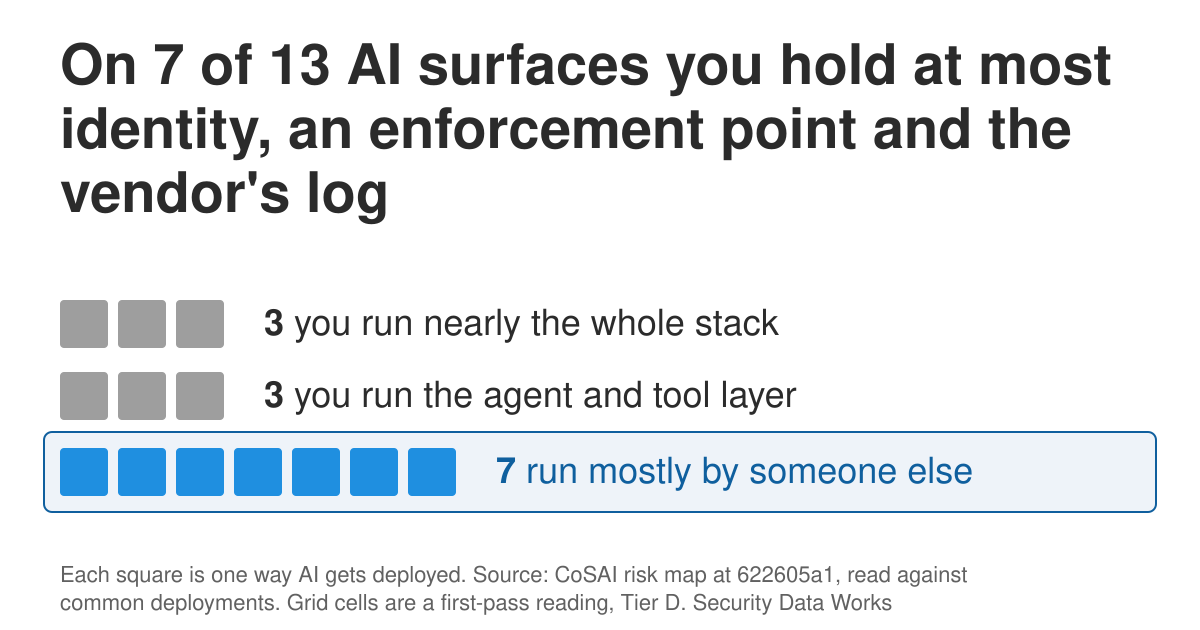
Read across the rows and the thirteen surfaces fall into three groups. On three of them a team inside the organization runs nearly everything it instantiates: self-hosted serving (S9, all ten listed components) and fine-tuning pipelines (S11, every component except a model registry that may be a vendor's), where that includes the model, and RAG pipelines (S12), where the team runs the data and retrieval side around an embedding model that is usually rented. On three more, the organization runs the agent and tool layer while the model sits elsewhere: coding agents (S4, where the model behind the harness is the vendor's and the isolation runtime is usually missing), MCP servers it runs itself (S5, all thirteen listed components operated, none of them a model), and self-hosted low-code builders (S6, twelve of thirteen listed components operated plus a node catalog the builder vendor defines, calling a rented model through an API).
On the remaining seven the organization holds much less than the diagrams suggest. Three of them, SaaS AI features (S1), browser AI (S3) and AI inside security tools (S13), have no component the organization operates at all in this reading, only shared and vendor-run cells. Enterprise assistants (S2) add the identity provider and the policy decision point, which is conditional access and group policy, and share almost everything else with the vendor. Managed build platforms (S7) and direct API use (S8) leave more in the organization's hands, cloud IAM, the audit log and the gateway on both, the data stores on S7 and the application on S8, but in both the serving of the model belongs to the vendor, and on S7 the model itself is at most shared through a managed tuning job. Local open-weight models (S10) are the odd one out, because the grid marks nearly every component O while the owner column in the underlying table reads "end user", which in practice means an individual on a laptop with no team behind them.
What I take from that reading, more than the grouping, is how small the organization's footprint gets once the model is rented. Across the seven, the most a security team holds is the identity provider, an egress or gateway enforcement point of its own if it has routed the traffic through one, and whatever audit log the vendor exports, and only S7 and S8 give it all three in this table; S1 and S13 share even the identity provider, and S3 and S10 have none of the three. So collection on those surfaces starts from whichever of the three exists, whatever the vendor's own console shows, and whether the exported log carries the content of an interaction or only who changed which setting varies a lot by product and is often off by default, which the series takes surface by surface.
The other thing I take from it is that identity is missing from two rows. Browser AI has no identity row because, once it is running, the agent acts inside the user's logged-in sessions, so its actions produce no grant or policy decision of their own, though the sign-in to the assistant itself may still show up as an OAuth consent; and local models have none because a model served on loopback from a laptop has no identity plane of its own. Those two, with the self-hosted builders that business teams stand up outside central IT, are surfaces where the asset and SBOM inventories many teams reach for first have little to start from, so discovery there leans on the endpoint, on process, port and extension inventory, which a later piece in the series works through.
CoSAI's own modelling rule helps explain why a grid like this has to be drawn separately from the map. Its component guide defines a component as "an architectural shape", says that the identity provider a tool server demands is a different instance from the agent's own while both are the same component, and states that "a second instance does not earn a second component". That is the right rule for a framework that has to stay stable across deployments, and it means the map answers the ownership question only at the level of ecosystem roles, through the personas it attaches to every risk and control, and leaves open which instance of a shape you run and which one a vendor runs, which is the question a collection plan has to answer first.
Limits of this map
What this sets up
The ownability pattern is also the cost side of a decision the next piece, Rent or own, takes on directly, whether to own a surface or rent it, sized to the team that has to run it. Owning more of the grid means owning the patching, logging, identity and detection for every O cell, and renting moves that work into the vendor's controls and into whatever the vendor chooses to log, so the trade is which visibility gaps you accept. I'd rather a reader carry the grid into that argument than take my word for the conclusion.
Bottom line: the most detailed version of the SAIF map is a map of the system you would build, the thirteen ways AI arrives are mostly systems you rent, and on most of them the most you hold is identity, an enforcement point of your own and whatever log the vendor exports, so that is where I would start drawing the collection plan, with the surfaces that lack even an identity row handed to endpoint discovery.
Sources
| # | Source | What it supports | Tier |
|---|---|---|---|
| 1 | CoSAI secure-ai-tooling, risk-map/yaml/components.yaml, risks.yaml, controls.yaml and personas.yaml at 622605a13fafaa2784acbdbe3f8d23ee22da4be7 (head of main on 2026-11-16) | 42 components, 4 categories, 11 subcategories; 18 agent, orchestration and tool components; Google copyright and SAIF alignment lines; personas on every risk and control | A in the sense of primary files read at a pinned commit; working-group content, not a ratified standard |
| 2 | CoSAI risk-map/README.md, same commit | Name "Coalition for Secure AI Risk Map (CoSAI-RM)"; October 2025 "Agent/Plugins" change | A (same) |
| 3 | CoSAI risk-map/docs/guide-components.md, same commit | Component as "architectural shape"; instance and component rule | A (same) |
| 4 | CoSAI risk-map/docs/reuse-contract.md, same commit, read 2026-11-16 | Stable closed-enum IDs; no per-file version; mappings best-effort and unendorsed; catalogs not exhaustive; no endorsement on reuse | A (same) |
| 5 | CoSAI risk-map/docs/exploring-the-risk-map.md, same commit, read 2026-11-16 | Activity-first query mode | A (same) |
| 6 | Google SAIF, "Components", https://saif.google/secure-ai-framework/components, fetched 2026-11-16 | 12 components, single Agent box, definition quote, no date | B |
| 7 | Google SAIF, "Focus on Agents", https://saif.google/focus-on-agents, fetched 2026-11-16 | Four stages and their sub-components, no date | B |
| 8 | Security Data Works research strand on deployment surfaces and the SAIF/CoSAI map (2026-11-09) | The thirteen surfaces, the per-component ownership table behind the grid, the Google-to-CoSAI reconciliation; counts and quotes independently spot-checked, the ownership cells not | D for the cells |
| 9 | Security Data Works research strand on shadow-AI discovery (2026-11-09) | Which discovery methods reach browser AI, local models and self-hosted builders | B for documented features, D for the coverage marks |
