
AI attack surface · Part 9
Finding shadow AI: sixteen methods and the join
A lab run on the evening of 9 November put nine kinds of AI onto one simulated developer workstation, and one of the osquery queries pointed at it was a file listing of the user's home directory with osquery's recursive wildcard, /home/dev/%%. It came back with 15,618 regular files, and not one of them sat under .ollama, .vscode, .config or .cursor, because osquery expands the first level of that wildcard with a shell-style glob that doesn't match names starting with a dot, and those four directories sat directly under the home directory, which is exactly where a local model store, an IDE's extensions and the MCP client configs in the fixture lived. A second query written afterwards with the explicit path, .ollama/models/blobs/, returned all five of the Ollama blobs, including the 638 MB of weights, and the write-up puts the lesson in one line, "a fleet query that does not already contain the path of the thing does not find the thing."
That is a small lab result, but I think it carries most of what this part of the series has to say about finding AI nobody approved. Shadow AI discovery is a join across at least five telemetry families, which are the network, the endpoint, the identity provider, SaaS admin consoles and the cloud control plane, and the family many programmes start with, the network, because the SSE or CASB is already deployed and ships a generative-AI app category, sees remote AI use well and local AI use barely at all. The endpoint sees the local half, but only as far as someone has written the paths and table names into the queries, and the identity and SaaS families see things neither of the other two can, such as an AI app granted access to a mailbox, or an AI feature a SaaS vendor switched on for every user. So this article walks sixteen discovery methods, says for each what it finds, what it misses and whether anything stands behind that beyond documentation, and then argues, as an inference the lab has not built or tested, that the engineering is mostly identity resolution across those sources, with the detection logic on top fairly simple once the join exists.
Reading time: about 20 minutes. Evidence tier: B for the two lab runs this article leans on, T1 for discovery methods and R4 for SBOM tooling, each pre-registered and run by an agent session on one host, then re-run by a second agent session; A for the SEC filing and for OCSF 1.9.0 facts read from the schema; B for what each vendor page says its feature does, every page re-read on 2026-11-16, and A for the CoSAI risk map in the sense of primary files read at a pinned commit on 9 November, working-group content and not a ratified standard; C for vendor statistics, with the bias flagged; D for the method-by-surface grid, the effort grades and the recommended sequence, which are an agent's single draft.
The incident class
Why this is a security question
CB Financial Services filed a Form 8-K under Item 1.05, the material cybersecurity incident item, saying that on 5 May 2026 its bank subsidiary "became aware of an internal incident involving the handling of certain non-public customer information using an unauthorized artificial intelligence-based software application", and that the customer information disclosed included names, Social Security numbers and dates of birth. The company determined the event was material on 7 May, and the filing was signed on 11 May. The filing does not say what the application was or how the data reached it, so it can't tell anyone which discovery method would have caught it, but it does settle that unsanctioned AI use can be a reportable incident and not only a governance nuisance.
The one organisational study in the literature reviewed for this series tempers the severity reading without contradicting it. A CSIRO team interviewed leaders at 27 Australian critical-infrastructure organisations between December 2025 and April 2026, and found informal AI use widespread, incidents real but "limited in scope and severity", and "no evidence of shadow agentic AI", with usage "primarily interactive, chat-based". The same interviews describe vendors who "were effectively turning [features] on" inside enterprise tools without assessment, and security teams with "some level of awareness ... but not a great detail" of those capabilities (Chhetri et al., arXiv 2606.00088, a preprint under review, Tier B). So the fair reading seems to be low severity per event, real cumulative exposure, and an embedded-AI problem that security teams are aware of without having detail on, which matters for the methods below, because embedded AI is the surface the grid below gives the network nothing on, though that is reasoning no lab run has tested, as Part 10 says.
The CoSAI risk map has two risks for unregistered AI directly, Shadow and Unknown Agents (unregistered agents operating "with inherited or valid credentials outside identity lifecycle controls") and Zombie and Shadow MCP Servers, and the controls that discovery actually feeds are its two inventory controls, one for models and data and one for agents, with a third for tool registries. In those terms this article is about how to populate an inventory when nobody registered the thing being inventoried.
One host
What a lab workstation showed
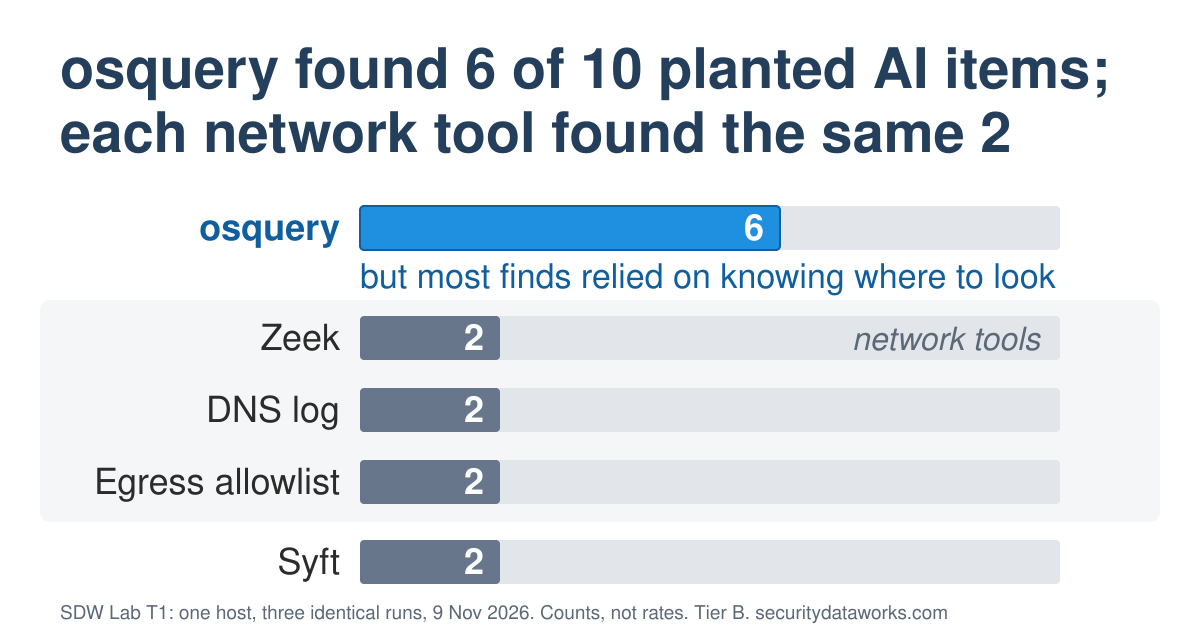
T1 is the one place in this series where the methods were run side by side against known ground truth. The workstation carried an Ollama runtime, a small local server speaking the OpenAI chat API, the Cline coding extension (4.1.26), two MCP client config files, a Chrome extension manifest, eight Python AI packages in a virtual environment, a GGUF and a safetensors model file, the same TinyLlama weights again inside Ollama's own store, and outbound calls to eight model API hosts and five AI SaaS sites, alongside six benign controls built to look similar. Five methods went over it: Zeek 8.0.11 on the workstation's network interface, a resolver's DNS log, osquery 5.24.0 as endpoint inventory, Syft 1.55.0 as the software bill of materials, and an egress allowlist. Every method's set of fired rules was identical across three fresh runs, and three re-runs by a second agent session reproduced them exactly.
| Planted on the workstation | Zeek (network tap) | DNS log | osquery | Syft | Egress allowlist |
|---|---|---|---|---|---|
| Ollama runtime on port 11434 | partial (only a second machine's calls to it, plus the registry pull) | partial (registry name only) | found (process and listening port) | missed | partial (registry flagged) |
| Local OpenAI-compatible server | partial (a second machine's calls) | missed | partial (port, no owner) | missed | missed |
| IDE extension (Cline) | missed | missed | found (vscode_extensions) | missed (0 components) | missed |
| MCP client configs (2 files) | missed | missed | found (only because the query named the paths) | missed (0 components) | missed |
| Browser extension | missed | missed | found (chrome_extensions) | missed (0 components) | missed |
| Python AI packages (8) | missed | missed | found (8 of 8 with the venv path named; 0 of 8 without) | found (8 of 8 with PURLs) | missed |
| Named model files (GGUF, safetensors) | missed | missed | found (by extension) | found (as models, no PURL) | missed |
| Same weights in Ollama's store | missed | missed | missed (hidden-directory glob) | missed | missed |
| Calls to 8 model APIs | found (8 of 8 by SNI) | found (8 of 8) | missed (no rule written) | missed | found (8 of 8) |
| Visits to 5 AI SaaS sites | found (5 of 5) | found (5 of 5) | missed (no rule written) | missed | found (5 of 5) |
| Found, of 10 | 2 | 2 | 6 | 2 | 2 |
The shape is lopsided in the way the thesis predicts. The three network methods each found the two remote surfaces in every run. Zeek saw the local runtimes only when a second machine called them, and only because the lab bound them to its bridge network, where Ollama's default is loopback, while the DNS log and the allowlist saw only the registry pull, because a runtime used solely from its own host never crosses the wire, and the registry pull is a footprint a runtime with its models already on disk never leaves. osquery was the only method that reached the IDE extension, the MCP configs and the browser extension at all. But five of the ten cells in the osquery column depended on knowing where to look, and two of its six finds rest on fixes made after the run, one to the scoring script and one to a table name, so counting only what worked as pre-registered it scores four, though the better evidence for what an untuned team would see is elsewhere in the column, where the undirected package query found none of the eight packages and the home-directory glob missed the store. Syft found the packages and the named model files and reported nothing for the extension directories or the config files. All five together missed the weights sitting in Ollama's store, which is the same artifact R4 found no SBOM tool could see. False positives were limited to the one expected in advance, a benign Python file server on port 8080 tripping the port rules, and no domain, package, process, extension or model-file rule fired on a control.
One host · why the broad query missed
So on one host, with planted surfaces, the network gave a clean view of remote AI use and almost none of local use, and the endpoint gave the only view of configs and extensions and the only full view of a local runtime, exactly as wide as the query list someone maintained. That second half is why the endpoint methods below get the most space, since they reach the most and break the most quietly when a path moves.
The methods
Sixteen methods, and what stands behind each
The series' research catalogued sixteen methods, each with what it finds, what it misses, its false positives, the telemetry it needs, the OCSF class its output lands in and an effort grade. The table below compresses that into one view and adds a column for what stands behind each row: a first-party lab run, vendor documentation only, or judgement. Eight rows have a run behind them, every run on one host, six rest on vendor documentation and two on judgement alone. A run behind a row means the lab exercised the method's core mechanism once, on one host, and in several rows on a narrower case than the row describes, which the last column says. Surface codes are the series' thirteen surfaces, S1 embedded SaaS AI through S13 AI inside security tools, as laid out in Part 1, with S5 and S6 read a little wider than Part 1 has them, to take in remote MCP servers and hosted builders.
| Method | Finds | Misses | OCSF class | Effort | Behind it |
|---|---|---|---|---|---|
| M1 SSE/CASB app catalogue | Web use of catalogued AI apps from managed devices on the SSE path; with a tenant header, personal-account attempts | Server-side AI in sanctioned SaaS (S1); off-network and personal devices; cloud workloads; local models after download; stdio MCP | HTTP Activity (4002), Web Resources Activity (6001) | L | Docs |
| M2 DNS query logs | AI domains resolved by anything on the corporate resolver, including servers and the one-time model download; personal-plan Copilot by its plan-specific hostname | Encrypted DNS, off-network devices, account attribution | DNS Activity (4003) | L | T1 run (resolver log, one workstation) |
| M3 Egress to model APIs | Server, CI and container calls to inference APIs; bring-your-own-key agents | Private endpoints to the provider's own AI service; unlogged cloud NAT; models behind a sanctioned gateway | Network Activity (4001), HTTP Activity (4002) | M | T1 run (workstation, SNI and an allowlist script; no proxy, NAT, flow log or server source) |
| M4 Browser extension inventory | AI extensions on managed browser profiles (S3) | Standalone AI browsers, personal devices, extensions that add AI in a later update | Software Inventory Info (5020) | L-M | T1 run (authored manifest) |
| M5 Process, app and port inventory | Local runtimes, desktop AI apps, CLI coding agents, local builders, serving stacks on servers | AI inside generic processes; stdio MCP servers running as node or python; renamed binaries | Process Activity (1007), Process Query (5015), Network Connection Query (5012) | M | T1 run |
| M6 Package and model-file inventory | AI packages; weights by extension and path, including model stores when named | The Ollama store under a broad glob; weights renamed to an innocuous extension | Software Inventory Info (5020), File Query (5007) | M | T1 run (store found post-hoc), R4 |
| M7 SBOM and SCA over repos and images | AI SDK dependencies; MCP servers as ordinary packages with advisories; named GGUF files | That a package is an MCP server; the Ollama store; IDE extensions; same-name code swaps | Software Inventory Info (5020) | L | R4, T1 run (directories only, no image or repo) |
| M8 OAuth consent grants | AI apps granted delegated access to mail, files or calendars; builder and connector grants | Copy-paste and upload; local agents using the user's own session; API keys | Authorize Session (3003), User Access Management (3005), API Activity (6003) | L-M | Docs |
| M9 Secrets scanning | Committed AI provider keys in code, workflow exports and config | Keys outside scanned repos; managed-identity access; anything local | Detection Finding (2004) | L | Docs |
| M10 IDE extension inventory | AI coding extensions across VS Code and its forks | JetBrains and editor-native AI; CLI agents | Software Inventory Info (5020) | L | T1 run (one extension, one edition) |
| M11 MCP config files | Declared MCP servers per client, with command, arguments and URL | Unlisted clients; renamed paths; servers passed on the command line or contributed by extensions | File Query (5007), Device Config State (5002) | M | T1 run (Cursor and Claude Desktop paths), R4 (post-hoc) |
| M12 GPU usage | Serving and training on servers and cloud GPU instances | Apple Silicon laptops; CPU-only inference; managed services | Device Inventory Info (5001); metrics outside OCSF | M (servers), H (laptops) | Judgement |
| M13 Procurement and expense | Paid seats and API spend, with the budget owner | Free tiers; unexpensed personal cards; marketplace invoices | None | L | Judgement |
| M14 SaaS toggles and admin audit | Which tenants have AI features enabled, for whom, since when | The use itself, in many products; AI added without a toggle | Device Config State (5002) or Device Config State Change (5019), a stretch | H | Docs |
| M15 Cloud control plane and audit | AI resources in known accounts; inference where audit logging covers it | Inference paths logged only as default-off data events; accounts nobody knows about | API Activity (6003), Cloud Resources Inventory Info (5023) | M | Docs |
| M16 Service and EASM scanning | Serving stacks, builders and vector stores listening on a network interface | Anything bound to loopback, which is Ollama's default; services behind authentication | Network Activity (4001) or a finding | L-M | Docs (Ollama default bind only) |
A few of the rows need more than a table cell, because the details are where a programme succeeds or fails.
The catalogue in M1 is where many programmes start, and it's a reasonable place to start. Microsoft documents a generative-AI category in Defender for Cloud Apps to which it has "added more than a thousand generative AI-related apps", each scored on "90+ risk factors", and the same page is candid that monitoring third-party AI sites through Purview needs devices onboarded to Purview (Tier B for what the feature does; the catalogue size is Tier C as a coverage claim). A domain match says claude.ai or chatgpt.com was used and nothing about whose tenant, and that attribution gap is what tenant-restriction headers close. Anthropic's anthropic-allowed-org-ids header, which a TLS-inspecting proxy injects, is available to Enterprise plans and Console organizations, covers web, desktop, API key and OAuth token access, and answers a request from a non-allowlisted organization with an HTTP 403 carrying tenant_restriction_violation, while a malformed header gets a 400. Each response carrying that error code is a personal-account or foreign-tenant attempt, and where the proxy logs the user and enough of the response to tell this 403 from others, the blocked requests are a discovery signal in their own right, though that is my inference, since the page documents the response and not the logging, and it works only where the proxy decrypts. OpenAI is reported to offer a similar header for ChatGPT Enterprise, ChatGPT-Allowed-Workspace-Id, though neither the header name nor its blocked response was confirmed at OpenAI's own page for this article.
M1 · the tenant header
The consent-grant query (M8) catches something the network methods in this list don't, which is an AI tool reaching into corporate data with delegated access. In Entra, consent grants are reviewable per enterprise app and exposed through Graph's oauth2PermissionGrants, and Google Workspace's OAuth log events record grants and API calls with application name, client ID, scope, user and IP, and now carry a "By an agent" flag with agent ID and name fields, which the page says are populated today only for Google Workspace Studio flows, with other agents to follow, so I wouldn't yet build a third-party-agent detection on it. A single scheduled query against either, joined to the same AI app list the catalogue uses, is cheap, and it reaches assistants' connectors, builder connections and AI add-ons. It misses everything that doesn't use OAuth, which includes copy-paste into a chat window and file upload, and given that the CSIRO interviews describe use as mostly interactive chat, those are probably the more common paths, so it complements the catalogue and doesn't replace it.
Secrets scanning (M9) is mostly a matter of filtering the secrets-scanning report you already have to AI providers, and the gaps sit in the details. GitHub's pattern data lists OpenAI, Anthropic (five token types), Hugging Face, Groq, Mistral, Cohere, DeepSeek, xAI, Perplexity, Azure OpenAI and Google Gemini keys, every one with push protection except the Gemini API key, which has neither push protection nor a validity check. The working assumption here, which GitHub doesn't document, is that a Gemini key shares the generic Google API key format, so a scanner can't tell it from a Maps key without probing it (Tier D).
None of the sixteen is a content-inspection method, which is a gap in this catalogue and not a judgement that DLP doesn't work. The CSIRO interviews attribute most detection of shadow use to monitoring and DLP tooling, naming Microsoft Defender, Purview, CrowdStrike and Netskope, with one organisation reporting more than 1,300 DLP events in a month and another calling it effective only "to some extent", and for the paste-and-upload path, which M8 can't see and the catalogue sees only as a destination, inline or endpoint DLP is the method that sees what was sent. It isn't graded against the thirteen surfaces here, and the lab hasn't run it.
IDE extension and MCP config inventory (M10, M11) is where the endpoint earns its place. osquery's vscode_extensions table now has a vscode_edition column covering VS Code, Insiders, VSCodium, Cursor, Windsurf, Trae, Antigravity and code-server, so one query covers most of the VS Code forks, and VS Code's enterprise policies include ChatApprovedAccountOrganizations, which disables every AI feature until the user signs into a GitHub account in an approved organization, closing the personal-account case from the editor side. GitHub documents a network-side counterpart, since Copilot requests go to plan-specific endpoints for every user and GitHub tells owners to block *.individual.githubcopilot.com to stop personal plans, so a firewall or DNS log can tell personal-plan Copilot from the business and enterprise endpoints without decrypting anything, and the blocked requests are a discovery signal of the same kind as the Anthropic 403s. MCP config files sit at known paths per client, ~/.claude.json and a project .mcp.json for Claude Code, .cursor/mcp.json and ~/.cursor/mcp.json for Cursor, .devin/mcp_config.json or ~/.config/devin/mcp_config.json for Devin Desktop, and for VS Code .vscode/mcp.json and the profile mcp.json, which its own docs now call deprecated in favour of a Copilot user mcp-config.json and a workspace-root .mcp.json, and they are the best available record of stdio MCP servers, which run as ordinary node, npx, uvx or python children of an IDE and produce almost nothing elsewhere. The cost is the path list, which moves when a product is renamed or re-plumbed, as Windsurf's MCP documentation URL now redirecting to Devin Desktop's and VS Code's own deprecation both show, and T1's glob result says the home-level ones have to be named explicitly, or the query based a level above the home directory, because a dot-directory directly under the query's base is skipped (on Linux, in a probe run the same day; Windows wasn't run). Microsoft now documents a Defender for Endpoint inventory of supported local agents and the MCP servers they declare, including the command that starts each local one, which moves the path list to the vendor for the agents it supports, though nothing here has tested its coverage and the page is clear that discovery doesn't prove use.
Once a server is known, the follow-on is watching what it offers. R5 in the lab snapshotted MCP servers' tools/list and diffed it, and its any-drift rule caught 9 of 9 poisoned changes on a corpus the same agent authored, but fired on 12 of 15 benign edits too, so its output belongs in a review queue more than in an alerting pipeline, and when a post-hoc arm, not yet independently re-run, replayed eleven real release transitions, the combined content rule, which looks for hidden-instruction markers, a large description rewrite or a widened schema, fired once, on a maintainers' description rewrite that counts as a false positive. That replay let transitive npm dependencies float to current versions, which manufactured one release's schema changes though not that firing, and Tool poisoning shows up as a diff carries the detail.
Package, model-file and SBOM inventory (M6, M7) is where R4 is first-party. Across Syft 1.55.0, Trivy 0.76.0 and ai-bom 3.6.0, no tool saw TinyLlama's weights once they sat in Ollama's blob store, and none surfaced a re-tag of those weights under a new Ollama name. The two MCP servers were seen well because they are ordinary npm and PyPI packages, with PURLs and every OSV-listed advisory matched through Grype and through Trivy's rootfs mode, though Trivy's default mode missed the Python one and no tool labelled either as an MCP server, and the two were chosen because they had advisories, while R4's own limits note that most MCP servers have none to match. The one tool that did label MCP servers, ai-bom, did it from client config text in a labelled post-hoc run, with no version and no link to the package, so the tool that knows what a thing is and the tool that knows its CVEs don't share an identifier, which is the join problem again inside a single category of tooling.
Cloud audit logging (M15) is mostly a question of defaults. AWS logs the common bedrock-runtime inference calls (InvokeModel, Converse and their streaming forms) as management events, but logs other runtime operations, such as bidirectional-stream inference, as data events, and the OpenAI- and Anthropic-compatible bedrock-mantle endpoint logs inference as data events too, which "are not logged by default and incur additional CloudTrail charges", and AWS says plainly that detective controls filtering on bedrock.amazonaws.com or bedrock-runtime.amazonaws.com "will not capture bedrock-mantle activity". On Google Cloud, Vertex AI's generateContent and predict calls are Data Access audit logs, which "are disabled by default and aren't written unless explicitly enabled". So a team whose detections were written against the default trail can have inference in its own accounts that its logs never record, and the fix is a configuration setting the team already owns.
For embedded SaaS AI the most direct method is the admin console (M14), and what it reaches is enablement, with use mostly out of its view. Atlassian's own learning material says "Rovo is enabled by default and can't be turned off, though org admins can deactivate AI features in individual apps", which is the pattern the CSIRO interviews describe, a feature that arrives in a sanctioned tool without anyone in the customer's security team deciding it should. The admin console tells you it's on; whether anyone used it, and with what data, is in the vendor's logs if it's anywhere, and in the products read for this series, few SaaS audit logs record an AI invocation as a distinct event (Tier D as a generalisation).
The grid
Reading the grid by column
Every method is also graded against every surface, finds (●), sees some of it or without attribution (◐), or structurally blind (○), with ● reserved for a method that finds the use and can tell sanctioned from unsanctioned in most cases. Those grades are judgement, so treat the grid as scaffolding on top of the facts above. Three cells are graded down from ● to ◐ because the method's own misses rule out a find: M14 on embedded SaaS AI, because the admin console misses the actual use, and M8 on both enterprise assistants and low-code builders, because a consent grant sees a connector and not the assistant or the builder behind it, and it misses API keys, which is how a self-hosted builder usually reaches a model. Four ● cells stay but carry a mark (†), because they hold only under a condition: model files and MCP configs are found only when the query names the path, as T1 showed, and managed-platform and fine-tuning activity only where audit logging covers the call.
Discovery methods · 16 methods × 13 deployment surfaces · Tier D
| Method | S1 | S2 | S3 | S4 | S5 | S6 | S7 | S8 | S9 | S10 | S11 | S12 | S13 |
|---|---|---|---|---|---|---|---|---|---|---|---|---|---|
| M1 SSE/CASB catalogue | ○ | ◐ | ◐ | ◐ | ◐ | ◐ | ◐ | ◐ | ○ | ◐ | ○ | ◐ | ○ |
| M2 DNS | ○ | ◐ | ◐ | ◐ | ◐ | ◐ | ◐ | ◐ | ○ | ◐ | ○ | ◐ | ◐ |
| M3 Egress to model APIs | ○ | ◐ | ◐ | ◐ | ◐ | ◐ | ◐ | ◐ | ○ | ◐ | ◐ | ◐ | ◐ |
| M4 Browser extensions | ○ | ◐ | ◐ | ○ | ○ | ○ | ○ | ○ | ○ | ○ | ○ | ○ | ○ |
| M5 Process/app/port | ○ | ◐ | ◐ | ◐ | ◐ | ◐ | ○ | ○ | ● | ● | ◐ | ◐ | ○ |
| M6 Packages and model files | ○ | ○ | ○ | ◐ | ◐ | ◐ | ○ | ◐ | ◐ | ●† | ◐ | ◐ | ○ |
| M7 SBOM/SCA (R4) | ○ | ○ | ○ | ○ | ◐ | ◐ | ○ | ◐ | ◐ | ◐ | ◐ | ◐ | ○ |
| M8 OAuth consent grants | ◐ | ◐* | ◐ | ◐ | ◐ | ◐* | ○ | ○ | ○ | ○ | ○ | ◐ | ◐ |
| M9 Secrets scanning | ○ | ○ | ○ | ◐ | ◐ | ◐ | ◐ | ◐ | ○ | ○ | ◐ | ◐ | ○ |
| M10 IDE extensions | ○ | ○ | ○ | ◐ | ◐ | ○ | ○ | ○ | ○ | ○ | ○ | ○ | ○ |
| M11 MCP config files | ○ | ◐ | ○ | ◐ | ●† | ○ | ○ | ○ | ○ | ○ | ○ | ○ | ○ |
| M12 GPU usage | ○ | ○ | ○ | ○ | ○ | ○ | ○ | ○ | ◐ | ◐ | ◐ | ○ | ○ |
| M13 Procurement/expense | ◐ | ◐ | ◐ | ◐ | ○ | ◐ | ◐ | ◐ | ○ | ○ | ◐ | ◐ | ◐ |
| M14 SaaS toggles/admin audit | ◐* | ◐ | ○ | ○ | ○ | ◐ | ○ | ○ | ○ | ○ | ○ | ○ | ◐ |
| M15 Cloud control plane/audit | ○ | ○ | ○ | ○ | ○ | ◐ | ●† | ◐ | ◐ | ○ | ●† | ◐ | ○ |
| M16 Service/EASM scanning | ○ | ○ | ○ | ○ | ◐ | ◐ | ○ | ○ | ● | ◐ | ○ | ◐ | ○ |
Key: ● finds the use and can usually tell sanctioned from unsanctioned; ◐ sees some of it, or sees it without attribution; ○ structurally blind; † holds only under a condition (an explicit path in the query, or audit logging that covers the call); * graded down from ● to ◐ because the method's own misses rule out a find. The network rows' ◐ on local models (S10) is the one-time download only, and on MCP servers (S5) it is remote servers only, so the local half of both is blind, which is the subject of Part 10.
Reading down the columns is more useful than reading across, because it shows where a surface has one method or none:
- Eight of the thirteen surfaces have no ● method, and the count depends on how strictly the cells are read. They are embedded SaaS AI (S1), enterprise assistants (S2), browser AI (S3), IDE and coding agents (S4), low-code builders (S6), direct API use and gateways (S8), RAG and vector stores (S12) and AI inside security tools (S13). If the three starred cells are left at ● the count is five, and if the four conditional cells are read as partial it is eleven, so I'd quote it as a range, and the point that holds across the range is that most surfaces are found by combining partial views, which is the join this article keeps returning to.
- Embedded SaaS AI (S1) has three partial methods and no strong one. M14 tells you it's on, M8 catches third-party add-ons that ask for consent, and procurement catches paid add-on SKUs, while the three network methods are blind to it across the board in the grid, because the model call goes server to server from the SaaS vendor to its model provider and the user's traffic looks the same either way, which is reasoning no lab run has tested (Tier D).
- MCP servers (S5) depend on M11, which depends on a path list someone maintains, either by hand or, for the agents a vendor supports, in the EDR, with R5-style snapshotting as the follow-on once a server is known.
- Local models (S10) are found well only from the endpoint, by process inventory and a model-file hunt that names the store's path, and R4 found that the SBOM tools it tested don't see the store at all.
- Self-hosted serving (S9) is the other column where the grid gives the three network methods nothing, because all three watch the path out and a serving stack answers on the inside. T1's tap did see a second machine call a local server, so an internal network sensor is a method this list doesn't have, and the strong methods in the list are process inventory and service scanning.
- Managed platforms and fine-tuning (S7, S11) are found well only where the cloud account is known and audit logging covers the call, which for
bedrock-mantleinference and Vertex AI's data-access logs needs a setting that is off by default.
The join
Four keys and where they break
The methods above emit into seventeen OCSF 1.9.0 classes between them, from DNS Activity and HTTP Activity through Process Query, File Query, Authorize Session and Cloud Resources Inventory Info, plus expense data with no OCSF class at all and GPU metrics that sit outside the schema, and shadow AI is found by joining them on four keys, the user, the device, the AI app or provider, and the credential, whether that is an OAuth client ID, an API key fingerprint or an IAM principal. The joins break in predictable places. Proxy logs carry a user and a domain but not the tenant, endpoint inventory carries a device and a file but no notion of an AI model, SaaS admin logs carry a tenant setting with no device, and cloud audit logs carry an IAM principal that maps to a human only through your identity graph. R4 showed the same break inside one category of tooling, where the tool that knew a package was an MCP server and the tools that knew its advisories had no identifier in common, and Part 6 grades the incumbent tool categories against the same surfaces and finds their misses split between where a tool sits, endpoint features vendors now document, and gaps that wait on standards.
The join · what each family carries
The model case shows the break most clearly. In OCSF 1.9.0 the ai_model object carries a provider, a name, a version and an identifier (with its numeric twin, uid_numeric, inherited from the base entity), and no hash, while the package object does carry a hash but types a package only as an application or an operating system (or unknown, or other). So a record that says "these weights, with this digest, were found on this laptop" can be written today only by putting the weights in a package typed as Other, or in a file record, and it doesn't land anywhere a query for AI models would look, which matters to anyone trying to join model inventory across tools. I'd treat a weights digest as a required field in whatever local extension you use until the schema has one, which is the argument Part 11 takes further.
A sequence
Where I'd start
The six-step sequence below is for a team starting from an SSE and an EDR, ordered by value per unit of effort, and it is judgement that nobody has measured (Tier D), with steps 1 and 3 adjusted for what the lab and the vendor pages showed. The sequence starts with monitoring, and that is a choice about visibility and not a finding that blocking fails, because the CSIRO interviews found responses spanning selective blocking, sanctioned alternatives, training and ongoing monitoring, and the one organisation of the 27 that reported no shadow AI use at all put that down to early, comprehensive blocking of non-approved tools.
- Turn on the catalogue's AI category and, where TLS inspection already runs, the tenant-restriction header, and log every blocked request as a personal-account attempt (M1). Only Anthropic's header and its 403 were verified for this article.
- Schedule the consent-grant query in Entra and Google Workspace, joined to the same AI app list (M8).
- Push four endpoint query packs: IDE extensions across editions, browser extensions, AI runtime processes with loopback listeners such as 11434, and a path hunt for MCP configs, GGUF and safetensors files and the Ollama
manifestsandblobsdirectories (M4, M5, M6, M10, M11), with the home-level dot-directories named explicitly, because a recursive glob based on the home directory skips them. - Enable the non-default audit paths for inference wherever AI services are permitted (
bedrock-mantledata events, Vertex AI Data Access logs), and fix detections that filter on the old event source (M15). - Add an AI-provider filter to the existing secrets-scanning report and a monthly expense keyword sweep (M9, M13).
- Review SaaS AI toggles quarterly for the top twenty SaaS vendors by user count, and subscribe to their subprocessor-list changes (M14).
T1 is not a test of step 3 as a programme. It ran twelve osquery queries on one container against planted fixtures for a few minutes, which is a long way from four query packs pushed to a fleet and tuned against a month of real false positives, so the step's value is still a reading of documentation plus one host.
Not measured
What nobody has run yet
Two measurements would turn most of this from reading into evidence, and neither has run. One would push those four query packs to the lab's own fleet and false-positive-test them, which would turn the model-file, MCP-config, IDE-extension and process cells into first-party grades, and the other would compare a network-only AI inventory against an endpoint-plus-identity inventory in one environment over the same 30 days, which is the only way I know to put a number on what a network-only programme misses. Until the second runs, any estimate of that share is a model with stated assumptions, and Three AI surfaces the network sees and can't name builds that model in a form you can rerun with your own weights, so I won't quote its range here. And nobody here has built the join itself, so the claim that the detection logic is simple once the join exists is untested too.
Limits
Limits
- The grid is judgement (Tier D). An agent graded every cell in one pass and nobody has re-graded them, so argue with any of them where your environment differs.
- Only eight of the sixteen methods have any lab run behind them, and every run was on one host. M1, M8, M9 and M14 to M16 rest on vendor documentation, which says what a feature does and nothing about how well it works, and M12 and M13 rest on judgement alone.
- The catalogue has no content-inspection row. DLP, which the one organisational study credits with most detection, isn't graded here and the lab hasn't run it.
- T1's surfaces were planted, and the rules were written by the same agent that planted them, so its "found" grades say what a method can see with a competent query, and the two places the pre-registered queries fell short, the hidden-directory glob and the undirected package query, are the evidence for how much that matters.
- R4's safetensors find counts only under a scoring rule added after the run, which bears on the M7 row.
- Effort grades are estimates, assuming the base tool is already licensed, and nothing measured them.
Falsifiers
What would change my mind
The 30-day comparison is the run that would test the thesis directly. If an endpoint-plus-identity inventory in a real environment turned up little the network catalogue hadn't already found, the argument for planning a programme around endpoint and identity collection would weaken a lot, and I'd want to know that before recommending the effort. On the endpoint side, a fleet run of the four query packs that showed false positives high enough to swamp the finds would move the endpoint methods from "most valuable" toward "most expensive", and either result is more useful than another documentation reading.
Bottom line: the network tells you which AI destinations your managed devices talk to, the endpoint tells you what AI exists on them but only as far as your queries name the paths, and the identity provider and SaaS admin consoles tell you about delegated access and switched-on features neither of the others can see, so I'd buy or tune the catalogue first because it's cheap, and plan the programme around the endpoint and identity collection that joins the rest, starting with the consent-grant query and an explicit-path endpoint hunt this quarter.
Sources
| # | Source | What it supports | Tier |
|---|---|---|---|
| 1 | Lab run T1, sdw-lab-benchmarks/t1-shadow-ai-discovery (2026-11-09 local, re-run by a second agent session, with fixes), with a post-hoc glob probe (2026-11-16) | Opening; five methods against ten planted cells; first-level hidden-directory glob; network sees local runtimes only via a peer | B (one host, pre-registered; probe post-hoc, not re-run) |
| 2 | Lab run R4, sdw-lab-benchmarks/ai-artifact-sbom (2026-11-09, re-run by a second agent session, with fixes) | Ollama store seen by no tool; re-tag not surfaced; MCP servers as packages; ai-bom config-only MCP labels | B (same) |
| 3 | Lab run R5, sdw-lab-benchmarks/mcp-manifest-drift, with the 2026-11-16 real-release arm and its correction, via Tool poisoning shows up as a diff | Snapshot-and-diff counts | B (authored corpus; release arm post-hoc) |
| 4 | SEC EDGAR, CB Financial Services Form 8-K, report dated 2026-05-07, signed 2026-05-11, read 2026-11-16 | Item 1.05; unauthorized AI-based application; data types | A |
| 5 | Chhetri et al., "From Frontier to Shadow AI", arXiv 2606.00088 (CSIRO), PDF read 2026-11-16 | 27 organisations; vendors turning features on; no evidence of shadow agentic AI; limited severity; detection mostly by monitoring and DLP | B (preprint) |
| 6 | CoSAI secure-ai-tooling risk-map/yaml at 622605a1, read 2026-11-09 | Shadow-agent and zombie-MCP risks; inventory controls | A in the sense of primary files read at a pinned commit; working-group content, not a ratified standard |
| 7 | Microsoft Learn, "How do I discover AI apps...", read 2026-11-16; Entra "Manage application permissions", read 2026-11-16 | GenAI catalogue, 90+ risk factors, Purview prerequisite; consent grants via Graph | B (C for the catalogue size as coverage) |
| 8 | Claude Help Center, "Enforce network-level access control with Tenant Restrictions", read 2026-11-16 | anthropic-allowed-org-ids, scope, 403 tenant_restriction_violation, 400 on malformed header | B |
| 9 | Google Workspace Admin Help, "OAuth log events", read 2026-11-16 | Grant and API events; "By an agent", agent ID and name, Workspace Studio flows only for now | B |
| 10 | GitHub github/docs secret-scanning pattern data, read 2026-11-16 | AI-provider key types; Gemini without push protection or validity check | B |
| 11 | osquery specs/vscode_extensions.table (master), read 2026-11-16; VS Code enterprise policies and MCP configuration reference, read 2026-11-16; GitHub Docs, "Managing GitHub Copilot access to your enterprise's network", read 2026-11-16 | vscode_edition values; ChatApprovedAccountOrganizations; VS Code MCP paths and deprecation; plan-specific Copilot endpoints | B |
| 12 | AWS Bedrock user guide, CloudTrail logging for bedrock-runtime and for bedrock-mantle, read 2026-11-16; Google Cloud Vertex AI audit logging, read 2026-11-16 | Common runtime inference calls as management events, others as data events; default-off data events; filters that miss bedrock-mantle; Data Access logs off by default | B |
| 13 | Atlassian Community learning lesson on Atlassian Intelligence and Rovo, read 2026-11-16; Ollama FAQ, read 2026-11-16 | Rovo on by default; Ollama binds 127.0.0.1:11434 | B |
| 14 | OCSF 1.9.0 schema (classes, ai_model, package), read 2026-11-16 | 17 class UIDs; no hash on ai_model; package.type_id values | A |
| 15 | MCP configuration docs for Claude Code, Cursor and Devin Desktop (Windsurf's MCP page redirects there), read 2026-11-16; Microsoft Learn, "Discover local AI agents with Microsoft Defender for Endpoint" (last updated 2026-11-03), read 2026-11-16 | Config file paths; EDR inventory of local agents and their MCP servers | B |
| 16 | Security Data Works background research on shadow-AI discovery (2026-11-09), checked by a second agent session | Methods M1 to M16, grid, sequence | B for documented facts, D for grades, effort and sequence |
