
AI attack surface · Part 2
Rent or own: sizing your AI attack surface to the team you have
In a run in my lab on 9 November, the same 1.1-billion-parameter TinyLlama weights went in front of a set of inventory scanners twice, once as a GGUF file with the model's name in the filename and once inside Ollama's content-addressed model store, which is how the weights actually sit on a host that runs Ollama. Syft 1.55.0 found the named file and typed it as a model, with the version unknown and no package URL, and the AI-specific scanner ai-bom 3.6.0 found it too under a made-up PyPI identifier, but none of Syft, Trivy 0.76.0 in either scan mode or ai-bom saw the same weights once they were in Ollama's store, in any of three runs. That result is about inventory tooling, but I think it also shows in miniature what owning an AI surface involves, because the model on that host belongs to the organization whether the team chose to run the host or a developer chose for it, so knowing it is there is the organization's job, and Syft and Trivy, tools a team may already run for software inventory, did not do that job once the weights were in the store.
Thirteen ways AI gets deployed, on one map placed the thirteen common deployment surfaces on CoSAI's 42-component risk map and marked who operates each part, and the pattern it found is that an organization runs nearly every component it instantiates on three surfaces (self-hosted model serving, fine-tuning pipelines and RAG stores), the agent and tool layer on three more, and on the remaining seven a security team holds at most the identity provider, an enforcement point of its own and an audit log, which on most of them is whatever the vendor exports. Read as a cost sheet, that grid poses a question that I think comes before any tool purchase, which is how much of the surface a given team should own at all.
Reading time: about 10 minutes. Evidence tier: D for the rent-or-own view, which is my practitioner perspective rather than a finding, and for the ownership table; B for vendor and project documentation of what a feature does; A for the one peer-reviewed software-engineering result; first-party lab measurement for the two runs cited, both agent-run and each re-checked by a second agent.
The cost side
What owning a surface costs
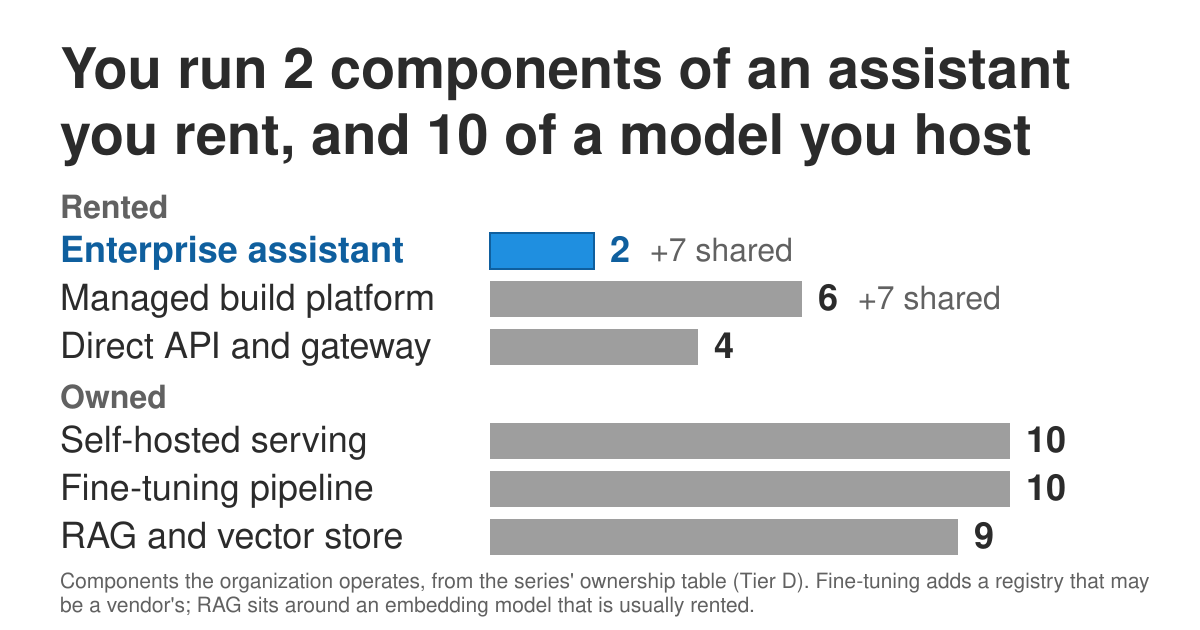
Owning a component means owning its patching, its logging, its identity and its detection, and the table below tries to make that cost more concrete by counting, for six of the thirteen surfaces, how many components the organization operates outright, how many it shares with a vendor (configuring or feeding something the vendor runs), and how many distinct teams the series' ownership table names on those rows. The three rented surfaces at the top are the ones a small or mid-sized organization is most likely to choose first, and the three owned surfaces at the bottom are the ones where the organization runs nearly everything, model included on the first two.
| Surface | Operated by the organization | Shared (you configure, the vendor runs) | Teams named on those rows | Identity provider | Network enforcement point | Audit record |
|---|---|---|---|---|---|---|
| S2 Enterprise assistants | 2 | 7 | 5 | operated | not listed | vendor's export |
| S7 Managed AI build platforms | 6 | 7 | 6 | operated | operated | operated |
| S8 Direct model API and gateways | 4 | 0 | 4 | operated | operated (the gateway) | operated |
| S9 Self-hosted model serving | 10 | 0 | 5 | operated | not listed | operated |
| S11 Fine-tuning pipelines | 10, plus a registry that may be a vendor's | 0 | 4 | operated | not listed | not listed |
| S12 RAG pipelines and vector stores | 9, around an embedding model that is usually rented | 0 | 5 | operated | not listed | operated |
Counts come from the per-component ownership table behind article 1's grid, read row by row; vendor-run components make up the rest (two on S2 and S7, one on S8). "Teams named" is the number of distinct team names in that table's owner column on the operated and shared rows, after folding synonyms the same way on every surface (ML platform and ML engineering count as one ML team, data engineering and data platform as one data platform team, and vendor entries are dropped), so it counts groups that have to cooperate and says nothing about headcount, and a different fold would move these counts by one or two. "Not listed" means the table has no such component on that surface, which may mean it is absent or that nobody wrote it down. Tier D throughout.
The team count does not separate the two halves of the table once the shared rows are counted, since every surface here names four to six groups and the managed build platform names more than any owned surface. What does separate them is the kind of work. On S2 and S7 much of what the organization touches is shared, seven components on each that it configures while the vendor runs them, such as an assistant's connectors, retention settings, custom-agent instructions and OAuth consent, whereas on S9, S11 and S12 nothing is shared and nearly everything is operated, which means patched, logged and watched by the teams the table names. So in this reading the coordination cost is roughly the same whichever way a team goes, and what owning adds is the operating work on top of it.
The result in the opening is the inventory part of that operating work, since Syft and Trivy did not see a model once Ollama had pulled it into its own store, though Syft did type the same weights as a named file and a safetensors directory in the same run. The logging part looks much the same: current vLLM, one of the common engines for self-hosted serving, ships with request logging off, and when an operator turns it on with --enable-log-requests it records request IDs and parameters at INFO and adds the prompt text only at DEBUG, so an owned serving tier produces no record of what it was asked until someone on the team decides it should, picks a log level that will hold prompts, and then decides where those records go and who reads them.
| Scanner | As a named GGUF file | Inside Ollama’s store |
|---|---|---|
| Syft 1.55.0 | found, typed as a model, no package URL | missed |
| Trivy 0.76.0 | not found (either scan mode) | missed |
| ai-bom 3.6.0 | found, under a made-up PyPI identifier | missed |
TinyLlama’s 1.1-billion-parameter weights, lab run of 9 November; the store column held in each of three runs, and Ollama’s content-addressed store is how the weights actually sit on a host that runs it. The opening's inventory run as a table: the layout a host running Ollama actually uses is the one none of the three scanners saw. Trivy's miss on the named file is from the same run's results table. SDW Lab run R4, one host, Ollama 0.20.6, three runs with identical results (first-party, agent-run and re-checked by a second agent).
The last part of the cost is the clock, and here renting and owning differ less than the framing suggests, because the frameworks, protocols and defaults that a team's mappings and detections key on keep moving whoever runs the model. MITRE ATLAS shipped six versioned releases between late May and the end of October 2026, v2026.05 to v2026.10, and across the releases from June to October it dropped eight technique IDs, three in v2026.07 and five in v2026.10, without marking any of them deprecated; the Model Context Protocol's 2026-07-28 revision deprecated its own logging feature and moved the record to stderr and OpenTelemetry; and platform logging defaults change by release note on rented and owned surfaces alike. What owning adds is the serving engine's and the pipeline's own release notes, and vLLM is a small example, since its request-logging default was the other way round until a change merged in August 2025, so a bare vllm serve on a version pinned before that change and the same command on a current release log requests differently.
| Setting | What current vLLM writes about a request |
|---|---|
Default, vllm serve | Request logging off: no record of what it was asked |
Switch 1, --enable-log-requests | Logged at INFO: request IDs and parameters |
| Switch 2, log level set to DEBUG | Adds the prompt text |
Before the change merged in August 2025 the default was the other way round, so a pinned version logs requests differently, and someone still decides where the records go and who reads them. The logging part of owning a serving tier: two deliberate choices stand between a default vLLM and a record of prompts. From vLLM source read 16 November 2026 and the change merged in August 2025 (Tier B for what the code does).
The rented side
What renting moves, and what it leaves you
Renting a surface moves most of that operating work to the vendor, which is a real benefit, and it also moves the risk into the vendor's controls and the record into whatever the vendor chooses to log, so I'd describe a team that rents a surface as choosing which visibility gaps to accept, since the risk itself has not gone anywhere, and the defaults on the rented side show it. Amazon Bedrock's documentation says that "model invocation logging is disabled by default", and once it is on it collects request and response data for four operations and for the OpenAI-compatible Responses and Chat Completions APIs on the bedrock-runtime endpoint, with bodies over 100 KB delivered to S3 as separate objects, while the same OpenAI-compatible APIs called through bedrock-mantle "are not currently captured". On Gemini Enterprise, an enterprise assistant, the usage audit logs replace query text and replies with <elided> unless an administrator turns on the prompt-and-response logging setting. The research behind this series found the same shape on the seven platforms it read closely, an administrative audit trail that is usually on and the content of interactions behind a second switch, a licence line or both, and the shape holds where the harness is the organization's and only the model is rented, since Claude Code's OpenTelemetry export is off until an administrator sets CLAUDE_CODE_ENABLE_TELEMETRY=1 and an exporter.
Rented surfaces · the content switch
On rented surfaces, the content record sits behind a switch
The administrative trail tends to be on; what was asked and answered waits for someone to turn it on.
| As shipped | The switch | Once it is on |
|---|---|---|
| Amazon Bedrock | ||
| invocation logging disabled by default | turn on model invocation logging | request and response bodies; over 100 KB, to S3 as separate objects |
| Even with it on, calls through bedrock-mantle are not captured. | ||
| Gemini Enterprise | ||
| usage audit logs show text as <elided> | turn on the prompt-and-response logging setting | query text and replies in the usage audit logs |
| Claude Code the harness is the organization's; only the model is rented | ||
| OpenTelemetry export off | CLAUDE_, exporter | OpenTelemetry metrics and events; prompt content is a further opt-in |
The same shape held on the seven platforms the series read closely.
So on a rented surface the security team's work moves to the components it still holds or configures. On an enterprise assistant (S2) the organization operates two components outright, the identity provider and the policy decision point, and configures seven more that the vendor runs, connectors, retention, custom-agent instructions and OAuth consent among them, which is where most of the configuration work sits, while the audit record is the vendor's export and the table lists no enforcement point unless the team has routed assistant traffic through an egress proxy or SSE of its own. Of the rented surfaces, only managed build platforms (S7) and direct API use through a gateway (S8) let the organization hold all three of identity, an enforcement point and an audit record it controls. Agents that reach vendor-hosted MCP servers add one more case where the record is whatever the vendor exports, which the MCP logging piece works through from the protocol side.
That is still a list worth working, because the content switches that exist can be thrown and the records they produce can be landed somewhere the organization controls before the vendor's retention runs out. For the one case this series has measured, a coding-agent fleet, keeping that record in object storage cost little: in a lab run on agent telemetry retention, a year of full prompt text for 1,000 users came out at about $20 to $79 a month in S3 Standard at average volume across the cases fixed before the run, a little more than double that at p90, at a list price read in June and with synthetic records standing in for real ones. The same stream sent to a SIEM that prices by ingest is a different bill, so on the rented side the expensive part is more likely to be getting the switch turned on, the export wired and the content landed in the right store than the storage itself.
Sizing
Sizing the decision to the team
My own view, which I hold as a practitioner opinion and not as something this series measured, is that vendor-managed surfaces may well be preferable for many organizations, and that it depends heavily on the organization, because for a small or mid-sized company managing a larger internal attack surface, a self-hosted serving tier or a fine-tuned model pipeline, is a real challenge in a sector moving this quickly. So for those teams I'd default to renting the surfaces that can be rented (enterprise assistants, managed build platforms, direct API use behind a gateway) and spend the security team's effort on what it still holds or configures there. Self-hosting and fine-tuning then need a named reason, such as data residency, cost at scale or a capability the rented models lack, rather than arriving by default because a team could stand them up. That default covers the surfaces an organization decides on, and local models on laptops, like the Ollama host in the opening, tend to arrive whatever the policy says, which makes them a discovery problem that a later piece on finding shadow AI takes up.
The build question gets the same answer for a related reason. A study of 133 popular GitHub systems found that 65 percent had a truck factor of two or less, meaning the departure of one or two key developers could leave the project in serious trouble, and those are projects with a worldwide pool of possible contributors, so my inference, which is Tier D and transfers an open-source result to internal tooling, is that a custom tool built by a five-person security team probably starts with a truck factor of one, unless the team deliberately puts a second person on it from the first commit, which a paid team can require and an open-source project can't. For a small team that tends to shrink "build" down to configuration and thin glue, meaning the settings, the detection rules over fields the SIEM already types and the job that lands vendor exports in the team's own store. The fuller case, along with what a build needs in place before it is safe to keep, is the subject of a later piece on custom tools, and turning on what you already license comes before either.
Larger or regulated organizations may reasonably choose to own more, and when they do they need the staff and the telemetry the owned surfaces demand, which the table suggests means getting four or five teams to operate and log consistently, and the inventory run suggests means not assuming the existing inventory tools will see the models. For those organizations the decision is less about whether to own and more about making each owned surface pay its way in records, so that a self-hosted serving tier or a fine-tuning pipeline arrives with an inventory entry, a log level chosen on purpose and a named team for each component, before it arrives with users.
Sizing · the default, the exception, the rest
Limits
Limits of this argument
Counter-evidence
What would change my mind
- A measured comparison of incident outcomes, or of detection coverage, between organizations that rent and organizations that own comparable AI surfaces, which the research behind this series does not include; the trade here is argued from who operates which component, and a result in either direction would replace it.
- Rented platforms turning content logging on by default with retention the customer controls, which would shrink the visibility gap renting accepts and move the default further toward renting.
- Inventory and SBOM tooling that types locally served models reliably, including content-addressed stores like Ollama's, which would lower the inventory part of the cost of owning and make self-hosting easier to justify for a mid-sized team.
Bottom line: the first AI-security decision for many teams is which surfaces to own, and for a small or mid-sized team I'd rent what can be rented, work the identity provider, the enforcement point, the configuration and the exported log on those surfaces, and keep self-hosting and fine-tuning for the cases with a named reason, accepting that the vendor's logging choices become my visibility gaps. The next piece takes the half of the CoSAI map that is new and asks how much of it the schema can hold.
Sources
| # | Source | What it supports | Tier |
|---|---|---|---|
| 1 | Security Data Works research strand on deployment surfaces and the CoSAI map, long ownership table (2026-11-09), rolled up 2026-11-16 | Components operated and shared per surface, teams named, identity, enforcement and audit rows | D (cells drafted in one pass, no second reader) |
| 2 | Owner perspective on rent versus own, 2026-11-09 | The default for small and mid-sized organizations; named-need rule; larger organizations may own more | D (stated practitioner view) |
| 3 | Lab run R4, "Can SBOM and scanner tooling see models, MCP servers and agent extensions?", 2026-11-09, sdw-lab-benchmarks/ai-artifact-sbom | Same weights found as a named GGUF file and missed in Ollama's store by Syft, Trivy and ai-bom; safetensors directory found by Syft | First-party measurement, re-run by a second agent on the same rig (verified with fixes) |
| 4 | vLLM source, vllm/engine/arg_utils.py at 902364d1 (main) and at release v0.32.0, read 2026-11-16; PR #21739, merged 2025-08-01 | Request logging off by default; prompts only at DEBUG; default changed in August 2025 | B |
| 5 | AWS, "Monitor model invocation using CloudWatch Logs and Amazon S3", read 2026-11-16 | Invocation logging disabled by default; operations covered; bedrock-mantle not captured | B |
| 6 | Google Cloud, "Access Gemini Enterprise usage audit logs with Cloud Logging", read 2026-11-09 | Text values replaced with <elided> unless the prompt-and-response setting is on | B |
| 7 | Anthropic, Claude Code monitoring documentation, read 2026-11-09 | OpenTelemetry export off until enabled | B |
| 8 | ATLAS moves fast and deprecates nothing, and the ATLAS releases list on GitHub, read 2026-11-16 | The eight ID removals between v2026.06 and v2026.10; six releases v2026.05 to v2026.10 | A for release data |
| 9 | MCP just told you where its logs went | The 2026-07-28 MCP revision's logging changes; hosted MCP servers | A for the specification, as carried there |
| 10 | What to keep when the agent did it | About $20 to $79 a month in object storage to keep a year of full prompt text for 1,000 coding users at average volume | First-party measurement, as carried there |
| 11 | Avelino, Passos, Hora and Valente, "A Novel Approach for Estimating Truck Factors", ICPC 2016 | 65 percent of 133 popular systems with a truck factor of two or less | A |
