
AI attack surface · Part 6
What the tools you already own can see
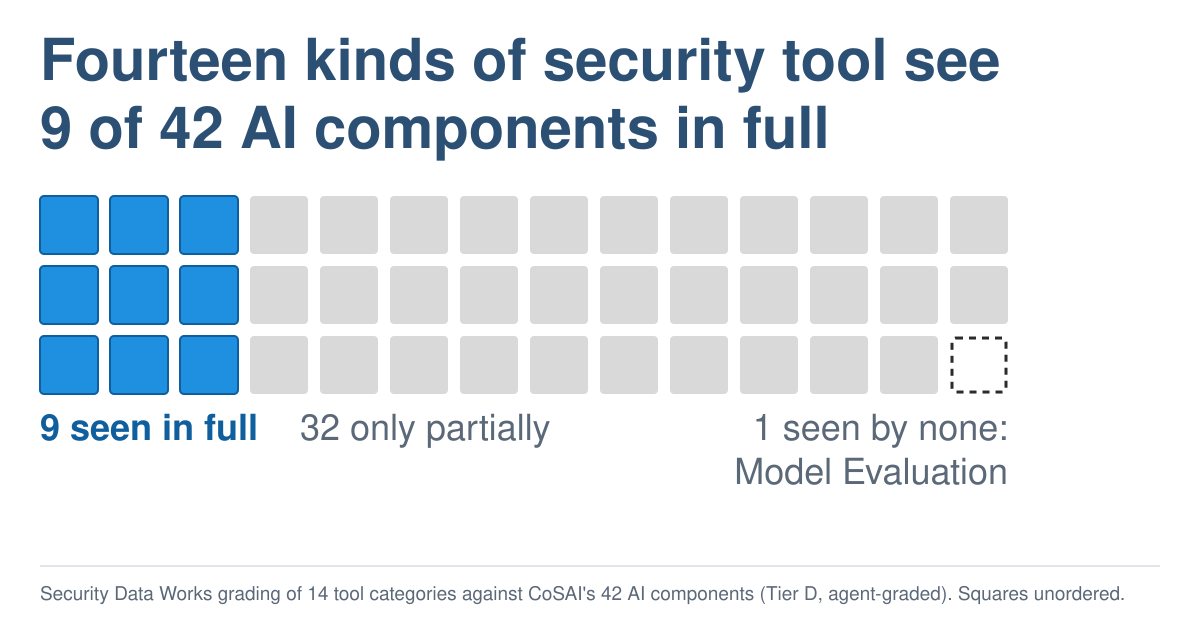
Fourteen categories of security tooling an organization may already own, graded against the 42 components in CoSAI's version of the SAIF risk map and against the thirteen deployment surfaces this series uses, see 9 of the components in full, 32 only partially and one not at all, and I think the useful result is less the count than the shape: the full views cluster in a few places, several of the misses come from where a tool sits and no product in the same seat would close them, and some of what looked like position a year ago is now a documented endpoint feature. So the question this article asks across the whole AI surface is how much of it the tools an organization already owns can see before anyone buys an AI-security product, and where they are blind because of where they sit.
A small version of the same question came up in an agent-run test in my lab on the evening of 9 November, in which nine kinds of AI went onto one simulated developer workstation, a container on my lab machine: an Ollama runtime, a small local server speaking the OpenAI API, an IDE coding extension, two MCP client config files, a browser extension, eight Python AI packages, two model files, outbound calls to eight model APIs and visits to five AI SaaS sites, with the same weights stored a second time inside Ollama's own model store and scored separately, which makes ten scored cells. Five discovery methods then went over it, each standing in for a kind of tool a security team may already run, which were Zeek on the workstation's network interface, a DNS log, osquery as endpoint inventory, Syft as the software bill of materials, and an egress allowlist. Each of the three network methods found the two remote surfaces, the API calls and the SaaS visits, and saw a local runtime at most as a port on another machine's connection to it or as the one-time model download, because a runtime used only from its own machine never crosses the wire. osquery found six of the ten cells (four under the query as it was written before the run), and four of its six finds came only because the query already named the table or the path. All five together found eight cells, partly found the local API server, and missed the weights in Ollama's store in each of three identical runs, a miss the write-up scores as a gap in the query, since a later query that named the blob path found them. That is one container and one fixture set, so it says nothing about any particular product.
Reading time: about 15 minutes. Evidence tier: D for every grade, an agent's reading of vendor documentation that no person has re-graded; B for what each vendor page says its feature does, read at the vendor's page on 2026-11-16, and C for how well any of it works; B for the two lab runs, each on one machine and pre-registered by an agent before it ran.
The grid
Fourteen categories against 42 components
The categories are the ones a mid-to-large organization commonly runs, which is a premise of the exercise and not something anyone measured, since no survey worth citing turned up: secure service edge (SSE, CASB and SWG), DLP, EDR and XDR, the enterprise browser and browser management, email security, identity (IAM, IGA and PAM), cloud posture (CNAPP, CSPM and DSPM, including AI security posture management), API and AI gateways, SIEM and SOAR, software composition analysis and SBOM, secrets scanning, device management (MDM and UEM), NDR, and vulnerability and exposure management. The components are the 42 in CoSAI's components.yaml at commit 622605a1, the same pin the earlier parts of this series use.
Each cell is one of three grades. Sees (S) means the category's documented features observe or control that component natively, with content or configuration detail, once the product sits in its normal position. Partially (P) means it observes existence, metadata or a subset, such as a domain without content or a package without its AI role, or that it sees fully only under a deployment condition many teams don't meet by default, and a paid add-on, a routing decision or a scan scope counts as such a condition. Blind means no documented feature reaches it. These are category grades, each resting on one or two documented features from one or two vendors, so they say what a kind of tool can reach and are not a comparison of the vendors named as evidence.
Fourteen of the 42 components are stages that run inside an application, agent or tool-server process, such as prompt assembly, the reasoning core, memory, the consent prompts and the input and output filters, and the grid collapses them into two rows so it stays readable, while every count treats those rows at their full size of six and eight components. Applied the same way to every cell, the definition of partial puts six cells that a looser reading would grade full at partial, four in the grid below (marked with an asterisk) and two on the surface table further down, and the reason for each is in the text that follows.
Incumbent categories · 14 categories × 42 CoSAI components
| CoSAI component | SSE | DLP | EDR | BRW | EML | IAM | CNAPP | APIGW | SIEM | SCA | SEC | MDM | NDR | VM |
|---|---|---|---|---|---|---|---|---|---|---|---|---|---|---|
componentDataSources | P | P | · | · | P | P | P | · | P | · | · | · | · | · |
componentDataFilteringAndProcessing | · | · | · | · | · | · | P | · | P | · | · | · | · | · |
componentTrainingData | · | P | · | · | · | P | P | · | P | · | · | · | · | · |
componentDataStorage | P | P | · | · | · | P | S | · | P | · | · | · | · | · |
componentModelFrameworksAndCode | · | · | P | · | · | · | P | · | · | S | P | · | · | P |
componentModelEvaluation | · | · | · | · | · | · | · | · | · | · | · | · | · | · |
componentModelTrainingTuning | · | · | · | · | · | P | P | · | P | · | · | · | · | · |
componentModelStorage | · | · | P | · | · | P | P | · | P | P | · | · | · | P |
componentModelServing | P | · | P | · | · | P | P | P* | P | P | P | · | P | P |
componentModelRegistry | P | · | · | · | · | P | P | · | P | P | · | · | P | · |
componentTheModel | · | · | · | · | · | · | P | P | P | · | · | · | · | · |
componentApplication | S | P | P | S | · | P | P | P | P | P | P | P* | P | P |
componentApplicationNetworkPolicyEnforcementPoint | S | P | P | P | · | · | · | S | P | · | · | · | P | · |
componentAgentToolTransport | P | · | P | · | · | · | · | P | P | · | · | · | P | · |
componentAgentNetworkPolicyEnforcementPoint | P | · | P | · | · | · | · | P | P | · | · | · | P | · |
componentTools | P | · | · | · | · | P | P | P | P | · | · | · | · | · |
componentToolServer | P | · | P | · | · | · | P | P | P | P | P | · | P | P |
componentToolRegistry | · | · | · | · | · | · | P | P | P | P | · | · | · | · |
componentAuthorizationPolicyEnforcementPoint | · | · | · | · | · | P | · | S | P | · | · | · | · | · |
componentToolNetworkPolicyEnforcementPoint | · | · | · | · | · | · | P | S | P | · | · | · | P | · |
componentIdentityProvider | · | · | · | · | · | S | P | · | P | · | · | · | · | · |
componentAuthorizationPolicyDecisionPoint | · | · | · | · | · | P* | · | P | P | · | · | · | · | · |
componentFederationProxy | · | · | · | · | · | P | · | P | P | · | P | · | · | · |
componentIsolationRuntime | · | · | P | · | · | · | P | · | P | · | · | · | · | · |
componentToolHosting | · | · | P | · | · | · | P | · | P | · | · | · | P | P |
componentRuntimeHosting | · | · | S | · | · | P | S | · | P | P | · | P | P | P* |
componentAuditRecordRepository | · | · | · | · | · | · | P | P | S | · | · | · | · | · |
componentRAGContent | P | P | · | · | P | P | P | P | P | · | · | · | · | · |
| Prompt and response content (6 components) | P | P | P | P | · | · | · | P | P | · | · | · | · | · |
| Internal orchestration and consent (8 components) | · | · | · | · | · | · | · | P | P | · | · | · | · | · |
| Sees (of 42) | 2 | 0 | 1 | 1 | 0 | 1 | 2 | 3 | 1 | 1 | 0 | 0 | 0 | 0 |
| Partial (of 42) | 15 | 12 | 16 | 7 | 2 | 14 | 19 | 26 | 39 | 7 | 5 | 2 | 10 | 7 |
componentAgentUserQuery, componentAgentSystemInstruction, componentAgentInputHandling, componentAgentOutputHandling, componentApplicationInputHandling and componentApplicationOutputHandling (prompt and response content), and componentReasoningCore, componentOrchestrationInputHandling, componentOrchestrationOutputHandling, componentMemory, componentAgentConsentSurface, componentApplicationConsentSurface, componentToolInputHandling and componentToolOutputHandling (internal orchestration and consent). S sees, P partially, a dot blind; an asterisk marks a cell graded P where a looser reading would give S. Category grades are an agent's reading of vendor documentation (Tier D). Component IDs are CoSAI's at 622605a1 (Apache-2.0); reusing them implies no endorsement by the Coalition or its members. Columns: SSE = SSE/CASB/SWG; DLP; EDR = EDR/XDR; BRW = enterprise browser and browser management; EML = email security; IAM = IAM/IGA/PAM; CNAPP = CNAPP/CSPM/DSPM incl. AI-SPM; APIGW = API gateway/WAAP/AI gateway; SIEM = SIEM/SOAR; SCA = SCA/SBOM; SEC = secrets scanning; MDM = MDM/UEM; NDR; VM = vulnerability and exposure management.Reading it
Where the full views come from
Read down the columns and across the rows and the grid is lopsided in a way I think many security teams will recognize. Of the 42 components, 9 are seen in full by at least one category, 32 are seen only partially at best, and one, componentModelEvaluation, is blind to all fourteen. The fourteen in-process components all sit inside the 32, since no category earns a full grade on any of them, so the best an organization gets there is the content those stages handle, caught on the wire by an inline proxy, a browser control or an AI gateway, or whatever the application chooses to write to a log the SIEM ingests. Because the two collapsed rows were graded as blocks, they also supply 14 of the SIEM's 39 partials and 14 of the gateway's 26, which is worth keeping in mind when reading those column totals.
The nine full views come from four places. Identity tools see componentIdentityProvider; posture tools see componentDataStorage and componentRuntimeHosting, which EDR also sees on the host; the SSE and the browser see componentApplication, the AI application as the user reaches it; and the enforcement points traffic passes through, the SSE and the gateway, account for the application's network enforcement point, with the gateway alone on the authorization enforcement point and the tool network enforcement point. The other two are what their categories were built to do, SCA seeing the libraries and frameworks (componentModelFrameworksAndCode) because libraries are packages, and the SIEM seeing componentAuditRecordRepository because that component is what a SIEM is. That last reading applies to five of the nine, since for the identity provider, the three enforcement points and the audit store the tool is the component, so a full grade there means the organization owns a control that occupies that box and sees the agents and traffic that actually go through it, which is a narrower thing than visibility into the AI system around it.
Reading the grid · where the full views come from
Five of the nine full views are the tool being the component
The nine CoSAI components some incumbent category sees in full, and who sees each
The tool is the component
- Identity provideridentity tools
- Application’s network enforcement pointSSE, AI gateway
- Authorization enforcement pointAI gateway
- Tool network enforcement pointAI gateway
- Audit record repositorySIEM
It sees into the AI system
- Data storagecloud posture
- Runtime hostingcloud posture, EDR
- The AI application, as the user reaches itSSE, browser
- Libraries and frameworksSCA
A full grade in the highlighted group means the organization owns the box, and sees only what passes through it.
None of the fourteen categories sees Model Evaluation.
Two columns need reading with care. The AI gateway collects the most full grades of any category, three of 42, and the second most partials, and all three are cells where it is the enforcement point, while on model serving it grades partial because it sees only the model traffic someone routed through it, which makes it a strong control for sanctioned traffic and close to no help in finding the unsanctioned kind. The SIEM's 39 partials say less than they seem to, because a SIEM is partial on nearly everything it could be sent, which turns its row into a question about which producers emit what and in what shape, and that question is the subject of What each AI surface emits today and Who gets the logs, earlier in the series.
The categories
What each kind of tool reaches
Rather than walk all fourteen categories, I'd point at the categories that carry the grid's strongest cells and the documented features that support them, read at each vendor's page on 2026-11-16. The examples lean on Microsoft because its public documentation of these features was the easiest to read in full, so the weighting says something about what vendors publish and nothing about whose product is stronger.
- Identity tools now give agents an identity type of their own, which is what the full grade on the identity provider rests on. Microsoft Entra Agent ID, for example, builds agent identities from "agent identity blueprints", takes in agents from AWS Bedrock and n8n through a sidecar SDK or workload identity federation, and says "All agent authentication and activity is logged for compliance and audit", while "Extending Microsoft Entra security features to agents requires Microsoft Agent 365", an add-on to E5, A5 and Business Premium and included in Microsoft 365 E7, which is why policy decisions for agents grade partial here. Delegation flows have stated limits too, and Okta's Cross App Access page lists "Autonomous agents" first under "When not to use", so that flow, by its own documentation, covers delegated user access and leaves the agent with no user session to some other mechanism.
- Cloud posture tools see the resources a managed AI platform creates. Defender for Cloud's AI security posture management documents discovery across Azure OpenAI, Azure AI Foundry, Azure Machine Learning, Amazon Bedrock and Google Vertex AI, an "AI Bill of Materials", and scanning of AI library dependencies such as TensorFlow, PyTorch and LangChain, with agent discovery labelled Preview and behind an Agent 365 licence from 1 July 2026. Its runtime companion, AI threat protection, lists only Azure OpenAI and Azure AI Model Inference as supported services, text tokens only, and "Connected AWS accounts: No", so for the same Bedrock agent a posture tool can see the resource while that vendor's runtime detection can't.
- The SSE sees AI applications reached through it, and the content when it inspects the session. Netskope's AI Guardrails scans prompts and responses for a named list of apps that includes Anthropic Claude, Amazon Bedrock, ChatGPT, GitHub Copilot, Google Gemini Enterprise and Microsoft 365 Copilot, and Defender for Cloud Apps documents a catalog of "more than a thousand generative AI-related apps" with "90+ risk factors" each. The limit is what gets inspected. Netskope documents that "Predefined certificate pinned applications bypass the Netskope cloud by default", and its predefined list, as read on 2026-11-16, contains none of ChatGPT, Claude, Cursor, OpenAI, Anthropic or Copilot, so nothing here says an AI client is bypassed by default. For a pinned app or a developer CLI that ignores the system certificate store, it documents two options, a bypass exception in the steering configuration and a steer-and-decrypt option it describes as the simpler route for developer tools, and a team that takes the bypass has traffic that goes directly to its destination without crossing the SSE.
- DLP and the managed browser see content at the moment a user pastes or uploads it. Chrome Enterprise Premium's DLP rules trigger on file upload, download, paste, print and URL visited on managed Chrome, which covers the "pasted into a chatbot" case without anything AI-specific, and Purview's current Data Security Posture Management, the version Microsoft now ships in place of DSPM for AI (relabelled classic), shows "the prompts and responses and if they contained sensitive information" in its AI activities tab, while Microsoft's current Purview overview for generative AI lists Microsoft Foundry, Entra-registered AI apps, Anthropic Claude (Enterprise) and ChatGPT Enterprise among the enterprise AI apps it covers and says prompts and responses are captured in the unified audit log, though neither current page restates which of those apps need a collection policy first, and for third-party AI sites reached in a browser the overview points to Endpoint DLP on Windows devices onboarded to Purview.
- The AI gateway sits on the hop between application and model, the one place an incumbent-adjacent control can see the composed prompt, user query, system instructions and retrieved context together, for the traffic routed through it. Kong's AI Gateway documents prompt guards for jailbreak and prompt-injection attempts, a sanitizer for PII and per-request OpenTelemetry span attributes, and Azure API Management documents OpenAI, Anthropic Messages (on its v2 tiers) and Vertex AI schemas, remote MCP servers and the ability to "Log prompts and completions to Azure Monitor".
- Endpoint tools are where the picture has moved most. Defender for Endpoint documents that it "discovers supported AI agents and their MCP servers on onboarded devices", with a record per agent that includes its host process, trust and auto-approve settings and "configured MCP servers", among them "MCP servers that run locally on the device, including the command that starts each one", on Plan 2, while its risk view needs E7 or Agent 365 and the page itself says "Discovery doesn't prove active use". CrowdStrike's March 2026 announcement describes AI Discovery in its exposure-management product, running on its endpoint sensor, as "Now generally available" for "AI apps and agents, LLM runtimes, MCP servers, and IDE extensions". Tenable's plugins report AI and LLM software on Windows, macOS and Unix agents, an Ollama install on Windows, and an Ollama instance reachable without authentication. All of that is inventory, what is installed or configured, and none of the pages read for this piece describes seeing what a client and a local server say to each other.
- Secrets scanning catches the static keys that often reveal a team calling a model provider directly. GitHub's pattern data marks OpenAI, Anthropic, Hugging Face, Azure OpenAI, Groq and Replicate keys for partner alerts and push protection, and Mistral AI and Perplexity keys for user alerts and push protection without a partner alert, which is real evidence of direct API use (S8) inside the repositories the scanner is pointed at, and so a partial grade.
- NDR sees connection metadata, and Zeek's
ssl.logrecords the client's SNI inserver_name, which is enough to name egress to model providers and model hubs; T1 bore that out for the remote half, with every TLS destination named by SNI in all three runs, on clients that did not use encrypted client hello, which the write-up notes will not hold indefinitely.
The surfaces
Eleven of thirteen surfaces with no category that sees them in full
The same grading against the thirteen deployment surfaces gives a sparser picture, and it is the version I'd hand to anyone asking which AI the existing stack has in view:
| Surface | Categories that see it | Partially | Blind |
|---|---|---|---|
| S1 AI features in SaaS apps | 0 | 6 | 8 |
| S2 Enterprise assistants | 4 | 6 | 4 |
| S3 Browser AI | 0 | 8 | 6 |
| S4 IDE and coding agents | 0 | 11 | 3 |
| S5 MCP servers you run † | 0 | 10 | 4 |
| S6 Self-hosted low-code builders † | 0 | 12 | 2 |
| S7 Managed AI build platforms | 1 | 6 | 7 |
| S8 Direct model API and gateways | 0 | 11 | 3 |
| S9 Self-hosted model serving | 0 | 7 | 7 |
| S10 Local open-weight models | 0 | 7 | 7 |
| S11 Fine-tuning pipelines | 0 | 5 | 9 |
| S12 RAG pipelines and vector stores | 0 | 8 | 6 |
| S13 AI inside security tools | 0 | 2 | 12 |
Counts of the fourteen categories by grade on each surface, from the same grading (Tier D), with the gateway and secrets scanning graded P on S8, where a looser reading would give S, because the first sees only routed traffic and the second only the repositories it scans. † The S5 and S6 rows were graded on broader definitions than this series uses: S5 without separating the remote, vendor-hosted MCP servers that the first part of the series files under coding agents, and S6 with hosted builders such as Copilot Studio, which the series files under enterprise assistants, in scope, so the identity, SSE, DLP and browser partials on those two rows may be generous for the self-hosted case.
Enterprise assistants are the best-covered surface by a wide margin, with the SSE, DLP, the browser and identity all grading as seeing them, because the large vendors built connectors and audit records for exactly that case, though the DLP and browser grades each rest on one vendor's feature (Purview and Chrome Enterprise Premium). Managed build platforms get one full view, from cloud posture. The other eleven surfaces, direct API use among them, have no category that sees them in full, and AI inside security tools is the extreme, with twelve of the fourteen categories blind to it, which leaves a team trusting the security vendor's own audit of its own agent.
The misses
Three kinds of miss
The blind spots that remain fall into three groups, and I think the split matters more than the list, because only the first group is a reason to buy something new, the second is a reason to check what is already licensed, and the third waits on someone else.
The misses · three groups
Three kinds of miss, and only one is a reason to buy something new
Each miss is explained in the lists below; the cause decides the next step
| Misses | Next step |
|---|---|
| Where a tool sits: no product in the same seat closes it | |
| A reason to buy something new |
| A documented feature or setting is already closing it | |
| A reason to check what is already licensed |
| Waits on a standard or a product's stated scope | |
| Waits on someone else |
The misses that come from where a tool sits, which no product in the same seat would close:
- The network side of local AI. stdio MCP servers run as local child processes with no network hop, and a local model with no egress shows up on the network once, as a download from a model hub, so the SSE, NDR and the gateway are blind to both by construction whichever product is bought.
- The agent-to-tool hop inside a managed platform (S7), where you see what the platform exports: Bedrock's model invocation logging "is disabled by default" and does not capture the same APIs called through
bedrock-mantle, and AgentCore's "CloudTrail coverage is currently available for certain AgentCore capabilities", named as Gateway and Agent Registry. - AI inside sanctioned SaaS (S1) and inside security tools (S13), where the AI call shares a domain and an identity with the ordinary app, so the record is whatever the vendor's audit log carries.
- The composed prompt, which only a hop between application and model sees whole, and only for routed traffic, while user-side tools see the user's half.
The misses that a documented feature or a configuration choice is already closing, untested here:
- The endpoint side of local AI. Endpoint inventory of local agents, their configured MCP servers and LLM runtimes is now documented by at least two endpoint vendors, as above, and T1's osquery found the runtime, the model files and the MCP configs once its queries named them; what none of those sources claims is the traffic between a client and a local server, or proof of use. On the weights themselves, the reading for this piece turned up no documented endpoint feature that identifies them as opposed to the runtime that loads them, and in R4 the SBOM tools run (Syft, Trivy and ai-bom) saw none of the weights once they sat in Ollama's content-addressed store, while SCA saw both MCP servers as ordinary npm and PyPI packages, with every listed advisory matched through Grype, and marked neither as an MCP server.
- Inspection-bypassed desktop apps and CLIs, which is a steering choice with a documented steer-and-decrypt alternative, so the gap is as wide as the bypass list a team chooses to keep.
The misses that wait on a standard or on one product's stated scope:
- Model identity, since weights have no package URL, CPE or advisory feed that a matcher can attach anything to.
- Agent memory, which has no OCSF object to be written to even by a willing producer, as What to keep when the agent did it found, and no D3FEND object in the lab's alignment run either.
- Autonomous agents with no user session, which the delegation flow Okta ships excludes by name.
Configuration
What configuration might move
Some partial grades are partial because a switch is off or a deployment condition isn't met, and Turn on before you buy, later in the series, takes the per-feature detail. Two cells might move with configuration, and both stay at their baseline here because the argument for moving them is untested. That argument would move the gateway column from partial to full on componentApplicationInputHandling and componentApplicationOutputHandling, on the reasoning that a guardrail enforced across an organization's accounts, such as Amazon Bedrock Guardrails enforcements through AWS Organizations, sees the prompt as the model receives it and the response as the model returns it without anyone routing the traffic, though AWS's page names the invoke and converse operations and does not say whether enforcement reaches the bedrock-mantle endpoint, and an API Management content-safety policy does the same only for traffic it fronts. It rests on platform guardrails more than on a gateway in the usual sense, and if it holds, the count of components seen in full would go from 9 to 11. One vendor's local MCP inventory may also lift EDR from blind to partial on the tool registry.
Shadow AI
Joining the partial views
For finding AI nobody sanctioned, the incumbent tools work best when their partial views are joined, and the join is a data problem before it is a tooling one. The SSE catalog finds enterprise assistants and web-delivered SaaS AI, secrets scanning and SCA find direct API use, self-hosted serving and RAG code inside repositories, device management, vulnerability scanners and endpoint tools find local installs, agents and their MCP configs, cloud posture finds managed-platform resources in connected accounts, the identity provider finds agents that authenticate through it, and NDR finds egress by SNI. None of those records shares a key with the others by default, since the SSE knows a user and a domain, SCA knows a repository and a package, the endpoint tool knows a host and a process, and the identity provider knows a principal, so the work is joining them on host, user and principal in one store. T1 is a one-container preview of the same thing, where no single method found more than six of ten cells and the union found eight. The series takes that up properly in Finding shadow AI, and I'd expect the join to be where most of the effort and most of the payoff sits, though nobody in this series has measured that yet.
Shadow AI · joining partial views
Limits
Limits of this grid
- The grades are agent-drafted (Tier D). An agent graded every cell from vendor documentation and a second agent checked the facts and the arithmetic, but no person has re-graded the grid, so argue with any cell where your own deployment differs.
- Little of the grid has a lab run behind it. Three SCA partials rest on R4, and T1 bears out the network and DNS reading on one container, while every other cell is a reading of documentation, which describes what a feature does and says nothing about how well it does it.
- Grades are for categories. Each one rests on one or two vendors' documented features, so a category grade can be stronger than the product a given team runs, and none of this ranks vendors.
- Two surface rows were graded on broader definitions than the series now uses, as the dagger on the surface table says.
- The surface list is fixed at thirteen, and the grid has no column for data-platform governance tools, which later work in this series flagged as the incumbent category most likely to reach training data and tuning, and which nobody has graded yet.
Open tests
What would change my mind
The endpoint question is no longer whether an EDR can name a stdio MCP server, since two vendors document that theirs can, but what a detection rule could key on once it has, and whether the inventory survives an MCP server launched ad hoc from a CLI with no config file; a lab run that launched both kinds on an instrumented host and scored what the inventory and the telemetry carried would settle it for that host. On the network side, a run that put a desktop AI client and a CLI agent behind an SSE with TLS inspection, first inspected and then under a bypass, would turn the SSE's prompt-content grade from a reading into a measurement. A third open question is whether common gateways log the Mcp-Method and Mcp-Name headers from the MCP 2026-07-28 revision by default, which nobody in this series has checked yet. Any of the three could move a cell, and I'd rather find that out in the lab than argue it from documentation.
Bottom line: the tools a typical organization already owns see the identity plane, the cloud resources a managed platform creates and the traffic routed through their own enforcement points (and, as their own job, the libraries and the audit store), they see local models and stdio tools only from the endpoint and only as installs, processes and config files, and the agent-to-tool hop inside a managed platform only through what the platform exports, while the stages inside an agent's process reach them at best partially, through whatever content crosses the wire, so I'd read any new vendor's coverage claim against the positional misses first, check what the endpoint and identity licences already include, which is not always what a team holds, and price the rest after that. The next part of the series takes the identity half further, in Delegation across the AI surface.
Sources
| # | Source | What it supports | Tier |
|---|---|---|---|
| 1 | Security Data Works survey of incumbent tool coverage (2026-11-09), category × component and category × surface grades | Every S/P/B cell; graded by an agent, facts and arithmetic checked by a second agent | D for the grades |
| 2 | CoSAI secure-ai-tooling, risk-map/yaml/components.yaml @ 622605a1 | The 42 components | A in the sense of primary files read at a pinned commit; working-group content, not a ratified standard |
| 3 | T1 shadow-AI discovery, sdw-lab-benchmarks/t1-shadow-ai-discovery (run 2026-11-09) | Opening; network methods see remote surfaces only; osquery finds what its query names; SNI on every TLS destination | B (one container; pre-registration written by an agent, not owner-reviewed) |
| 4 | R4 AI artifact inventory, sdw-lab-benchmarks/ai-artifact-sbom (2026-11-09) | Ollama store seen by no tool; MCP servers seen as packages | B (same) |
| 5 | Microsoft Learn, "What is Microsoft Entra Agent ID?", read 2026-11-16 | Agent identity type, blueprints, third-party agents, logging, Agent 365 licence line (basis of the partial on policy decisions) | B |
| 6 | Okta Developer, "Cross App Access", read 2026-11-16 | Autonomous agents under "When not to use" | B |
| 7 | Microsoft Learn, "AI security posture management" (Defender for Cloud), read 2026-11-16 | Discovery across five platforms, AI BOM, library scanning, agents Preview, July 2026 licence change | B |
| 8 | Microsoft Learn, "AI threat protection" (Defender for Cloud), read 2026-11-16 | GA, supported services, text tokens only, "Connected AWS accounts: No" | B |
| 9 | Microsoft Learn, "How do I discover AI apps...", read 2026-11-16 | Defender for Cloud Apps GenAI catalog, 90+ risk factors, sanction controls | B |
| 10 | Netskope docs, "AI Guardrails" and "Certificate Pinned Applications", read 2026-11-16 | Supported-app list; pinned-app bypass default; none of six AI names on the predefined list; bypass and steer-and-decrypt options; DevTools section | B |
| 11 | Microsoft Learn, "Learn about Microsoft Purview Data Security Posture Management (DSPM)" (current version, page metadata updated 2026-06-25) and "Microsoft Purview data security and compliance protections for Microsoft 365 Copilot and other generative AI apps" (updated 2026-05-27), read 2026-11-16 | Prompts and responses in the AI activities tab; enterprise AI apps covered, Foundry and ChatGPT Enterprise among them; unified audit log capture; Endpoint DLP for third-party AI sites; classic relabelling | B |
| 12 | Microsoft Learn, "AI gateway capabilities in Azure API Management", read 2026-11-16 | Schemas, MCP and A2A, prompt and completion logging | B |
| 13 | Kong, "AI Gateway", developer.konghq.com, read 2026-11-16 | Prompt guards, sanitizer, OpenTelemetry span attributes | B |
| 14 | GitHub Docs secret-scanning pattern data (github/docs, pattern-docs/fpt/public-docs.yml), read 2026-11-16 | AI-provider key patterns, partner and push-protection flags | B |
| 15 | Tenable plugins 196906, 233770 and 302134, read 2026-11-16 | AI/LLM software report; Ollama installed (Windows); Ollama unauthenticated access | B |
| 16 | Zeek base/protocols/ssl/main.zeek, read 2026-11-16 | server_name logged from SNI | B |
| 17 | AWS, Bedrock model invocation logging and AgentCore observability pages, read 2026-11-16 | Logging off by default; bedrock-mantle not captured; CloudTrail for certain AgentCore capabilities | B |
| 18 | Security Data Works review of incumbent AI-governance features (2026-11-09) | Proposed gateway cell moves and the EDR tool-registry candidate, not applied | D |
| 19 | Google, "Use Chrome Enterprise Premium to integrate DLP with Chrome", read 2026-11-16 | Upload, download, paste, print and URL-visited triggers on managed Chrome (basis of the browser grade on S2) | B |
| 20 | AWS, "Apply cross-account safeguards with Amazon Bedrock Guardrails enforcements", read 2026-11-16 | Guardrails applied across an organization's accounts | B |
| 21 | Microsoft Learn, "Enforce content safety checks on LLM requests" (API Management llm-content-safety policy), read 2026-11-16 | Content-safety checks on prompts and completions, and on MCP tools and A2A APIs | B |
| 22 | Microsoft Learn, "Discover local AI agents with Microsoft Defender for Endpoint", read 2026-11-16 (last updated 2026-11-03) | Local agent and MCP server inventory, local start commands, Plan 2 licence, "Discovery doesn't prove active use" | B |
| 23 | CrowdStrike blog, "New CrowdStrike Innovations Secure AI Agents and Govern Shadow AI Across Endpoints, SaaS, and Cloud" (2026-03-23), read 2026-11-16 | AI Discovery described as generally available for AI apps and agents, LLM runtimes, MCP servers and IDE extensions | B for what it describes; C for any efficacy |
| 24 | Microsoft Learn, "Learn about Data Security Posture Management" (new version), read 2026-11-16 (last updated 2026-05-26) | The replacement overview; does not restate the capture details | B |
