
AI attack surface · Part 8
The API view: 200 OK is not success
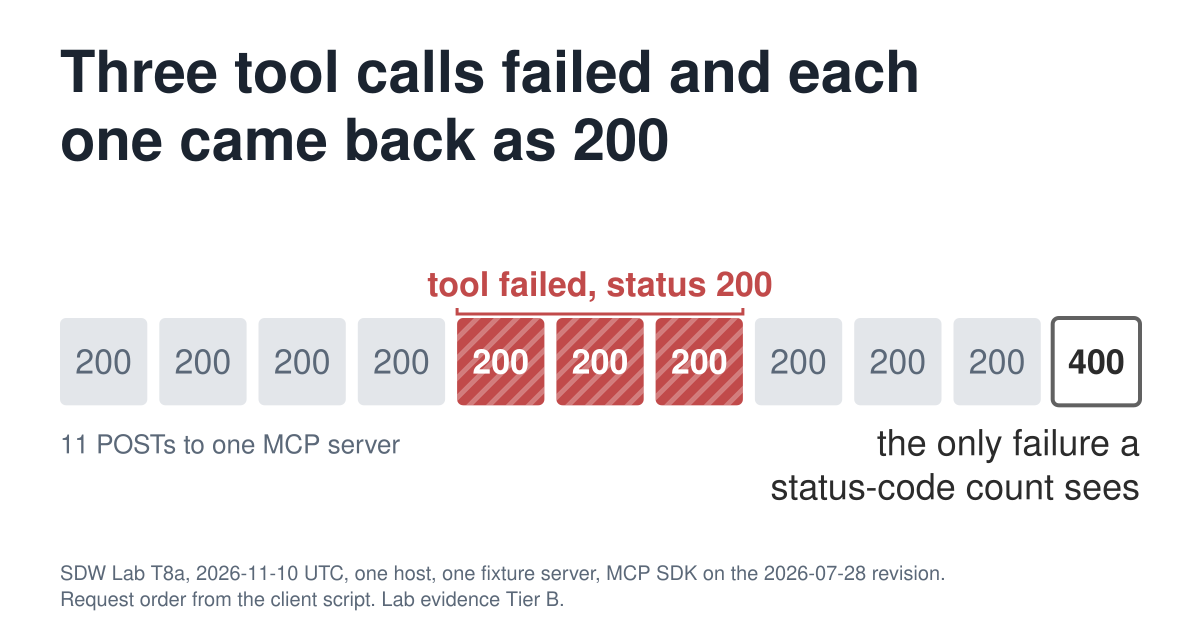
On 2026-11-09 an agent session in my lab sent ten MCP tools/call requests from the official Python SDK's client to a small SDK server backed by DuckDB, for a schema-mapping bench, and four of the ten failed: a SQL syntax error, a rejected DROP, a query against a missing table and a call to a tool that did not exist. Every one of the four came back as a successful JSON-RPC response carrying a tool result with isError: true, and three of them, the syntax error, the rejected DROP and the missing table, reached the wire as the same sentence, Error executing tool <name>, so whatever went wrong stayed inside the server process. That run was over a local pipe with no HTTP in it, and a second bench the same evening, T8a (2026-11-10 UTC), had the same kind of server behind Streamable HTTP with the status codes recorded. On the SDK release that speaks the 2026-07-28 protocol revision, eleven POSTs got ten 200s and one 400, the 400 was a protocol-level error for a missing resource, and the three tool calls built to fail (a tool that raises, an unknown tool and a missing argument) were all among the 200s. An API gateway in front of that server that counted status codes and did not read the JSON-RPC body would have logged one 400, for the missing resource, and nothing for the three failed tool calls.
This is the eighth part of a series on the AI attack surface. Part 1 set out thirteen ways AI gets deployed, Part 4 asked what each surface writes down about prompts and responses, and Part 7 followed the credentials an agent acts with and ended at the gateway key, where the caller is a key and the person behind it is optional. This part takes the API view of the same traffic and asks what an API gateway or API-security tool actually sees of model and tool calls, whether a stolen key running at quota would show up, and where. The capture counts behind the opening live in OCSF already has the AI-agent objects, the before-and-after protocol measurements and the new MCP routing headers in MCP just told you where its logs went, and the delegation records in Delegation is the new logon event, and I link to each rather than repeat it.
Reading time: about 23 minutes. Evidence tier: A for the MCP specification and the CISA KEV catalog, read 2026-11-16; B for the OWASP API Security Top 10 2023, for each provider's documentation of what its logging does, all re-read at the provider's own page on 2026-11-16, for the threat-research reports as their authors' accounts, and for the two lab runs, each pre-registered and run by an agent session on one host; C for any dollar figure a vendor computed or reported; D for the grades in the API-view matrix, which are an agent's single draft, and for my own reasoning where it is labelled.
The traffic
Two kinds of API in, two kinds out
AI consumes two kinds of API and provides two, and keeping the four apart saves a lot of confusion about what a given sensor can see. On the consuming side it calls model APIs, directly on the direct-API surface (S8) and underneath the assistants, coding agents, builders and managed platforms (S2, S4, S6, S7), and it calls tool APIs, directly or through an MCP server (S5) or a builder's connectors (S6). On the providing side it exposes inference endpoints, the managed endpoints of S7, the self-hosted servers of S9 and the local servers of S10 that end up reachable, and agent endpoints, meaning MCP servers you host, agent-to-agent endpoints and agent runtimes with an invoke API. The consuming side is where cost abuse and over-trusted responses live, and the providing side is where unauthenticated exposure and resource exhaustion live, which matters because a gateway placed in front of your own APIs sees the providing side and an egress gateway sees the consuming side, so a team that runs only one of the two is looking at one direction of it.
The traffic · four kinds of API
The breaks
Three things that break an API tool's idea of normal
An API gateway or API-security tool sees requests and responses keyed by endpoint, status code and caller credential, and it builds its model of normal from those three, so the useful question is where AI traffic stops fitting them. I count three places, each grounded in a lab capture or a primary document.
Status codes stop meaning failure
The MCP specification is explicit that a tool which fails while running reports the failure inside a normal result. Both the 2025-11-25 and the 2026-07-28 revisions of the Tools page define two mechanisms, protocol errors returned as standard JSON-RPC errors for things like unknown tools, malformed requests and server errors, and tool execution errors "reported in tool results with isError: true", and the examples they give of the second kind are "API failures", input validation errors and business logic errors (MCP specification, Tier A). So when an MCP tool calls a downstream API and that API returns a 500 or a 403, the specification asks the server to wrap the failure in a result, and over Streamable HTTP that result travels in a 200. The 2026-07-28 revision requires a 400 for a handful of named protocol errors, such as a request missing its required metadata, and the Python SDK's code for that revision goes further and gives any -32602 it returns as plain JSON a 400 from its own status table, which is why T8a saw a 400 for the missing resource on the new revision and a 200 for the same error on the older one (SDK source, Tier B for what the code does). MCP just told you where its logs went has that before-and-after in full, and nothing in either revision moves tool execution errors off 200.
The SDK in my lab went further than the specification in one respect. Both revisions list an unknown tool as a protocol error, and the Python SDK's high-level server class (FastMCP on 1.30.0, MCPServer on 2.3.0) returned it as a tool result with isError in every arm of T8a, so on a server built on that class with its defaults, a call to a tool that does not exist comes back over Streamable HTTP on a 200 (T8a, Tier B). That is a known deviation, since the SDK's tracker has carried it as an open bug since 2026-10-08 (python-sdk issue #3659), with a fix proposed in PR #1872 since January, and the TypeScript SDK's McpServer throws the -32602 protocol error the specification describes (source read at v2.4.0, not run), so what a gateway sees depends on the SDK and release behind the server. By the Python SDK's own status table, the fix would probably turn a probe walking tool names into 400s on the new revision and leave it on 200s on the old one, which I have read in the source and not measured. Until then such a probe may look on the wire like a series of successful calls, and an anomaly model built on 4xx rates sees nothing, because the evidence sits in the JSON-RPC body, which a gateway sees only if it has been set up to parse MCP, and in the server's OpenTelemetry spans, where the 2.3.0 server in T8a marked each failed tool call with error.type set to tool_error.
The breaks · status codes stop meaning failure
Model APIs do the same thing with refusals. Anthropic's documentation says that when Claude declines to answer, "Safety classifiers return this stop reason as a normal HTTP 200 response, not an error", and that stop_reason is part of every successful response, separate from errors, which use 4xx and 5xx codes (Anthropic documentation, Tier B). Amazon Bedrock's Converse API lists guardrail_intervened and content_filtered among the values of stopReason in its success response, which the reference says comes back as HTTP 200, so I read a guardrail block on that API as a 200 with the reason in the body, though the page does not say so in one sentence (AWS API reference, Tier B for the field values, D for my reading). Neither of the lab runs had a model in the loop, so this half rests on documentation, and I'd want a capture before quoting a refusal rate seen at a gateway.
The tool name is now a header, if anything logs it
The 2026-07-28 revision requires Mcp-Method and Mcp-Name headers on Streamable HTTP requests, so a gateway can record which method and which tool a request is for without parsing JSON-RPC, and in T8a the new revision sent Mcp-Method on every POST and Mcp-Name on every tool call, while the older revision sent neither. The Tools page in the same revision adds an x-mcp-header annotation that lets a server mirror chosen tool parameters into Mcp-Param-{name} headers so that load balancers, proxies and WAFs can route on them, with a warning that servers should not mark passwords, keys, tokens or personal data that way because "header values are visible to network intermediaries" (MCP specification 2026-07-28, Tier A). That gives a gateway more to log than it had a year ago, and also more to leak into its logs. Whether gateways log these headers by default is the open question, and the documentation check in MCP just told you where its logs went found two gateways that list the method and the tool name in their MCP logs, one of which reads the body and checks the headers against it, so I would not assume a header-only view anywhere yet. That piece also measured what happens once the tool name lands in a store, where the layout that kept it as a typed column was the fastest on every hunt in the run.
The caller is a key, and the human is optional
Gateways meter and rate-limit per key, subscription or team, and Part 7 showed that a LiteLLM key created by an admin with no user_id has no owner and that Azure API Management's own per-user token example reads the user from an x-user-id request header, which the caller asserts about itself. So by default a gateway can say how much a key spent and cannot say which person spent it. The same split shows up in the cloud's own records. Calls to Amazon Bedrock's bedrock-mantle endpoint carry callWithBearerToken in the request parameters of every CloudTrail event, whose value tells you whether a call came in on a Bedrock API key rather than a signed IAM request, and bearerTokenType where it applies, which is the field to check for the kind of key (AWS documentation, Tier B; the page does not define the type values and I have not checked which marks a long-term key), and that is worth a column, since a long-lived bearer key is the kind of credential that ends up in a public repository.
The cross-reference
The OWASP API list, row by AI failure
The OWASP API Security Top 10 2023 is the list most API-security programs already map to, so I've used it as a cross-reference column against the AI form of each failure rather than as the frame. The matrix below keys each row on what goes wrong in AI traffic, names the OWASP ID it corresponds to, lists the surfaces where it mostly shows up, and grades what an API gateway or API-security tool that the traffic actually crosses would see of it, with the place the evidence lives instead.
| What goes wrong, in AI form | OWASP API 2023 | Surfaces | In the API path | Where the evidence is instead |
|---|---|---|---|---|
| An agent's tool returns an object the person it acts for should not see, because the tool authorizes the agent (Langflow CVE-2026-55255 in KEV, one user running another's flow, the same class in a builder) | API1 | S2, S5, S6, S12 | nobody | The tool server's own log, if it records the delegated subject |
| An inference or orchestration endpoint answers without authentication (LiteLLM CVE-2026-59822 and two of the five Langflow entries added to KEV in 2026, CVE-2026-33017 and CVE-2026-9198) | API2 | S6, S8, S9, S10 | partial | External attack-surface scans, flow logs, the server's access log if enabled |
| A tool's input schema lets the model set a property the user could not | API3 | S5, S6 | nobody | Schema review and manifest diffing |
| Token inflation, long contexts and tool loops run up spend; LLMjacking is the stolen-credential version | API4 | S5, S7, S8, S9 | sees, if metered and in path | Gateway token metrics per key, provider usage reports, Bedrock stream-completion token counts |
| An agent's credential reaches admin functions because it was granted the integration's full scope | API5 | S5, S6, S13 | partial | Identity-provider grant logs (scope at issue time), the tool API's audit log |
| An agent automates a flow that was safe at human speed, such as bulk export or mass messaging | API6 | S2, S6, S7 | partial | Business-flow rate analytics, rarely the security stack |
| A fetch or browse tool reaches internal addresses (MLflow CVE-2026-64849 in KEV, added 2026-08-19, the same class in an ML platform's server) | API7 | S5, S11, S12 | nobody | Egress and DNS logs from the tool host, cloud metadata-service access |
| A serving port, debug endpoint or permissive CORS setting ships open on a model server (Langflow CVE-2025-34291 in KEV, a permissive CORS setting) | API8 | S6, S9, S10 | nobody | Configuration scanning, EDR listening-port events |
| Unregistered model endpoints, forgotten MCP servers, keys for retired deployments | API9 | S5, S8, S9, S10 | partial | Traffic-based API discovery, egress to AI provider domains |
| The model treats a tool's response as trusted input (indirect prompt injection in API terms; the analogy is the author's) | API10 | S2, S3, S5, S12 | nobody | Little at the API layer, because the poisoned response is a well-formed 200 |
"Sees, if metered and in path" means a gateway that meters tokens records it for the traffic that crosses it, which leaves out a stolen cloud credential used directly against the provider, "partial" means it shows only if the traffic crosses the sensor or only as a weak proxy, and "nobody" means the exchange is well formed and authorized, so the gateway records an ordinary success.
Read down the grade column and one row of the ten, the spend row, is something a token-metering gateway sees for the traffic that crosses it, four are partial, and five are invisible at the API layer, because in those five the request is authorized and the response is a well-formed success, so the evidence sits with the tool server, the identity provider, the egress path or the configuration. That is roughly why I'd treat an API-security product's claim to understand prompts, tool semantics or agent intent as a vendor claim about how well a product works, Tier C until someone measures it against a labelled corpus, which I did not find for this piece. Three rows have their own homes in this series and on the site. Unsafe consumption, API10, is the exfiltration and injection leg that the lethal trifecta, three ways works through, and schema widening, API3, is what manifest diffing catches as a change, which tool poisoning shows up as a diff measured. Inventory, API9, is where the next part, on finding shadow AI, picks up.
The defaults
Where stolen-key abuse shows up by default
LLMjacking is the use of stolen cloud or model-provider credentials to consume someone else's AI capacity, usually to resell it, which makes it the stolen-credential version of the API4 row. Sysdig's threat research team named it in May 2024 after watching credentials taken from a host running a vulnerable Laravel version get checked against ten AI services, and it noted two things a detection engineer can use, that the Bedrock InvokeModel call "is logged by CloudTrail" while that record "does not capture details about the prompt input and output", and that the attackers called GetModelInvocationLoggingConfiguration to see whether prompt logging was on (Sysdig, 2024-05-06, Tier B). Microsoft's Digital Crimes Unit described Storm-2139 in February 2025, whose members "exploited exposed customer credentials scraped from public sources" to reach generative AI accounts and then "altered the capabilities of these services and resold access to other malicious actors" (Microsoft, 2025-02-27, Tier B). Permiso, writing up its own LLMjacking cases in October 2024, said initial access was "almost always" an exposed access key on GitHub and that "None of the affected clients had invocation logging enabled to better understand the motivations of the attacker" (Permiso, 2024-10-03, Tier B), so those victims could see that the key had been used and what it cost and could not say what had been generated with it.
The 2026 reporting moves the same class forward in two directions. Google's Threat Intelligence Group, writing on 2026-11-02 from its own incident investigations, says the dominant initial access has been exposed or stolen cloud identity tokens, IAM credentials, service account keys, GitHub personal access tokens and session tokens among them, and reports observed charges "exceeding $100,000 USD in a single day" in individual incidents, with cumulative charges at some organizations reaching $1 million before access was revoked (Google Threat Intelligence Group, 2026-11-02, Tier B as the authors' account of their own cases). Wiz's incident response team, writing on 2026-10-20, described a variant with no stolen key in the victim's tenant at all, where a phished cloud administrator's access was used to link attacker-controlled Google Cloud projects to the victim's billing account, so that "all API key generation, prompt requests, and model outputs occurred entirely within foreign tenants" and the victim's "internal security and audit logs provided no visibility into the nature, content, or context of the AI workloads being executed", while charges reached tens to hundreds of thousands of dollars within 24 to 48 hours (Wiz, 2026-10-20, Tier B). In that case the inference never touched the victim's API path, and the record it left was the bill plus the organization-policy and billing-permission changes that made it possible. Those are different cases from Sysdig's, and its $46,080-a-day figure is a ceiling it computed from four regions' maximum quotas at Claude 2 pricing (Tier C as a vendor-computed estimate), which I keep apart from Google's observed figure.
What a security team can see of the stolen-key version depends heavily on which cloud endpoint served the model, and the difference comes down to logging defaults. The inset below says whether the inference call itself, without its content, lands in the audit trail with nobody having turned anything on. Part 4 covers the separate question of logging prompts and responses, which is off by default on the three clouds in the table below.
| Endpoint | Is the inference call in the audit trail by default? | Token counts | Also worth knowing |
|---|---|---|---|
Amazon Bedrock, bedrock-runtime | Yes. InvokeModel, InvokeModelWithResponseStream, Converse and ConverseStream are management events, visible in Event history with no setup and delivered by a trail once one exists | Streaming calls only, on a separate stream-completion event | Agents, knowledge-base retrieval, flows, ApplyGuardrail, bidirectional streaming and async invocation are data events, off by default and billed |
Amazon Bedrock, bedrock-mantle | No. Inference (CreateInference, including the OpenAI- and Anthropic-compatible routes) is a data event, off by default and billed | Not on the event | Its eventSource is bedrock-mantle.amazonaws.com, so filters on bedrock.amazonaws.com miss it |
| Google Vertex AI (now Gemini Enterprise Agent Platform) | No. predict, rawPredict, generateContent and streamGenerateContent are Data Access audit logs, disabled by default | Not documented on the audit-logging page | Admin Activity logs (deployments, IAM changes) are always written |
| Azure OpenAI (Foundry classic) | No. Request-level resource logs are not collected until a diagnostic setting routes them | In platform metrics, which are automatic | The activity log and platform metrics are automatic |
| Direct provider APIs | No event in your audit trail at all; usage lives in the provider's console and admin APIs | Anthropic's usage report gives counts per API key, workspace and model, in buckets down to one minute, typically within five minutes (the legacy Admin API endpoint; Anthropic points new integrations at its Usage and Cost Analytics API) | OpenAI's audit-log reference could not be read for this article, so what it records is unverified here |
So on Bedrock's main runtime endpoint the stolen-key pattern Sysdig described, a new principal or user agent calling InvokeModel across regions after checking the logging configuration, is visible in the default audit record, region by region and for a limited window unless a trail delivers it, and on Vertex, on Azure OpenAI and on Bedrock's newer bedrock-mantle endpoint the same abuse leaves nothing in the default audit trail beyond the bill and the platform metrics, so the first control on those is turning the log on (provider documentation, Tier B). Google's own threat-intelligence post says the same about its platform, that inference operations "are contained within Data Access logs, which are disabled by default due to volume and ingestion costs" (Google now calls the product Gemini Enterprise Agent Platform on both pages, and only the audit-logging page's URL still says vertex-ai).
One detail on that page belongs in any detection content written against Bedrock. When a call streams its response, Bedrock writes a second CloudTrail event once the stream finishes, with an eventType of AwsServiceEvent, carrying the input and output token counts that the API-call event cannot know yet and joined back to it through parentRequestId. That event shares eventName, eventSource, userIdentity, source address and user agent with the call that produced it, and AWS says that eventType "is the only field that distinguishes the two", that the service event "isn't authorized" or evaluated by IAM policies, and that queries counting invocations or asking whether a policy blocked a request should keep only AwsApiCall (AWS documentation, Tier B). A rule that skips that filter counts each streaming call twice on a management-events trail, and more if the trail also takes data events, since each event then arrives with a data-event copy, and a rule hunting for requests a policy failed to block will read every completion record as one. That count error has not been measured here, so the double-count rests on AWS's description until a run plants a burst in synthetic CloudTrail and scores it.
The defaults · streaming calls in CloudTrail
The bill
Spend per identity
It would be tidy to say that cost per identity beats volume per fleet as the stolen-key signal, but the arithmetic supports a narrower claim than that. What to keep when the agent did it carries Anthropic's figure of about $13 per developer per active day for coding-agent use (a vendor usage figure, Tier C), which puts a 1,000-developer fleet at $13,000 on a day when everyone is active, and at about $6,600 on an average calendar day if I use the 185 active days a year that piece works from. Against the average day, Sysdig's computed ceiling of $46,080 is about seven times the whole fleet's spend and Google's observed figure of more than $100,000 is about fifteen times it, and even against the everyone-active day they are three and a half and nearly eight times. The three figures are different kinds of number, an average, a 2024 quota ceiling and the top of what one team observed, and they only meet on one bill if the stolen credential and the fleet are invoiced together, but the gap is wide enough that a theft running at full quota for a full day would show as a fleet-level spike on a fleet that size, and I would not argue otherwise.
The bill · fleet day against a theft day
Where a per-identity record earns its place is in the parts of the pattern that come before the spike and after it. Before it, both Sysdig and Google describe a validation phase in which the attackers learn whether a credential works and which models it reaches, and the requests are small enough to cost almost nothing, single-token calls in Google's cases and a deliberately invalid parameter that came back as a ValidationException in Sysdig's, so the signal there is a per-identity record of call shape and error codes more than of spend. Google says those sweeps let the actor confirm the stolen keys "while remaining undetected by the victim's endpoint detection and response (EDR) and SIEM volume anomaly alerts", and they show up as the first model call a principal has ever made, or, for a key that already calls models, as a new source, model or region for it. After it, a fleet spike tells you money is moving without telling you which key to revoke, and a team that has bound each key to an owner, as Part 7 argued, can answer that in one query. And on smaller fleets, or on a key whose normal day is a few dollars, the full-quota day stops being a rounding problem at either level. All of that is my reasoning from the reports and the arithmetic above, Tier D, and a per-key cost rule scored against a planted burst is the measurement that would test it.
The bill · before, during and after
A per-identity record helps before and after the spike
What each view shows across a stolen-key episode
Before: validation
- What happens
- Small calls test the key: single-token requests, an invalid parameter
- Fleet spend total
- Costs almost nothing, so nothing shows
- Per-identity record
- A principal’s first model call, or a new source, model or region
The spike
- What happens
- The key runs at full quota
- Fleet spend total
- A fleet-level spike on a large fleet at full quota
- Per-identity record
- Adds little: the fleet total already shows it
After
- What happens
- Someone has to revoke a key
- Fleet spend total
- Money is moving, but the total doesn’t say which key
- Per-identity record
- The key to revoke, in one query if each key has an owner
The data side of this is cheap. Logging metadata only, token counts, model, agent and tool name, came to about 1.1 KB per million billed tokens in the lab's retention run, which What to keep when the agent did it carries in full, so keeping per-key, per-model token counts for cost detection is not a storage question. The counts already exist in several places: on Bedrock's stream-completion events for streaming calls, in a gateway's token metrics, in provider usage reports such as Anthropic's per-key report, and in the OpenTelemetry GenAI attributes gen_ai.usage.input_tokens and gen_ai.usage.output_tokens for applications that instrument themselves. CoSAI's risk map puts cost and identity under one control, controlApplicationAccessManagement, which covers "identity and authorization controls" together with "usage quotas, rate limiting, cost monitoring, and anomaly detection" (CoSAI secure-ai-tooling at commit 622605a1, Tier A in the sense of primary files read at a pinned commit, working-group content and not a ratified standard), and I'd take that pairing as a design instruction, since a token budget attached to a shared key can tell you that spend spiked and not whose.
The Wiz case is the limit of all of this. When the attacker runs the inference in projects they own and bills it to yours, there is no key of yours in the path and no per-identity count to watch, and the evidence is the change history of the billing account, the organization policy and service enablement, which are the records Wiz recommends hunting in and which sit on the administrative side of Google Cloud's audit logs, since the Agent Platform audit-logging page says "Admin Activity audit logs are always enabled; you can't disable them" (Wiz, 2026-10-20; Google Cloud documentation, Tier B). So the spend signal has two layers, per identity where the calls are yours and per billing account where they are not, and the second needs someone watching billing permissions as a privileged control plane.
What I'd do
Where I would start
Pulling the breaks, the defaults and the spend together, these are the moves I'd make first, roughly in this order (my recommendations, built on the Tier B facts above):
- Turn the inference audit trail on where it is off. That means Data Access logs for the Vertex AI service, a diagnostic setting on each Azure OpenAI resource, and data-event capture for
bedrock-mantle, with detective filters widened tobedrock-mantle.amazonaws.com. - Count Bedrock invocations on
eventType = AwsApiCall, and join the stream-completion events back throughparentRequestIdfor tokens. On a trail that also takes Bedrock data events, keep the management copy only, which I have read in the documentation and not measured. - Read the response body for failure, since the status will not carry it. For MCP that is
isErrorand the JSON-RPC error field, for model APIs it isstop_reasonorstopReasonand the error code on a model call, and at the gateway it is loggingMcp-MethodandMcp-Nameonce your clients speak the 2026-07-28 revision. - Keep a spend baseline per key and per principal. Pull provider usage per key at hourly or finer grain, alert on the first model call a principal ever makes, on a new source, model or region for a key that already calls models, and on spend against that key's own history, and set budgets that cap as well as notify.
- Watch the control plane around the model. That covers enablement of AI services in projects that never used them, changes to billing-account permissions and organization policy, and any read or change of model-invocation logging settings by a principal that is not your infrastructure-as-code.
- Stop trusting identity headers the caller sets, and bind every gateway key to an owner, which is where Part 7 left it.
The first three items are configuration and the fourth is the one that needs a baseline, so it is the one I would start collecting for today.
Limits
What would change my mind
Bottom line: on AI traffic a failed tool call, a refused prompt and, on the Python SDK's high-level server today, even a call to a tool that does not exist can come back as a 200, so API tooling that keys on status codes sees little of the failure, and whether a stolen key running at quota leaves anything in the audit trail depends on which cloud endpoint served it, visible by default on Bedrock's runtime endpoint and not on Vertex, Azure OpenAI or bedrock-mantle, so I'd turn those logs on first, read the response body for failure, and keep a spend history per key and per principal, starting with whichever provider's usage report your team can already pull.
Sources
| # | Source | What it supports | Tier |
|---|---|---|---|
| 1 | Lab runs R2 (2026-11-09) and T8a (2026-11-10 UTC), sdw-lab-benchmarks/agent-toolcall-schemas and t8a-mcp-before-after, RESULTS.md, VERIFICATION.md, results/matrix.md | Opening: four failures as successful results, the masked cause, ten 200s and one 400 on the 2026-07-28 arm, unknown tool as isError in every arm | B (one host each, pre-registered) |
| 2 | OCSF already has the AI-agent objects | R2 capture counts | B |
| 3 | MCP just told you where its logs went | T8a before-and-after, Mcp-Method and Mcp-Name, gateway documentation check, query cost of a typed tool name | B |
| 4 | MCP specification, Tools page, revisions 2025-11-25 and 2026-07-28, read 2026-11-16 | Protocol errors versus tool execution errors; x-mcp-header and Mcp-Param-{name} | A (the project's own specification) |
| 5 | Anthropic, "Handling stop reasons", read 2026-11-16 | Refusals as a normal HTTP 200 | B |
| 6 | AWS, Bedrock Converse API reference, read 2026-11-16 | stopReason values on the 200 success response | B |
| 7 | AWS, "Monitor Amazon Bedrock API calls using CloudTrail" and "Monitor bedrock-mantle API calls using CloudTrail", read 2026-11-16 | Management versus data events, stream-completion events and the eventType filter, bedrock-mantle defaults, event source and bearer-token fields | B |
| 8 | Google Cloud, Agent Platform (Vertex AI) audit logging, read 2026-11-16 | Inference methods as Data Access logs, disabled by default | B |
| 9 | Microsoft Learn, "Monitor Azure OpenAI" (Foundry classic, updated 2026-05-12), read 2026-11-16 | Resource logs need a diagnostic setting; activity log and metrics automatic | B |
| 10 | Anthropic, Usage and Cost API, read 2026-11-16 | Per-key usage, bucket sizes, freshness | B |
| 11 | OWASP API Security Top 10 2023, read 2026-11-16 | Cross-reference IDs | B (community project) |
| 12 | CISA KEV catalog 2026.11.13, read 2026-11-16 | LiteLLM CVE-2026-59822, five Langflow entries added in 2026, MLflow CVE-2026-64849 | A |
| 13 | Sysdig, "LLMjacking: Stolen Cloud Credentials Used in New AI Attack", 2024-05-06, read 2026-11-16 | Origin of the term, CloudTrail visibility, logging-configuration check, $46,080 computed ceiling | B; C for the cost figure |
| 14 | Microsoft On the Issues, 2025-02-27, read 2026-11-16 | Storm-2139 | B |
| 15 | Permiso, "When AI Gets Hijacked: Exploiting Hosted Models for Dark Roleplaying", 2024-10-03, read 2026-11-16 | Exposed keys on GitHub; no invocation logging at affected clients | B |
| 16 | Wiz, "From Phishing to LLMjacking", 2026-10-20, read 2026-11-16 | Billing-account linking; inference in foreign tenants; no visibility in the victim's logs | B |
| 17 | Google Threat Intelligence Group, "The Rise of LLMJacking", 2026-11-02, read 2026-11-16 | Initial access by stolen identity tokens; over $100,000 in a day; Data Access logs off by default | B |
| 18 | What to keep when the agent did it | $13 per active day (vendor figure), about 1.1 KB per million tokens for metadata | B (lab) / C (usage figure) |
| 19 | Part 7 | Ownerless gateway keys, caller-set identity headers | B |
| 20 | CoSAI secure-ai-tooling, risk-map/yaml/controls.yaml at 622605a1 | controlApplicationAccessManagement text | A in the sense of primary files read at a pinned commit; working-group content, not a ratified standard |
| 21 | Security Data Works background research on non-human identity and the API view (2026-11-09), spot-checked by a second agent session the same day | Consumer/provider split, the row mapping behind the matrix | B for vendor facts, D for the mapping |
| 22 | python-sdk issue #3659 and PR #1872; TypeScript SDK packages/server/src/server/mcp.ts at v2.4.0; Python SDK mcp/shared/inbound.py status table, read 2026-11-16 | Unknown tool as a known Python SDK bug; TypeScript returns -32602; the SDK's error-code-to-HTTP-status mapping | B (project tracker and source) |
