
ATLAS and the control catalogs
Which controls cover AI systems: ATLAS to D3FEND to 800-53, and where SCF can't follow
When someone asks which of your existing controls cover your AI systems, the answer you can compute from public data runs from MITRE ATLAS through D3FEND to NIST SP 800-53 and CSF 2.0, and it reaches 191 of ATLAS's 221 techniques while saying much less than that count suggests, so this is what reaches, where it falls off, why the Secure Controls Framework's AI controls can't be joined in, and what happened when mapped controls met planted attacks.
Reading time: about 17 minutes. Evidence tier: A for the MITRE ATLAS, D3FEND, NIST and SCF sources as published; B for the chain, the burn-down and my lab runs, each on one machine and agent-run, with the chain a single run not yet published; D for the control-to-check mapping and every telemetry grade, flagged in line. Sources are listed at the foot.
Before I tried to map existing controls onto AI attacks, I built a version of that map for conventional attacks as the D3FEND Wall, a coverage map that makes defensive gaps visible by setting every D3FEND defensive technique against every ATT&CK technique it is joined to through the digital artifact they share. The question that work answered for ATT&CK has an obvious successor for AI, which is which of an organization's existing controls cover its AI systems, and it's a fair question, because most of the controls an organization already runs were written before anyone deployed an agent with tool access, and few teams want to buy a new framework if the old one already reaches.
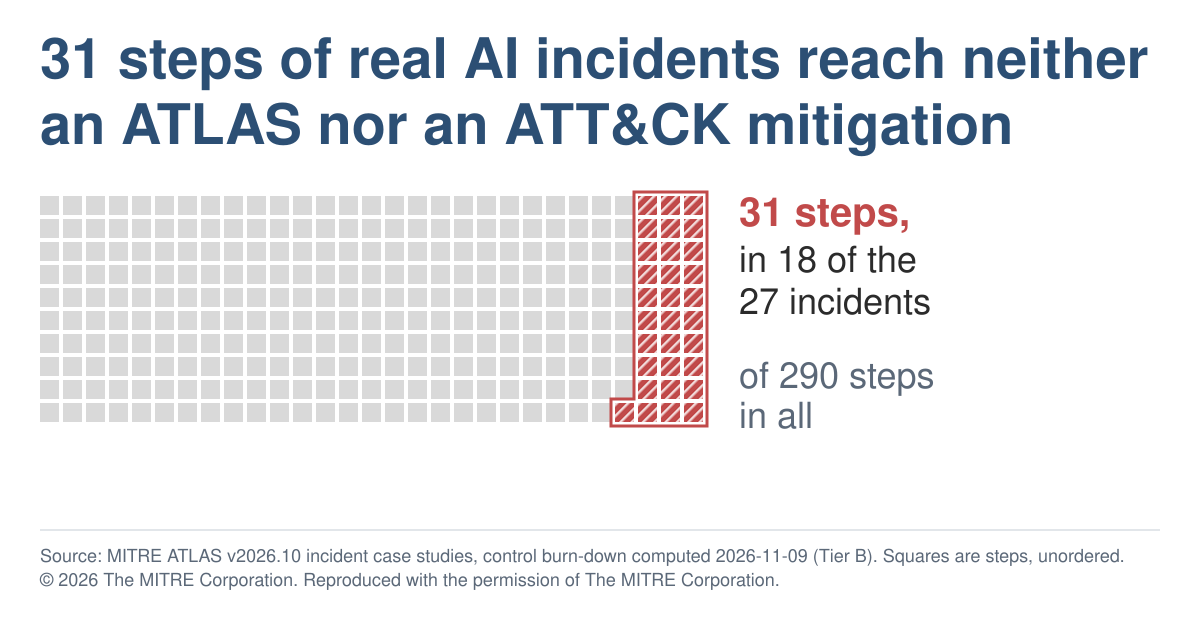
The answers on offer tend to come in two forms. One is a vendor overlay that asserts coverage on a slide, and the other is a framework crosswalk built by a standards body for its own purposes, which is real work but usually stops at the edge of that body's catalog. What I wanted was something in between, a chain computed end to end from public, license-clean data that would say, for each technique in MITRE ATLAS, which defensive techniques and which control-catalog entries it reaches and, just as usefully, where it falls off. I had an agent compute it against ATLAS v2026.10 on 2026-11-09, and the short version is that the chain reaches an 800-53 control or a CSF 2.0 subcategory for 191 of ATLAS's 221 techniques and still says less than that count suggests. Most of the D3FEND hop rests on rows I've proposed that MITRE hasn't merged yet, and the 800-53 mapping it lands on is a thin slice last modified in 2022, and when you count the 290 steps in ATLAS's 27 real incidents instead of techniques, 31 steps in 18 of those incidents reach neither an ATLAS nor an ATT&CK mitigation, so all three are worth understanding before any of it goes in front of an auditor.
Method
The chain and its three denominators
The chain has four hops. ATLAS techniques reach D3FEND through the digital artifacts they act on, D3FEND defensive techniques reach NIST SP 800-53 Rev. 5 through D3FEND's own published mapping, and, on a separate route, ATLAS mitigations reach NIST CSF 2.0 through the ATLAS mitigation IDs that NIST IR 8596, the Cyber AI Profile, lists as example informative references against CSF subcategories, which were extracted from the PDF into an edge list, and the profile is still an initial preliminary draft (released 2025-12-16, comments closed 2026-01-30, read 2026-11-16). I wrote about the general method, an artifact as the joint between offense, defense and controls, in From field mappings to the controls layer, where the offense side was ATT&CK, and this is the same idea pointed at ATLAS.
Three denominators are in play, and they're easy to mix up. The ATLAS-to-D3FEND crosswalk I built in July, and published as a repository in November, covered ATLAS 5.1.1's 140 techniques and moved 117 of them into D3FEND's inferred matrix, acceptance-tested in MITRE's own container (The blind quadrant; the crosswalk repository). The November rebaseline against D3FEND's develop branch, which carries ATLAS v2026.06, moved 137 of 173 once the rebaseline rows and my open pull requests are applied, against 2 of 173 on develop alone. And the chain in this essay runs against ATLAS v2026.10, which has 221 techniques, 44 mitigations and 77 case studies (27 incidents and 50 exercises). Every count below belongs to the 221 unless I say otherwise.
The rules for each hop matter as much as the data. An artifact counts as reaching a defense under the rule MITRE's own D3FEND API applies, where a defense covers an attack if it restricts the same artifact class or an ancestor of it, and a check against three of MITRE's published API responses found 30 same-artifact and 95 ancestor bindings and no descendant matches. The 800-53 hop uses sp800-53r5-control-catalog-d3fend-mapping.xlsx at develop 048c693, which parses to 180 edges across 111 controls and 41 defenses and matches the published 1.6.0 ontology with no difference in either direction. The CSF hop uses that extracted edge list, in which 26 of the 44 ATLAS mitigations carry an edge (116 edges to 69 subcategories). The ATLAS data, D3FEND's 800-53 spreadsheet and the IR 8596 text are Tier A, my crosswalk rows and the extracted CSF edge list are Tier B, and the computation over them is Tier B, from a single agent run.
Reach
What reaches
| Hop | Techniques reached (of 221) |
|---|---|
| Has an ATLAS mitigation directly (counting inherited from a parent) | 168 (186) |
| Has a D3FEND artifact row | 183 |
| Reaches a D3FEND defense under MITRE's rule | 176 |
| Reaches an SP 800-53 r5 control | 141 |
| Reaches a CSF 2.0 subcategory directly (counting inherited) | 135 (155) |
| Reaches 800-53 or CSF | 191 |
| Reaches neither | 30 |
Computed 2026-11-09 over ATLAS v2026.10, D3FEND develop 048c693 and the edge list extracted from IR 8596. Tier B computation over Tier A and Tier B inputs; single agent run.
Read quickly, 191 of 221 looks like a reassuring answer, since it says that around 86% of ATLAS techniques land on at least one control in a catalog most regulated organizations already report against. I'd read it more slowly than that, for three reasons that each cut the number down.
The first is provenance. Of the artifact rows that carry ATLAS into D3FEND, only the restrictions for AML.T0021 and AML.T0037 are merged on D3FEND's develop branch (checked 2026-11-16), and the rest are my crosswalk's proposed rows and open pull requests. So the D3FEND hop, and everything downstream of it, describes coverage as it would stand if those proposals are accepted, which I think is likely for most of them, on the evidence of two merges and review comments on several more, though nothing is settled until it merges.
The second is the age and thinness of the 800-53 mapping. D3FEND's spreadsheet carries a last-modified date of 2022-09-19 in its own metadata, long before ATLAS had any agent techniques, and it names a defensive technique on 117 of its 1,189 control rows. Only 17 of the 41 defenses it maps are among the 150 defenses the chain reaches at all, and 20 further rows point at D3-MAC, an identifier since retired in favor of System Call Filtering, which MITRE's own build also drops. (The 79 defenses in the controls-layer essay count CCI items as well as 800-53 controls, which is why that figure is larger.) So every technique that reaches 800-53 does so through a small, dated slice of it, and 35 techniques reach a defense and then stop because that defense has no 800-53 row.
The third is the one I find most instructive, which is that a chain can be valid at every hop and still tell you very little. AML.T0051.000, direct prompt injection, is a good example. The crosswalk says it injects a DigitalMessage, D3FEND's defenses on that artifact are Message Authentication and Message Encryption, and D3FEND maps those to CM-14, Signed Components. Each step is defensible on its own terms, and the result is that one of the most discussed attacks on language models is "covered" by a control about code signing. That one hop, from DigitalMessage to Message Authentication, carries 24 techniques to CM-14, and it is why CM-14 dominates the 800-53 layer when controls are ranked by how often an incident's smallest covering set can't do without them, essential in 9 of the 27 ATLAS incidents and 32 of the 50 exercises, which is an artifact of the mapping and says nothing about whether signed components help.
One chain · AML.T0051.000
Gaps
Where it falls off
The 30 techniques that reach no control framework at all fall into four groups. The External Harms parent (AML.T0048) and four of its five sub-techniques are there, because harms are outcomes rather than acts on an artifact. Several attacker-side resource-development techniques are there, such as four of the six acquire-infrastructure sub-techniques (T0008.000 to T0008.003) and two ways of obtaining capabilities (T0016.002 and T0016.003), because a defender rarely controls those steps. A cluster of agent techniques is there too, including AML.T0117 Autonomous Attack-Path Adaptation, AML.T0017.001 Autonomous Exploit Development, AML.T0034.002 Agentic Resource Consumption and AML.T0110 AI Agent Tool Poisoning, where the act happens inside an agent's own planning loop or tool set, which is neither an artifact in D3FEND's sense nor something an 800-53 control was written to address. And some are simply new, like AML.T0132, misconfigured or publicly exposed AI services, added on 2026-09-15, and AML.T0137, training-data inference from a model, added in v2026.10 itself.
Further back in the chain, 38 techniques have no artifact row at all, including direct injection's parent AML.T0051 LLM Prompt Injection, AML.T0054 LLM Jailbreak, AML.T0080 AI Agent Context Poisoning, AML.T0110 AI Agent Tool Poisoning and AML.T0115 Publish Poisoned AI Artifacts. Another seven have an artifact row but no defense under MITRE's rule, because D3FEND has no defense restricting that artifact class or any ancestor of it (SoftwareRepository, TransducerSensor, IntrusionDetectionSystem and Metadata among them). Across the chain, 60 of the 100 offensive artifact classes have no defense on the same class, so they reach a defense, if at all, only through an ancestor, which is how the File class ends up standing in for a lot of AI-specific behavior.
The chain · where it falls off
SCF
Where SCF fits, and why it isn't a column here
The obvious next step for a governance audience is the Secure Controls Framework, because many teams already use it as the hub that connects their obligations, and SCF 2026.3 has a substantial AI domain of its own. I've kept to counts from the 2026.3 workbook, read on 2026-11-03 (Tier A for what the publisher's file contains). Its Artificial Intelligence and Autonomous Technologies domain holds 160 controls, 36 of which mention agents in their descriptions, and SCF maps five AI focal documents, ISO/IEC 42001:2023 (149 SCF controls), NIST AI 100-1 AI RMF 1.0 (158), NIST AI 600-1 (140), the EU AI Act (121) and Texas TRAIGA (33). The union of those five touches 315 SCF controls, and 200 of them, 63%, sit outside the AI domain, in ordinary security, governance, HR and risk controls, which fits what the incident data below says about how much of an AI attack is familiar tradecraft.
The fact that decides how SCF connects to this chain is structural, and it applies to the AI domain specifically. No control in that domain maps to SP 800-53 (any revision or baseline), ISO/IEC 27001:2022, ISO/IEC 27002:2022 or CSF 2.0, and every column with those names has zero entries from it. SCF does map plenty of its other controls to 800-53, which is the general route the controls-layer essay describes, so an ATLAS technique that reaches 800-53 can land on ordinary SCF controls. What it can't do is arrive at SCF's AI controls, because the bridge on SCF's side doesn't exist for them, and the route that works for ATT&CK, through SCF's ATT&CK column, doesn't help either, since SCF carries no ATLAS column and ATLAS appears in the workbook only three times, in free-text suggestion cells.
SCF · where the chain stops
The chain can reach SCF, but not SCF's AI controls
The other reason SCF isn't a column is that adding it would mean reshaping SCF rows onto ATLAS techniques, which this essay doesn't do. SCF publishes its own mappings, and what this site shows of them is counts and a consensus view, so here I keep to counts with attribution and point at the publisher's mappings. The two AI control frameworks compared alongside it are more restrictive about reuse. The CSA AI Controls Matrix v1.1 (247 controls) ships the more complete machine-readable data, JSON, YAML and OSCAL, but CSA's licensing FAQ says the free version is "for internal reference only" with no derivatives, and AIUC-1's terms forbid copying or derivative works of its content. AIUC-1's own ATLAS crosswalk page says it was last updated on 2025-07-22, lists mitigations only up to AML.M0025, and attaches a requirement to 17 of ATLAS v2026.10's 44 mitigations, none of them from the 18 mitigations ATLAS has added since, M0026 to M0043, which include all of its agent-access and agent-tool mitigations (read 2026-11-16, Tier A for the publishers' own pages).
What that leaves, practically, is two artifacts that point at each other. SCF answers which controls the AI frameworks agree on, and the AI view of the Control Consensus page draws that from SCF's own AI crosswalk columns, while the ATLAS chain answers which controls touch real attack paths, and I think a governance team needs both questions answered and shouldn't expect one table to do it. NIST's own 800-53 AI overlays, which would be the natural place for this to be settled, have no public draft yet. On 2026-10-20 NIST renamed the project from Control Overlays for Securing AI Systems to SP 800-53 Control Overlays for Super Intelligence Systems (COSIS), citing a 2026-09-29 executive order, and the only documents are the 2025-08-14 concept paper and a 2026-01-08 annotated outline for predictive AI (read 2026-11-16, Tier A).
Incidents
What real incidents actually need
Technique counts treat every technique as equally important, which they aren't, so the second half of the analysis switched units from techniques to the steps in real incidents. ATLAS v2026.10's 27 incident case studies contain 290 steps that use 107 distinct techniques.
About half of those steps are tradecraft a team that works from ATT&CK already knows. Of the 221 ATLAS techniques, 150 (67.9%) have no ATT&CK reference, either directly (173 don't) or through a parent, but in the incident record only 146 of 290 steps (50.3%) use those ATLAS-native techniques, while the 50 red-team exercises run 79.5% native. "Native" here is ATLAS's own linkage, so it's an upper bound on what's new, since a few native techniques are ATT&CK behavior in substance, and ATT&CK v20 added AI techniques of its own, Direct and Indirect Prompt Injection (T1699, T1698) among them, that ATLAS v2026.10 doesn't yet link to (ATLAS moves fast and deprecates nothing has the detail). So the exercise record makes AI attacks look more novel than the incident record does, and the incident record says roughly half of a real AI attack is an ordinary intrusion.
Then the analysis asked how far the catalogs reach over those steps if you pick controls greedily, each time taking the control that covers the most uncovered steps, a computation that was independently re-implemented and reproduced. ATLAS's own mitigations reach 19.3% of steps after one control, 50.7% after four, 64.5% after seven and 71.7% after ten, and then stop at a ceiling of 75.5% (219 of 290 steps), with only 17 of the 44 mitigations ever adding a step. On the familiar half, ATT&CK's mitigations are close to complete on their own, reaching 142 of 144 steps. That leaves 31 steps in 18 of the 27 incidents that no catalog reaches, 30 of them ATLAS-native, concentrated in financial harm (6 steps), LLM prompt crafting (5) and enterprise resource and environment discovery (5 and 4). The greedy table itself is on the ATLAS Wall.
Incident steps · greedy burn-down
One result needs stating carefully, because it undercuts the greedy ranking above. A degree-preserving shuffle of the control-to-technique graph, run a thousand times, produced curves at or above the real greedy ATLAS curve 16.1% of the time on the published seed, and 13.7% to 16.1% across all the seeds tried (this run was not pre-registered). The real curve beats roughly 84% of the shuffles, but that isn't enough to tell it apart from what you'd get by shuffling the mappings while keeping each control's breadth and each technique's number of controls. In plain terms, how fast a greedy order accumulates coverage seems to be explained mostly by how many techniques each control is mapped to and how many controls each technique has, and that's worth knowing before anyone treats a greedy top ten as a priority list. The null tests order only, so it can't say anything about the 75.5% ceiling or the 31 uncovered steps, which are facts about which techniques have any mapping.
A different ranking question gives a different top of the list. If you ask which control an incident's smallest covering set can't do without, over the 48 incidents in my research set (the 27 ATLAS incidents plus 21 researched separately from public reporting, a step list I haven't published yet), AML.M0043, AI Agent External Resource Lifecycle Management, comes first (essential in 19, possible in 21) and Control Access to AI Models and Data at Rest second (18 and 25), while Threat Intelligence Program, first in the greedy order, drops to fourth because it is broadly relevant and usually substitutable. That computation was re-solved for all 321 flow-and-layer pairs with no mismatches, though the 21 researched incidents use a different unit from ATLAS's published steps, technique uses mapped from reporting at about six per incident against ATLAS's eleven or so, and that mapping had one coder and no second reader, so it is Tier D. I'd attach a caution to M0043 in particular, which leads largely because it is the only ATLAS mitigation mapped to Acquire Infrastructure and Stage Capabilities, two attacker-side resource-development techniques a defender rarely controls, so its position says as much about gaps in ATLAS as about where defenders have reach.
All of this measures relevance, and I'd keep it apart from interdiction, because a mapped control is relevant to a step that happened, while whether it would have stopped that step is a separate question this data doesn't answer. A later bench on v2026.10 took eight of the top twelve controls in the greedy order, the ones whose text names something a check can key on, implemented each as the check its text describes, and planted 22 of the step-slots the burn-down credits to them (18 distinct steps), chosen by a rule fixed before the run, each control's three most-used defender-side techniques and the most recent incident step for each, out of about 217 control-step credits in all. On SQLite, the engine named before the run, one was caught cleanly, seven only alongside legitimate background, and fourteen not at all, six of those because the step leaves no event on the defender's side (DuckDB gave 2, 5 and 15). That run was agent-built and independently verified, but the control-to-check mapping had one agent drafter and no second reader, so the mapping is Tier D while the planted runs are Tier B (t4-interdiction).
Telemetry
When a mapped control meets a planted attack
The last test pushed one level further down, from controls to telemetry, because a control that requires detection is only as good as the field the detection reads, and that work has its own essay, ATLAS has no detection layer, so I'll give only the parts that bear on control mapping. Following the crosswalk's artifacts into OCSF 1.9.0 over the same 290 incident steps, between 55.5% and 57.9% of steps land on a specific field depending on the grader (161 under a first grader, Claude Opus 5.5, grading in one pass, and 168 under a blind second grader, Gemini 3.8 Flash), while the share landing on any field at all depends on which grader you believe, 81% against 70%, and the step that would settle it hasn't run. Every one of those grades is Tier D. The split by origin survives both graders, with steps that use ATT&CK-referenced techniques reaching a specific field 85.2% and 91.8% of the time and ATLAS-native steps 33.9% and 33.3% (counting direct ATT&CK references only, so more steps count as native here than the 146 above).
Then eight techniques got a rule each over a planted corpus. Two were detected cleanly, five were noisy and one was missed, and a mapping table would have scored seven of the eight as covered. The two clean ones matched on the attack's own content, the injected SQL and the decoded command line, and one of those turned out to be clean only for the letter case the bench planted, while every rule that matched on an artifact kind got caught in the background its lookalike produces. The general vocabulary problem behind this, that D3FEND's proposed AI artifact nouns and OCSF's ai_* objects share no exact match across 25 rows, is in the same essay.
Relevance vs interdiction · planted benches
The mapping credits all 22; the SQLite check caught 1 cleanly
Advice
What I'd tell an architect who has to answer the question this quarter
I think the chain is useful, and I'd use it, but as a map of where to look rather than as a coverage claim. Concretely, I'd do four things with it:
- Separate the familiar half from the native half before mapping anything, because roughly half the steps in real AI incidents are ordinary intrusion tradecraft that ATT&CK-based controls already reach, and the work that's actually new is concentrated in the other half.
- Report coverage by step with its denominator named, and not as a technique percentage on its own, since 191 of 221 techniques reaching a catalog and 31 of 290 incident steps reaching none are both true and tell very different stories.
- Keep the SCF view and the ATLAS view as two linked answers, the first for what the frameworks agree on and the second for which controls touch real attack paths, and don't build a joined table you can't publish or defend.
- For any control that claims detection, check the field and fire a planted test, because in the planted bench two of the seven techniques with a mapped field came out as clean detections, and one of those two only for the case it was planted with.
The general version of this lives in the security-context-graph folder of my lab repository, where every edge carries its source and a tag for how weak its proxy is, so a multi-hop answer reports its weakest hop, and I'd note that the same lab found conceptual grounding close to inert against a plain schema-validity check and graph structure helping a retrieval answer on 1 of 9 queries (2026-06-08), so what the graph buys is navigation with its provenance showing rather than a smarter model.
Limits
What this doesn't show yet
Each of these changes a number or a claim, and I'd rather name them than have a reader find them.
- The chain outputs and the 21-incident step list aren't published. The lab benches are public at the links above, but the ATLAS-to-800-53 chain and the 48-incident hitting set are not, so a reader can check the method and the public inputs and can't yet re-run my counts, and nobody has independently re-implemented the chain.
- A second CSF route. The alternative 800-53 to CSF path through NIST OLIR hasn't been computed yet, so CSF reach currently depends on an ATLAS mitigation existing and being in the IR 8596 bridge, which excludes 18 mitigations, including all four added in v2026.10 and the three added in the two releases before it.
- Interdiction beyond eight controls. The planted-check bench covers eight top controls on one machine with one agent's control-to-check mapping, and the remaining controls, and a second person's mapping, are untested.
- Upstream status of the crosswalk rows. Two artifact rows are merged on D3FEND develop as of 2026-11-16, and the D3FEND hop depends on the rest, so this count needs re-checking whenever the chain is re-run.
Sources
Sources and method
| What | Source | Tier |
|---|---|---|
| ATLAS v2026.10 | mitre-atlas/atlas-data releases, 2026-10-28 | A |
| D3FEND ontology and the 800-53 mapping | d3fend/d3fend-ontology, develop 048c693, read 2026-11-16 | A |
| CSF route | NIST IR 8596 initial preliminary draft, read 2026-11-16; edge list agent-extracted, not yet published | A for the draft; the extracted edge list B |
| NIST 800-53 AI overlays | COSIS project page, read 2026-11-16 | A |
| ATLAS-to-D3FEND crosswalk | atlas-d3fend-crosswalk | B |
| Chain and hitting set | agent-computed 2026-11-09, not yet published | B, single run |
| Control burn-down and ATT&CK overlap | the ATLAS Wall, independently re-implemented | B |
| Planted control checks | t4-interdiction | B; mapping D |
| Telemetry column and second grader | atlas-ocsf-observables, m1-r1-blind-regrade | B; grades D |
| SCF 2026.3 | SCF terms, read 2026-11-16; counts from the publisher's workbook | A |
| AIUC-1 ATLAS crosswalk | standard.aiuc-1.com/crosswalks/mitre-atlas, read 2026-11-16 | A |
