
AI attack surface · Part 5
Who gets the logs: IDE agents, enterprise assistants and managed platforms compared
Claude Code's OpenTelemetry export makes a good small test of what an AI product hands a security team by default, and in an agent-run test in my lab on 2026-11-10 (UTC) it was pointed at a local collector, with the same scripted agent session run three times at the documented defaults and three times with every content setting on, and each run was scored on twelve telemetry fields a security team would want from the record. At the defaults the export carried eight of those fields, the user's identity down to the account email, the session id, the tool name, the model, four token counters, a cost figure, host attributes and timestamps, and it carried the prompt, the tool arguments, the tool output and the response only as lengths or the literal string <REDACTED>. With every content setting on, all twelve fields arrived and matched the known session, though the file contents the tool read came through only on the tracing path, which the docs still call beta (lab run T2, Claude Code 2.1.321, one machine, Tier B). None of that is a defect, since the defaults are documented and deliberate, but it is a small, measured instance of a pattern that the product comparison below finds across nearly every AI product a security team gets asked to approve, which is that the record of who did what to which setting arrives by default and the record of what was said and done waits on a second decision somebody has to make.
The comparison below takes that pattern across twelve products in three deployment classes, which is a separate count from the twelve fields above: the IDE and coding agents (GitHub Copilot, Cursor, Claude Code, OpenAI Codex, and Windsurf, which Cognition renamed Devin Desktop on 2026-06-02), the enterprise assistants (Microsoft 365 Copilot, ChatGPT Enterprise, Claude Enterprise, Gemini Enterprise) and the managed build platforms (Microsoft Foundry, Amazon Bedrock, and Google's Gemini Enterprise Agent Platform, which Google renamed from Vertex AI on 2026-04-22 and which Part 4 still calls Vertex AI). Part 4 graded the telemetry surface by surface; this piece asks the procurement-shaped question that sits under it, which is who ends up holding the content record for each product, under which licence, and who has to flip the switch.
Reading time: about 16 minutes. Evidence tier: B for what each product's logging feature does, from the vendor's own documentation read on 2026-11-16; B for the lab run in the opening (one machine, agent-run); C for one third-party reading of Microsoft Foundry's logs; D where a product's place in the comparison rests on what its documentation leaves unsaid, and for the inference-routing reading. Nothing here measures how well any feature works.
Two channels
An admin trail everywhere, the content somewhere else
The first thing the documentation shows, product after product, is an administrative audit trail that carries settings, seats and sign-ins and leaves the conversation out, usually saying so directly. GitHub's Copilot audit log page says the log "does not include client session data, such as the prompts a user sends to Copilot locally" and that it "retains events for the last 180 days", and it recommends streaming to a SIEM for anything longer; the same page still says "a custom solution is required to access this data", pointing at custom hooks, while GitHub's agentic-activity page documents the managed OpenTelemetry channel described below. Cursor's compliance page says its audit payloads "carry identifiers, names, and changed settings, never prompts, agent output, generated code, or credentials". Anthropic's audit-log help page says the title and content of chats "are not available to be exported in audit logs (only their unique identifiers will be exported)". Microsoft's CopilotInteraction record in Purview Audit, which is written automatically once an organization has auditing on, documents a Messages property holding a message ID, an isPrompt flag and a JailbreakDetected flag, plus an XPIADetected flag on each resource Copilot touched, and the schema has no field for the text itself (read from the documented properties, since the page does not say so in a sentence).
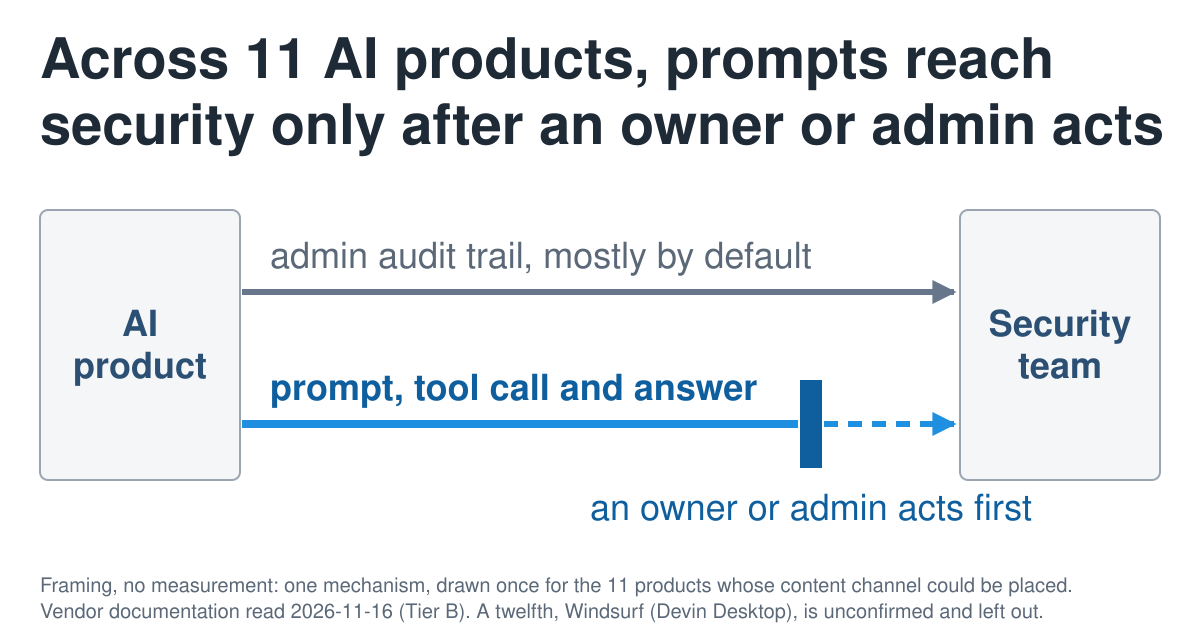
So when a team says it has the Copilot logs, or the Claude logs, it is worth asking which of the two channels it means. The admin trail answers who got a seat, who changed a policy and who signed in, which is real governance evidence and close to useless for reconstructing what an agent did during an incident. The content channel, the prompt, the tool call and the response, is a separate product decision on every product here whose channel could be established, with its own owner, its own licence line or toggle and its own path to you. Three of the assistants keep the conversations whether or not anyone asks, but even there the security team reads them only after someone grants a role, a permission or an API, and the rest of this piece is about those owners, licences and paths.
Two channels · the opening run, field by field
At defaults the export carried 8 of 12 fields, none of them content
Claude Code 2.1.321 OpenTelemetry export, one scripted session run three times each way
| Field | Defaults | All content on |
|---|---|---|
| User identity, to the account email | arrived | arrived |
| Session id | arrived | arrived |
| Tool name | arrived | arrived |
| Model | arrived | arrived |
| Four token counters | arrived | arrived |
| Cost | arrived | arrived |
| Host attributes | arrived | arrived |
| Timestamps | arrived | arrived |
| Prompt | withheld | arrived |
| Tool arguments | withheld | arrived |
| Tool output | withheld | arrived, traces only |
| Response | withheld | arrived |
| Fields that arrived | 8 of 12 | 12 of 12 |
How the content record reaches you
The obvious way to sort the content channel is by where it lands, the vendor's cloud, the customer's cloud account or the developer's laptop, but the distinction that matters more is where the record is produced and how it crosses to the customer, because two of the coding-agent vendors build the record from their own copy of each turn and push it to a destination the customer runs, which lands in the same kind of store as a laptop exporter's output and behaves differently on tampering and completeness. That gives four paths.
- Emitted on the endpoint. Claude Code's export is "opt-in and requires explicit configuration", and prompt text is recorded only as a length unless
OTEL_LOG_USER_PROMPTS=1is set. Codex takes an[otel]table inrequirements.toml, whoselog_user_promptkey the configuration reference describes as an opt-in to exporting raw prompts. GitHub documents OpenTelemetry for Copilot clients through enterprise managed settings with separate capture classes, where "every capture class defaults to false" and an admin can turn on identity alone "to attribute agent activity to a user without collecting prompts, responses, or tool content". - Pushed by the vendor to a destination you run. Cursor's OpenTelemetry Export, an Enterprise feature, delivers from a server-side egress proxy to an endpoint the customer runs, and its conversation-content family, prompts, responses and optionally tool arguments and results, scrubbed and capped at 32 KiB per message and 8 KiB per tool side, "is off by default". GitHub streams Copilot usage records, each "Copilot API usage record" carrying a request or response body, through enterprise audit-log streaming to destinations such as S3, Azure Blob Storage or Google Cloud Storage, in public preview and only for enterprises on Enterprise Managed Users or GitHub Enterprise Cloud with data residency, after an admin selects "Enabled everywhere" for the stream.
- Held by the vendor and pulled. Microsoft 365 Copilot stores "the user's prompt and Copilot's response" with the tenant's other Microsoft 365 content, and searching it in an eDiscovery case requires membership of "the eDiscovery Manager role group". OpenAI's Compliance Logs Platform carries ChatGPT Enterprise and Edu conversation logs as immutable JSONL, behind a permission only a workspace owner can grant. Anthropic's Compliance API serves chats, files, projects and the transcripts of local Claude Code, Cowork and Claude in Chrome sessions captured under a Claude Enterprise sign-in. Codex has the same shape, since local Codex sessions have "the same Compliance API support as Work Cloud" and "records appear under the
conversation_messageandcodex_logevent types", though OpenAI adds that these sources "do not establish a complete record of every local command, file operation, screenshot, approval, or external action". - Written by the platform inside your cloud account. Bedrock's model invocation logging writes request and response bodies up to 100 KB inline, larger bodies as S3 objects, with the caller's IAM or STS ARN "captured automatically", into CloudWatch Logs or S3 in the same account and Region. Agent Platform's request-response logging writes to a BigQuery table in the customer's project, with a sampling rate between 0 and 1, and no column in its documented schema identifies the caller. Foundry's agent tracing "captures detailed telemetry - including latency, exceptions, prompt content, and retrieval operations" into the customer's Application Insights resource, and "Foundry enables it automatically after you connect an Application Insights resource to your project". Gemini Enterprise, an assistant, belongs here too, because its usage audit logs go to the
_Defaultbucket of the customer's Cloud Logging project.
Two of these need a further sentence. Foundry's agent tracing sits beside a model-inference layer whose diagnostic logs carry no content as documented: the monitoring page describes the RequestResponse category as "logs for every inference request and response, including status codes and latency" and lists no prompt or completion field, and Elastic's integration, a third party, says that "the default logging doesn't log the inputs and outputs of the service" and reads the prompt from API Management gateway logs placed in front of the model (Tier C for that reading of Microsoft's logs). So a Foundry application that calls a model directly, outside an agent, has no content in its native logs unless a gateway is put in front or Purview's DSPM for AI is set up, whose policy for enterprise apps "captures prompts and responses for regulatory compliance from Entra-registered AI apps, ChatGPT Enterprise Connector, and applications built on Microsoft Foundry" (Part 6 covers that path). Windsurf, now Devin Desktop, can't be placed: the admin guide for its plugins describes analytics dashboards, report export and a REST API for analytics and SCIM, and Cognition's enterprise API documents audit logs and session messages for Devin sessions, but none of the pages read says whether either reaches the desktop editor's local agent sessions.
The table puts the twelve on the paths and on two separate default tests, because "on by default" hides a real difference: whether the vendor keeps the content without anyone acting, and whether a security team can read it without an owner or admin acting first. A product appears on two rows where it documents two channels.
| Product | Path the content record takes | Kept without anyone acting? | Who acts before security can read it |
|---|---|---|---|
| GitHub Copilot | Emitted on the endpoint; pushed by the vendor (preview) | No: capture classes default to false; the stream needs "Enabled everywhere" | Enterprise admin |
| Cursor | Pushed by the vendor | No: conversation content off by default | Team admin, Enterprise plan |
| Claude Code | Emitted on the endpoint; held by the vendor and pulled | No: export is opt-in; transcript capture starts when the Compliance API is enabled | Admin through managed settings; primary owner |
| OpenAI Codex | Emitted on the endpoint; held by the vendor and pulled | Not stated for Compliance API records; prompt export is opt-in | Admin through requirements.toml; workspace owner or admin key |
| Windsurf (Devin Desktop) | Not established for local sessions | Unconfirmed | Unconfirmed |
| Microsoft 365 Copilot | Held by the vendor and pulled | Yes | eDiscovery Manager role grant |
| ChatGPT Enterprise | Held by the vendor and pulled | Yes, under the admin's retention setting | Workspace owner grants the conversation permission |
| Claude Enterprise | Held by the vendor and pulled | Yes, indefinitely by default | Primary owner enables the Compliance API |
| Gemini Enterprise | Written in your cloud account | No: prompt text only with the content setting on | Gemini Enterprise Admin |
| Microsoft Foundry | Written in your cloud account | No: tracing starts when Application Insights is connected | Project owner connects the resource |
| Amazon Bedrock | Written in your cloud account | No: "disabled by default" | Account admin |
| Google Agent Platform | Written in your cloud account | No: "disabled by default" (Pre-GA) | Project admin |
Placed from the vendor pages read on 2026-11-16. Each cell is Tier B for what the feature does, and a placement where a page is silent is Tier D. "Kept without anyone acting" asks whether the vendor keeps the content record with no setting changed; "who acts" names the role the documentation puts between the record and a security reader.
Counting each product once, then, no product among the eleven whose content channel could be established hands the content to a security team without an owner or admin acting first. Three assistants, Microsoft 365 Copilot, ChatGPT Enterprise and Claude Enterprise, keep the conversations regardless and gate the reading of them behind a role, a permission or an API, seven produce no content record at all until a setting is turned on, Codex doesn't say whether its Compliance API records exist before anyone asks, and Windsurf's local sessions can't be placed from the pages read. So the pattern from the opening holds in a sharper form: the content is usually not produced until someone asks for it, and where it is kept anyway, it was built for retention and e-discovery rather than as a feed a detection can sit on.
What each path costs you
Each of the four paths hands a security team a different problem, and I think the problem matters more than the class boundary the product was sold under.
Content record · four paths
Four paths the content record takes, and the problem each one hands you
Products on each path, and the catch each path documents
| Path | Products | The catch |
|---|---|---|
| Written by the platform in your cloud account | Bedrock, Agent Platform, Foundry, Gemini Enterprise | Off by default and incomplete in documented ways; nothing from before the switch exists |
| Held by the vendor and pulled | Microsoft 365 Copilot, ChatGPT Enterprise, Claude Enterprise; Claude Code and Codex through the Compliance API | The vendor's retention and pull window bound the investigation |
| Pushed by the vendor to a destination you run | Cursor; GitHub's usage-records stream (preview) | Built from the vendor's copy of each turn; Cursor documents that some turns can drop |
| Emitted on the endpoint | Claude Code, Codex, GitHub Copilot clients | Reaches you only while the laptop exporter is configured and stays configured |
When the platform writes the record into your own cloud account, it sits under your IAM and your retention, and a detection pipeline can treat it like any other log source. The price is that it is off, and that it is incomplete in ways the docs state: Bedrock's logging covers calls "made through the bedrock-runtime endpoint", and calls on the same APIs through bedrock-mantle "are not currently captured"; Agent Platform's request-response logging runs under Google's Pre-GA Offerings Terms, drops request-response pairs larger than the BigQuery 10 MB row limit, and has no caller column, so attributing a logged prompt to a principal means joining it to Data Access audit logs that are themselves "disabled by default"; Foundry's tracing page warns that tracing "can capture sensitive information, such as user inputs, model outputs, and tool arguments and results", which is the point for an investigation and a privacy decision for whoever connects it; and for Bedrock and Agent Platform alike, nothing from before the switch was thrown exists to recover. Gemini Enterprise's prompt text appears only when the "Enable logging of prompt inputs and response outputs" setting is on, with text values otherwise "replaced with <elided>", while turning off the OpenTelemetry instrumentation setting beneath it means "no logs are sent to Cloud Logging" at all.
When the vendor holds the record and you pull it, the vendor's retention and the vendor's pull window bound the investigation. OpenAI's Compliance Logs Platform "retains data for 30 days", so anyone who wants longer "should implement a system to continuously download all logs", and a collector that stops for longer than that loses the log files it didn't fetch, though the conversations themselves stay in the workspace under the admin's retention setting; the old stateful conversations route was removed on 2026-06-05, so the logs platform is the path that remains. Anthropic's Compliance API is the opposite case on retention, since captured local-session transcripts are held "6 years by default, or your organization's custom conversation retention period when a finite one is set", and like OpenAI it waits on an owner, because the primary owner enables the API, capture of local sessions "is tied to the Compliance API being enabled for your organization", and "a session that ended before capture started for your organization is not listed". Anthropic also documents inference hooks, through which an organization's own security server "receives each governed prompt before inference and can deny it in real time", an inline path that hands the prompt to the customer's own server before the model sees it, though the docs say rewriting or redacting the prompt is not supported.
When the record is emitted on the endpoint, it reaches you only if an exporter there is configured and stays configured. Claude Code's docs state the gap, saying that "a developer's setting can still disable a signal or switch it to the console exporter, so set the selectors in managed settings too if you need them locked". Codex documents the same kind of gap on one build, since its macOS desktop app 26.1027.30824 bundles a CLI that "doesn't support [otel] in requirements.toml, so it can't enforce log_user_prompt = false through this policy". GitHub's per-class capture applies fully only to Agent Host sessions in VS Code, while "the local agent harness uses the legacy all-or-nothing captureContent setting". The vendor-pushed channels avoid the laptop-tamper problem, and in exchange the record is built from the vendor's copy of each turn: Cursor's page says a local turn's records are built "from its own server-side copy of the turn", that some turns "can drop", and that agent turns "that run entirely in the client rather than through Cursor's servers" are not exported.
Volume is the last cost, and it favours the paths where the record lands in storage you control. The lab's R6 run put full-context prompt logging for 1,000 coding-agent users at about 100 GB of raw JSON per active day, against about 0.6 GB for metadata alone, which is cheap to keep in object storage and expensive if it lands raw in a SIEM priced by daily ingest; what to keep when the agent did it carries the full storage arithmetic. So the paths that put the record in a bucket or table you own, whether the platform writes it there or a vendor or an endpoint exporter sends it, are the ones where turning content on is cheapest to sustain, provided it goes to object storage first and a metadata projection goes to the SIEM.
Licence and owner
Who has to flip the switch, and on which licence
The licence pattern on the 2026-11-16 pages is useful for budgeting before anyone signs. Content access tends to sit on the top tier or in a separate line item: Cursor's audit log and OpenTelemetry Export are Enterprise-only, while SSO reaches Teams; Claude for Teams gets SSO and server-managed settings, and Claude for Enterprise "adds domain capture, role-based permissions, and the compliance API"; OpenAI's Compliance Platform "is available to ChatGPT Enterprise and Edu workspaces"; and GitHub's usage-records stream is limited to Enterprise Managed Users and data-residency customers while in preview. Microsoft inverts the pattern for its own Copilots, since CopilotInteraction is in Audit (Standard), as are custom applications built with Copilot Studio and Microsoft Foundry, but interactions with non-Microsoft AI apps are logged as AIAppInteraction records with consumption "charged based on the number of audit records ingested" and kept 180 days, which is the line item to find before claiming Purview covers unsanctioned AI use. On the managed platforms the tier question turns into a cost question, and Microsoft's monitoring page adds that "there's a cost for collecting data in a Log Analytics workspace, so only collect the categories you require".
Who holds the switch matters as much as the licence, because it decides whose calendar the logging decision waits on. On Anthropic's side the primary owner enables the Compliance API and only Owner and Primary Owner roles can configure inference hooks; on OpenAI's, "only a workspace owner can grant broad compliance access or the Conversation messages permission"; Microsoft puts stored Copilot content behind the eDiscovery Manager role group; Gemini Enterprise's logging needs the Gemini Enterprise Admin role; and the coding agents put the switch in managed settings that someone has to deploy to every laptop, by MDM or the vendor's server-managed channel. Those roles often belong to whichever team bought the product, which may not be security, so a collection plan for AI content is partly a matter of getting the right owner to make a one-time decision before the retention clock starts.
MCP allowlists
Allowlists keyed on a name
Tool and MCP allowlisting differs across the coding agents, and the match key is the thing to check. GitHub documents two methods: a managed-settings allowlist, generally available, with "secure matching based on name, URL, or stdio commands", and a registry allowlist in public preview, "not the recommended method", whose enforcement "is based only on server name/ID matching, which can be bypassed by editing configuration files" and which GitHub marks as not supported for Copilot in the cloud. Claude Code warns that a serverName entry "is not a security control" and that enforcing which servers actually run takes serverCommand or serverUrl entries. Codex enables a server only when "both the server name (<id>) and its identity must match", matching on the command for stdio servers and the URL for HTTP ones. Even the strongest of those decides which server runs and says nothing about whether an approved server's tool descriptions changed since it was approved, which is what tool poisoning shows up as a diff measures in the lab.
MCP allowlists · the match key
Two of these MCP allowlists match only on a name
What each coding agent’s allowlist checks before a server runs
Matches on a name
- GitHub registry allowlist public previewserver name or ID only, which can be bypassed by editing configuration files
- Claude Code serverName entrydocumented as not a security control
Can match on what actually runs
- GitHub managed-settings allowlist generally availableURL or stdio command, as well as name
- Claude Code serverCommand or serverUrlthe command or the URL
- Codexname and identity must both match: the command for stdio, the URL for HTTP
None of these checks whether an approved server’s tool descriptions changed since it was approved.
Inference routing
Routing inference through a platform you own
There is one move that crosses the class boundaries, and it is the reason I'd look at the managed platforms even for a team that only runs coding agents. Claude Code's allowedProviders managed setting "lists which services a managed machine may reach Claude through, such as the Anthropic API, Amazon Bedrock, or an LLM gateway", from version 2.1.285, and its accepted values include "vertex" for Google's Agent Platform and "foundry" for Microsoft Foundry; set from MDM or a managed settings file it is enforced, while a list set only in server-managed settings is one the docs say to treat "as a convenience for machines you can't reach with device management" rather than as enforcement. Codex's requirements.toml has a model_provider key to "enforce the model provider ID, overriding local and session configuration", though its docs say the key is not supported for local computer access with Work Cloud. When the route is forced, the coding agent's model calls become managed-platform traffic and land in the customer's invocation logs, if those are on, which is plausibly the most direct way available today to get an organization-owned record of a coding agent's model calls without trusting a laptop exporter. That reading comes from the docs and is not a measured result (Tier D), and it has two costs. The route carries the model request and response and none of the local tool executions, file reads and shell commands the agent runs between calls, and on that route only the laptop-side events carry them, because Anthropic's session endpoints do not return "Claude Code sessions authenticated with a Claude Console API key, or run through a third-party cloud platform such as Amazon Bedrock, Google Cloud, or Microsoft Foundry".
Inference routing · what crosses
That limit connects to two blind spots worth writing into any collection plan regardless of product. One is the boundary between a vendor's own surfaces: Codex cloud environments "don't inherit local device policy, MDM settings, or local network access", Anthropic's custom retention controls don't apply to "any other feature that runs Claude Code in the cloud", and GitHub's registry enforcement doesn't reach Copilot in the cloud, so the same product can be governed on the laptop and much less governed in the vendor's runner. The other is the error path inside an MCP server, where the current Python SDK release tells the client only that a tool failed and writes the cause to the server's own stderr, which MCP just told you where its logs went works through from two lab captures, so for servers on that release no client-side or gateway record in any product above carries the reason.
Limits
Bottom line: across these twelve products the security team mostly gets the settings trail by default and has to ask, pay or configure for the content, and on the pages read on 2026-11-16 none of the eleven that could be placed hands that content to security before an owner or admin acts. The path the record takes, written into your cloud account, held by the vendor behind a pull window, pushed by the vendor to a destination you run, or emitted on the developer's laptop, decides whose copy it is, who can switch it off or tamper with it, and whose retention bounds an investigation, so the first collection decision I'd make for any of them is to turn the content channel on before the first incident, land it in a bucket you own, and write down which person holds the switch. What the tools you already own can see picks up from there, with the security tools already in the environment rather than the AI products themselves.
Sources
| # | Source | What it supports | Tier |
|---|---|---|---|
| 1 | GitHub Docs: "Review audit logs for Copilot"; "Agentic audit log events"; "Streaming the audit log for your enterprise"; "Monitoring agentic activity in your enterprise"; "MCP management"; "MCP private registry enforcement", all read 2026-11-16 | Audit log scope, 180 days and custom-hook note; usage-records stream, preview scope, body field, destinations; client OTel capture classes default false; allowlist match keys | B |
| 2 | Cursor Docs: "Enterprise"; "Compliance and monitoring"; "OpenTelemetry Export", read 2026-11-16 | Audit payload scope; Enterprise-only features; conversation content off by default, server-side delivery, caps, dropped turns | B |
| 3 | Claude Code Docs: "Monitoring"; "Authentication"; "Settings reference"; "Control MCP server access", read 2026-11-16 | OTel opt-in, prompt redaction, exporter-selector lock; allowedProviders and its values; serverName not a security control | B |
| 4 | OpenAI Codex docs: "Admin setup"; "Managed configuration"; "Configuration reference"; "Compliance API and audit events", read 2026-11-16 | log_user_prompt opt-in; macOS desktop build gap; MCP name and identity match; model_provider enforcement; Compliance API record types and completeness caveat; cloud environments outside local policy | B |
| 5 | Cognition: "Windsurf Plugins Guide for Admins"; "Devin Desktop FAQ"; enterprise API "List Audit Logs" and "List session messages"; "Local Agent Controls", read 2026-11-16 | Analytics and REST API; 2026-06-02 rename; audit and session APIs for Devin sessions; no local-session logging setting found | B |
| 6 | Microsoft Learn: "Audit logs for Copilot and AI applications" (ms.date 2026-08-26); "Data, Privacy, and Security for Microsoft 365 Copilot" (updated 2026-11-04); "Search for and delete AI data" (eDiscovery); "Data Security Posture Management for AI" (updated 2026-06-25), read 2026-11-16 | CopilotInteraction schema; Audit (Standard) scope; AIAppInteraction billing and 180 days; stored prompts and responses; eDiscovery Manager role; DSPM capture from Foundry apps and the ChatGPT Enterprise connector | B |
| 7 | OpenAI Help Center, "OpenAI Compliance Platform for Enterprise and Edu customers"; OpenAI, "Enterprise privacy", rendered in a browser 2026-11-16 | Eligibility; owner-granted conversation permission; append-only logs; 30-day log retention; stateful route removed 2026-06-05; admin-controlled conversation retention | B |
| 8 | Anthropic: Claude Help Center retention, audit-log and organization-export articles; Claude Platform Docs "Compliance API", access, sessions, FAQ and inference-hooks pages, read 2026-11-16 | Indefinite default retention; Compliance API enablement and capture start; session transcripts, 6-year default and cloud-provider exclusion; audit export scope; inference hooks | B |
| 9 | Google Cloud Docs: Gemini Enterprise usage audit logs and observability settings (updated 2026-11-10); Agent Platform audit logging and request-response logging (updated 2026-11-12); Agent Platform release notes, read 2026-11-16 | _Default bucket, content setting, <elided>, Admin role; Data Access off by default; request-response logging off, Pre-GA, no caller column; 2026-04-22 rename | B |
| 10 | Microsoft Learn: "Monitor model deployments in Microsoft Foundry Models" (updated 2026-10-19); "Set up tracing in Microsoft Foundry" (updated 2026-10-21), read 2026-11-16 | Model-inference log categories with no content field; Log Analytics cost note; agent tracing captures prompt content into Application Insights once connected | B |
| 11 | Elastic, Microsoft Foundry integration v0.14.0 (technical preview), read 2026-11-16 | Model-inference logs carry no inputs or outputs; content read from API Management gateway logs | C for its reading of Microsoft's logs |
| 12 | AWS Docs: Bedrock model invocation logging, read 2026-11-16 | Off by default, 100 KB bodies, identity.arn, bedrock-runtime only | B |
| 13 | Lab run T2, sdw-lab-benchmarks/t2-platform-telemetry (2026-11-10) | Claude Code OTel: 8 of 12 fields at defaults, 12 with every content setting on | B (one machine; pre-registration written by an agent, not owner-reviewed) |
| 14 | Lab run R6, sdw-lab-benchmarks/agent-telemetry-retention (2026-11-09), via What to keep when the agent did it | 100 GB raw per active day per 1,000 users at ingest, against 0.6 GB metadata | B |
| 15 | Security Data Works survey of IDE agents, enterprise assistants and managed platforms (2026-11-09) | The twelve-product scope, the class tables and the licence pattern | B for the cells, with the 2026-11-16 reading taking precedence where they differ |
