
AI attack surface · Part 4
What each AI surface emits today
In an essay on the parsing layer I described a failure I had seen across Splunk, Zeek and Tenable data: "In each case the data technically arrived, and a naive integration would report success: bytes moved, events ingested, a green check on the source-health page. And in each case the data was wrong in a way that mattered and was hard to see." That was about firewall timestamps, Zeek events stamped with the wrong time and CVE context folded into an unparsed field, and nothing to do with AI, but I think the same shape is waiting for the first team that connects its AI audit feeds, in a form the vendor documentation makes easy to check. Microsoft's Purview writes a CopilotInteraction record for Copilot exchanges automatically once auditing is on, so the connector goes green on day one, and the record's Messages array carries a message id, an IsPrompt flag and a JailbreakDetected flag for each turn and not one word of what was asked, because the text is stored in the user's mailbox and reached through eDiscovery.
Part 1 of this series set out the thirteen ways AI gets deployed in an ordinary organization and who operates each part, and Part 3 showed that roughly half of what attackers have done to those surfaces is tradecraft a team working from ATT&CK already knows, with the AI-native half landing on a specific OCSF field about a third of the time, so the producer-side question comes next, which is what record each surface actually emits today, who has to turn it on, where it lands, how long it is kept and in what shape. Each surface gets two grades, the best per-interaction record a defender can reach and the one it ships with, because the distance between those two is most of what a collection plan has to close. How much of the map that distance covers once the switches are thrown is the subject of Part 13, and the product-by-product comparison of who receives the content channel, under which licence, is Part 5.
Reading time: about 19 minutes. Evidence tier: B for what each vendor feature does, from the vendor's own documentation, nearly all of it read on 2026-11-16 with the exceptions named where they occur; C for anything about the OpenAI Compliance Platform beyond its 30-day retention figure, which is the one fact read at OpenAI's own page (Tier B); D for every grade and for the claims that something does not exist, since the grades began as an agent-run survey of vendor documentation and have had no second reader.
The rubric
How the grades work
A grade describes the best per-interaction record a defender can get from a source, and the ladder below gives it twice, best first and default second.
| Grade | What the record holds |
|---|---|
| A | A first-party record per interaction, with a human or workload identity, the model id, the tools called or data accessed, and the prompt and response content (the content may be opt-in), exportable to a store you own |
| B | The same per-interaction record with identity, model and tool names or data accessed, but no content in the log itself, so the words are reachable only through a separate export, eDiscovery, or not at all |
| C | A first-party record that is admin and configuration only, aggregated usage, or per interaction without a caller identity you can use |
| D | Network or endpoint telemetry only: a process, a listener, a domain, a file, an extension inventory row |
| E | Nothing attributable |
(opt-in) means off until an administrator turns it on, and ($) means a paid tier, add-on or metered charge beyond the base product. One case falls between two letters, a per-call record with the caller and the model but no tools or content, which is what Bedrock's default CloudTrail event holds, and the ladder marks it C+ rather than stretch either definition. Argue with any row where your deployment differs.
Thirteen surfaces
The grade ladder
| Surface | Best | Default | What lifts the default | Where the best record lands |
|---|---|---|---|---|
| S1 AI features inside SaaS apps | D | E | DLP or a CASB catalogue that flags the feature; Purview's pay-as-you-go AIAppInteraction for third-party AI apps seen through browser or network DLP ($) | Your DLP, proxy and SIEM |
| S2 Enterprise assistants | A for Claude Enterprise with a Compliance Access Key ($); B for Microsoft's Copilots, with the text in eDiscovery | B for Microsoft's Copilots, with the model provider but not reliably the model name; the others need a key, a setting or a sink first | A Compliance Access Key; eDiscovery or DSPM for the Copilot text and longer Purview retention ($); the prompt-and-response setting and a log sink for Gemini Enterprise | The vendor's cloud, pulled or exported to you |
| S3 Browser AI | A for a vendor's agent browser whose sessions land in its compliance API (Claude in Chrome, Claude Enterprise, key required, $); D for extensions and other AI browsers | D | Browser management extension inventory; Endpoint DLP on paste to AI sites ($) | The vendor's cloud for the agent browser; your endpoint and proxy logs otherwise |
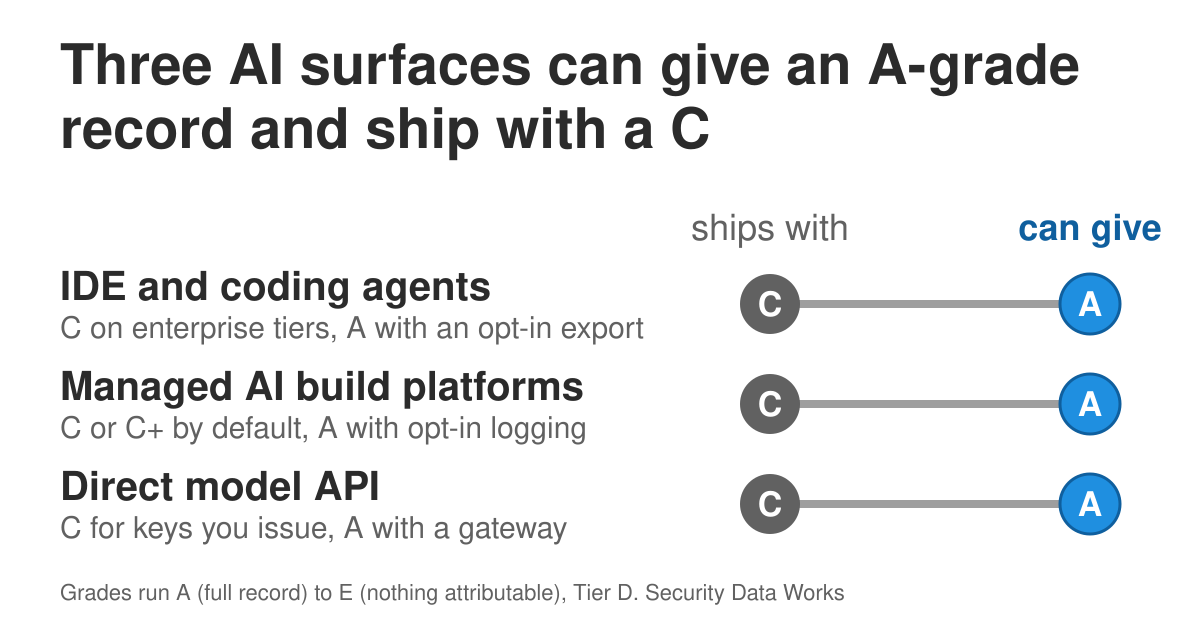
| S4 IDE and coding agents | A (opt-in; $ for Cursor's export and the compliance APIs) | C ($) on the enterprise tiers that have an admin audit log; not established below them | Claude Code's OTel export and content flags; Cursor's export and its conversation-content family; a compliance API pull | The developer's laptop for Claude Code's export; the vendor's cloud for Cursor's export and the compliance APIs; then your collector |
| S5 MCP servers you run | B (A if you run client, server and gateway) | D | Client tool events with the details flag on; server stderr or spans; a gateway that reads the new MCP headers | Your collector |
| S6 Self-hosted low-code builders | C | C | n8n Enterprise log streaming ($), which adds the owning user on workflow events and the user and tool name on calls into n8n's own MCP server; Langflow and Flowise not surveyed | Your syslog, webhook or Sentry |
| S7 Managed AI build platforms | A (opt-in) | C+ on Bedrock (caller and model per call, no tools or content); C on Vertex and Foundry | Bedrock invocation logging; a Foundry diagnostic setting; Vertex Data Access logs plus request-response logging (Pre-GA) | Your cloud account |
| S8 Direct model API and gateways | A with a gateway | C for keys you issue (usage and admin events, nothing per request); D for keys nobody knows about | Routing the traffic through a gateway with logging on | Your destination for a gateway you host; the provider's logging terms for a hosted one |
| S9 Self-hosted model serving | C on its own logs (the gateway's A if one sits in front) | C (an access line per request, with no caller and no content) | vLLM's request and output logging flags; a gateway | Host and container logs |
| S10 Local open-weight models | D | D | Endpoint telemetry; no vendor page read documents a per-request record | Your EDR |
| S11 Fine-tuning pipelines | C | C | Control-plane job events and access logs on the training bucket | Your cloud account |
| S12 RAG and vector stores | B on platform RAG; D self-built | Varies by platform | Bedrock knowledge-base data events ($); Gemini's content setting; Purview's AccessedResources is on already | The platform's audit log |
| S13 AI inside security tools | B for Security Copilot (provider, not reliably the model name) | B for Security Copilot; others not surveyed | Nothing to switch for Security Copilot; other vendors unknown | The vendor's audit feed |
Each grade applies the rubric's own wording to the cited vendor page, and where a cell needs explaining, such as Anthropic's compliance API as the A on S2 and S3, Bedrock's default CloudTrail event on S7 or vLLM's default access log on S9, the reason is in the section on that surface below. S6 is scoped to self-hosted builders, as Part 1 scoped it. Every grade is Tier D.
Read down the default column and three groups come out. The enterprise assistants, the managed platforms and the gateways are where the best records live, and on the assistants and platforms the content is either held in a second channel or switched off until someone decides otherwise, while the gateways tend to log it unless told not to, which only helps once the traffic actually goes through one. The coding agents sit a step lower by default, because the record a SOC usually connects first is an admin trail of seats and settings, sold with the enterprise tier, and the per-interaction record is an export that a platform or developer-experience team has to configure. And the surfaces where unsanctioned use tends to live, AI features inside SaaS apps, most browser AI and local models, have no record built for a defender in the general case, so the best they reach is the endpoint and network evidence of an AI thing running.
S2
Enterprise assistants: the record exists, and the words live somewhere else
Microsoft's Copilots are the best-instrumented surface in the table and also the clearest case of content held apart. The CopilotInteraction record carries the user, time and location, the app and host, the agent id, name and version for Copilot Studio agents, the plugins used, and an AccessedResources list with each file or message id, its sensitivity label and an XPIADetected flag for cross-prompt injection detected in that resource, which makes it close to a retrieval log for free. The model name is the field I would test in a tenant before trusting, because the same page still says in its property table that model name and version are "not available in Microsoft 365 Copilot scenarios" and later shows records with ModelName: claude-sonnet-4-6 when a user picks a model, adding that the Auto setting may leave both out. Retention is 180 days under Audit (Standard), up to a year with an Audit (Premium) retention policy, and ten years with a per-user add-on, and audit records for third-party AI apps are a separate pay-as-you-go line kept for 180 days.
Anthropic's Compliance API is the one source on this surface that puts the words, the person, the model and the tool calls in a single record. It returns chats, files, projects and the transcripts of sessions in Anthropic's agent products, Claude Code and Claude in Chrome among them, and each transcript carries the user's id and email, the model on every assistant message and the tool calls with their inputs, but only to a Compliance Access Key created for a Claude Enterprise tenant, while an Admin API key reaches the activity feed and nothing else, and the feed itself records who did what without the prompt text. Gemini Enterprise writes usage audit logs to Cloud Logging, where query text, replies and grounded content appear only when the prompt-and-response setting is on, and otherwise "text values are replaced with <elided>", and the logs land in the _Default bucket, which keeps them 30 days unless a project changes it. For ChatGPT Enterprise, OpenAI's help page for the Compliance Platform, read through a browser render on 2026-11-16, says the Compliance Logs Platform "retains data for 30 days", so anyone who wants longer has to download the logs continuously (Tier B).
So on S2 a team on Microsoft 365 Copilot with auditing on has a B today, with the provider but not reliably the model name, because that record arrives without anyone asking, and the other assistants sit lower until the key, the setting or the sink exists. Reaching an A means a second path for the words. On Microsoft's side that path is eDiscovery and DSPM, which keeps the Purview record a B by the rubric's own wording, since the text has to be found by search and joined back, while a compliance pull on Anthropic's side returns the words inside the same record, and both paths usually belong to a legal or compliance team.
S2 · the record and the words
S4 and S5
Coding agents and the tools they call
The pattern on coding agents is that the vendor's admin audit log, which is what a SOC tends to connect first, is a C on the enterprise tiers that have one, and the A-grade record sits in an opt-in OpenTelemetry stream or a pull API. GitHub's enterprise audit log, for Copilot Business and Enterprise, keeps 180 days of plan, policy and seat changes plus "agent activity on the GitHub website", and says plainly that it "does not include client session data, such as the prompts a user sends to Copilot locally". Cursor's audit logs, available on the Enterprise plan, carry identifiers, names and changed settings and "never prompts, agent output, generated code, or credentials". Its separate OpenTelemetry Export, also Enterprise and run by Cursor server-side, sends token, tool-call and cost metrics and a model-call summary per API request, tags records with an optional user id, account id and email, and has a conversation-content family that streams prompts, responses and the arguments and results of tool calls, which "stays off until you enable it". OpenAI's Codex governance page says local computer access with Work Cloud has the same Compliance API support as Work Cloud, with records under conversation_message and codex_log, sends local execution to a separate OTel collector you configure, and warns that "Conversation visibility alone does not establish a complete record of local actions".
Claude Code shows how fine-grained the opt-in can be. Its telemetry stays off until CLAUDE_CODE_ENABLE_TELEMETRY=1 and an exporter are set, and then each kind of content needs its own flag, OTEL_LOG_USER_PROMPTS for prompts, OTEL_LOG_TOOL_DETAILS for Bash commands, MCP server and tool names and tool input, and OTEL_LOG_RAW_API_BODIES for the full request and response JSON, which carries the entire conversation history on every call. Two details matter for a collection plan. A repository's own settings file can't turn telemetry on or redirect it, though managed settings can, and for user-configured MCP servers the event's tool_name is the literal "mcp_tool", with the real server and tool names appearing only when the details flag is on. So a team that enables the default stream without that flag can count calls to the MCP servers its developers configured and cannot say which tool any of them reached.
| Setting | What it adds to the OpenTelemetry stream |
|---|---|
CLAUDE_CODE_ENABLE_TELEMETRY=1 and an exporter | Turns the export on. In the default stream a call to a user-configured MCP server carries tool_name "mcp_tool" |
OTEL_LOG_USER_PROMPTS | Prompts |
OTEL_LOG_TOOL_DETAILS | Bash commands, MCP server and tool names, tool input |
OTEL_LOG_RAW_API_BODIES | Full request and response JSON, which carries the entire conversation history on every call |
Each of the last three flags is set on its own. A repository’s own settings file can’t turn telemetry on or redirect it, though managed settings can. Each kind of content sits behind its own flag, and the highlighted one is the difference between counting MCP calls and knowing which tool each reached. Claude Code documentation read 16 November 2026 (Tier B for what each setting does).
The MCP servers an organization runs itself (S5) grade one notch below that, a B, because a client's tool event names the caller, the model and the tool but carries nothing of what the server did with the call, and an A needs the client, the server and a gateway in front of it all logging. That split is what the 2026-07-28 MCP revision made explicit when it deprecated in-protocol logging in favour of stderr or OpenTelemetry and added Mcp-Method and Mcp-Name headers on Streamable HTTP, so the evidence now sits in three places, the client, the server and the authorization server, with a gateway as the one point that sees the wire view of the first two. MCP just told you where its logs went works through that collection plan and what a lab capture of both revisions showed reaches each log, so I won't repeat it here. Out of the box, the server you stood up is a child process or a listener to the EDR, which is a D.
S7, S8 and S9
Managed platforms and gateways: good raw material, mostly switched off
The managed build platforms have the richest records in the series and ship them off. On Bedrock, "model invocation logging is disabled by default", and once on it captures full request and response bodies, inline up to 100 KB and as separate S3 objects beyond that, with the model id and the IAM or STS principal that made the request, for Converse, ConverseStream, InvokeModel and InvokeModelWithResponseStream on the bedrock-runtime endpoint; calls through bedrock-mantle "are not currently captured", and the logs are kept until you delete the configuration, so retention is whatever the bucket or log group says. CloudTrail, which is on from the day the account exists, records those runtime calls as management events with the caller and the model id but no content, which gives Bedrock a better default than the other two platforms, the C+ in the ladder, while agents, knowledge-base retrievals and guardrail checks appear only as data events that need advanced event selectors and cost extra, and the 90-day event history that exists without a trail holds management events only. A principal ARN names a person only when people call with their own roles or sessions, though, and where an application calls through one shared role, the human behind each request is visible only if the application passes it in requestMetadata.
Google's and Microsoft's platforms need two switches each. On Vertex AI, which Google's pages now file under the Gemini Enterprise Agent Platform name, Data Access audit logs for generateContent, predict and rawPredict have to be explicitly enabled, and the content comes from a separate request-response logging feature that is disabled until configured, writes full_request and full_response to BigQuery at a sampling rate you choose, and has no caller-identity column in its schema. So an A-grade record on Vertex means joining that content table to an audit log that carries the principal, both of which have to be on, and which key the join would use is unconfirmed, because the request id is the likely candidate but the audit-log page doesn't show it. That content feature still carries a "Pre-GA Offerings Terms" banner, which means an organization can switch it on today if it accepts Pre-GA terms and that the S7 A in the ladder rests on Bedrock's GA feature instead. On Foundry, resource logs "aren't collected and stored until you create a diagnostic setting", and the monitoring page doesn't say whether any log category carries prompt or completion text, so I wouldn't assume it does until a test tenant shows it. Foundry's agent tracing, which can record message content when an opt-in is set, is documented on pages not read for this piece, so its default is left out here.
For direct model API use (S8) the gateway decides the grade. Without one, what a defender holds for the keys the organization issued is the provider's usage and billing lines per key and its admin events for keys and members, which is aggregated usage and so a C, and for keys nobody issued it is DNS and TLS SNI to provider hosts, proxy logs and secret-scanning hits, which is a D. With a gateway the organization hosts, the record can be the best on the list, because the gateway sees each request routed through it and you own its output. LiteLLM's proxy, once a logging callback is configured, logs messages and responses unless turn_off_message_logging is set and keeps spend and metadata either way. Cloudflare's hosted AI Gateway says "Logs are enabled by default for each gateway", with a per-request header that keeps the metadata and drops the bodies, though for customers whose first gateway dates from 24 September 2026 or later the logs follow Cloudflare's Workers Logs pricing and retention rather than yours, and its listed log fields name no caller. Identity at a gateway is the virtual key, the team and whatever user id the caller passes, so the A is only as good as the key-issuance discipline behind it. Self-hosted serving (S9) behaves the same way from the other side. vLLM writes a uvicorn access line for each HTTP request by default, with no caller and no content, which is a C, while its request logging is off by default and, once on, logs request ids and parameters at INFO and prompt inputs only at DEBUG, and output logging needs request logging and writes the output text at INFO, so a gateway in front is still what turns its record into the gateway's.
The surfaces with no AI record
The remaining rows are the part of the surface where shadow AI tends to live, and their grades are low for a different reason, which is that in the general case no record designed for a defender exists, so there is nothing AI-specific from the vendor to turn on. A local open-weight model (S10) is the plainest case: Ollama "binds 127.0.0.1 port 11434 by default", its server log is written for troubleshooting on the machine itself and its pages don't document what that log records per request, and its own answer to whether prompts leave the machine is "We don't see your prompts or data when you run locally", which is good for privacy and leaves the endpoint as the only witness I would count on. What the EDR sees is a process, a loopback listener, multi-gigabyte weight files and the download from a model hub, which says a model ran and nothing about what it was asked. AI features a SaaS vendor switched on (S1) make a server-to-server model call that the user's traffic never shows, so the evidence is the SaaS domain in proxy logs and whatever the vendor's general audit log happens to record. Browser AI (S3) is visible mainly as an extension inventory row and, with Endpoint DLP, as a paste into an AI site, with the exception of a vendor's own agent browser that reports into that vendor's compliance API, as Claude in Chrome does into Anthropic's, where the session transcript is the same A-grade record as on S2.
Fine-tuning pipelines (S11) sit at C, because each platform surveyed records the training job and the resulting model as control-plane events and the training bucket's access logs show reads, but none of the documents read links a trained model back to the rows that went into it, which leaves a data-poisoning investigation to rebuild lineage from bucket logs by hand. RAG is split by who built it: on a platform the retrieval log can be good, since Purview's AccessedResources already lists every file Copilot read with its label and an injection flag, and Bedrock records knowledge-base retrievals as paid data events, while a pipeline built on a vector database has that database's audit log, where one exists, and whatever the application chose to write. The AI inside security tools (S13) was surveyed only for Microsoft's Security Copilot, whose interactions land in Purview like the other Copilots, and for the rest the grade is unknown, which I'd keep distinct from an E until someone reads those vendors' documentation.
Fields
The fields that matter, side by side
For the sources that contribute to an A or a B, this is what each record carries, restricted to the ones whose vendor page was read in full on 2026-11-16, which leaves out OpenAI's compliance platform (read only for its retention figure) and Foundry's agent tracing (not read).
| Source | Human identity | Agent or workload identity | Model id | Tool calls | Content | Default | Retention | Shape |
|---|---|---|---|---|---|---|---|---|
Purview CopilotInteraction | Yes | Agent id, name, version | Provider yes; model name contradictory on the page | Plugins | Not in the record; mailbox via eDiscovery | On with auditing | 180 days; 1 year Premium; 10 years add-on | Office 365 Management Activity JSON |
| Anthropic Compliance API | User id and email on each session; email, IP on the feed | Session per product | On each assistant message | Tool calls with inputs, in transcripts | Chats and transcripts (not the activity feed) | Needs a Compliance Access Key; records start at enablement | 6 years for the feed and local transcripts; your content policy for chats (indefinite by default) | Vendor JSON |
| Gemini Enterprise usage logs | Pseudonymous user id and user info | Agent name, SPIFFE ID | Model run and model requested | Not stated | Only with the content setting on | Content off | 30 days in _Default, configurable | Cloud Logging entries |
| Claude Code OTel | Email, account id | Session id | Yes | Tool name and decision; MCP names behind a flag | Per-signal flags | Off | Your collector | OTLP, mostly vendor-named events |
| Cursor OTel Export | Optional user id, account id, email | Not stated | Model-call summary (attribute names not read) | Tool-call metrics; arguments and results with content on | Prompts, responses, tool I/O, off until enabled | Off until an admin configures it; content off | Your collector | OTLP |
| Bedrock invocation logging | Principal ARN | requestMetadata if the caller sets it | Yes | In bodies | Full bodies | Off | Until you delete it | ModelInvocationLog 1.0 |
| Vertex request-response logging | None in the schema | None | Model and version | In bodies | Full request and response | Off (Pre-GA) | Your BigQuery table | BigQuery rows, optional OTel column |
| LiteLLM gateway | User id the caller passes | Virtual key, team | Yes | In messages | Yes unless turned off | On once callbacks are set | Your destination | StandardLoggingPayload |
Cells checked against the vendor pages read on 2026-11-16 where the page states the field; "not stated" means the page doesn't say, and the identity and model cells for Purview and Claude Code rest on an earlier check on 2026-11-09. Vertex's content table is a C on its own and reaches an A only joined to an audit log. Tier B for the facts, D for the selection.
Two things stand out from the matrix to me. The first is that, apart from the gateways, the sources that hold content either keep it in a second channel or leave it off until someone asks, and the second is that identity weakens the closer a record gets to the model, from a named user in Purview and Anthropic's transcripts and a pseudonymous id in Gemini's logs to a principal ARN on Bedrock to no identity at all in Vertex's content table, so the person behind a model call is often a join away even when the call itself was logged.
Fields · identity by source
What shape each record arrives in
None of these sources emits OCSF, with or without the ai_operation profile, in the documents read for this series, and the OpenTelemetry GenAI and MCP attributes the more modern ones use are still at development stability, so their names can change under a stored corpus, which leaves normalization as the organization's cost whichever product it buys (Tier D as an absence claim). OCSF already has the AI-agent objects measured what the choice of landing shape costs, by writing one real MCP tool call into OCSF, OpenTelemetry and OWASP's Agent Observability Standard and timing five hunts over a million synthetic calls in each layout, and the typed OCSF layout was the fastest or level on every hunt, in DuckDB on one shared host. So the practical reading I'd take into a pipeline design is to normalize the caller, the model id and the tool name into typed columns at ingest, keep the raw vendor payload beside them for the facts no schema types yet, and remember the caution Part 3 carried from the lab, that a field the schema can hold says nothing about whether any product fills it.
How long each vendor keeps it
Where the vendor holds the record, the clock is usually short: 180 days for Purview Standard and for GitHub's audit log, 30 days in Cloud Logging's _Default bucket unless a project changes it, 90 days of CloudTrail event history for management events, and 30 days for OpenAI's Compliance Logs Platform, with Cursor's audit page stating no period and its Admin API capping each query at a 30-day window. Anthropic is the exception, keeping the activity feed and local session transcripts for six years by default and chat content under the organization's own policy, though its feed reaches back only to the day the Compliance API was enabled, with nothing backfilled, so the date someone turns it on is the start of the record. Where the record lands in your own account, as on Bedrock, Vertex and a gateway you host, retention is whatever you set. So anything you want for a year-long investigation window has to be pulled into your own store on a schedule, and the question that usually stops that is cost. What to keep when the agent did it priced it from a lab run, and a year of full prompt text for 1,000 coding-agent users came to about $20 to $79 a month in object storage across the compression and row-order settings the run fixed before it ran, while the same full-context logging is about 100 GB of raw JSON per active day at ingest, which is why it argues for landing content in object storage and sending a metadata projection to the SIEM.
Retention · the vendor's clock
Limits
Limits of this reading
- The grades are a first-pass draft (Tier D). They apply the rubric to the vendor pages with no second reader yet, and your tenant's settings may already put a surface a grade higher or lower.
- Vendor documentation describes what a feature does and says nothing about how well it works. Nothing here tests a product;
XPIADetectedandJailbreakDetectedare fields, and how often they fire correctly is a separate question no page answers. - Some primaries were read only in part or not at all. OpenAI's Compliance Platform help page was read only for its retention figure, Foundry's tracing pages, its monitoring data reference and Cursor's export Wire Reference were not read, and Windsurf, Triton, Langflow, Flowise, vector-database audit logs and AI features in SaaS and security tools beyond Microsoft's were not surveyed. What Ollama's server log records per request is untested.
- Pages change between reads. Between 2026-11-09 and 2026-11-16 Cursor's pages were reworded and gained a conversation-content export, and Google's Vertex pages took a new product name while the content feature stayed Pre-GA, so every row here is dated 2026-11-16 and worth a re-read before you build on it.
Bottom line
What I'd collect first
Bottom line: on the sanctioned surfaces a per-interaction record mostly exists, but it ships as an admin trail or with the content held apart, so the first collection work is turning on the content switch that exists for each surface, routing it to a store you own before the vendor's retention runs out, and normalizing caller, model and tool name into typed columns on the way in, while on SaaS AI features, most browser AI and local models there is no AI record to turn on and the work is an inventory join over endpoint and network data you already collect, which is where Part 5 picks up with who in the organization actually receives each of these channels.
Sources
| # | Source | What it supports | Tier |
|---|---|---|---|
| 1 | Microsoft Learn, "Audit logs for Copilot and AI applications" (page date 2026-08-26), "Microsoft Purview data security and compliance protections for generative AI apps" (2026-05-27) and "Learn about auditing solutions in Microsoft Purview" (2026-05-18), all read 2026-11-16 | CopilotInteraction fields, automatic logging, text in the mailbox, model-name contradiction, pay-as-you-go third-party apps, retention | B |
| 2 | Anthropic, "Compliance API" with its activity-feed, sessions and FAQ pages, platform.claude.com, read 2026-11-16 | Key types, transcript contents and fields, six-year retention, no backfill | B |
| 3 | Anthropic, Claude Code "Monitoring", code.claude.com, read 2026-11-16 | Telemetry off by default, per-signal content flags, managed settings, mcp_tool naming | B |
| 4 | OpenAI, Codex "Governance", learn.chatgpt.com, read 2026-11-16 | Compliance API record types, local OTel, completeness caveat | B |
| 5 | OpenAI Help Center, "OpenAI Compliance Platform for Enterprise and Edu customers" (article 9261474), read 2026-11-16 (browser render) | 30-day log retention | B |
| 6 | Cursor, "Compliance and Monitoring" and "OpenTelemetry Export", cursor.com, read 2026-11-16 | Audit scope and exclusions, Enterprise plan, server-side export, optional user attributes, conversation-content family, 30-day query window | B |
| 7 | GitHub Docs, Copilot "Review audit logs", read 2026-11-16 | Audit scope, tiers, no local prompts, 180 days | B |
| 8 | Google Cloud, Gemini Enterprise usage audit logs (updated 2026-11-10) and Cloud Logging quotas, read 2026-11-16 | <elided> content, model fields, _Default bucket, 30-day retention | B |
| 9 | AWS, Bedrock model invocation logging, Bedrock CloudTrail monitoring and CloudTrail event history, read 2026-11-16 | Default off, bodies, principal ARN, bedrock-mantle gap, management and data events, guardrail attribution, 90 days | B |
| 10 | Google Cloud, Vertex AI request-response logging and audit logging (both updated 2026-11-12), read 2026-11-16 | Pre-GA banner, default off, BigQuery schema without identity, Data Access logs need enabling | B |
| 11 | Microsoft Learn, "Monitor Azure OpenAI" (Foundry classic, updated 2026-02-27), read 2026-11-16 | Resource logs need a diagnostic setting | B |
| 12 | LiteLLM "Logging" and Cloudflare AI Gateway "Logging" (updated 2026-11-05), read 2026-11-16 | Message logging switch; logs on by default per gateway; Workers Logs retention for new customers | B |
| 13 | vLLM vllm serve reference, Ollama FAQ and Troubleshooting, and n8n "Log streaming", read 2026-11-16 | Access log and request logging defaults; loopback bind and server log; Enterprise log streaming fields | B |
| 14 | Security Data Works survey of telemetry by surface (2026-11-09, agent-run, spot-checked) | Grade rubric, surface table, fields table, absence claims | D for grades and absences |
| 15 | OCSF already has the AI-agent objects, MCP just told you where its logs went and What to keep when the agent did it | Landing-shape query cost, the MCP collection plan, retention pricing and ingest volume | As tiered there |
| 16 | The parsing layer nobody owns | The opening quotation | First-person observation |
