
AI attack surface · Part 3
Half of it is new, and the new half is the half the schema cannot hold
I have sat in incident reviews where a control everyone trusted turned out to have never seen the data it needed, and nobody could tell that from the dashboard, and the lesson I took from those rooms is that a control can only catch what it can see. That is a useful test to put to the AI attack surface, because the question usually asked of it, how much of AI security is new, tends to get answered with a feeling, and there is now enough of an incident record to answer it with a count and then follow the count down into the telemetry.
The first two parts drew the surface, thirteen ways AI gets deployed placed on CoSAI's 42-component version of the SAIF map, and whether to rent or own each of them, and this part looks at what attackers have done to those surfaces so far. It takes the 27 case studies MITRE ATLAS v2026.10 types as real incidents, 290 attack steps between them, and asks three things of each step: does it use a technique a team working from ATT&CK already knows, does it land on a risk in the CoSAI map, and does it land on a field in OCSF 1.9.0 where a detection could see it. The answer to the first is about half, though nearly half the record is somebody else's AI attacking ordinary systems, and on the surfaces an organization deploys itself closer to three in five steps are AI-native. The more useful finding is that the two halves land differently on the other two questions.
Reading time: about 14 minutes. Evidence tier: A for counts read directly from the ATLAS v2026.10 YAML, the ATT&CK Enterprise v20.1 STIX bundle and CoSAI's risks.yaml at commit 622605a1, read on 2026-11-16, the last of them A in the sense of a primary file read at a pinned commit, since it is working-group content and not a ratified standard; B for the scripted classification of the 290 steps and for the lab join to OCSF; D for the assignment of incidents to deployment surfaces and for every artifact-to-field grade behind the OCSF split.
The count
The incident record splits in half
ATLAS links some of its techniques to an ATT&CK technique through an attack-reference, and the overlap analysis behind the site's ATLAS Wall uses that link to sort every technique into three classes: ATT&CK-referenced, a sub-technique whose parent is referenced, and ATLAS-native, meaning a team that knows ATT&CK has no entry for it. Run over the 290 steps in the 27 incidents, 144 (49.7%) use a referenced technique or a child of one and 146 (50.3%) are ATLAS-native. The red-team record looks very different, since 373 of the 469 steps in ATLAS's 50 Exercise case studies (79.5%) are native, so counting exercises and incidents together overstates how much of a real AI attack is new, and I'd quote the incident figure whenever the question is what defenders have faced.
The catalogue is further ahead of the incidents than that. In ATLAS v2026.10, 150 of 221 techniques (67.9%) and 93 of 129 parent techniques (72.1%) have neither an ATT&CK link of their own nor a linked parent, and 67 of the 116 techniques used in at least one incident are native, counting a parent as used when one of its sub-techniques is (107 distinct techniques are named in a step directly, 60 of them native). The overlap analysis reads 150 as an upper bound on what is new in substance, because ATLAS's own linkage is conservative: Exfiltration via Cyber Means (AML.T0025) is ATT&CK behaviour in substance, and two native techniques share an exact name with an ATT&CK technique that ATLAS doesn't link. ATT&CK has also started to close the gap from its side. The v20.1 STIX bundle, as fetched on 2026-11-16, carries T1698 Indirect Prompt Injection, T1699 Direct Prompt Injection and T1700 AI-Enabled Exfiltration, all created in September 2026 and three of the five AI techniques v20 added (the other two are T1608.007 AI Result Poisoning and T1685.007 Impair Autonomous Defenses), and the ATLAS v2026.10 YAML references none of the three, so prompt injection, which every count here treats as native, now has an ATT&CK home by concept. How fast the native set is growing release to release is a separate story, and ATLAS moves fast and deprecates nothing carries it.
The map
The two halves land on the map differently
The second question is whether a step reaches a risk on the CoSAI map, which here means its technique, or the technique it specializes, appears in some risk's ATLAS mappings in risks.yaml at 622605a1. By that test 78 of the 290 steps (26.9%) are on the map, 99 are ATT&CK-referenced steps off it, 102 are AI-native steps off it, and 11 are outcomes, the financial or societal harm at the end of an attack, which no framework mitigates directly. Of the 78 on-map steps, 45 are ATT&CK-referenced and 33 are native, and exactly half of the 78, 39 steps, are three ATT&CK techniques: Valid Accounts (15), Unsecured Credentials (14) and Exploit Public-Facing Application (10).
Where those steps land matters more than the count, because the three CoSAI risks about agent identity that look best evidenced by incidents, Cross-Tenant Credential Propagation, Shadow and Unknown Agents and Stale Agent Identity Binding, are reached by nothing except the first two of those techniques. The same 15 Valid Accounts steps hit all three risks, and the 14 Unsecured Credentials steps add a second set of hits on Cross-Tenant Credential Propagation, so the 59 risk hits rest on 29 credential steps and on no AI-native step, which follows from the mapping, since those three risks list Valid Accounts and Unsecured Credentials and nothing else. ATLAS's own step descriptions say what those 29 steps were (my reading of them, Tier D). Twenty sit in the six incidents where the AI belongs to the attacker, and there the credentials open email, Kubernetes and cloud secrets, internal databases, GitHub and government portals, with one step using exposed tokens against a model hub. Of the nine on a defender's own surface, five are account use against an AI service, three of them the fraudulent or pooled accounts behind model-distillation campaigns and two the stolen or scraped credentials in the LLMjacking and Storm-2139 cases, and the other four are credentials collected from a compute cluster, a victim host, an SSH key file and a build configuration. Six risks show the opposite pattern, the three model-centric ones, Model Exfiltration (14), Model Evasion (7) and Model Reverse Engineering (6), along with Rogue Actions (6), Prompt Injection (5) and Sensitive Data Disclosure (3), since every hit on those six comes from a native technique.
The map · credential steps to agent-identity risks
risks.yaml at 622605a1 (Tier B); the reading of what each step was is Tier D.That pattern is easy to over-read, and the data supports a narrower reading than it first suggests, for three reasons I'd want any reader to have before quoting it. The first is that risk hits are not independent evidence: the six steps behind Model Reverse Engineering are the same six that make up the non-T0025 part of Model Exfiltration, and the five Prompt Injection steps sit inside Rogue Actions' six. The second is that "native" here is ATLAS's linkage, which says nothing about substance, and 8 of Model Exfiltration's 14 hits are Exfiltration via Cyber Means, which the overlap analysis itself calls ATT&CK behaviour, while the Prompt Injection hits are the direct and indirect techniques ATT&CK v20 now carries as T1699 and T1698. The third, and the one that explains most of the pattern, is in risks.yaml itself, where 19 of the 36 risks carry a mitre-atlas mapping list and 17 carry none, the mapped lists resolve to 24 distinct technique IDs, and they are pinned to ATLAS 5.0.1, an older edition than the incidents. The unmapped 17 include four agent, tool and MCP risks, Agent Delegation Chain Opacity, MCP Transport Hijacking, Runaway Agent Tool Loops and Orchestrator Route Hijacking, plus Retrieval/Vector Store Poisoning, while eight others in that family carry a mapping, and an incident step can only reach a risk somebody mapped, so the agent risks that show incident evidence are the ones mapped to three generic techniques, Valid Accounts, Unsecured Credentials and software supply chain, plus Rogue Actions, which is reached through prompt injection.
So what I'd take from the map is modest and, I think, still worth having. The hits on the agent-identity risks are a mapping result more than incident evidence for those risks, because what the steps show is ordinary credential theft and account abuse, most of it by an attacker's agent against systems that have nothing to do with AI, and only a handful of steps where a key or an account was used against a model service. The six all-native risks are evidenced by AI-native technique as ATLAS counts it, but part of that is familiar exfiltration and prompt injection that ATT&CK has started to absorb, and the map can't yet say whether the unmapped agentic risks are rare in the incident record or simply invisible to it.
By surface
Where the halves fall, surface by surface
Each of the 27 incidents was also assigned to the deployment surface it attacked, using the thirteen surfaces from part one, plus a row for incidents where the AI belongs to the attacker. That assignment is the largest single judgement in this article, so the table is Tier D, and because most of the surfaces rest on a single case study I print counts instead of percentages.
| Surface | Incidents | Steps | ATT&CK-referenced | On map | ATT&CK off map | Native off map | Outcome |
|---|---|---|---|---|---|---|---|
| S1 AI features in SaaS apps | 4 | 24 | 10 | 5 | 9 | 7 | 3 |
| S2 Enterprise assistants | 1 | 6 | 1 | 0 | 1 | 5 | 0 |
| S3 Browser AI | 0 | 0 | |||||
| S4 IDE and coding agents | 1 | 7 | 2 | 3 | 0 | 4 | 0 |
| S5 MCP servers you run | 1 | 9 | 3 | 1 | 3 | 4 | 1 |
| S6 Self-hosted low-code builders | 1 | 18 | 13 | 2 | 11 | 5 | 0 |
| S7 Managed AI build platforms | 1 | 9 | 3 | 1 | 2 | 4 | 2 |
| S8 Direct model API and gateways | 4 | 43 | 16 | 16 | 10 | 14 | 3 |
| S8, vendor API used as attacker C2 | 1 | 1 | 0 | 0 | 0 | 1 | 0 |
| S9 Self-hosted model serving | 1 | 7 | 4 | 4 | 1 | 1 | 1 |
| S10 Local open-weight models | 1 | 6 | 1 | 1 | 1 | 4 | 0 |
| S11 Fine-tuning pipelines | 1 | 3 | 2 | 2 | 1 | 0 | 0 |
| S12 RAG pipelines and vector stores | 1 | 4 | 2 | 0 | 2 | 2 | 0 |
| S13 AI inside security tools | 3 | 16 | 7 | 9 | 5 | 1 | 1 |
| AI held by the attacker | 6 | 137 | 80 | 34 | 53 | 50 | 0 |
| Total | 27 | 290 | 144 | 78 | 99 | 102 | 11 |
ATLAS v2026.10 Incident case studies against CoSAI risks.yaml at 622605a1. "ATT&CK-referenced" counts steps whose technique, or its parent, ATLAS links to ATT&CK; the four right-hand columns partition the steps by whether they reach a CoSAI risk. Incident-to-surface assignment Tier D; step counts scripted (Tier B). An organization's own assignment may differ.
Two things in the table seem worth a sentence each. Nearly half the record, 137 of 290 steps across six incidents, is AI held by the attacker, where the target is ordinary infrastructure and there is no deployment surface on the defender's side at all, and those steps are more familiar than the rest: 80 of the 137 are ATT&CK-referenced, against 64 of the 153 steps on the defender's own surfaces. So the "half familiar" headline is partly a property of attacker-side incidents, and on the surfaces an organization deploys itself, the AI-native share is closer to three in five (89 of 153), which is a post-hoc cut on a Tier D assignment and one I'd quote only with that label on it. The other is how unevenly the incidents fall, with direct API use and gateways (S8) carrying 43 steps across four incidents, browser AI carrying none, and fine-tuning pipelines three, so a surface's place in this table says as much about what has been written up as a case study as about where attackers go.
By surface · whose AI it is
The schema
The new half is the half the schema cannot hold
The third question is the one closest to this site's lane, and the lab has a measured answer to it, which ATLAS has no detection layer sets out in full. That essay builds the column ATLAS lacks, from technique to D3FEND artifact to OCSF 1.9.0 field to a Sigma rule, over the same 27 incidents, with a first set of grades drafted by the agent that ran the bench and a blind second grader (Gemini 3.8 Flash, three passes, working from a shortened schema excerpt) that re-read every row. That essay carries the method, and the part that matters here is the split, where steps whose technique carries its own ATT&CK reference land on a specific OCSF field 85.2% of the time under the first grades and 91.8% under the second, while ATLAS-native steps land on one 33.9% and 33.3% of the time.
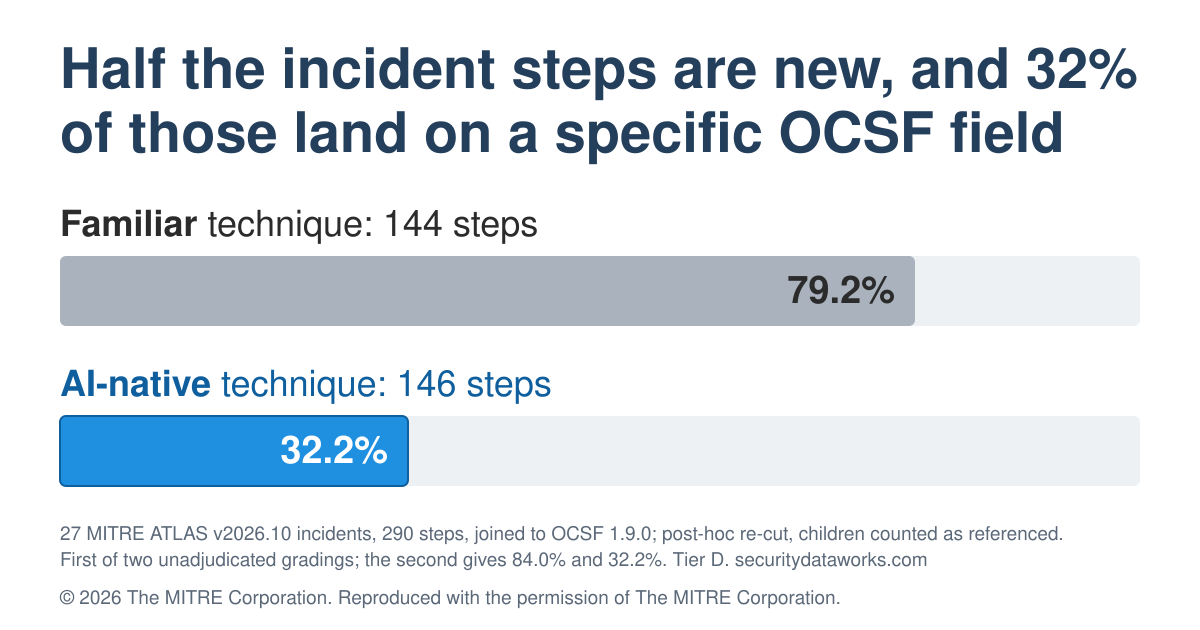
That split runs on a slightly different line from the halves above, and the line differences are worth keeping apart from the grader difference. The lab script counts a technique as ATT&CK-referenced only when it carries its own reference (36 techniques, 122 steps), while the overlap analysis also counts the children of referenced techniques (144 steps), and the split runs over all 290 steps, including the 108 that fall before the defender has telemetry (Reconnaissance, Resource Development and AI Attack Adaptation). Re-cut after the fact along each line, both graders' grades keep the gap on every cut:
| Cut | Steps, referenced / native | Referenced, specific field (first / second grader) | Native, specific field (first / second grader) |
|---|---|---|---|
| Own reference, all 290 steps (the lab's line) | 122 / 168 | 85.2% / 91.8% | 33.9% / 33.3% |
| Children counted as referenced (the 144 / 146 line) | 144 / 146 | 79.2% / 84.0% | 32.2% / 32.2% |
| Own reference, defender ground only | 82 / 100 | 98.8% / 95.1% | 31.0% / 31.0% |
| Own reference, 48 incidents | 172 / 248 | 89.0% / 90.7% | 33.1% / 31.5% |
Specific field means OCSF 1.9.0 has a field that records the specific thing (graded direct or event). Rows two and three are post-hoc re-cuts; the 48-incident row adds 21 incidents researched from public reporting and mixes ATLAS procedure steps with researcher-mapped technique uses, so I read it as a robustness check. Every grade is Tier D.
The 22 child steps are the weak part of the familiar half, since under the first grades only 10 of them land on a specific field and 8 land on nothing, which is why counting them as familiar pulls the referenced share down.
Where the two graders part is how much of the native half lands on nothing at all, 31.0% of native steps under the first grades and 48.8% under the second, and I'd read both figures carefully, because most of those steps are ones no defender schema was going to hold. Under the first grades, 25 of the 52 are the attacker's own agent planning and adapting before the defender has any telemetry, 11 are outcomes such as financial harm, and 8 are Exfiltration via Cyber Means, which has no crosswalk row but lands on an ordinary network field, network_traffic.bytes_out, when read against OCSF directly. Of the 89 native steps on defender ground that are not outcomes, counting those 8 as observable, 8 (9.0%) have no field under the first grades and 26 (29.2%) under the second grader, who also put model evasion and direct prompt injection at no field. Those are two unadjudicated readings, and I can't yet say whether the gap between them is a real disagreement over what counts as a carrier or an artefact of the shortened excerpt the second grader worked from. Under the first grades the no-field steps also trace to the crosswalk more than to the schema, since 54 of the 55 come from the 15 techniques that have no row in the ATLAS-to-D3FEND crosswalk.
The schema · what the no-field steps are
The schema's part of this is narrower than the no-field count suggests, and it sits mostly on the specific-field side, where the native steps ride generic carriers. OCSF already has the AI-agent objects walks through it version by version. OCSF 1.9.0 can name the agent (ai_agent) and the model (ai_model) and, with the ai_operation profile, hold a prompt's text in message_context.prompt_text, but ai_model is an identity descriptor with five attributes (four of its own plus uid_numeric inherited from the base entity), there is no tool object in 1.9.0 (the tool-definition object, ai_capability, reached a release only with OCSF 1.10.0 on 2026-11-20), and there is no AI event class, so an agent's tool call has to ride on an existing class such as API Activity. That is why, in the lab's reading, the AI-native techniques that do find a home in 1.9.0 mostly find a name tag: of the no-row techniques the profile makes observable, only the jailbreak lands on a field that records the act itself rather than which agent or model was involved. And even where a field exists, two of eight planted rules in the same bench fired cleanly, both matching on the attack's own content, and in the detection essay five of the other six drown in lookalike background and one misses outright.
What to do
What I'd do with the split
The familiar half is the part a security team can act on this quarter, because it lands on fields that already exist, though in the lab's planted run the rules for Valid Accounts and Unsecured Credentials were both the noisy kind, at a median precision of 0.25 and 0.083 on a synthetic corpus, so having the field gets a team to a detection that needs tuning, which is still a better starting place than the native half has. The AI-service identity case rests on a handful of steps, mainly the LLMjacking incident, where stolen cloud credentials opened the environments hosting model services, and Storm-2139, which used scraped customer credentials against generative AI services, and the work those cases point to is making sure the identities AI services use, the API keys, service principals and agent identities, are in the same inventory and the same detections as every other non-human identity, which Delegation across the AI surface takes up later in the series. I'd also add the ATT&CK v20 AI techniques to whatever coverage view the team keeps, since prompt injection and AI-enabled exfiltration now have IDs on that side too.
The new half needs a different kind of work, because the gap there is in the schema and the catalogue as much as in the detections. I'd build the observable column locally, starting from the lab's per-technique table and re-grading every row against what your own products emit, since the schema being able to hold a field tells you nothing about whether your sources write to it. I'd turn on whatever content logging the AI platforms in use offer, because among the techniques the lab read directly against the schema, the prompt-text field is the one profile field that records the act itself, and it is empty unless something writes the prompt into it. And I'd carry the version of every framework in each detection's metadata, ATLAS release, ATT&CK release and CoSAI commit, because the line between the two halves is moving from both sides at once. Which surfaces emit any of this today, and in which shape, is where part four picks up.
Limits
Bottom line: across the 27 real AI incidents in ATLAS, roughly half the steps are tradecraft a team working from ATT&CK already knows, and that familiar half lands on OCSF fields that already exist, while the map's agent-identity risks are reached only through two credential techniques CoSAI mapped to them, mostly in incidents where the AI belonged to the attacker. The AI-native half reaches a specific field about a third of the time and otherwise rides generic carriers, and of the AI-specific steps a defender could log, about one in eleven has no field at all under the first grades and about three in ten under the second. I'd spend this quarter making sure AI service identities sit inside the non-human identity program the team already runs, and start the observable column for the other half now, with the adjudication of the two graders as the next lab run I'd want before quoting either no-field reading as anything firmer.
Sources
| # | Source | What it supports | Tier |
|---|---|---|---|
| 1 | MITRE ATLAS v2026.10 YAML and the Security Data Works overlap analysis built from it with ATT&CK Enterprise STIX v20.1 (2026-11-09) | 290 incident steps; 144 ATT&CK-referenced, 146 native; exercises 79.5% native; 150 of 221 techniques native | A for the ATLAS technique counts; B for the scripted step classification |
| 2 | ATT&CK Enterprise STIX v20.1, mitre-attack/attack-stix-data, fetched 2026-11-16 | T1698, T1699, T1700 present, created September 2026; ATLAS v2026.10 references none | A |
| 3 | CoSAI secure-ai-tooling risk-map/yaml/risks.yaml at 622605a13fafaa2784acbdbe3f8d23ee22da4be7, fetched 2026-11-16 | 36 risks, 19 with ATLAS mappings, 24 distinct IDs, pinned to ATLAS 5.0.1; risk-to-technique mappings | A in the sense of primary files read at a pinned commit; working-group content, not a ratified standard |
| 4 | Security Data Works step classification of the 27 incidents against risks.yaml (scripted; re-derived 2026-11-16) | 78 on map, 99 / 102 / 11 off; 45 / 33 on-map split; risk hits by technique | B |
| 5 | Security Data Works deployment-surface research (2026-11-09) | Incident-to-surface assignment | D |
| 6 | Lab run R1, sdw-lab-benchmarks/atlas-ocsf-observables (2026-11-09, independently re-run; supplement 2026-11-16, post-hoc) | ATT&CK-referenced vs native specific and any-field shares; 54 of 55 no-field steps | B for the join, D for the grades |
| 7 | Lab run M1, sdw-lab-benchmarks/m1-r1-blind-regrade (2026-11-09; adjudication between the two graders not run) | Second-grader split | D |
| 8 | ATLAS has no detection layer and OCSF already has the AI-agent objects | Method, planted-rule results and OCSF object detail | as tiered there |
