
AI attack surface · Part 17
Every custom tool gets a high priest
In 2023, while I was a customer and not anyone's vendor, I submitted a pull request to Palo Alto's own Splunk app for PAN-OS logs, the parsing logic that turns the firewall's syslog feed into fields a SIEM can search, because its field extractions were broken in ways that went well past timezones, and the change touched on the order of a thousand files and was tested against large-scale existing data. It has never been merged, it still shows as open in a repository that has since been archived, and the app carried well over a hundred broken and missing field extractions for years, which the essay on it puts down to incentives, since a community Splunk app is, in that essay's words, "a cost center, maintained on the margins". The question that story raises is the one a proposal to build your own AI-security tooling tends to skip, which is who keeps a piece of parsing logic working once the data under it moves, and whose job that is once the person who understood it has gone.
AI coding tools change that question in one direction and, I think, leave it alone in another. A coding agent can produce a first version of an MCP-server inventory script or a prompt-injection filter quickly, which makes a build look cheaper to start, while what a custom system costs over its life is mostly the keeping, which is the direction a Google paper on machine-learning systems and the older software-maintenance literature both point, and in this sector the things a security tool parses keep moving, with MITRE ATLAS now releasing about monthly. So my argument in this piece, which is a view I hold as a practitioner that this series did not measure, is that every custom tool a security team adds tends to acquire a high priest, the one person who actually knows how it works, and that the cheaper the build looks, the easier it becomes to add priests without anyone counting them.
This is the seventeenth article in a series about the AI attack surface, and it sits between the SAIF coverage map and the closing set of decisions because it supplies the last step of the order the series has been building toward, which is to turn on what you already license, then evaluate what the configured stack still cannot see, then buy against written questions, and only then build. Turn on before you buy covers the first step and What the new vendors can deliver the third, and Rent or own already made the short version of this piece's case for small teams. What follows is the longer case: what a custom system costs, which builds I think are worth it anyway, what an organization should have in place before it favours building, and a five-item checklist for anything that gets built.
Reading time: about 19 minutes. Evidence tier: D for the high-priest argument, for every transfer of open-source results to internal tools and for the build test, all of which are my reasoning; C, as a direction only, for the general claim that maintenance outweighs the build, since the classic figures are available to this piece only secondhand; A for the peer-reviewed software-engineering papers, read at the primary or, for one, the authors' working paper; B for METR's randomized trial on AI-assisted development, a preprint, and for its 2026 follow-up.
The cost
What a custom system costs the organization
We are our own worst enemy made the general argument, that security teams budget a new system as one more contract and one more console while its real cost arrives through the groupings it can join, a count David Reed's combinatorics says roughly doubles with each system added, which that essay reads as a direction and not a literal tally of coalitions that will form. What I'd add for this piece is the person at the centre of each of those groupings. Every system that stays in a stack long enough seems to accumulate one person who actually knows how it works, the one who gets paged when it breaks and asked when anyone wants to change it, and I call that person its high priest, which is my name for a pattern I think most practitioners will recognize, offered as an argument and without a measurement behind it. A purchased system acquires its priest with a vendor behind them, so when the priest leaves there is documentation, a support line and other customers who hit the same problem first. A custom system acquires one with nobody behind them except the person who wrote it, and that difference is what this section prices.
A custom tool also tends to take the shape of the team that wrote it. One peer-reviewed test of Conway's old claim is MacCormack, Baldwin and Rusnak's study of five matched pairs of software products, each pairing an open-source project with a commercial one, which found that in all five the product from the loosely coupled open-source community was the more modular (Research Policy, 2012, read in the authors' working-paper version, Tier A). My inference (Tier D) is that a tool written by one person inside one team sits at the tightly coupled end of that comparison and will tend to carry that person's interfaces and that team's assumptions, and both outlive the author's tenure.
The software-engineering record on what keeping a system costs is older than the current wave of AI tooling, and I think most of it transfers, with the transfer labelled where it is mine.
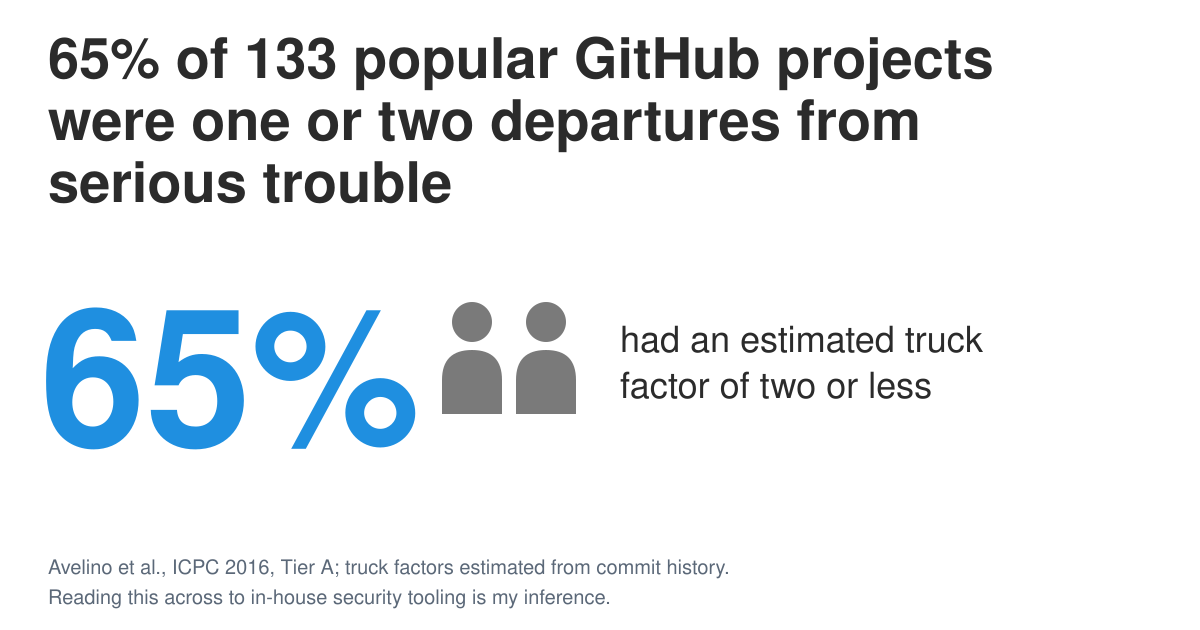
- Truck factor. Avelino, Passos, Hora and Valente estimated truck factors, the number of developers who would have to leave before a project is in serious trouble, for 133 popular GitHub systems and found that 65 percent had a truck factor of two or less (ICPC 2016, Tier A).
- Abandonment and survival. Three years later Avelino, Constantinou, Valente and Serebrenik followed 1,932 popular GitHub projects and found 315 of them (16 percent) abandoned in the sense that every truck-factor developer had stopped contributing, and only 128 of those 315 (41 percent) survived, in 86 percent of cases because a single new developer took the project on (ESEM 2019, Tier A).
- Why projects end. Coelho and Valente surveyed the maintainers of 104 popular GitHub projects that had been deprecated and grouped the causes into nine reasons, of which being usurped by a competitor was the most common in their per-project table, at 27 projects, and they found that contributing guidelines and continuous integration had an important association with whether a project failed or succeeded (ESEC/FSE 2017, Tier A).
- Debt in systems with a model inside. Sculley and nine colleagues at Google argued, from their experience running production machine-learning systems rather than from a measured sample, that "developing and deploying ML systems is relatively fast and cheap, but maintaining them over time is difficult and expensive", and they named the debt under headings that read like a review of this year's AI-security build proposals: boundary erosion, entanglement, hidden feedback loops, undeclared consumers, data dependencies, configuration debt and changes in the external world (NeurIPS 2015, Tier A).
- An operations budget. Google's SRE book describes a 50 percent cap on the aggregate operational work of its SREs, with the excess pushed back to the product teams (Tier B), and my view is that few security teams run an equivalent budget, so the toil a custom tool generates tends to land on whoever is nearest, which is usually its author.
The transfer of those results to an internal security tool is my inference, and I think it runs in the unfavourable direction. A popular open-source project whose maintainer leaves has a worldwide pool of potential successors, and the 2019 study says even that pool rescues fewer than half of the abandoned projects, while an internal AI-security script whose author leaves has the rest of the team, who did not write it and have their own queues. As for the share of lifecycle cost that goes to maintenance, the software-maintenance literature has long put it at the larger part of the total, but this piece has those figures only secondhand and they measure different things, so it carries the direction and prints no number.
The cost · abandonment and survival
Bottom line: the build is the visible part of a custom system's cost and, on the direction the literature gives, probably the smaller one, and the larger part, keeping it working once its author moves on, lands on a team that often has no one lined up to take it on.
The clock
An upstream that keeps moving
The second part of the cost is particular to this sector, and it is how often the things a tool reads change underneath it. MITRE ATLAS now ships about monthly, with six versioned releases between late May and the end of October 2026, and across the June to October releases it dropped eight technique IDs without marking any deprecated. The Model Context Protocol has published five dated revisions since November 2024, the latest on 2026-07-28, which deprecated its own logging feature and moved the record elsewhere, OCSF has landed a minor version every three to five months (1.7.0 in November 2025, 1.8.0 in March 2026, 1.9.0 in August and 1.10 on 20 November), and platform logging defaults change in release notes often enough that I'd pin them. Stacked together, a custom tool that maps ATLAS techniques, parses MCP traffic or reads a platform's AI audit log has something to absorb in most months, and that work goes to whoever understands the parser, on whatever schedule the upstream sets.
The clock · what a parser has to absorb
A vendor faces the same clock, and the case for buying is that it spreads the upgrade work across its customers and has someone whose job is to do it. The opening is the reason I don't want to overstate that, since a vendor-published integration carried broken extractions for years, so buying doesn't guarantee that anyone pays the upgrade tax. What a purchase can change is that the obligation sits in a contract with a named party, so a team can write the schema and version it expects into that contract and hold the vendor to it at renewal, a lever that an internal tool whose author has left does not offer, though it exists only where a team has written it in, and the app in the opening was a community app maintained on the margins, as that essay puts it. Vendors also have a survival rate of their own, which the piece on who bought whom takes up, and a sensor bought from a start-up that is acquired and folded into a platform is the bought equivalent of the priest leaving, so I'd want the contract to say what happens to the schema and the export when the product is acquired.
The temptation
What AI coding tools change, and what they leave alone
The reason the question feels urgent this year is that AI coding tools have cut what a build appears to cost, and on the Tier C direction above that was already the smaller part. The most careful trial cited here is METR's, in which 16 experienced open-source developers completed 246 tasks in mature repositories they had worked in for about five years on average, with each task randomly assigned to allow or disallow early-2025 AI tools (mostly Cursor Pro with Claude 3.5 and 3.7 Sonnet). Allowing the tools increased completion time by 19 percent, while the developers had forecast a 24 percent reduction beforehand and still estimated a 20 percent reduction afterwards (arXiv preprint, July 2025, Tier B). METR itself says its developers and repositories don't represent most software development and that AI tools seem plausibly useful in other settings, such as an unfamiliar codebase, and a small greenfield internal tool is closer to that than to METR's mature repositories. METR's February 2026 follow-up, on late-2025 tools, estimated an 18 percent reduction in completion time for the returning developers with an interval running from 38 percent faster to 9 percent slower, said it is likely developers are faster with the tools now than in early 2025, and called its own new data only very weak evidence for the size of that change, because developers who no longer want to work without AI had stopped enrolling (Tier B). So I'd treat the 2025 slowdown as dated and keep the perception gap, which the follow-up did not re-measure.
The temptation · the perception gap
The part of it I'd carry into a build decision is that gap, since the people doing the work misjudged its cost by about forty points in the direction of "cheaper than it was", and my inference is that a build proposal written in that state will tend to under-price the build and say little about the maintenance. A generated tool adds a further wrinkle, because Sculley's configuration debt and undeclared consumers are the kinds of debt a fast build accumulates fastest, as a generated tool tends to arrive with its configuration embedded in the code and its consumers unlisted, so its author may be the high priest of code that nobody, including the author, has read end to end. So I'd ask that the maintenance line of any AI-security build proposal be written by someone other than the person holding the coding agent.
The test
When building is the right call
None of this is an argument against building, and I'd distrust a version of it that was, because the coverage work in this series says the incumbent tools stop at the edges of the AI surface and much of the content record is off by default, so some of the gap has to be closed by hand. The test I'd apply to a proposed build is whether it is configuration of a system the organization already runs, or a thin layer with a documented interface over such a system, as opposed to a new system with its own storage, its own model and its own console. The first kind is often a few hundred lines a second engineer can read in an afternoon, and the second kind is a new member of the stack with everything the previous two sections said that implies. Five kinds of build pass that test in my view.
- An evaluation harness. Nasr, Carlini and colleagues bypassed twelve recent prompt-injection and jailbreak defences with attack success above 90 percent for most of them, against defences whose original papers had mostly reported near-zero success (USENIX Security 2026, Tier A), which suggests that the number worth having for any filter, bought or built, is one measured against attacks adapted to it. The harness I mean is a frozen plan with the team's own attack budget and scoring, run over an open attack library such as Microsoft's PyRIT or NVIDIA's garak (Microsoft also ships PyRIT's attacks inside Foundry as a preview AI Red Teaming Agent; Tier B for what each does), which makes it a thin layer by the test above and closer to configuration than to a new system. It carries no production traffic and checks a vendor's filter as well as the team's own, a question the vendor has little incentive to answer against its own product, which is why it is the one build I'd suggest even to a small team that can afford a written plan. The nearest component on CoSAI's map,
componentModelEvaluation, is the model builder's own accuracy testing during and after training, which none of the fourteen incumbent categories in article 6's grades sees and the new-vendor rows reach only through inventory and integrity controls on category framing (Tier C), so it neighbours the harness I mean without being the same step. - Detections as code. A rule written in the Sigma specification (v2.1.0 is current, released 2025-09-12) over fields the SIEM already types is version-controlled text that any backend with a converter can run, so it has a documented interface by construction and a second reader by habit, and the artifact is the rule, which keeps the priest risk low.
- Hook and policy configuration. The managed-settings file for a coding agent, the hook that denies a tool call and the gateway policy that pins an API key to an owner are configuration of systems the organization already runs, they are reviewable as text, and they produce structured tool-call records, the decision and the typed arguments of each call, which the research behind this series found no product shipping as a complete record as of its November 2026 read, so the remainder comes from a hook or gateway the team writes.
- Adapters that normalize telemetry. A mapping that lands the caller, the model and the tool name in typed columns at ingest, with the raw vendor payload kept beside them, has a published format on each end, which a second engineer can diff, and article 4 explains why that normalization is the organization's cost whichever product it buys; its upgrade work is real, since the vendor JSON and the schema both move, which is why the checklist below asks for pinned versions and a test that fails when they change.
- Thin glue in general. A saved query that joins telemetry the organization already collects, or a job that lands vendor exports in a store the team controls before the vendor's retention runs out, is glue a successor can trust when it pins its inputs and fails loudly.
What does not pass, in my view, is the sensor: building your own inline inspection point, your own production injection classifier, your own agent-identity broker or your own model-file scanner. Each is something the new vendors already sell as a core product, and I'd leave it to them, because there the vendor's upgrade work, spread across its customers, is likely to cost less than staffing a priest of your own for a component that sits directly in an attacker's path. The AI gateway shows both sides of that. The CISA Known Exploited Vulnerabilities catalog (version 2026.11.20) carries four LiteLLM entries added in 2026, a SQL injection, a command injection, an authentication flaw in its MCP endpoint and, added on 18 November, code execution through its guardrail-testing route, and Delegation across the AI surface reads the first three one by one. Those bugs are in LiteLLM's code, so a custom gateway would not carry them, but it would sit in the same position, holding the same provider keys, with one maintainer to find and fix that class of bug, and the entries also show that an adopted gateway is what gets attacked at scale, so buying one moves the patching to someone staffed for it without removing the exposure.
The test · what passes
Preconditions
What an organization needs before it favours building
Some organizations do favour building, often because they are large, regulated or have an engineering culture that has earned it, and my view is that they need one or both of two things in place first, each of which works on a different term in the subgroup count.
The first is an architecture review and application-rationalization habit that can decline a system and retire one, which works on the number of systems directly. A custom tool that enters through the same gate as a purchase, answering the same questions about its owner, its running cost and what it replaces, gets priced on the same accounting, and a review that can also retire tools that no longer earn their place is the only mechanism I know of that makes the count go down. The test I use for that gate is the one from my book's first chapter, that a move has to clear the technical bar and the operational, staffable bar at once, since a tool nobody else can run fails the second however well it performs on the first. An organization without that habit has nothing that makes the count go down, so I would not let it favour building.
The second is centralization on a few core systems or vendors, treated as close to permanent, which works on the exponent by shrinking the number of distinct interfaces a custom tool can form around. If an organization has decided that it runs one identity provider, one cloud control plane, one SIEM and one AI gateway, then a custom tool is glue between a small fixed set of published interfaces, and a successor who knows those four systems can read it. The price is lock-in, and I'd plan as if a centralization decision cannot be undone, which means choosing the core systems for what they are likely to be in five years and for which open schemas they export, and writing OCSF and Sigma into everything bought and renewed so the exits stay open while the lock-in is accepted.
An organization with neither is the one the high-priest argument is mostly about, since it adds systems one defensible decision at a time with no gate that removes them, and each custom tool it builds sits on a different combination of interfaces, so each acquires its own priest and the priests rarely overlap. For that organization I'd build nothing past the thin-glue tier until one of the two is in place.
Checklist
Five things any custom build needs
The checklist is short because a long one tends not to get used, and where a CoSAI control fits an item it is named, which is cleanly the case for one of the five and conditionally for three more, where the tool is itself an agent or an MCP server, so the closing piece can pin those items to the coverage map. I'd apply it to anything past a one-off query, including the thin glue.
| # | Item | What "done" looks like | CoSAI control, where one fits | Why it is on the list |
|---|---|---|---|---|
| 1 | A named owner and a named second | Two people who can each explain the tool and deploy a fix, recorded in the inventory entry and reviewed when either changes role | none; controlAgentInventoryManagement if the tool is itself an agent or an MCP server | 65 percent of 133 popular open-source systems had a truck factor of two or less, and of the projects that lost every such developer, the 41 percent that survived mostly did so by finding one more; the second person is that rescue arranged in advance |
| 2 | Documented interfaces | The inputs it reads with their versions pinned, the outputs it writes with their schema and version, the systems that consume them, and a test that fails when a pinned upstream changes | none | Sculley's undeclared consumers and data dependencies, and an upstream that moves in most months |
| 3 | A sunset or re-decision date | A date at most twelve months out (a starting point, Tier D) on which the tool is re-justified against what the owned stack and the market now cover, brought forward by an ATLAS release, an OCSF minor version, an MCP revision, a platform logging change or an acquisition | none | Being usurped by a competitor was the most common main reason in Coelho and Valente's per-project table, and in this market the competitor is often a feature a vendor already in the stack has shipped |
| 4 | An inventory entry | A row in the same register as the purchased tools, with owner, second, interfaces, sunset date, the surfaces it touches and the components it covers | controlModelAndDataInventoryManagement; controlAgentInventoryManagement as well if the tool is an agent or an MCP server | NIST SP 800-53 Rev. 5 CM-8 already asks for a component inventory, and a review can only retire what it can see |
| 5 | A telemetry contract | Typed identity, model and tool-name fields at ingest, an export schema stated by version (OCSF 1.9.0, or OpenTelemetry's GenAI conventions with their development status written down) and a retention the organization controls | controlAgentObservability, where the tool is or fronts an agent | A custom AI-security tool is itself on the AI surface, and if it emits nothing in the shared schema it becomes one more place the coverage view has to mark blind |
Control IDs and descriptions as they appear in CoSAI's controls.yaml at commit 622605a1, read 2026-11-16. The items and the twelve-month default come from the research behind this series, and the pairing of items to controls is a one-pass reading of that file with no second reader (Tier D); the twelve-month default is a starting point I'd adjust. The evidence column cites the Tier A studies above.
Items 1 and 4 are what make the review habit in the previous section possible at all, since a rationalization pass can only retire what it can see and only reassign what has a named owner. Item 5 is the one that touches this series' subject most directly, because a tool built to reduce blindness on the AI surface that does not itself log in the shape the rest of the pipeline reads would add a blind cell to the very map it was meant to fill in.
Small teams
For a small team
Rent or own made the small-team version of this argument. My inference there (Tier D) was that a custom tool built by a five-person security team probably starts with a truck factor of one, unless the team deliberately puts a second person on it from the first commit. I'd add here that the same team's operational time is probably already spent on the stack it owns, while the upgrade work from an upstream that moves in most months lands on that same one person. So for a small team I'd shrink the build list to the configuration half of the five above (the managed settings and the hook, Sigma rules over fields the SIEM already types, the inventory join as a saved query, the job that lands vendor exports in the team's own store) and, if it can afford one build with a written plan, the evaluation harness, since that one is small, carries no production traffic and answers a question the vendor has little incentive to answer against its own product.
Limits
Limits of this argument
- The high-priest argument is my view and has no measurement behind it. The research for this piece found no study of how internal security tools are maintained or retired, so everything here transfers from open-source projects and from general software maintenance, and the transfer is my inference (Tier D).
- The truck-factor estimates are themselves approximate. In the 2016 study's own survey of developers from 67 of the systems, 53 percent of valid answers were positive or partially positive about the estimated truck factors, so the 65 percent is an estimate from commit history, which is weaker than a headcount.
- The mirroring study is five matched pairs of open-source against commercial products, read in the working-paper version, and its step to a one-person internal tool is my inference.
- METR measured experienced developers in large, mature codebases, and its authors say they do not claim those developers and repositories represent most software development; its 2026 follow-up points toward a speedup on newer tools and calls its own data very weak evidence, so the perception gap is the part this piece leans on, and the 2025 slowdown should be read as dated.
- The maintenance-outweighs-build premise is a direction from secondhand figures (Tier C), and the papers cited above show concentration of knowledge and abandonment, which point the same way without measuring cost share.
- The five-item checklist has not been tested on a real build; it is assembled from the evidence above and from the CoSAI controls, and the twelve-month default is a judgement.
Falsifiers
What would change my mind
- A measured study of how internal security tools are maintained and retired, or an organization publishing its own tool-retirement rate with causes, which would replace my Tier D transfer with evidence in either direction.
- A controlled study of AI-assisted development on security tooling that found the maintenance share falling as well as the build time, which would weaken the case that coding agents leave the expensive part alone.
- A vendor publishing results for its own filter under an attack adapted to that filter, with the attack set open to inspection, which would weaken the case for a team running its own harness against that product.
Bottom line: AI coding tools made the build look cheap, and probably made small builds cheaper, and nothing cited here says they moved the maintenance, so I'd build the harness, the rules, the policies, the adapters and the glue, configure everything else the organization already owns, and give every build an owner, a second, a pinned interface, a sunset date, an inventory row and a telemetry contract before it ships. The closing piece turns this, and the rest of the series, into a set of decisions with dates on them.
Sources
| # | Source | What it supports | Tier |
|---|---|---|---|
| 1 | The parsing layer nobody owns, and PaloAltoNetworks/Splunk-Apps pull request #294 on GitHub, read 2026-11-16 | The opening: a fix never merged, still open in an archived repository; a community app maintained on the margins | First-hand |
| 2 | We are our own worst enemy, with David Reed, "That Sneaky Exponential" (1999) as cited there | The subgroup accounting, read as a direction | B |
| 3 | Guilherme Avelino, Leonardo Passos, Andre Hora and Marco Tulio Valente, "A Novel Approach for Estimating Truck Factors", ICPC 2016, arXiv 1604.06766, read 2026-11-16 | 65 percent of 133 popular systems with a truck factor of two or less; 53 percent survey agreement | A |
| 4 | Guilherme Avelino, Eleni Constantinou, Marco Tulio Valente and Alexander Serebrenik, "On the abandonment and survival of open source projects: An empirical investigation", ESEM 2019, arXiv 1906.08058, read 2026-11-16 | 315 of 1,932 projects abandoned; 128 of those survived, 86 percent through one new developer | A |
| 5 | Jailton Coelho and Marco Tulio Valente, "Why Modern Open Source Projects Fail", ESEC/FSE 2017, arXiv 1707.02327, read 2026-11-16 | 104 deprecated projects, nine reasons, a competitor the most common in the per-project table (27 projects) | A |
| 6 | D. Sculley et al., "Hidden Technical Debt in Machine Learning Systems", NeurIPS 2015, read 2026-11-16 | Fast and cheap to build, expensive to maintain; named debt classes; an experience paper | A |
| 7 | Alan MacCormack, Carliss Baldwin and John Rusnak, "Exploring the duality between product and organizational architectures", Research Policy 41(8), 2012 (read in the HBS working-paper version 08-039, 2026-11-16) | In all five matched open-source and commercial pairs, the open-source product was the more modular | A |
| 8 | METR, "Measuring the Impact of Early-2025 AI on Experienced Open-Source Developer Productivity", arXiv 2507.09089, July 2025, with METR's blog post on the study, read 2026-11-16 | 16 developers, 246 tasks; +19 percent time against a forecast 24 percent reduction; METR's own scope limits | B (preprint, randomized trial) |
| 9 | METR, February 2026 update on the uplift study, metr.org, read 2026-11-16 | Returning developers an estimated 18 percent faster on late-2025 tools (interval 38 percent faster to 9 percent slower); data called very weak evidence because of selection | B |
| 10 | Betsy Beyer et al., Site Reliability Engineering, 2016, ch. 1, read 2026-11-16 | 50 percent cap on aggregate operational work | B |
| 11 | Milad Nasr, Nicholas Carlini et al., "The Attacker Moves Second", USENIX Security 2026, arXiv 2510.09023, read 2026-11-16 | Twelve defences bypassed at above 90 percent attack success for most under adaptive attack | A |
| 12 | Microsoft PyRIT and NVIDIA garak repositories on GitHub; Microsoft Learn, "AI Red Teaming Agent" (preview) for Foundry; all read 2026-11-16 | Open attack libraries for an evaluation harness | B (what each tool does) |
| 13 | CoSAI risk map, components.yaml and controls.yaml at commit 622605a1, read 2026-11-16 | componentModelEvaluation as training-stage evaluation; the control texts behind the checklist pairings | A in the sense of primary files read at a pinned commit; working-group content, not a ratified standard |
| 14 | What the tools you already own can see | componentModelEvaluation seen by none of fourteen incumbent categories | D (grades), over B sources |
| 15 | CISA Known Exploited Vulnerabilities catalog, version 2026.11.20, read 2026-11-23 | Four LiteLLM entries added in 2026: SQL injection, command injection, MCP endpoint authentication, code execution through the guardrail-testing route | A |
| 16 | SigmaHQ, sigma-specification releases on GitHub, read 2026-11-16 | Specification v2.1.0, released 2025-09-12 | B |
| 17 | ATLAS moves fast and deprecates nothing, MCP just told you where its logs went, and the MCP specification and OCSF schema release lists on GitHub, read 2026-11-16 | ATLAS about monthly; five dated MCP revisions since November 2024; OCSF minors every four or five months | A for release and specification data |
| 18 | NIST SP 800-53 Rev. 5, CM-8 System Component Inventory | Component inventory as an existing control | A |
