
AI attack surface · Part 15
What the new vendors can deliver, and four sentences that cannot be
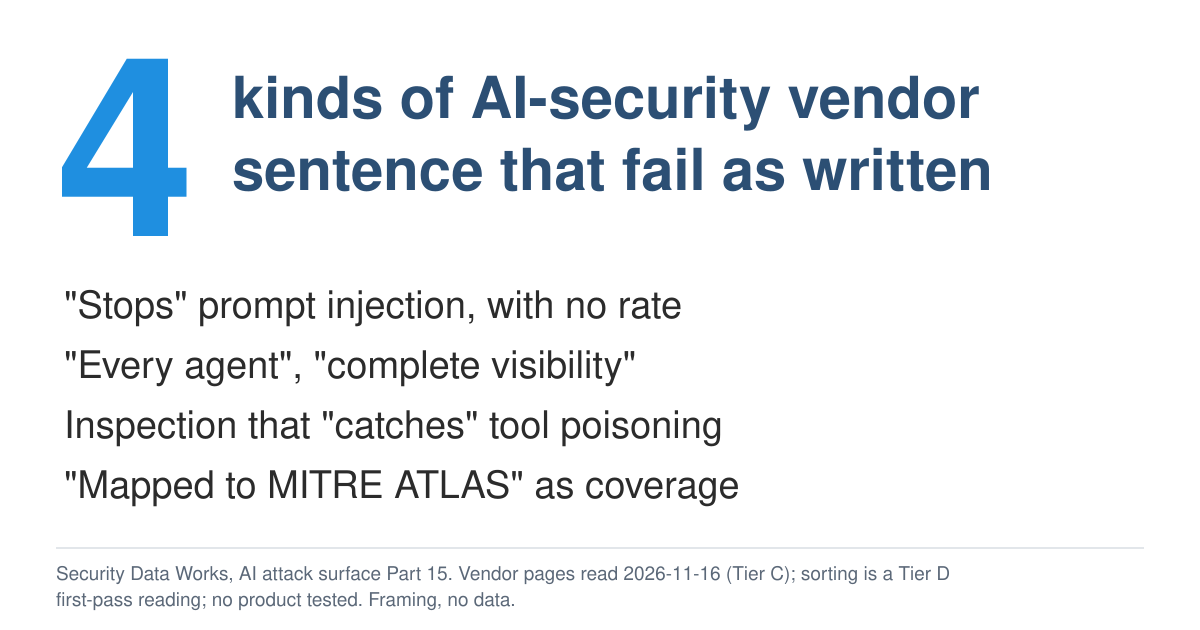
Read against their own product pages, the new AI-security categories split into a deliverable core and four kinds of sentence that fail as written. The core is inventory inside the sources a buyer connects, identity issuance and scoping for agents, change detection on tool manifests, model-file scanning and a lower rate of known injection patterns, and three of those five are already in the incumbents' products. The four sentences are "stops" prompt injection without a rate, "every agent" without a sensor list, inspection that catches poisoning it can't see, and "mapped to MITRE ATLAS" read as detection, and each fails on the reach of a sensor or on the attacker moving second, which more engineering on the same sensor doesn't fix. So the purchase question I'd put to any vendor is four answers in writing, about the sensor, the surfaces it's deployed on, the export schema and the evaluation set, because a number about a security product means what the method behind it lets it mean, and the method is the part a product page tends to leave out.
This is the fifteenth part of a series on the AI attack surface. Part 13 asked what the platforms an organization already licenses will show once their switches are thrown, and Part 14 read the year's acquisitions as purchases of sensors. This part reads the new vendors' own sentences, category by category, against what public evidence and two runs in my lab can check. Part 16 then turns all of it into a coverage view a team can build for itself.
Reading time: about 18 minutes. Evidence tier: C, with the bias flagged, for every vendor claim, all read on the vendor's own page on 16 November 2026; A for the two peer-reviewed results on guardrail evasion; B for the UK NCSC's guidance; first-party lab measurement for two runs in my lab, the ATLAS-observables run (R1) and the manifest-drift run (R5), which test the mechanisms the claims depend on and no vendor's product. The sorting of claims into sentence types is a first-pass reading with no second reader (Tier D), and the Limits section says what that costs.
Census
What the market's own census says
The most detailed public census I know of is the AI Security Startups Map that Prompt Security curates, and on 16 November its data file listed 480 vendors across 14 categories, up from 470 on 9 November. Two bias flags sit next to every number from it, because the curator is itself an AI-security vendor cataloguing its competitors, and since SentinelOne completed its acquisition of Prompt Security on 5 September 2025, according to SentinelOne's own 10-Q, the census is also an incumbent's view of the market (Tier C on both counts). The categories are overlapping tags the curator assigns, so across the 480 vendors the 14 tags sum to 1,283, a mean of 2.67 per vendor, and only 52 vendors carry a single tag, so the per-category counts can't be added into a market size, and the typical vendor sells a bundle of discovery, policy and inline inspection.
Even with those flags attached, where the weight sits says something, because after governance, the broadest tag at 314, the largest is runtime and guardrails at 246 vendors, the category whose headline sentence is the hardest to deliver as written, as the next sections argue, while model security, whose curator definition leads with scanning model files, carries 57. In the week between the two reads the runtime tag grew by seven, governance by eight and the model tag not at all, which I'd read as a direction of travel and no more, since one week of a curated list is a small sample.
Claims ledger
The ledger
The table takes each category, quotes the curator's one-line definition of it where that line makes the claim, adds one vendor's sentence as an example, and sets each against the mechanism the sentence depends on and the evidence that tests that mechanism, with each vendor appearing once. The map tag is the curator's nearest category, so an example vendor may carry other tags, and Wiz, an incumbent, isn't on the map at all. From each page I quote the line that states what the product does for its category, and where the same page carries a broader or a narrower sentence the type cell says so, since several pages carry both. The type follows one rule, applied to every row: a sentence is deliverable as scoped when it names a mechanism with a boundary (a connected source, an installed agent, a gateway on the path, a file scan, a cross-reference table), with any broad phrasing in it carried as a qualifier; it fails as written when it promises an outcome against attackers with no rate (sentence 1) or claims coverage with no mechanism that bounds it (sentence 2). The three rows whose category is the vendor's own label are categories with one example, not verdicts on that product, the choice of example says nothing about whose product is stronger, and none of these products was tested here, so the last column gives the nearest public or lab evidence for each mechanism and says so where none exists.
Claims ledger · 12 categories · quotes read 16 November 2026
| Category (closest map tag, vendors) | What the category says (C, read 2026-11-16) | Sentence type (mechanism rule, Tier D) | Mechanism it depends on | Nearest public or lab evidence |
|---|---|---|---|---|
Runtime and guardrailsruntime, 246 | Curator: "Blocks prompt injection, jailbreaks, data exfiltration, and unauthorized tool calls before they reach the model or downstream systems." Lakera (Check Point): "Prompt injection, jailbreaks, and adversarial instructions blocked before they reach the model." | Sentence 1: "stops" without a rate; the same page also says it "enforces security on every AI interaction your organization runs" | A learned classifier on the traffic routed through it | Nasr et al. 2025 (A); Hackett et al. 2025 (A, workshop, vendor flag); NCSC 2025-12-08 (B) |
| Runtime guardrails, with a rate the vendor's own label, not a map tag | CrowdStrike, in the release announcing the Pangea deal, 2025-09-16: "up to 99% efficacy at sub-30ms latency", footnoted "internal benchmark testing on GPU-based edge deployment" | A rate with no attack set | A classifier scored on a test set the vendor chose | Nasr et al. 2025 (A): most of 12 defenses had first reported near-zero attack success |
Observability and governancegovernance, 314 | Curator: "Continuous discovery, inventory, and behavioral profiling of every AI agent across the enterprise." Noma, under its AI-SPM product: "Discover every agent, MCP, skill, and tool, and surface risk" | Deliverable as scoped; the "every" or "full range" phrasing, read without that boundary, is sentence 2 | Posture connectors to the sources the buyer grants | No public or lab test of platform connectors found; nearest is lab run R4 (Part 11), a different sensor, where file scanners missed the same weights once they sat in Ollama's store |
| Shadow-AI discovery split over network 25, browser 35, aes 47, sspm 15 | Harmonic: "The only platform that classifies every AI task" | Sentence 2: "every" or "complete" with no bounding mechanism; the same page's FAQ scopes it: coverage "expanding as more endpoints and integrations come online", inline controls "where the surface supports them" | Endpoint, browser and MCP-gateway sensors where they are deployed | Part 9: in one lab run the endpoint query found a local runtime only where it already named the path |
AI posture managementaispm, 76 | Wiz: "Discover AI services, technologies, and SDKs without any agents" | Deliverable as scoped; the same page also says "Uncover shadow AI" with "full-stack visibility" | Cloud control-plane and code-repository APIs | Part 4: local models graded D, with endpoint telemetry the only source that sees them |
AI endpoint and local-tool discoveryaes, 47 | Proofpoint, Acuvity release, 2026-02-12: "comprehensive visibility and enforcement across the full range of AI usage", including "locally installed AI tools like OpenClaw and Ollama" | Deliverable as scoped; the "every" or "full range" phrasing, read without that boundary, is sentence 2 | An endpoint agent watching processes, files and sockets | Part 10: a local runtime and its model store are visible to an endpoint agent on the hosts it runs on |
AI identityidentity, 125 | Curator: "Issues verifiable, scoped, and revocable identities to AI agents and non-human workloads." Oasis (now acquired by Cyera, per its own page), under Inventory: "See every non-human identity in real time." | Deliverable as scoped; the "every" or "full range" phrasing, read without that boundary, is sentence 2 | Identity-provider, cloud IAM and secret-store APIs | Part 7: no production source read carries per-hop scopes and a parent pointer on one record |
MCP and LLM gatewaysmcp-gateway, 115 | Runlayer: "Govern every MCP and LLM call through one gateway" | Deliverable as scoped; the "every" or "full range" phrasing, read without that boundary, is sentence 2; the same page also says "See every agent, MCP, and skill in use" | A gateway the traffic is forced through | Part 10: a stdio MCP server runs as the client's subprocess, so its calls cross no network |
| Agent and MCP scanning the vendor's own label, not a map tag | Snyk Agent Scan README, v0.6 and later: "reports scored risk indicators for threats such as prompt injection, exposure to untrusted or private data, destructive capabilities, and malicious agent skills" | Deliverable as scoped; read as catching poisoning in general, sentence 3; the README's v0.5.x section, marked for deprecation, says it "scans for common security vulnerabilities like prompt injections, tool poisoning, toxic flows" | Reading the descriptions and manifests a server publishes | Nearest is lab run R5, a diff over the same descriptions: it fired on every authored poisoning and on most authored benign edits; a code-only change leaves no manifest trace (argued) |
| Detection mapped to frameworks the vendor's own label, not a map tag | Zenity: "Detect threats, investigate, and respond, mapped to OWASP and MITRE ATLAS." | Deliverable as scoped; read as detection coverage, sentence 4 | A table from product features to technique IDs | No test of a vendor's table found; by analogy, the lab's own mapping (R1): 2 of 8 pre-registered techniques (7 mapped) detected cleanly, and 0 of 17 mitigation interdictions survived a refute pass (model-judged, Tier D) |
Model securitymodel, 57 | Curator: "supply-chain scanning of model files for backdoors, malware, and poisoning." Palo Alto Networks, Protect AI release, 2025-07-22: "brings together model scanning, posture management, AI red teaming, runtime protection, and AI agent security" | Deliverable as scoped; the same release calls Prisma AIRS "the industry's most comprehensive AI security platform" | File access to model artifacts in a registry or hub | Part 11: scanner output gives model weights no identifier a vulnerability matcher can use |
| Platform-wide claims 428 of 480 vendors carry two or more tags | HiddenLayer: "proactively defends against the full spectrum of AI threats", for "agentic, generative, and predictive AI applications" | Sentence 2: "every" or "complete" with no bounding mechanism | Whatever sensors the platform runs over the customer's AI | Parts 11 and 10: inside the customer's own AI, file scanners missed weights in Ollama's store, and a stdio MCP server crosses no network |
Ask in writing: which sensor; on which of my surfaces; what export schema and version, with which fields typed; evaluated against which adaptive attack set, at what false-positive rate, on inputs shaped like mine.
Under that rule three rows fail as written (one "stops" and two "every"), one gives a rate with no attack set, and eight are deliverable as scoped, six of which carry a phrasing that turns into one of the four sentences when it's read without its boundary (four "every" or "full range", one inspection claim and one mapping). Those counts are what this rule gives and not a property of the market, since a stricter rule that typed each sentence as written, with no credit for a named mechanism, would move most of the qualified rows to the failing side, and a second reader may well prefer it.
Claims ledger · what one rule gives
- Fail as writtenRuntime and guardrails; Shadow-AI discovery; Platform-wide claims
- A rate with no attack setRuntime guardrails, with a rate
- Deliverable, with a phrasing that fails without its boundaryObservability and governance; AI endpoint discovery; AI identity; MCP and LLM gateways; Agent and MCP scanning; Detection mapped to frameworks
- Deliverable as scopedAI posture management; Model security
Deliverable core
What the market can deliver
Read across the deliverable rows, the core of what this market can sell is real, and I want to say that plainly before the rest of the article spends its time on the sentences that fail. Inventory within the sources a buyer connects is deliverable, so an AI posture tool that reads cloud control planes and code repositories will find the managed model endpoints and SDK imports in the accounts it's given, and an endpoint agent will find a local runtime on a laptop it's installed on. Identity issuance and scoping for agents is deliverable, and so is credential inventory and rotation for the non-human identities a platform can see. Change detection on tool manifests is deliverable and cheap, since R5 measured a few milliseconds per snapshot on an open connection. Model-file scanning for known-unsafe serialization is an established technique. And a classifier in front of a model does reduce the rate of known injection patterns and puts friction in front of low-effort attackers, which Nasr and his co-authors concede in the same paper that breaks the classifiers, since detectors still block "some unsophisticated or opportunistic attacks".
Three of those five deliverables are also what the incumbent platforms converged on, namely inventory within the sources a platform can reach, an identity type for agents and a classifier in front of the model that logs what it decided, and Part 13 found those features in tiers an organization may already hold, some on by default and others behind an add-on or a switch, with none of them emitting OCSF or stable OpenTelemetry natively. So the purchase decision on those three compares an incumbent's feature with a net-new product on the same four questions, and the other two, manifest change detection and model-file scanning, are the ones I didn't find among the incumbents' built-in features, though acquirers have bought into both, Snyk with Invariant Labs and Palo Alto Networks with Protect AI (Part 14 has the deals), so I wouldn't read that as open ground.
Four sentences
Four sentences that cannot be delivered as written
What fails is four kinds of sentence that keep appearing on the pages that sell these products, each for a reason in the architecture of the claim that more engineering on the same sensor doesn't fix. I'd add that most of the people building these products are working on hard problems in good faith, and that some of the pages scope their claims below the headline, Harmonic's FAQ and CrowdStrike's footnote among them, while others carry a broader line beside a scoped one, which is part of why the headline is worth reading closely.
1. "Stops" or "blocks" prompt injection, without a rate
An inline guardrail is a classifier sitting in front of a model that has no internal boundary between data and instruction, which is the NCSC's point, and the classifier is itself a learned model that an attacker can query and optimize against, which is the point of Nasr, Carlini and twelve co-authors, whose adaptive attacks bypassed 12 recent defenses "with attack success rate above 90% for most", where "the majority of defenses originally reported near-zero attack success rates" (USENIX Security 2026, Tier A, read as the arXiv v1 preprint, with an affiliation flag because the authors include researchers at OpenAI, Anthropic and Google DeepMind). Hackett and colleagues at Mindgard and Lancaster University reached "up to 100% evasion success" in some instances against six prompt-injection and jailbreak detectors, a best-technique figure and not a typical one (LLMSec 2025 workshop, peer-reviewed, Tier A, with a vendor flag since the authors include Mindgard, which sells guardrail testing). So a guardrail's true block rate depends on how hard the attacker works, which the vendor can't know when it writes the page, and the UK NCSC put the buyer's version of this in one line: "Beware any that claim they can 'stop' prompt injection, and instead look at those who understand how they reduce it" (Tier B).
Sentence 1 · fixed test set against an adaptive attacker
The efficacy number in the second row, from the release announcing CrowdStrike's deal for Pangea, states a rate and footnotes how it was measured, and the footnote is what a buyer should read: the 99% comes from "internal benchmark testing", which means a test set the vendor chose, and the release names no attack set, no false-positive rate and no adaptive arm. That's the evaluation design the Nasr paper measures as overstating robustness, because a defense that looks near-perfect on a fixed set can fall to an attacker who adapts to it, so the number can't be compared with anything until its denominator is published.
My own lab produced a smaller lesson about a different kind of rule. In the ATLAS-observables run, a pre-registered Sigma rule for direct prompt injection, a keyword match over the prompt text in OCSF's message_context.prompt_text field in stored telemetry, missed the planted injection on all three seeds on DuckDB, the engine the pre-registration named, while on SQLite the same rule fired, at a precision of 0.048, on twenty benign lower-case quotes per seed as well (ATLAS has no detection layer carries the run). The rule's own semantics are case-insensitive, and it broke because the SQL my pipeline compiled for SQLite matches LIKE case-sensitively on DuckDB, so the miss came from the test bench rather than from the rule, and what I take from it is narrower than the papers' point: a detection's behaviour depends on the compiler and engine under it, which a product page has no reason to mention.
What is deliverable is a lower rate of known patterns and a logged decision per request, and the stronger architecture is the one the NCSC and the agent-design literature describe, which limits what a confused model can do instead of promising it won't be confused: execution bounds, per-tool permissions and credential isolation in CoSAI's terms (controlAgentExecutionBounds, controlAgentPluginPermissions, controlAgentCredentialIsolation). Nasr's group left plan-then-execute defenses out of their evaluation for exactly that reason, since by their account the attack would fail in most of the scenarios they selected when an agent's control flow doesn't depend on the data it reads, though they note those designs cost utility. So for hijacking what an agent does next, "stops" can be close to true for an agent built that way, on the tasks such a design can handle, though the data it passes along can still be poisoned, and when it holds the credit belongs to the agent's design, whatever classifier sits in front of it.
2. "Every agent" and "complete visibility"
"Every agent", "every AI asset" and "complete visibility" are closed-world claims over the reach of a sensor, and each sensor has a known edge. A posture tool sees the accounts and repositories it's connected to, an endpoint agent sees the devices it's installed on, a browser control sees the browser it lives in, and a gateway sees the traffic forced through it, and the surfaces where unsanctioned AI tends to live are the ones where the matching sensor usually isn't deployed: an open-weight model running offline on an unmanaged laptop with no endpoint agent, or with one whose queries don't name the model store, a stdio MCP server that a gateway never sees because it's a child process with no network hop, and an AI feature inside a SaaS app making a server-to-server call the user's traffic never shows (Three AI surfaces the network sees and can't name works through all three). A run in my lab put a small instance of this on the record in November, where the same TinyLlama weights that inventory tools found as a named file were seen by none of them once they sat in Ollama's content-addressed store (Part 11 carries the run), which is the general rule in miniature, since discovery finds what a scanner was built to recognize in the places it was given access to.
Sentence 2 · where "every" ends
A vendor can say "every agent in the tenants, browsers and endpoints you connect" and mean it, and one of the pages above comes close once you read past the hero line, since Harmonic's FAQ says coverage grows "as more endpoints and integrations come online" and that inline controls apply "where the surface supports them", which is the scoped sentence the headline leaves out. The platform-wide version of the claim, defending "agentic, generative, and predictive AI applications" against "the full spectrum of AI threats", is the same closed-world claim stretched over the customer's whole AI footprint of models, agents and tools, and the edges above sit inside it, since the weights in an Ollama store and a stdio MCP server are both the customer's own AI. A separate share of the incident record, which Part 3 counts at 137 of 290 steps (one reading of where incidents sit, Tier D), is AI on the attacker's side, which is outside what these categories set out to cover.
3. Inspection that catches tool poisoning
Scanners that read an MCP server's tool descriptions and manifests can catch some poisoning, and Snyk's Agent Scan README describes doing that, its current line (v0.6 and later) reporting "scored risk indicators for threats such as prompt injection" among others, and its v0.5.x section, marked for deprecation, saying it scans for "prompt injections, tool poisoning, toxic flows" (B for what it does). The scored form is close to the scoped sentence this article asks for. The claim fails where it's read as covering poisoning in general, because inspection at the protocol layer sees descriptions, schemas and names change without seeing the intent behind a change, and because a server whose code changes while its manifest stays byte-identical produces no protocol-level signal at all.
The manifest-drift run (R5) measured the first half of that, where a snapshot-and-diff detector over three MCP servers, two reference servers and the lab's own, fired on all three kinds of authored poisoning on each (9 of 9), and also on 12 of 15 authored benign edits under the OCSF-native rule and 9 of 15 under a contract rule, because OCSF's ai_capability object keeps the tool description only as a fingerprint, so a hidden instruction and a typo fix move the same field. The body-aware rules, two that read the description text a producer has to compute because OCSF has nowhere to put it and one schema-widening check, separated the two sets completely on that corpus, nine of nine and zero of fifteen, but the poisonings and the rules were written by the same hand, so that result is an upper bound and circular by construction. On 11 transitions between real published releases the same composite fired once, on a maintainers' rewrite of one tool's description that the pre-registration, which counts every release as benign, scores as a false positive, though a reviewer might still want to read it, since the documented contract changed and the manifest can't show whether behaviour did. That replay also carries an artifact of its own, because npx installs each published version with today's transitive dependencies, so all thirteen versions ran on the same current MCP SDK, and under today's version of its validation library the August 2025 server-filesystem package emits empty input schemas its maintainers never shipped, which makes thirteen of its fourteen tools look as though they gained a full schema in November 2025 and leaves 14 of the replay's 25 contract-rule events inseparable from the artifact. The release-arm results file documents the artifact and notes that a faithful replay would pin each install to its publish date, and Tool poisoning shows up as a diff carries both arms.
Sentence 3 · lab run R5
The code-only case is argued and not measured, since R5 didn't include a server whose behaviour changed under a stable manifest. The argument holds without one, though, because a manifest differ compares manifests, and a rug-pull that leaves the manifest alone leaves it nothing to compare. A catalogue of known servers keyed by name and version has the same blind spot for a same-name, same-version content swap. Catching either needs provenance at build time and behaviour on the server side (controlComponentIdentityProvenance and controlToolRegistryAndDiscoveryIntegrity in CoSAI's terms), which is a different sensor from the one doing the inspection.
4. "Mapped to MITRE ATLAS" as coverage
Mapping is a cross-reference between a product feature and a technique name, and the ATLAS-observables run measured, by analogy, how far the lab's own mapping is from detection. Of eight ATLAS techniques pre-registered with planted events, my own crosswalk's mapping table would have scored seven as covered (the eighth has no crosswalk row), and on the pre-registered engine two were detected cleanly on every seed, five fired in a background that drowned them and one was missed. The two that fired cleanly were the ones whose OCSF field carries the attack's own content, the injected SQL and a decoded exec command line, and a post-hoc probe found that one of those two, the SQL-injection rule, also misses a lower-case union select on DuckDB, which an attacker can choose freely because SQL keywords ignore case (ATLAS has no detection layer has the full column).
Sentence 4 · lab run R1
A second, separate pass sits behind the "0 of 17" in the ledger, and it has to be read with its method attached. Over nine recent agentic and generative-AI case studies in ATLAS v2026.06, a model labelled 97 mapped mitigation-and-case pairs, 17 of which it judged as plausibly interdicting a step, and a second model pass instructed to refute unless the interdiction survived strict scrutiny upheld none of the 17. That's model judgement on both legs with no human second reader (Tier D), run on an ATLAS release that has since moved to v2026.10, so I'd read it as the same lesson stated at the control level, short of a measured rate.
None of this makes ATLAS useless for a vendor or a buyer. ATLAS is a catalogue of observed techniques with a mitigation list, four of whose 44 entries are about detection or monitoring by name, and it carries no data source or analytic for any technique, so a heatmap of green cells over ATLAS says the vendor has read ATLAS, which is worth something for triage, but it isn't evidence of what the product would have caught.
Procurement
The four questions, in writing
If those four sentences fail as written, the useful thing to ask a vendor for is four answers a buyer can check, which are the same four Part 13 asks of the incumbents' features:
- which sensor the product sits on;
- on which of the buyer's surfaces that sensor is actually deployed;
- what it exports, in which schema and version, and which fields arrive typed;
- what it was evaluated against, meaning which adaptive attack set, at what false-positive rate, on inputs shaped like the buyer's own.
The third question is the one I'd ask first in a security-data practice, and it's the one the vendor pages say least about. None of the marketing pages and releases quoted above names OCSF or OpenTelemetry, though the documentation sites where an export schema would more likely be written down weren't read for this article, and the shape matters a great deal: when a lab run wrote one real MCP tool call into OCSF, OpenTelemetry's GenAI conventions and OWASP's Agent Observability Standard, the number of facts that arrived as typed fields differed by more than a factor of two between the richest and the sparsest (OCSF already has the AI-agent objects carries the table, and notes that the richest column leans on objects that were on OCSF's main branch and not in the 1.9.0 release, and that shipped in 1.10.0 on 2026-11-20). A product that can't say which of those shapes it emits is asking the buyer to write the normalization layer, and that's a cost no efficacy number captures.
I think a vendor that answers all four in writing is probably selling something real, and one that answers the fourth with a static internal benchmark has told the buyer what it hasn't tested yet.
Limits
Limits
- No product was tested. R1 and R5 test mechanisms the claims depend on, on authored corpora, on one host each, with pre-registrations that an agent froze before each run and that I haven't reviewed, and R5's real-release arm, which an agent session ran on my lab host, is post-hoc and not yet independently re-run.
- The quotes are one day's reading of marketing pages and releases. Pages change, and the vendors' documentation sites, where scoping and export schemas are more likely to be written down, weren't read.
- The sentence types are a first-pass reading with no second reader (Tier D). Twelve rows from twelve vendors is a sample, and the counts under the mechanism rule describe this table under that rule, which a stricter rule would change.
- The market-map counts are Tier C twice over, because the curator is a vendor and is now owned by an incumbent, and because the tags are the curator's and overlap.
- The 0 of 17 is model-judged and dated to ATLAS v2026.06.
- The guardrail papers were read as preprint or proceedings abstracts and the sections the research notes cite, and the Nasr figures come from arXiv v1, so the camera-ready numbers may differ.
Falsifiers
What would change my mind
A runtime vendor publishing a block rate against a named adaptive attack set, with the false-positive rate and the base model stated, would move that row out of the first sentence type, and I'd retest the claim against the published set rather than against the page. A discovery vendor publishing, per surface, which sensor it uses and where that sensor's reach ends would turn an "every" into a scoped and checkable claim, of the kind Harmonic's FAQ already states in part. On the inspection side, a run of R5 against a server whose behaviour changes under a byte-stable manifest, with a server-side sensor watching, would turn the code-only argument into a measurement, and the real-release arm re-run with each install pinned to its publish date would give the false-positive count a clean denominator. And a re-run of the counterfactual pass on ATLAS v2026.10 with a human second reader would tell me whether 0 of 17 survives as more than an illustration.
Bottom line: the deliverable core of the new AI-security market is inventory inside the sources you connect, identity issuance and scoping for agents, change detection on tool manifests, model-file scanning and a lower rate of known injection patterns, and three of those five are already in the incumbents' products; the four sentences that fail are "stops" without a rate, "every" without a sensor list, inspection that catches poisoning it can't see, and "mapped to ATLAS" read as detection, and each fails on sensor reach or on the attacker moving second, so the purchase question is four written answers about sensor, surfaces, export schema and evaluation set. Part 16 shows how to put those answers on a map next to what a team has verified for itself.
