
AI attack surface · Part 14
Who bought whom, and which sensor they bought
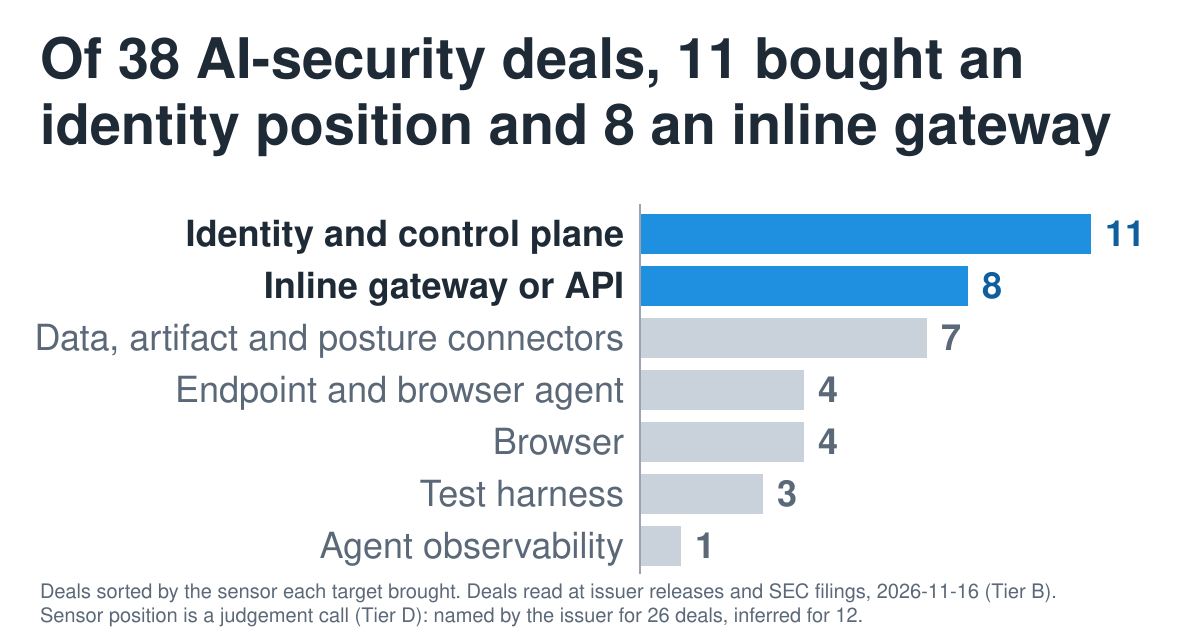
Thirty-eight AI-security acquisitions signed or closed between April 2025 and November 2026 can be confirmed at the buyer's or target's own release or an SEC filing, and they sort more usefully by the sensor each target brought than by price, because that sensor's position decides which AI deployment surfaces the combined product can see and what has to be true before it sees them. Identity and inline gateways are the two large groups, and between 12 and 15 of the deals gave the acquirer a position it didn't already have, the clearest of them CrowdStrike and Zscaler moving into the browser, the API call and the agent's own trace, while no deal in the list buys a view of what a device does locally when it runs none of the buyer's software.
Palo Alto Networks' purchase of Koi Security shows what that reading looks like for one deal. Palo Alto's 10-Q said in February 2026 that it had agreed to pay $300 million in cash and replacement awards, and its 10-K says the deal closed on 14 April for $231 million of purchase consideration, plus $61 million of replacement equity awards that it allocated to future services, which brings the filing to within about $8 million of its own signing figure. None of those numbers says what Palo Alto bought, though, and the 10-K's description does: an endpoint posture management company whose agentic endpoint security is meant to protect coding agents and other autonomous tools on the endpoint, which is to say a sensor on the developer's machine. That's the question I'd ask of every deal here, when an incumbent buys an AI-security startup, which sensor came with the purchase, where it sits, and which deployment surfaces that position can reach.
Where Turn on before you buy read what the platforms an organization may already license can do once configured, this piece reads the other side of that decision, the run of acquisitions that moved AI-security startups into incumbent portfolios over 2025 and 2026. The reading was done on 16 November 2026 by an agent working from my brief, and the deals that couldn't be confirmed at a primary are left out.
Reading time: about 16 minutes. Evidence tier: B for each deal fact, read at the issuer's own release or an SEC filing on 2026-11-16, including any price the issuer states; C for press-reported prices and for the market census, whose curator is now owned by one of the acquirers; D for the sensor assigned to each deal, the reach table and the new-position scoring, which an agent drafted without a second reader.
The census
How many vendors there are, and why the count misleads
The AI Security Startups Map that Prompt Security curates listed 480 vendors on 16 November, ten more than a week earlier, so any figure from it is dated and directional, and its curator has been part of SentinelOne since September 2025, so the census is an incumbent's view of the market as well as a vendor's view of its competitors (Tier C on both counts). Its categories are tags, averaging 2.67 per vendor, so the typical startup in it sells a bundle of discovery, policy and inline inspection, and an acquirer's press release that names one capability understates what was bought. What the new vendors can deliver works through the census in full, since its subject is checking those claims one capability at a time.
The census data file marks 39 vendors as acquired, and 31 of those are in the ledger below; the ledger adds seven deals the file doesn't mark, mostly identity companies, and leaves out eight it does, two cut for resting on press alone, five dated before the window, and one, Aptible, whose own announcement describes a compliance platform rather than AI security. The site's older AI-native versus AI-augmented and DSPM infrastructure pages describe parts of this market from before most of these deals, and they read best now as background to the ledger below.
The ledger
Thirty-eight deals, read at a primary
The table lists every AI-security deal that could be confirmed at a primary. A gateway, browser, endpoint, data, test or observability deal is in when the issuer describes the target in AI terms, which for SquareX is Zscaler's release ("for the AI era") rather than its 10-K. An identity deal is in when the issuer's description names agents or non-human identities, and four of the eleven (CyberArk, SGNL, Astrix and WideField) are in on this series' framing around agent access, since the primaries read for them describe identity security without naming AI. Acquisitions in the same filings that meet neither rule, such as CrowdStrike's Onum, Palo Alto's Chronosphere and Check Point's Cyclops, are left out. That gives 38 targets bought by 24 acquirers between April 2025 and November 2026, with Cisco's purchase of Robust Intelligence, which closed in Cisco's fiscal first quarter of 2025 (the quarter that ended in October 2024), left outside the window as the precursor. Six of the 38 are still pending or have no confirmed close. Prices appear only where the issuer states one. For four deals there's a signing or announcement figure and a figure recorded at close, which in several filings is stated net of cash acquired or excludes stock that vests later, and for Prompt Security the 8-K's aggregate and the 10-Q's itemized components both describe what was paid at close; I print both figures with what each measures, and where the filing bridges them (Koi's $61 million of replacement awards) the table says so.
| Acquirer ← target | Signed or announced | Status | Price in a primary (what it measures) | Sensor the target brought |
|---|---|---|---|---|
| Palo Alto Networks ← Protect AI | 2025-04-28 | Closed 2025-07-22 | $635M total purchase consideration | Artifact and posture connectors |
| Tenable ← Apex Security | 2025-05-29 | Closed June 2025 | $47.8M total consideration | Artifact and posture connectors |
| Snyk ← Invariant Labs | 2025-06-24 | Acquired | Not disclosed | Inline gateway or API |
| Concentric AI ← Swift Security | 2025-07-01 | Acquired | Not disclosed | Browser |
| SentinelOne ← Prompt Security | 2025-08-05 | Closed 2025-09-05 | About $180M in cash and stock paid at close (8-K); the same close itemized as $133.6M cash plus 1,555,099 shares and assumed options (10-Q) | Endpoint and browser agent |
| Cato Networks ← Aim Security | 2025-09-03 | Acquired | Not disclosed | Inline gateway or API |
| F5 ← CalypsoAI | 2025-09-11 | Closed 2025-09-26 | $180M purchase consideration (release); $145.2M cash (10-K) | Inline gateway or API |
| Check Point ← Lakera | 2025-09-16 | Closed 2025-10-22 | About $187M net cash | Inline gateway or API |
| CrowdStrike ← Pangea | 2025-09-16 (wire copy located, not opened) | Closed 2025-09-26 | $212.1M cash, net of cash acquired | Inline gateway or API |
| Zscaler ← SPLX | 2025-11-03 | Acquired 2025-10-31 | $40.6M cash, plus $16.6M restricted stock | Test harness |
| Veeam ← Securiti AI | See close | Closed 2025-12-11 | $1.725B | Data and posture connectors |
| ServiceNow ← Veza | 2025-12-02 | Closed 2026-03-02 | About $1.2B, substantially cash | Identity and control plane |
| CrowdStrike ← SGNL | 2026-01-07 (agreement) | Closed 2026-02-20 | $627.9M cash, net of cash acquired | Identity and control plane |
| CrowdStrike ← Seraphic | 2026-01-12 (agreement) | Closed 2026-02-03 | $327.4M cash, net of cash acquired | Browser |
| Zscaler ← SquareX | 2026-02-05 | Acquired 2026-02-05 | $112.8M cash | Browser |
| Varonis ← AllTrue.ai | February 2026 (page undated) | Close not confirmed | Not disclosed | Data and posture connectors |
| Palo Alto Networks ← CyberArk | 2025-07-30 (agreement) | Closed 2026-02-11 | $21.1B total purchase consideration, mostly stock | Identity and control plane |
| Proofpoint ← Acuvity | 2026-02-12 | Acquired | Not disclosed | Endpoint and browser agent |
| Check Point ← Cyata | 2026-02-12 | Acquired February 2026 | Not disclosed | Endpoint and browser agent |
| Palo Alto Networks ← Koi Security | 2026-02-16 (agreement) | Closed 2026-04-14 | $300M in cash and replacement awards at signing; at close $231M purchase consideration plus $61M of replacement awards allocated to future services | Endpoint and browser agent |
| OpenAI ← Promptfoo | 2026-03-09 (agreed) | Close not confirmed | Not disclosed | Test harness |
| Cyera ← Ryft | 2026-04-23 | Acquired | Not disclosed | Data and posture connectors |
| Silverfort ← Fabrix Security | 2026-04-28 | Acquired | Not disclosed | Identity and control plane |
| Palo Alto Networks ← Portkey | 2026-04-30 (agreement) | Closed 2026-05-29 | $140M in cash and replacement awards at signing; at close $117M purchase consideration plus $2M of replacement awards | Inline gateway or API |
| Cisco ← Astrix Security | 2026-05-04 | Closed 2026-06-29 | Not disclosed | Identity and control plane |
| Akamai ← LayerX | 2026-05-14 | Closed July 2026 | About $205M at announcement; $192.9M cash at close | Browser |
| Zscaler ← Symmetry Systems | See close | Acquired 2026-05-27 | $152.9M cash | Data and posture connectors |
| F5 ← SurePath AI | See close | Closed 2026-06-15 | $50.1M | Inline gateway or API |
| A10 Networks ← TrojAI | See close | Closed 2026-06-15 | $34.1M cash plus $5.0M stock | Inline gateway or API |
| SailPoint ← Entro Security | 2026-06-15 | Closed 2026-06-29 | About $122.6M cash | Identity and control plane |
| 1Password ← Apono | 2026-06-15 | Acquired | Not disclosed | Identity and control plane |
| Cisco ← WideField Security | See close | Closed in Cisco's fiscal Q1 2027 | Not disclosed | Identity and control plane |
| Okta ← Permiso | 2026-07-30 | Closed 2026-08-26 | Not disclosed | Identity and control plane |
| Cyera ← Oasis Security | July 2026 (press, Tier C) | Completed by 2026-09-01 (Cyera blog); release 2026-09-03 | Valued at $1B | Identity and control plane |
| Workday ← C1 | 2026-10-12 (agreement) | Pending | Not disclosed | Identity and control plane |
| Proofpoint ← Varonis | 2026-10-15 | Pending, expected first half of 2027 | About $6.3B, $49.75 a share in cash | Data and posture connectors |
| CrowdStrike ← Fiddler AI | 2026-11-03 | Pending, expected CrowdStrike FY2027 Q4 | Not disclosed | Agent observability |
| CrowdStrike ← Dreadnode | 2026-11-03 | Pending, expected CrowdStrike FY2027 Q4 | Not disclosed | Test harness |
Deal facts read at the acquirer's or target's own release or an SEC filing on 16 November 2026 (Tier B). "See close" means the primary read gives the close and no separate announcement date was opened. "Acquired" is the release's own wording where no completion notice or filing was read, so those rows are as close-confirmed as the release is. The sensor column is a judgement (Tier D): for 26 of the 38 the issuer's own description names the position, and for the other 12, including five of the eight gateway rows, it is inferred from the product's public category; Swift Security's browser position comes from the market map's description (Tier C), since Concentric's release doesn't say how the product is deployed. WideField's description rests on press coverage (Tier C); Cisco's release confirms only the close. Ryft is a data lake built for AI agents rather than a sensor, and Fabrix builds AI agents for identity teams, so both sit in their rows on thin grounds.
The filed figures can sit well below the press figures that circulated around a deal, which is worth knowing before anyone quotes a deal size. Tenable's 10-K records $47.8 million of total consideration for Apex against press reports of $100 to $105 million, and Koi is $231 million plus $61 million of replacement awards at close in Palo Alto's filing against press reports of about $400 million (both press figures are Tier C and were not re-read). The filings don't say why their figures differ from the press ones, so I wouldn't guess, and Portkey's $117 million plus $2 million of awards against a $140 million signing figure is a gap the filing leaves unexplained too. Three reported deals are left out because no primary confirmed them as of 16 November: Palo Alto Networks and Clutch Security, which are reported talks that neither company has announced, and Cyera with Genie Security and Check Point with Deepchecks, which rest on press coverage alone.
Deal prices · filing against press
The sensors
What each kind of sensor can reach
Sorting the 38 targets by the sensor each one brought, rather than by the acquirer or the price, gives seven positions, and the table below gives the surfaces each position can see and the condition it needs. The surfaces are the series' thirteen deployment surfaces from Part 1, and the reach column describes what a position allows and says nothing about any product's measured coverage, since none of these products was tested for this article.
| Sensor the target brought | Deals | Surfaces it can reach | Only where |
|---|---|---|---|
| Identity and control plane | 11 | The credentials behind MCP servers you run (S5), self-hosted builders (S6), managed build platforms (S7) and AI inside security tools (S13), and the OAuth grants behind AI features in SaaS (S1) | The identity is issued, brokered or vaulted through a system the product connects to; it records the grant and its use, not the prompt or the response |
| Inline gateway or API | 8 | Direct model APIs and gateways (S8), apps on managed platforms or self-hosted serving that call through it (S7, S9), MCP traffic when it's forced through (S5) | Traffic is routed through it, and a call that goes direct is invisible; SaaS, assistant and browser traffic (S1 to S3) only once the guardrail is folded into the buyer's own proxy |
| Data, artifact and posture connectors | 7 | Managed build platforms (S7), model files and serving storage (S9), fine-tuning data (S11), RAG stores (S12) | Accounts, stores and registries the product has been connected to |
| Endpoint and browser agent | 4 | Coding agents (S4), local open-weight models (S10), local MCP servers (S5) and browser AI (S3) | Endpoints carrying the vendor's agent |
| Browser | 4 | Browser AI (S3), the browser half of enterprise assistants (S2) and of AI features in SaaS (S1) | Browsers running the extension or the enterprise browser |
| Test harness | 3 | No production surface; the apps it is pointed at before deployment, mostly S7, S8 and S12 | A test run someone schedules |
| Agent observability | 1 | Agents on managed platforms and in custom code (S6, S7) | Code that has been instrumented |
Drafted from the ledger's sensor column (26 positions named by the issuer, 12 inferred) and the series' surface definitions (Tier D). Reach means the position can see the surface, not that any product was shown to.
Every row carries a condition in the last column, and I'd read that column first, since it's where most of the work after a deal sits. The two large rows are identity at 11 and inline gateways at 8, and I wouldn't lean on their order, because identity deals were admitted on a wider rule than the rest and five targets could sit in two rows: moving Prompt Security, AllTrue.ai and SPLX into the gateway row would make it 11, level with identity, moving TrojAI and Invariant Labs out of it (to testing and to MCP-server scanning) would make it 6, and dropping Fabrix and WideField would make identity 9. What I'd take from the identity row is what it can see, which fits what Delegation across the AI surface found when it traced where agent credentials sit and who logs the hand-off; an identity product reads the grant and the token's use, so it can tell you an agent's service account touched a repository and can't tell you what the agent was asked to do there. The gateway deals reach the most AI-specific content, prompts and responses included, on one condition, routing, and even routed traffic needs reading below the status line, since The API view found tool failures riding back on HTTP 200 responses.
The sensors · how far the two big rows move
New positions
Buying a sensor they didn't have
A reasonable expectation is that acquirers sort into families, each extending only the surfaces its existing sensor already reached, so that a SASE vendor would buy an inline product and an EDR vendor an endpoint one. Scored on one rule for every row, where a deal counts as a new position when the acquirer didn't already sell a product whose sensor sits in the same one of the seven positions, whatever the sub-kind of product, 12 of the 38 deals bought a position the acquirer didn't have, and 15 if three arguable rows go the other way (SquareX against Zscaler's cloud browser isolation, Promptfoo against OpenAI's own evaluation tooling, and Acuvity against Proofpoint's insider-risk endpoint agent, whose product page wasn't opened). A stricter rule that asks for the same kind of product, so that a firewall doesn't count as an LLM guardrail, puts the count nearer 19. CyberArk is the row the rule choice moves most visibly, since Palo Alto had sold an identity threat detection module for Cortex XSIAM since March 2023, which puts it in the identity position under the position rule and outside it under the stricter one. All of these are judgement calls (Tier D). CrowdStrike is the clearest case on either rule, since its five deals in the ledger brought an API-level guardrail (Pangea), a browser runtime (Seraphic), an agent-tracing product (Fiddler) and a test harness (Dreadnode) to a company whose home sensor is the endpoint agent, and only SGNL sits next to an identity product CrowdStrike already sold. Zscaler's SPLX and SquareX, Akamai's LayerX and Concentric AI's Swift Security point the same way.
New positions · CrowdStrike
So the family pattern holds for most of the deals, and the new-position deals need reading with care before they say anything about where incumbents think their sensors miss AI traffic: four of the buyers (Veeam, ServiceNow, OpenAI and Workday) aren't security vendors with a sensor for anything to be missing from, three of the deals bought test harnesses that see no production traffic at all, and two acquirers, CrowdStrike and Zscaler, account for six of the 14 deals scored as new, which are the 12 firm rows plus SquareX and Promptfoo. What I'd actually claim is narrower, that those two endpoint and proxy incumbents are buying their way into the browser, the API call and the agent's own trace. What holds for every deal, old position or new, is the claim underneath it, that a bought sensor reaches what its position reaches and arrives with the condition in the reach table's last column.
The edge
What none of the deals buys
The same family expectation would say that no deal in the list buys a sensor for a laptop the company doesn't manage, and the ledger contradicts that. Zscaler's 10-K says SquareX is expected to extend Zscaler's browser capabilities "including on unmanaged devices", and Zscaler's release, which frames the deal around the AI era where the filing calls SquareX a browser security company, says it embeds lightweight extensions into any browser on managed or BYOD devices, so a device the company doesn't manage is a documented position for at least one product in the ledger, on the issuer's own description and untested here (Tier B for what the feature does). Akamai's release describes LayerX as working with the mainstream browsers people already use, and it doesn't say whether that includes unmanaged devices. What I think survives is narrower, and it's the gap the shadow-AI parts of this series kept finding: no deal in the ledger buys a view of what a device does locally when it runs none of the buyer's software, so an open-weight model a developer runs on a personal machine with no extension and no agent, talking to nothing but localhost, sits outside every row of the reach table. Three AI surfaces the network sees and can't name measured that gap from the network side, and Finding shadow AI from the inventory side.
The edge · what none of the deals buys
Two other surfaces are thin in the ledger. AI inside security tools (S13) appears only through the identity products, which see the tool's service account, so by position nothing in the list reads what a SOC copilot was asked or what it answered. And the fine-tuning pipelines (S11) are reached only by the data connectors, which can say where training data sits and how it's classified and can't say which rows went into which run, a gap A fine-tuned model is a data store that can be weaker on safety works through.
The question
What to ask when your vendor buys someone
When an incumbent you already run announces one of these deals, the practical questions follow from the reach table more than from the press release, and I'd ask them in writing.
- Which of the seven positions did the target's sensor occupy, and does the combined product keep it, since a guardrail delivered as an API call and one delivered inside a SASE proxy reach different traffic even under the same product name.
- Which surfaces does that position reach in your environment, given your routing, your managed-device coverage and which identity systems are connected, because your routing and device coverage set the "only where" column and the vendor's datasheet can't.
- What record the sensor writes, in what schema, where it lands and for how long, which is the question Turn on before you buy asked of the platforms you already hold.
- Whether the deal has closed and what the integration date is, since six of the 38 hadn't closed or confirmed a close on 16 November, and until a deal closes the capability is something the buyer intends to ship.
The next part, What the new vendors can deliver, takes the coverage claims these products make one sentence at a time and reads which of them can be delivered at all.
Limits
Limits of this reading
The ledger is as complete as the search behind it and no more, and since the census lists 480 vendors and gained ten in a week, there are almost certainly AI-security deals in the window that aren't here; the 38 are the ones that could be confirmed at a primary on one day. Prices are the issuer's own and mean different things across rows, so I wouldn't sum them or compare them as valuations, which is why the reach table carries no prices. The sensor assignment is the weakest link, because the census already shows that the typical startup sells a bundle, and five targets (Prompt Security, AllTrue.ai, SPLX, TrojAI and Invariant Labs, whose own release names both a runtime security layer and MCP-server scanning) could sit in two rows; each sits where its issuer leads, and the gateway row runs from 6 to 11 depending on where they go, which is why the article treats identity and gateway as roughly tied. Moving Prompt Security alone would also make it a new position for SentinelOne, which sold no inline gateway. The releases and filings were read for what each target does, not for what record its sensor writes, so this article doesn't answer the log-format and export-schema question; it stays on the list to ask the vendor. And nothing here says how well any product works, which is Part 15's subject.
Falsifiers
What would change my mind
If an acquirer published, for a product it bought, a dated record of what the sensor sees on a device it doesn't manage and that carries none of its software, I'd drop the edge claim, though I don't see how such a sensor would work short of the network seeing local inference, which Part 10's lab run didn't for Ollama on loopback. If another reader scored CrowdStrike's four new positions differently, the one reading I'd stand behind in that section would go, since it doesn't depend on the rule choice the way the overall count does. And if the next quarter's deals moved toward the endpoint and browser rows and away from identity and gateways, I'd read that as the incumbents deciding the content on the device matters more than the credential and the routed call, and I'd want to rerun this table to see it.
Bottom line: read an AI-security acquisition by the sensor the target brought and the condition that sensor needs, since the 38 deals confirmed on 16 November 2026 split into seven positions with identity and inline gateways the two large rows, and between 12 and 15 of them gave the acquirer a position it didn't have before, the clearest of them CrowdStrike and Zscaler moving into the browser, the API call and the agent's trace; but by position every production sensor among them still sees only traffic routed through it, endpoints and browsers carrying its software, or stores, identities and code connected to it, which leaves a device that runs none of it, and touches nothing the company routes or brokers, outside the reach of the whole list.
Sources
Sources
| # | Source | What it supports | Tier |
|---|---|---|---|
| 1 | SEC filings read 2026-11-16: Palo Alto Networks 10-K FY2026 (filed 2026-09-10), 10-Qs for quarters ended 2026-01-31 and 2026-04-30, 8-K of 2025-07-31; CrowdStrike 10-K FY2026; F5 10-K FY2025 and 10-Q for the quarter ended 2026-06-30; SentinelOne 8-K of 2025-09-08 and 10-Q for the quarter ended 2025-10-31; Tenable 10-K FY2025; Zscaler 10-K FY2026; ServiceNow 10-Q for the quarter ended 2026-03-31; Akamai 10-Q for the quarter ended 2026-09-30; SailPoint 10-Q for the quarter ended 2026-07-31; Okta 10-Q for the quarter ended 2026-07-31; A10 Networks 10-Q for the quarter ended 2026-09-30; Check Point 6-Ks of 2025-12-02 and 2026-02-12 and 20-F of 2026-03-31; Cisco quarterly releases filed as 8-Ks (2024-11-13, 2026-08-12, 2026-11-12); Workday 8-K of 2026-10-13; Varonis 8-K of 2026-10-15 | Close dates, recorded consideration, signing dates and the issuer's description of each target | B |
| 2 | Issuer releases and posts read 2026-11-16: Palo Alto Networks (Protect AI intent and completion; Cortex XSIAM ITDR module, 2023-03-06), Tenable, Snyk, Cato Networks (PR Newswire copy), F5 (release and completion post), Check Point, Veeam, Zscaler (SPLX and SquareX), ServiceNow, Varonis (undated blog), Proofpoint, Concentric AI, Promptfoo, Cyera (two releases and a blog), Silverfort, Cisco blog, Akamai, SailPoint, 1Password, Okta, CrowdStrike (two releases) | Announcement dates, stated prices, deal status, what each target does in the issuer's words | B |
| 3 | AI Security Startups Map (Prompt Security, a SentinelOne company), vendor API pulled 2026-11-16 | 480 vendors, 2.67 tags per vendor; 39 vendors marked acquired | C (curated by an acquirer) |
| 4 | Press coverage: TechCrunch and others on Palo Alto Networks and Clutch Security; Times of Israel and TechCrunch on the Cyera and Oasis signing; SecurityWeek and Futurum on WideField; Calcalist, Globes and the Wall Street Journal as cited in coverage for unconfirmed prices | The press-reported prices; why three reported deals are left out; the Oasis signing month; WideField's description | C |
| 5 | Security Data Works research on the new vendor landscape (2026-11-09) | The census count of a week earlier; the sensor positions the reach table starts from | D (positions) |
| 6 | Deal ledger and tally script, run 2026-11-16 | 38 deals; seven sensor positions; 12 to 15 of 38 new to the acquirer under the position rule; 6 pending | B for deal facts, D for assignments |
| 7 | Palo Alto Networks 10-Q for the quarter ended 2026-01-31 and 10-K FY2026, Koi Security notes | Koi's signing and closing figures | B |
